


Key Takeaways
- AI Overviews and chat-based search now answer many queries without clicks, so brands need strategies that focus on AI citations, not only blue-link rankings.
- E-E-A-T and category-level authority drive which sources AI systems reference, so content must show depth, accuracy, and consistent expertise across a full topic ecosystem.
- Programmatic SEO provides the scale, structure, and technical setup that AI search requires, including schema, model context access, and high content velocity.
- New metrics such as AI citation frequency, coverage across generative engines, and content volume by topic matter more for 2026 SEO planning than rankings alone.
- AI Growth Agent helps marketing teams operationalize programmatic SEO for 2026 by planning, producing, and optimizing AI-ready content at scale, with a demo available at this scheduling link.
The New Reality: Why Traditional 2026 SEO Planning Will Fail in the AI Era
AI Overviews and the Shrinking Click-Through Rate
Google AI Overview uses generative AI to summarize answers directly on the results page, which reduces clicks even for top-ranked pages. High rankings still matter, but they no longer guarantee traffic. The new goal is earning citations inside these summaries so your brand appears in the answer, not just below it.
2026 SEO plans that only optimize title tags, metadata, and traditional snippets will underperform. Marketing leaders need strategies that deliberately align content with how AI systems select and surface sources.
Programmatic Velocity as a Requirement for Visibility
AI-assisted publishing increases online content volume every day, which makes any static library feel smaller over time. Publishing one or two articles a month often fails to build the coverage AI models expect when they look for comprehensive, up-to-date sources.
Modern search systems reward recency, topical depth, and consistent structure. Brands that deploy programmatic content strategies can cover more queries, update more frequently, and give AI models a richer dataset to reference.
From Ranking to Citation as the Core AI SEO Outcome
Large language models select sources they consider reliable, complete, and easy to parse. If your site does not meet that bar across enough topics, AI results will highlight competitors that do. Citation has become the practical indicator of whether your brand is present in AI-driven discovery.
Strategic Implications for Marketing Leaders: Adapting Your 2026 SEO Mindset
E-E-A-T as the Basis for AI Trust
E-E-A-T, which stands for Experience, Expertise, Authoritativeness, and Trustworthiness, now functions as a core filter for AI search optimization. Systems favor sources that show clear expertise through accurate explanations, transparent sourcing, and consistent topical coverage.
2026 SEO strategies should elevate subject-matter experts, include examples from real practice, and maintain editorial standards that support trust. This depth gives AI models more reasons to reference your content across related searches.
Category Leadership and Content Ecosystems
Effective AI search strategies build complete content ecosystems around a category, not isolated posts about single products. A strong ecosystem covers definitions, use cases, comparisons, implementation steps, and troubleshooting.
Marketing leaders can map their category into pillars and clusters, then plan content that connects these topics with internal links and a consistent structure. This approach helps AI systems see your site as a primary reference for the whole space.
Resource Allocation and Trade-Offs in 2026 SEO Planning
Manual writing alone rarely supports the volume, speed, and technical rigor that AI search now expects. Small internal teams and traditional agencies may produce strong individual articles but struggle to sustain daily, structured publishing.
Programmatic solutions help teams allocate effort toward strategy, review, and subject-matter input while automation handles research, drafting, and formatting. AI Growth Agent was built for this use case and gives marketing leaders a way to scale without expanding headcount at the same rate.
Programmatic SEO: The Cornerstone of 2026 SEO Planning for AI Search
Why Programmatic SEO Is Essential for 2026
Programmatic SEO structures content creation as an engineered system. It combines templates, datasets, and automation to generate many consistent, search-ready pages that share schema, formatting, and topical logic.
This method matches how AI systems consume information, because they can parse repeated structures, understand relationships between pages, and access more examples of your expertise across similar queries.
The Limits of Traditional Approaches in the AI Era
Craft-style SEO models focus on a small set of flagship pieces, which often leaves gaps in coverage. Generic AI writing tools swing to the other extreme and create text without strategy, schema, or technical implementation.
Programmatic SEO fills the middle ground by pairing automation with a planned content architecture. It aims for both breadth and depth, with technical details such as structured data, internal linking, and consistent metadata handled at scale.
AI Growth Agent as a Programmatic SEO Partner
AI Growth Agent operates as a Programmatic SEO Agent that designs and executes content architectures for a defined category. The system focuses on topics that support AI citations and then publishes structured articles that map to those opportunities.
You can see how this model supports 2026 SEO planning by scheduling a demo of AI Growth Agent.
The AI Growth Agent Framework: An Autonomous Approach to 2026 SEO Execution
Onboarding That Aligns the Agent to Your Brand
AI Growth Agent starts with a kickoff session led by a professional journalist who documents your positioning, audience, products, and expertise in a Company Manifesto. This reference guides how the agent explains concepts, selects examples, and frames recommendations.
The result is programmatic content that stays close to brand voice while still moving at automation speed.
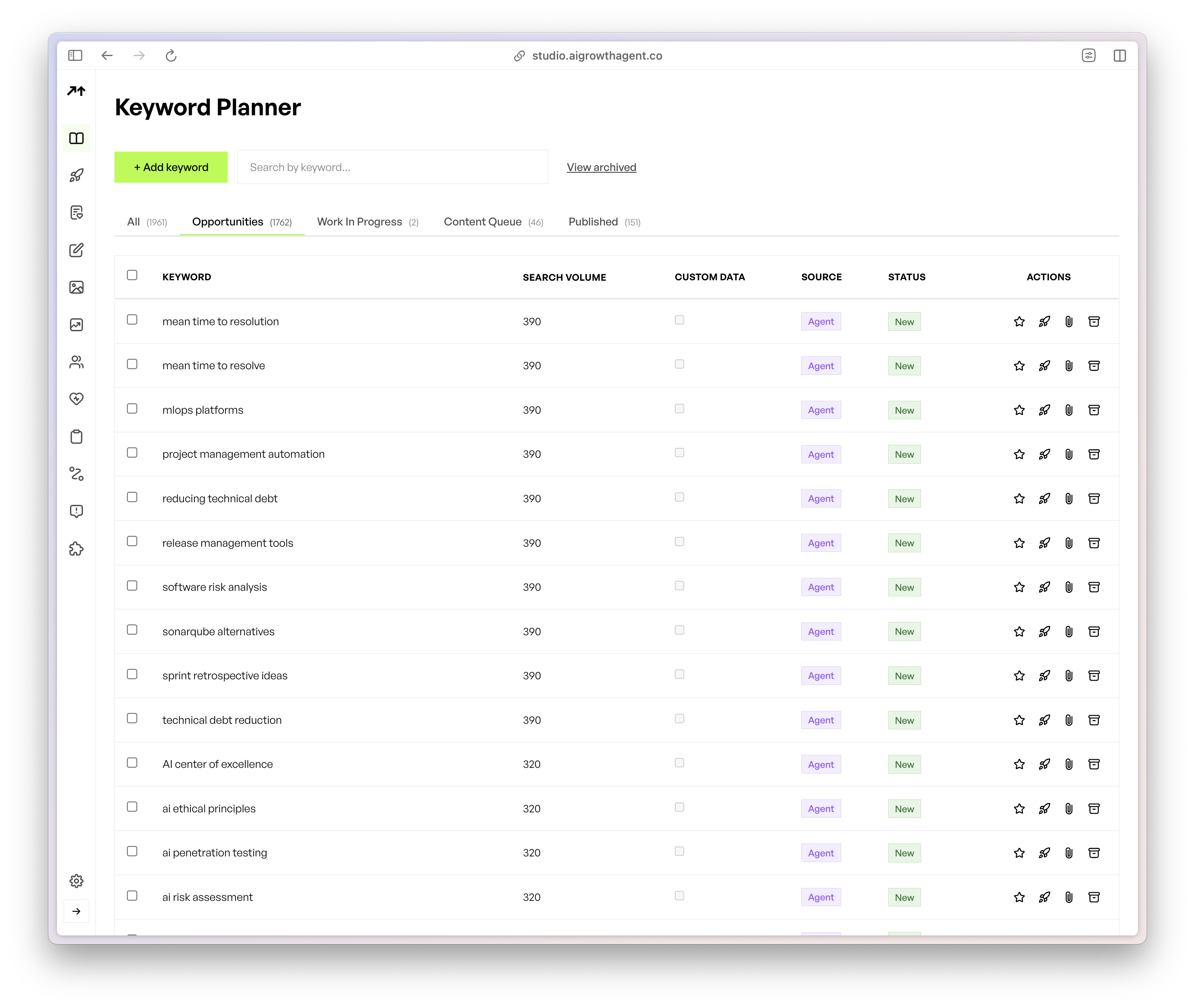
Programmatic Keyword and Content Research for AI Visibility
The agent scans large sets of keywords and questions related to your category, then groups them into pillars and clusters. Each cluster becomes a content plan that targets clear AI search opportunities and fills topical gaps.
This approach keeps production tied to measurable search demand instead of ad hoc ideas.
Technical Infrastructure for AI Indexation
AI Growth Agent configures a blog architecture optimized for AI systems, including LLM.txt files and a blog Model Context Protocol implementation. These elements help models access a structured view of your content instead of treating each page as an isolated document.
Consistent technical foundations reduce friction for crawlers and generative engines, which supports both organic search and AI citations.
The Programmatic SEO Content Agent
The content agent manages research, drafting, on-page optimization, and schema markup in a single workflow. Each article ships with headings, lists, internal links, and metadata tuned for AI readability.
This lifecycle enables regular publishing without requiring manual formatting for every piece.
The AI Growth Agent Studio for Oversight and Control
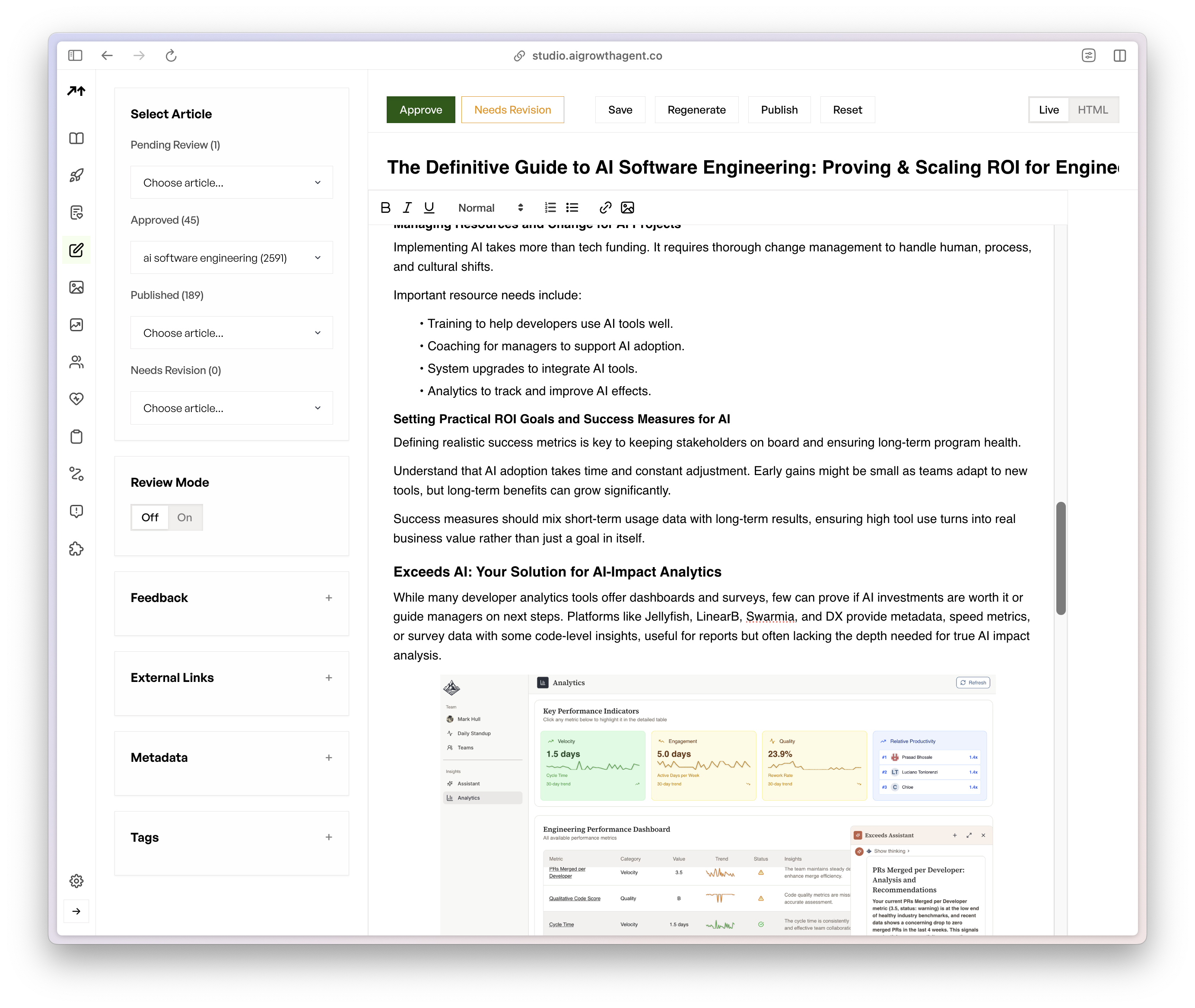
The Studio interface gives marketing teams visibility into planned articles, drafts, and performance. Teams can request edits, add examples, or choose whether pieces publish automatically or after review.
This control helps teams maintain quality while still benefiting from automation.
AI Search Monitor and Feedback Loop
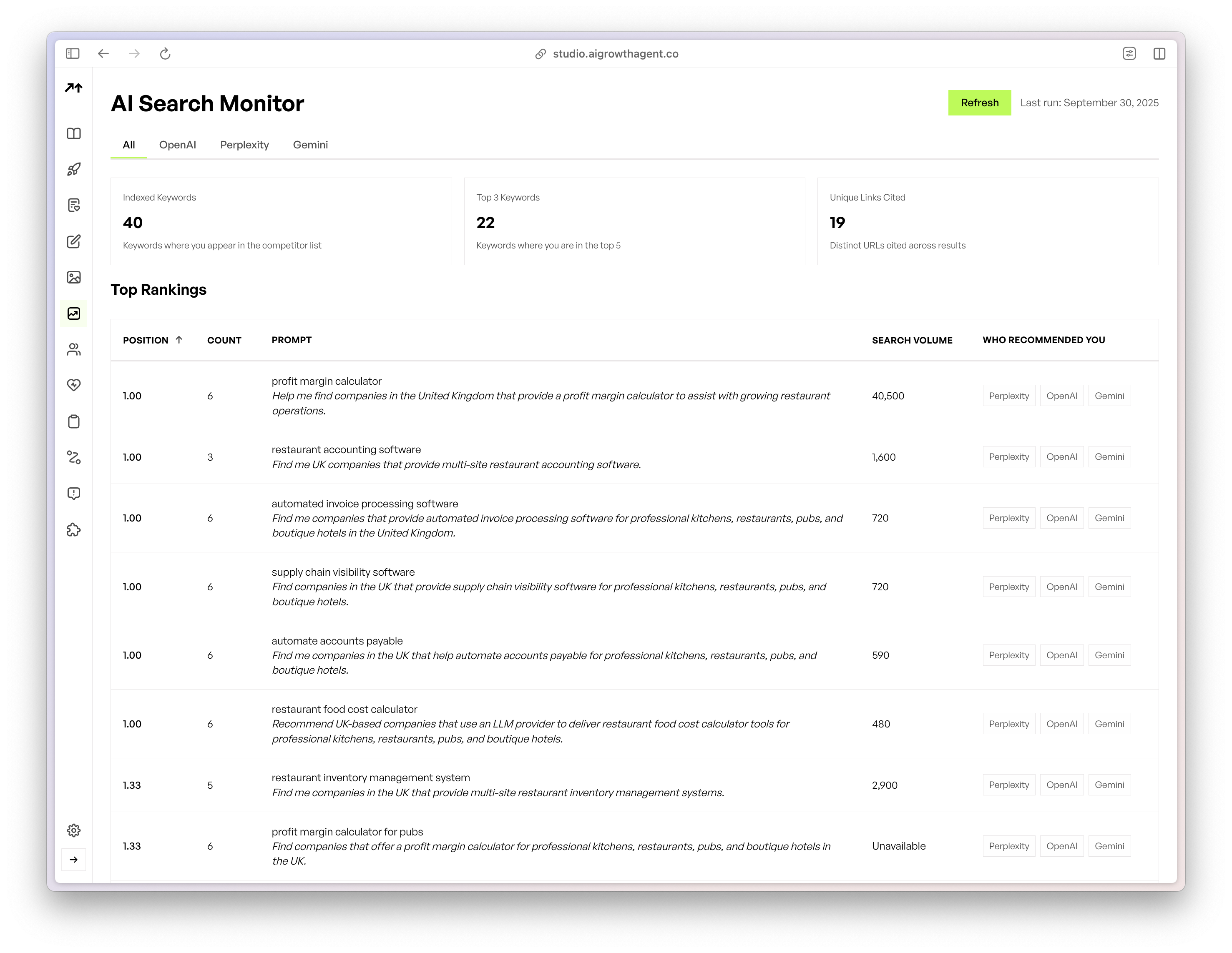
The AI Search Monitor tracks how often your content appears in AI Overviews and chat responses, along with keyword coverage and URL-level performance. These insights inform adjustments to topics, internal links, and on-page structure.
Connection to Google Search Console shows how programmatic efforts contribute to organic traffic over time.
Mastering AI Overviews and Generative Engine Optimization for 2026 SEO Planning
The Growing Influence of AI Overviews in SERPs
AI Overviews built on Google Gemini now appear on many result pages and answer queries directly in the interface. As these summaries expand, they shape which brands users see first, even before scrolling.
Plans for 2026 should treat AI Overview inclusion as a distinct objective, with content designed to match the structures these summaries favor.
Actionable Tactics for AI Overview Optimization
Content that uses clear headings, concise lists, and direct answers tends to be easier for Google to extract into AI Overviews. Semantic markup and schema further clarify entities, relationships, and key facts.
AI Growth Agent bakes these patterns into templates so every new article arrives structured for potential inclusion.
Generative Engine Optimization as an Expanded Search Strategy
Generative Engine Optimization, or GEO, extends SEO principles to AI systems across Google, TikTok, ChatGPT, Reddit, and YouTube. GEO keeps E-E-A-T at its core while adjusting formats and topics to match each discovery channel.
AI Growth Agent supports this wider view by designing content that is useful both as a web page and as a source for AI summaries, snippets, and recommendations.
You can explore how GEO fits into your 2026 SEO planning by booking a strategy demo.
Common Challenges and Pitfalls in 2026 SEO Planning
Relying Only on Traditional SEO Metrics
Rankings and organic sessions still matter, but they miss how frequently AI systems mention your brand. A dashboard that only tracks classic SEO metrics might show stability while AI-driven visibility declines.
Updated measurement should include AI citations, share of voice in AI Overviews, and content coverage across priority topics. AI Growth Agent surfaces these metrics as part of its reporting.
Overestimating Generic AI Writing Tools
Basic writing tools can accelerate drafting but usually stop at raw text. They often omit schema, do not manage internal links, and cannot configure technical files for AI access.
Programmatic SEO requires workflow automation that includes planning, formatting, and deployment so each piece publishes in an AI-friendly structure.
Underinvesting in Content Volume and Coverage
Low publishing frequency makes it difficult to become a primary reference for a category. When AI systems find more detailed coverage from competitors, they will lean on those sources for citations.
AI Growth Agent addresses this by supporting daily or near-daily content while preserving editorial consistency.
Handling Organizational Resistance to AI SEO Adoption
Teams may worry about brand risk, quality drift, or operational change. Those concerns are valid and can be addressed through staged rollout, human review, and clear performance reporting.
AI Growth Agent offers flexible approval workflows and transparent metrics so leaders can introduce programmatic SEO without disrupting existing campaigns.
AI Growth Agent Client Examples: Early Wins in AI Search
Exceeds AI: Performance Review Tools
Exceeds AI used AI Growth Agent to publish focused content on engineer performance reviews and quickly began appearing as a recommended alternative in Perplexity and in Google AI Overview snapshots for core terms.
Gitar: CI/CD Automation Authority
Gitar built an ecosystem around AI-assisted CI/CD and now appears frequently in AI answers for topics like fixing broken builds and self-healing pipelines, which positions them as a reference brand in that niche.
Bucked Up and BeConfident: Niche Category Visibility
Bucked Up gained citations for protein soda queries, while BeConfident achieved top recommendations in Brazil for learning English on WhatsApp. Both cases show how targeted, programmatic content can help brands stand out in specific niches.
Frequently Asked Questions: Navigating 2026 SEO Planning in the AI Era
How rapidly are AI Overviews expanding, and what does this mean for traffic?
AI Overviews expanded globally by May 2025 and continue to grow. Google reports that these features increase overall search usage, but they also concentrate attention on summary panels. Brands that adapt content for AI Overviews can keep or grow visibility even if traditional click-through rates decline.
What is the significance of E-E-A-T in 2026 AI search ranking?
E-E-A-T now functions as a practical quality benchmark for content that AI models trust enough to cite. Brands that consistently show real-world experience, expert authorship, and accurate explanations are more likely to appear in summaries and recommendations.
How does programmatic SEO differ from traditional SEO for AI search optimization?
Programmatic SEO automates research, drafting, and technical implementation for many pages at once, using consistent templates and schema. Traditional SEO relies more on manual content and smaller libraries. For AI optimization, the programmatic model provides the volume and structure that large models prefer.
Can existing content management systems support advanced AI search optimization?
Standard CMS platforms can host AI-ready content but often require custom development for features like LLM.txt, Model Context Protocol, and advanced schema. Many teams choose AI Growth Agent’s hosted option to gain these capabilities without building them in-house.
What is Generative Engine Optimization and why is it crucial for 2026 SEO planning?
Generative Engine Optimization focuses on how AI systems discover, interpret, and surface content across search, social, and chat interfaces. As user behavior shifts from typing queries into a single search box to asking questions across multiple AI tools, GEO becomes essential for staying visible where decisions begin.
Conclusion: Position Your Brand for AI-First 2026 SEO
AI-led discovery has shifted SEO from a ranking contest to a citation contest. Effective 2026 plans align content, technical setup, and measurement with how AI systems choose and display sources.
Programmatic SEO gives marketing teams a repeatable way to meet these requirements at scale. AI Growth Agent operationalizes that approach, from research to publishing to AI citation tracking.
