


Key Takeaways
- AI-powered search now requires keyword platforms that expand a few seed terms into 10,000+ long-tail variations each week for programmatic SEO.
- The 12 most valuable capabilities include bulk expansion, SERP clustering, intent filtering, and API exports that support enterprise-grade pSEO.
- SEMrush and Ahrefs scale research effectively but stop short of full automation, while AI Growth Agent runs an end-to-end keyword-to-content pipeline.
- Free stacks like Google Keyword Planner support early-stage teams, but hybrid AI automation delivers roughly 3x more output without adding developers.
- AI Growth Agent automates the full pSEO lifecycle for rapid AI citations, so schedule a demo to reach top Perplexity and Google AI Overview rankings within weeks.
12 Critical Features for Enterprise-Grade pSEO Keyword Platforms
Modern programmatic SEO relies on specific platform capabilities that traditional keyword tools rarely cover at scale. These 12 features define enterprise-ready solutions instead of basic research utilities.
1. Large-Scale Seed Keyword Expansion. Platforms need to generate 10,000+ long-tail variations from seed inputs every week. Successful programmatic SEO uses seed keywords and tools that expand them into longer-tail variations with consistent search intent patterns.
2. Modifier and Entity Extraction. Automated detection of variables such as locations, product types, and business categories supports template-based content at scale.
3. Bulk Metrics and KD Filtering. Platforms must process thousands of keywords at once and surface those with keyword difficulty scores below 30 to unlock scalable ranking opportunities.
4. Competitor Gap Analysis. Systematic SERP analysis highlights programmatic opportunities that competitors have not yet captured.
5. SERP Clustering and Intent Filtering. Grouping keywords by search intent keeps programmatic content aligned with user expectations and ranking patterns.
6. API and CSV Export Capabilities. Reliable export options support automation workflows and connect keyword data to content management systems.
7. Long-Tail Discovery at Scale. Identifying keyword patterns where only one variable changes, such as job titles or business types, enables efficient template creation.
8. Volume Forecasting and Trend Analysis. Forecasting search volume changes helps teams prioritize which content to ship first.
9. Topical Authority Mapping. Clear maps of content clusters guide comprehensive coverage strategies and support authority building.
10. AI-Powered Query Generation. Machine learning uncovers emerging keyword opportunities and new search patterns faster than manual research.
11. Multi-Language and Geographic Support. Localized keyword data allows programmatic SEO to scale across markets and regions.
12. Real-Time Data Updates. Fresh keyword metrics and SERP snapshots protect your competitive edge as search results shift.
|
Feature |
Ahrefs |
SEMrush |
AI Growth Agent Fit |
|
Bulk Expansion |
Strong |
Excellent |
Automated Integration |
|
API Export |
Strong |
Available |
Native Automation |
|
Intent Clustering |
Manual |
AI-Assisted |
Autonomous |
|
pSEO Integration |
None |
Basic |
End-to-End |
These capabilities reduce keyword cannibalization and connect directly to AI Growth Agent’s Manifesto-driven content strategy so each programmatic page targets a distinct search intent.
Schedule a consultation session to see how our agent automates the pipeline from keyword research through content publishing with these advanced features.
Best pSEO Keyword Research Platforms for 2026
The 2026 programmatic SEO stack falls into clear tool categories, and each category offers different strengths for scaling keyword research.
|
Tool |
Scalability |
Automation/API |
pSEO Fit Score |
|
SEMrush Enterprise |
Excellent (27B+ keywords) |
Strong API |
9/10 |
|
Ahrefs |
Very Good |
Strong API |
7/10 |
|
Keyword Insights |
Good (Niche Focus) |
CSV Export |
8/10 |
|
Google Keyword Planner |
Basic |
Web-based |
5/10 |
SEMrush maintains one of the largest keyword databases, with more than 27 billion keywords that support large-scale generation alongside competitors, and its tracking limits support enterprise workflows that manage 10,000+ long-tail keywords every week.
Ahrefs delivers deep keyword research but does not include native programmatic SEO integrations. Keyword Insights focuses on clustering and intent analysis, which helps teams design effective templates.
AI Growth Agent differentiates itself by automating the workflow from programmatic keyword research through content publication and AI citation monitoring. Clients such as Gitar.ai reached top ChatGPT citations for “AI self-healing pipelines” within two months, which shows the platform’s programmatic velocity.
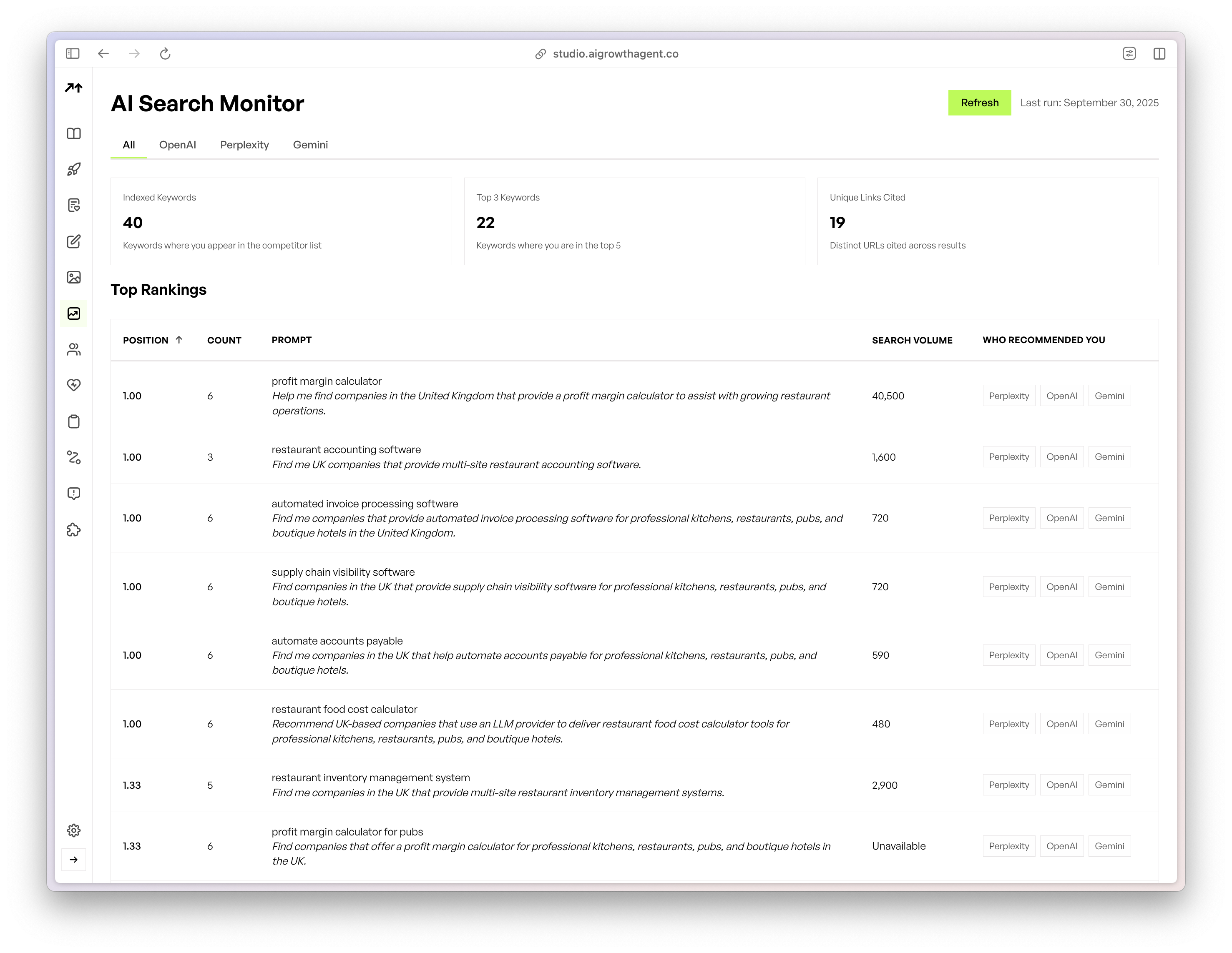
Schedule a demo to see if you’re a good fit for our autonomous programmatic SEO platform.
Bootstrapped pSEO Stacks: Free vs Paid in 2026
Scaling From 10 Seed Keywords to 10,000 Without Developers
Budget-conscious teams can still build effective programmatic keyword research stacks using a mix of free and low-cost tools.
Free Stack Foundation:
- Google Keyword Planner for seed expansion and volume data
- Google Trends for seasonal and geographic insights
- Outscraper for SERP data extraction
- ChatGPT for keyword clustering and intent analysis
Hybrid Approach for 2026: Teams that combine these free tools with AI Growth Agent’s automation usually see roughly 3x faster output than manual workflows. Our platform ingests data from any source and converts it into publication-ready content with advanced schema markup.
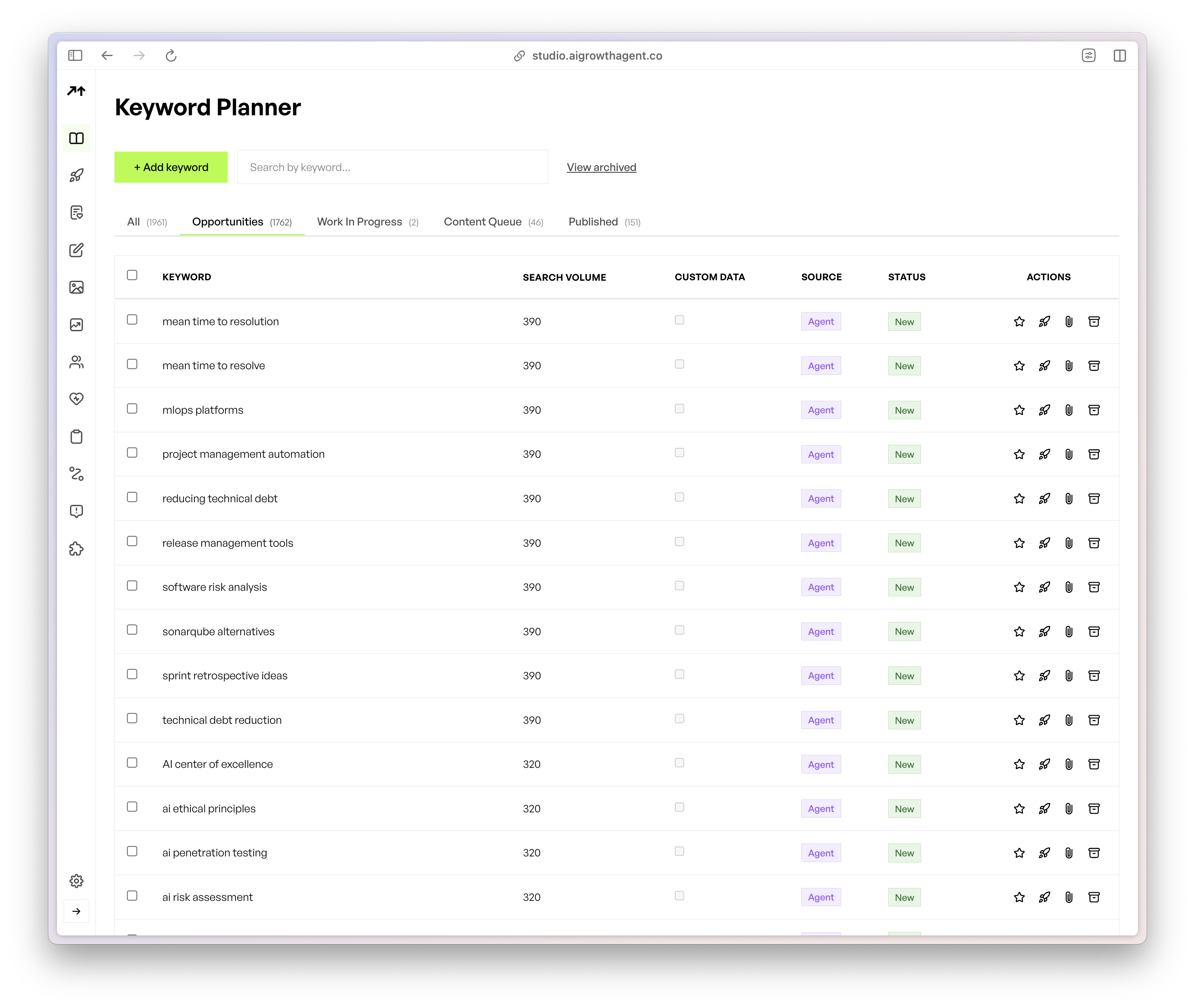
This workflow starts with seed keyword discovery through free tools, then moves into bulk expansion and clustering. AI Growth Agent then automates content creation, technical SEO, and publishing, which normally require developer support.
Schedule a consultation session to see how our agent turns basic keyword research into autonomous content authority.
AI Growth Agent as a Full pSEO Keyword-to-Content Engine
AI Growth Agent moves beyond traditional keyword tools and operates as an autonomous platform that manages the full programmatic SEO lifecycle, from keyword discovery to content publication and AI citation monitoring.
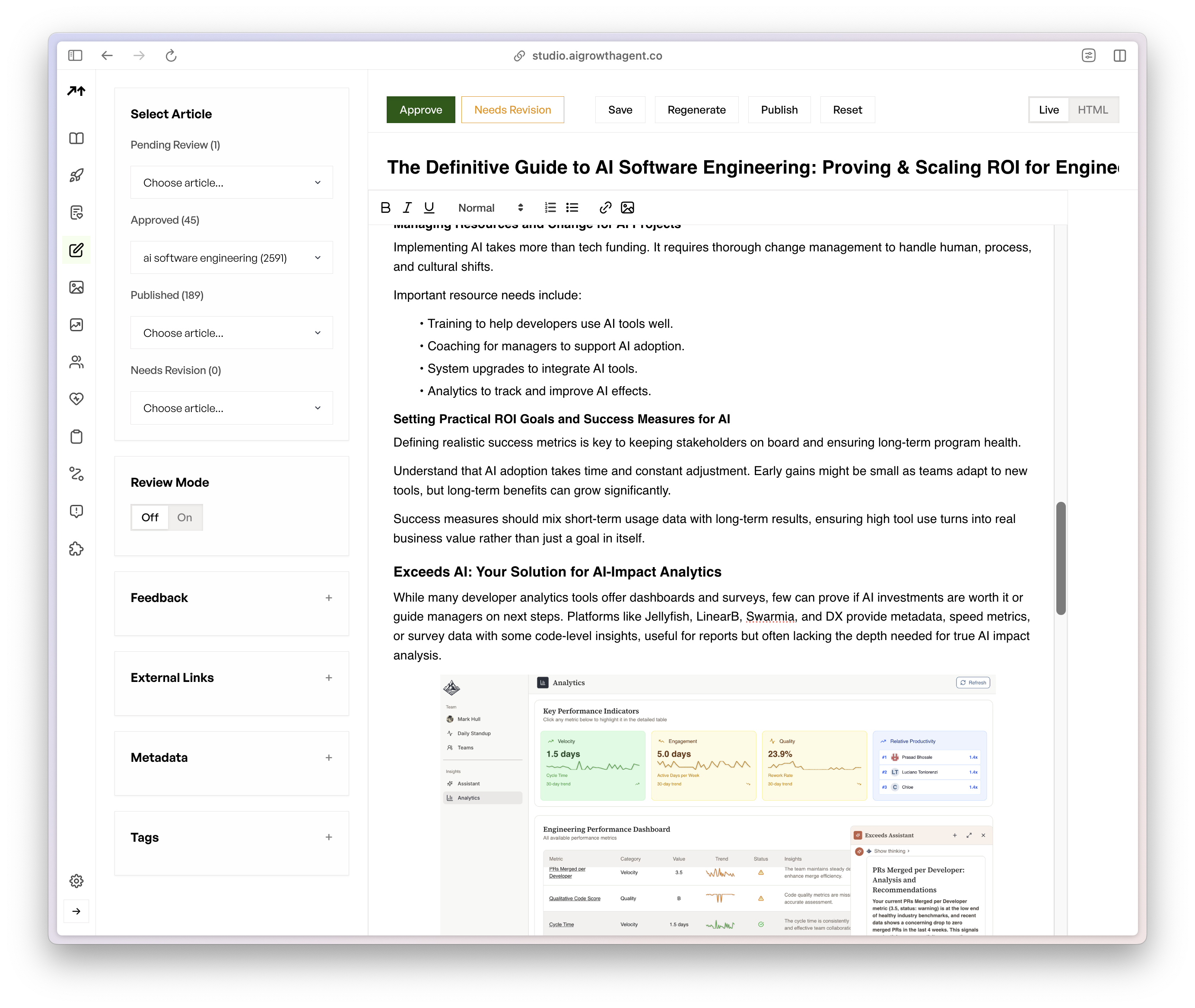
Key capabilities include multi-tenant deployment for portfolio companies, real-time content injection for trending topics, and database-to-content automation that activates proprietary data. The platform also includes the world’s first blog Model Context Protocol (MCP), which lets AI search engines interface directly with your content database.
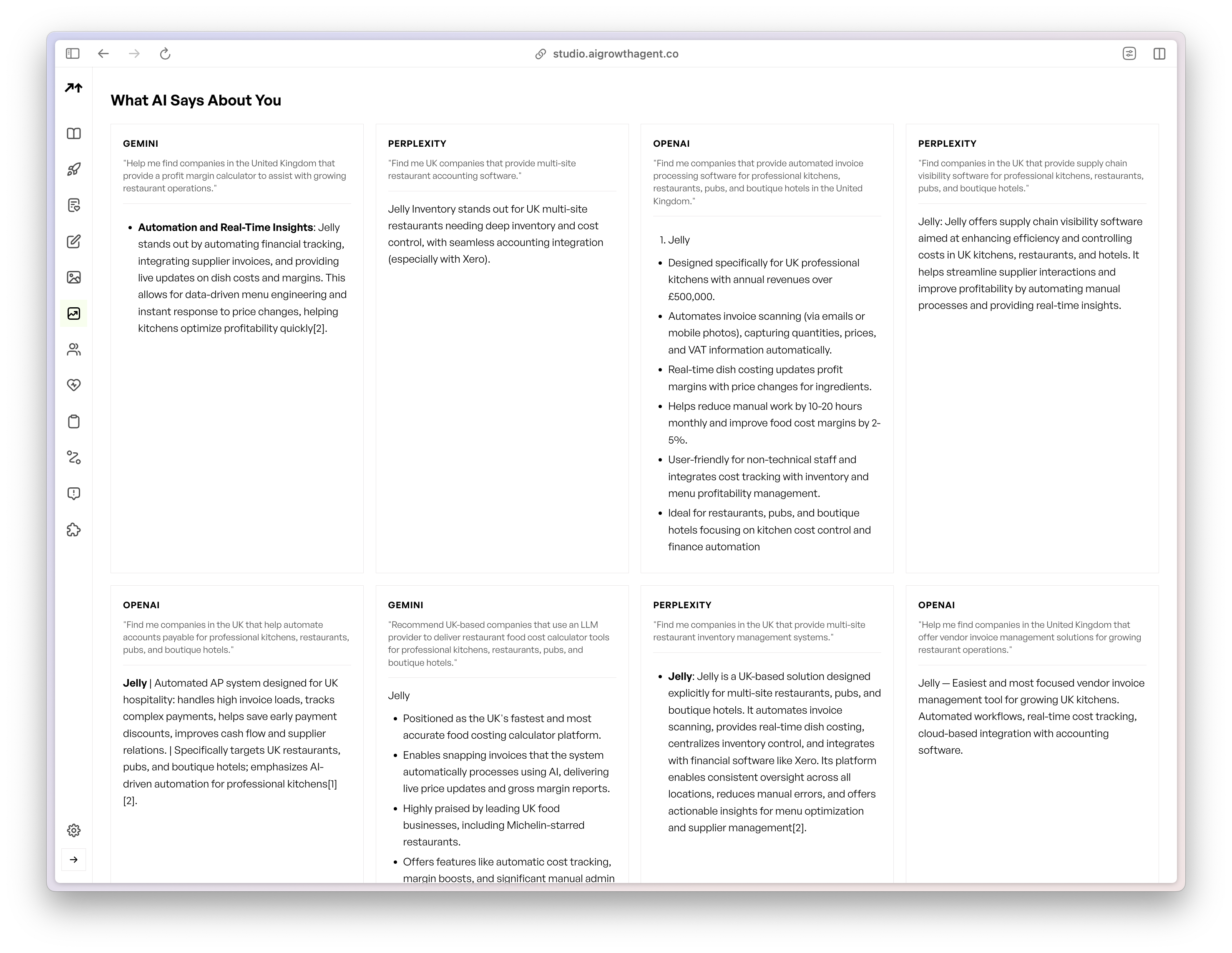
Client results validate this approach. BeConfident reached the number one Google AI Overview citation in Brazil within weeks, and Exceeds AI became Perplexity’s top recommendation for AI performance review tools in only two weeks.
Schedule a demo at AI Growth Agent to see how our autonomous system delivers superhuman programmatic SEO velocity and authority.
Implementation Checklist and 2026 Outlook
Essential Implementation Steps:
- Audit current keyword research capabilities and document scalability gaps
- Set up API integrations that support automated data flow
- Build bulk keyword processing workflows
- Create intent clustering and modifier extraction processes
- Configure ROI tracking through organic traffic and AI citation metrics
2026 Industry Predictions: AI agent platforms such as AI Growth Agent will dominate programmatic SEO, with Model Context Protocol and advanced schema helping autonomous content systems drive roughly 80% of AI citations. Specialized programmatic SEO strategies already show an average 340% ROI compared with traditional manual methods.
Schedule a consultation session to position your company ahead of this programmatic SEO shift.
Frequently Asked Questions
What is the best free keyword research tool for programmatic SEO?
Google Keyword Planner, combined with Google Trends, offers the strongest free foundation for programmatic SEO keyword research. Teams that need to scale to 10,000+ keywords weekly usually add paid tools or AI automation platforms such as AI Growth Agent, which manage the full research-to-publish workflow.
How does AI Growth Agent differ from traditional keyword research tools?
AI Growth Agent extends beyond keyword research and delivers autonomous content creation, technical SEO, and publication. Traditional tools still require manual analysis and writing, while our platform converts keyword data into published, schema-optimized articles that often earn AI citations within weeks.
What timeline should I expect for AI search engine citations?
With solid programmatic SEO in place, AI citations usually appear within two to four weeks. Our clients often move faster, as Exceeds AI gained Perplexity recommendations in two weeks, and BeConfident reached the top Google AI Overview citation within three weeks of publication.
Do these platforms offer API access for automation?
SEMrush and Ahrefs both provide robust API access for automation, with broad data coverage for Enterprise users, and rate limits that control request volume.
How do I calculate ROI from programmatic SEO keyword research investments?
Track organic traffic growth, keyword ranking improvements, and AI citation frequency over time. Industry benchmarks show an average 340% ROI from programmatic SEO strategies, and B2B SaaS companies often reach 702% ROI with seven-month break-even periods when they implement comprehensive programmatic approaches.
Conclusion: Moving From Research to Autonomous Authority
The most effective keyword research platforms for programmatic SEO in 2026 focus on scalability, automation, and AI integration. Traditional tools such as SEMrush and Ahrefs still provide strong research support, but autonomous platforms that manage the full keyword-to-content pipeline now define the competitive edge.
AI Growth Agent embodies this shift by turning keyword research into published authority that earns AI citations and drives measurable traffic growth. Schedule a demo at AI Growth Agent to see how our autonomous programmatic SEO platform can position your company as the definitive authority in its category.
