


Key Takeaways
- In 2026, 70% of brands stay invisible in AI search results because of authority gaps and content overload, while AI summaries cut CTR by 47%.
- Core blockers include weak knowledge graph presence, missing structured data, low content velocity, crawl barriers, and competitors publishing at a greater scale.
- Effective solutions require technical audits such as JSON-LD schema and LLM.txt, plus content engineering with question-based headings and daily publishing.
- Traditional SEO agencies and tools cannot operate at the needed scale. Programmatic SEO enables autonomous publishing and fast AI citations within weeks.
- AI Growth Agent delivers outcomes like #1 ChatGPT citations for brands in 3 weeks. Schedule a demo to dominate AI search.
The Hidden Reasons Your Brand Stays Invisible in AI Search
Your brand stays invisible in AI search when technical, authority, and content gaps block AI systems from trusting and citing you. Manual SEO cannot close these gaps at scale.
1. Authority Gaps and Weak Knowledge Graph Presence
Brands without earned media mentions in authoritative outlets are not pulled into AI training data, which produces zero citations. Missing trust signals, such as fresh statistics, clear data attribution, and visible author credibility, prevent inclusion as cited sources.
2. Structured Data Gaps That Hide Your Content
Missing structured data, schema markup, and descriptive metadata make your content hard for AI models to interpret. Unclear entity relationships and brand signals in Schema Markup cause hallucinations or exclusion from AI Overviews.
3. Content Velocity That Falls Behind Competitors
Pages not updated quarterly are three times more likely to lose AI citations, and over 70% of cited pages were updated within 12 months. AI-cited content is 25.7% fresher than traditional organic Google results, so slow publishing quickly erodes visibility.
4. Crawl Blocks and Technical Barriers to Indexing
Poor logical site architecture prevents full indexing by AI systems and limits discoverability. Robots.txt settings often block AI bots from critical pages, which removes those URLs from AI training and retrieval.
5. Confusing Entity Signals Across the Web
Mismatched brand names, product labels, and profiles across platforms confuse AI models about your identity and relationships. This confusion lowers citation confidence and pushes AI systems toward clearer competitors.
6. Low-Value Content With Little Information Gain
Shallow coverage, weak semantic depth, and incomplete topic exploration misalign with how AI interprets intent. Generic articles without unique data, frameworks, or examples fail to deliver the information that AI systems prioritize.
7. Competitors Winning Through Scale and Automation
While your team publishes manually, competitors run programmatic strategies that ship daily, technically sound content. Their constant output floods AI training data with their brand signals and crowds out slower publishers.
The cost of invisibility compounds over time. Beyond the 47% CTR drop, competitors shape your category narrative when AI systems lack reliable data about your brand. Manual SEO cannot match the speed and precision that AI visibility now demands.
Practical Steps to Make AI Search Cite Your Brand
Improving AI search visibility requires a clear system that upgrades your technical foundation, content structure, and publishing cadence.
Technical Infrastructure Audit
• Implement JSON-LD schema markup for FAQPage, HowTo, Organization, and Product data.
• Configure LLM.txt files to guide AI bot crawling behavior across your domain.
• Deploy Model Context Protocol (MCP) to create direct communication paths with AI systems.
• Adjust robots.txt so AI bots can access key content while you maintain security controls.
Content Engineering Strategy
• Use question-based headings that mirror how people phrase prompts to AI tools.
• Write clear, definitive statements with journalistic phrasing in the opening paragraph to raise citation odds.
• Cluster keywords programmatically so you cover each topic area with complete semantic depth.
• Maintain steady content velocity with regular updates, new data, and refreshed statistics.
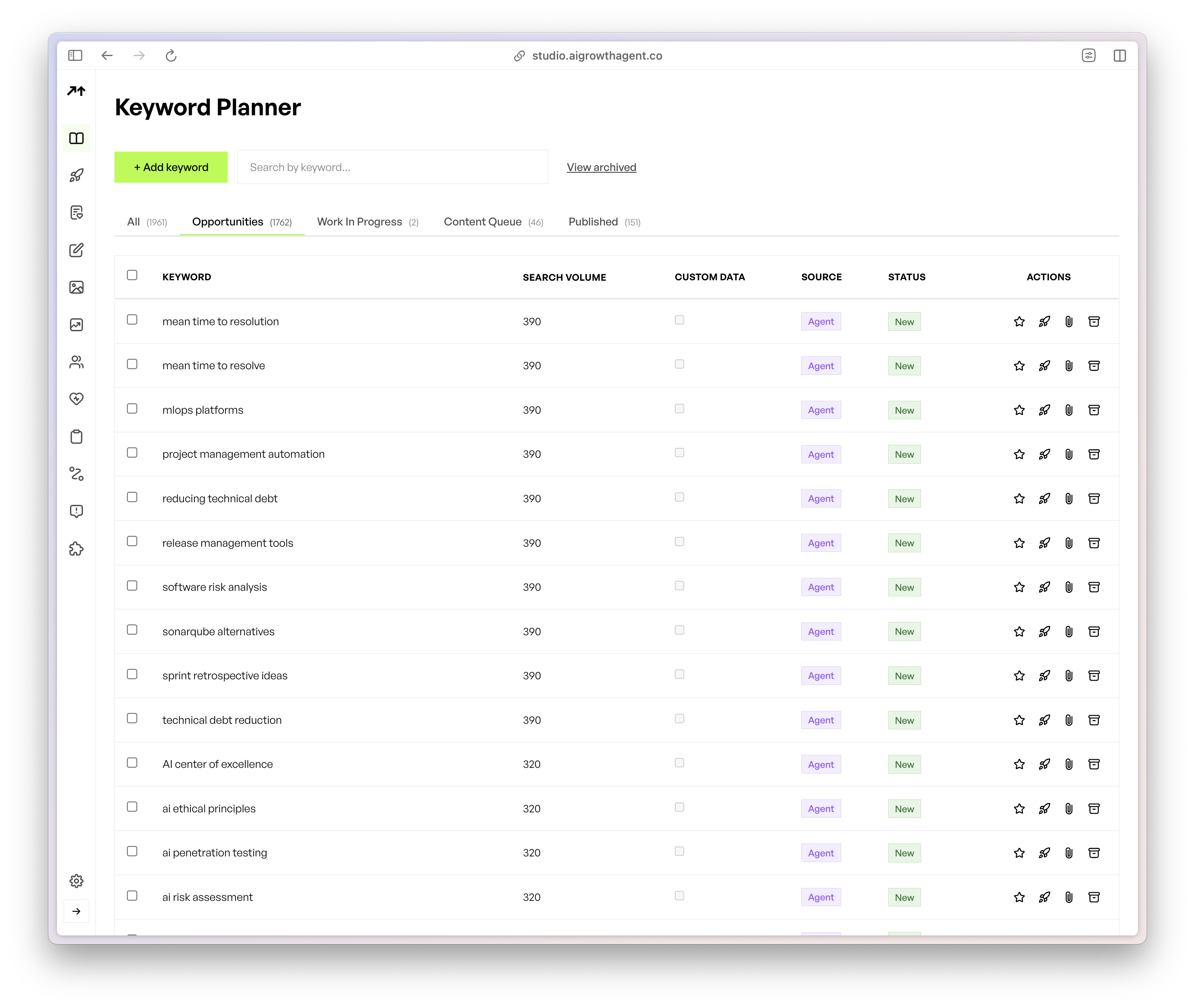
AI Growth Agent automates this workflow through Manifesto programming and autonomous content engineering. Our programmatic system removes technical friction while preserving the quality and authority signals AI systems require.
Schedule a demo to see if you are a good fit for our autonomous SEO agent.
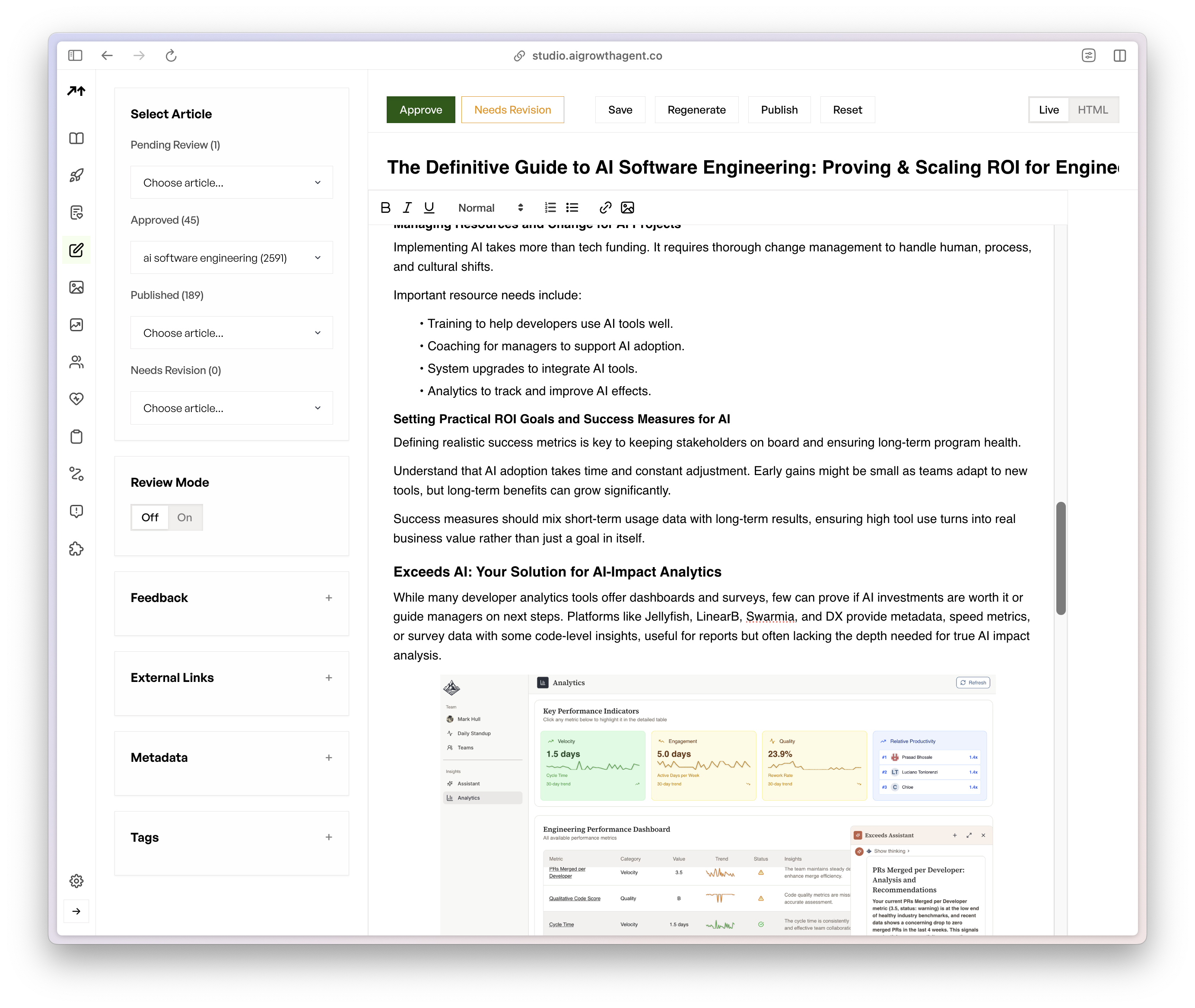
Boost Visibility in Google AI Overviews, ChatGPT, and Perplexity
Google AI Overviews now appear in 16% of US searches as of late 2025, so a consistent presence there shapes brand discovery across your category.
Daily Content Velocity for AI Overviews
Use programmatic SEO to keep a predictable publishing schedule. AI systems refresh citations within days when they detect fresher competitor content, so daily or near-daily updates protect your position.
Entity Signals That Strengthen Brand Authority
Add clear author bios with credentials and expert quotes with explicit attribution to strengthen authority. Implement FAQ and HowTo schema so AI systems can extract precise answers from your pages.
Answer-First Content That AI Can Reuse
Use a clean heading hierarchy with H2 and H3 tags that break content into small, retrievable sections. Lead each section with a direct answer, then support it with detail so AI tools can quote you confidently.
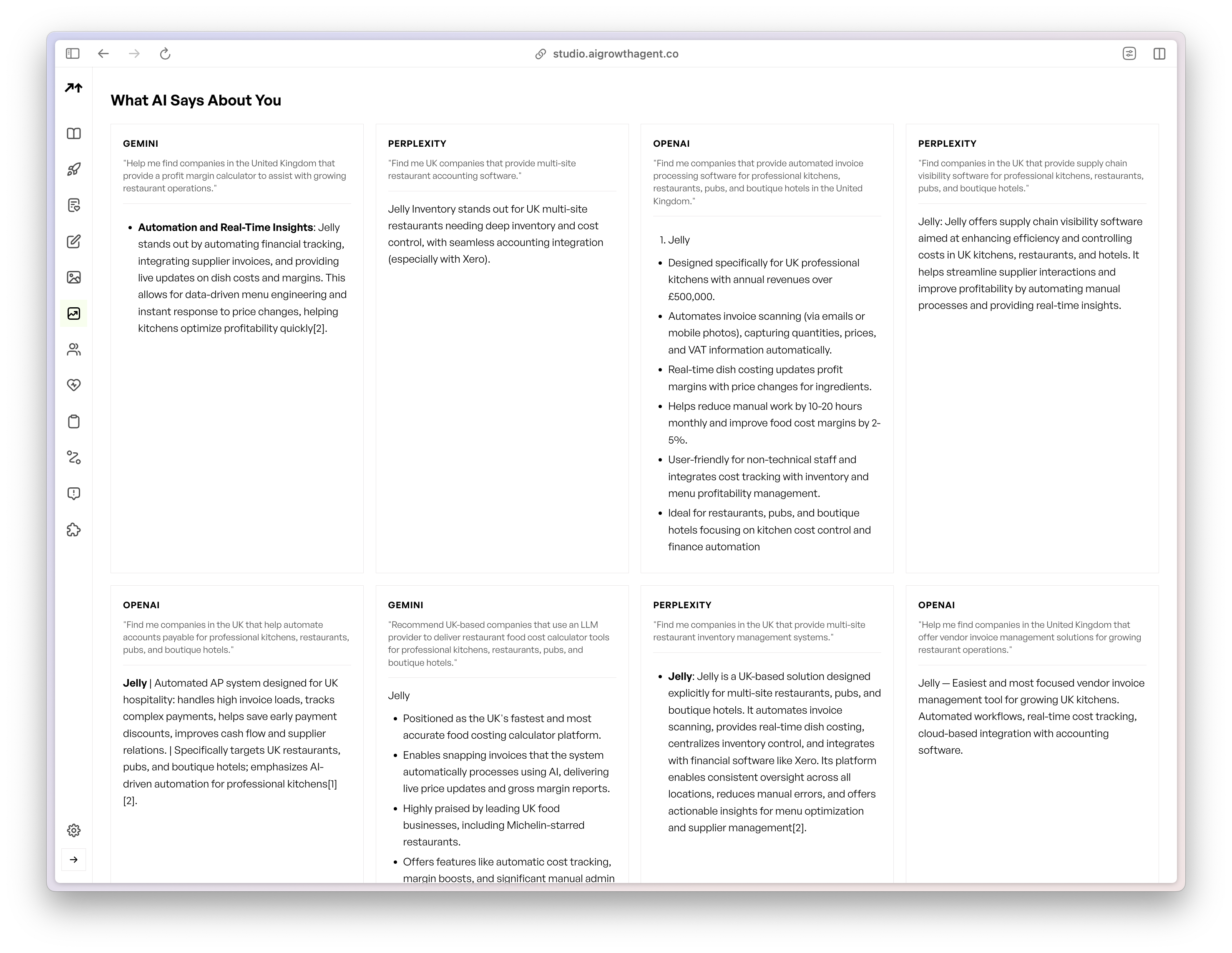
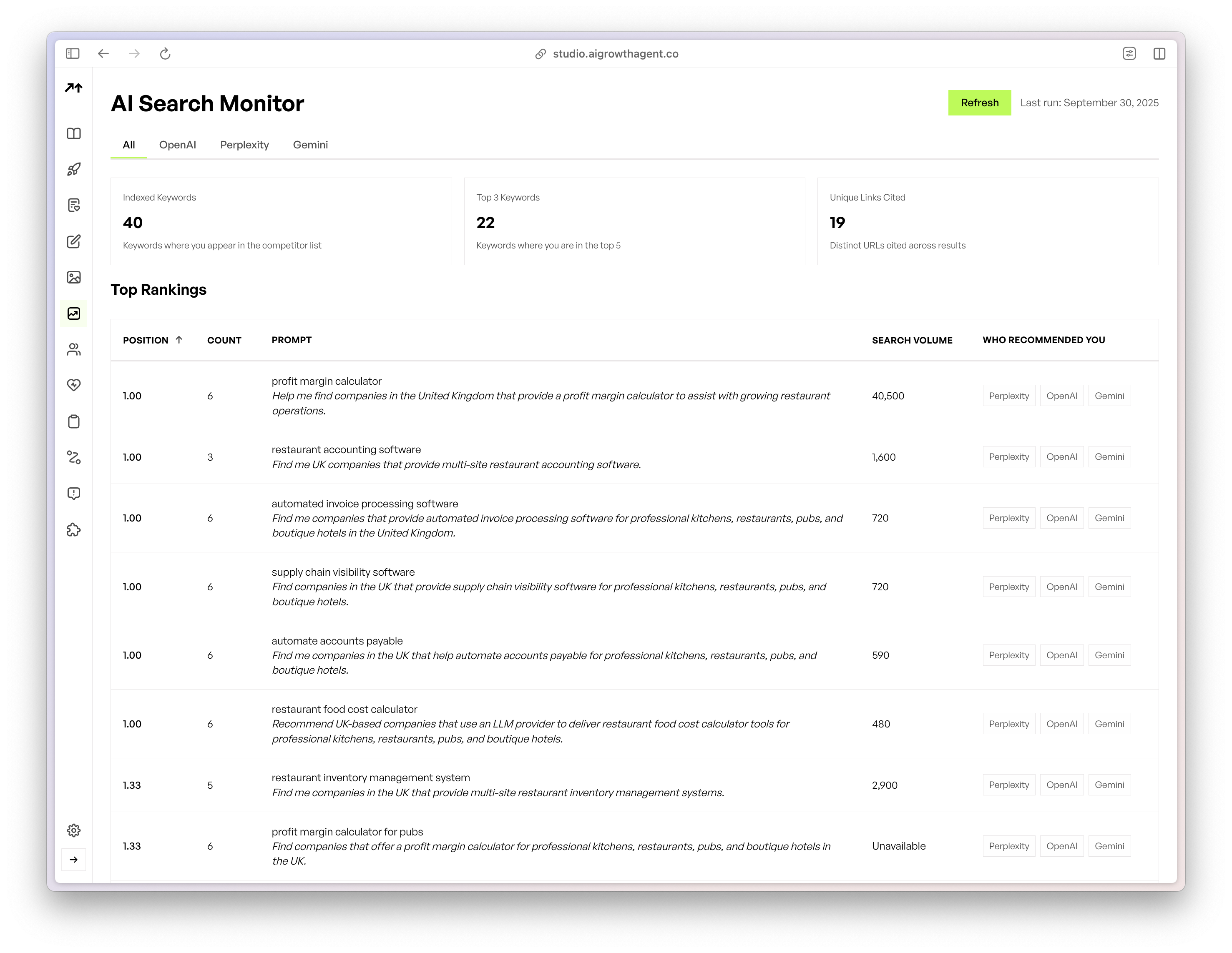
AI Growth Agent Studio tracks performance across ChatGPT, Perplexity, and Google AI Overviews in real time. You see which URLs drive citations, where gaps exist, and which topics need more coverage.
How AI Growth Agent Compares to Agencies and AI Tools
AI visibility now depends on scale, speed, and technical depth that manual approaches rarely achieve. The table below shows how solutions differ.
|
Features |
AI Growth Agent |
SEO Agencies |
AI Writing Tools |
AI Monitors |
|
Autonomous Publishing |
Yes |
No |
Partial |
No |
|
Schema/MCP Engineering |
Yes |
Rare |
No |
No |
|
ROI Timeline |
Weeks |
3-6 months |
No execution |
Metrics only |
Traditional agencies rely on billable hours and manual workflows, which limit content velocity and slow technical changes. Generic AI tools still need heavy manual setup and lack the SEO engineering required for AI citations. Monitoring platforms highlight problems but do not execute fixes.
AI Growth Agent closes this gap by pairing programmatic content creation with autonomous technical optimization. This combination delivers the scale and sophistication needed for AI search dominance.
Real Brands Gaining AI Authority with Programmatic SEO
Recent case studies show how programmatic SEO can rapidly increase AI citations and authority.
Bucked Up reached the #1 ChatGPT citation for “best protein soda” within 3 weeks of launch, competing directly with Feisty Drinks and Clean Simple Eats.
Gitar became the reference brand for AI-powered CI/CD automation in under two months. The brand now leads conversations across Google AI Overviews, ChatGPT, and Perplexity for queries such as “fix broken CI builds automatically” and “best AI reviewer for CI failures.”
BeConfident secured #1 Google AI Overview recommendations as the top English learning app in Brazil within weeks, winning visibility against Duolingo and Busuu.
These outcomes match broader programmatic SEO patterns. Dynamic Mockups grew organic traffic by 220.65% using programmatic pages, while another brand scaled from 67 to more than 2,100 monthly signups in 10 months.
Start Building AI Search Authority with Programmatic SEO
The window to claim AI search authority keeps shrinking as more brands adopt programmatic strategies. Manual SEO cannot sustain the publishing speed and technical rigor needed for consistent AI citations.
AI Growth Agent provides an autonomous programmatic SEO engine that builds citation-dominating authority while your team focuses on core operations. Our selective onboarding ensures we partner only with premium brands that already have strong foundations and aim for category leadership.
We do not operate as an SEO repair shop. We act as the growth engine for brands ready to scale through programmatic content engineering.
Schedule a demo to see if you are a good fit and learn how our autonomous agent can position your brand as the definitive authority in AI search.
Frequently Asked Questions
How fast can my brand appear in Perplexity and ChatGPT responses?
With programmatic SEO velocity, brands usually see first AI citations within 1 to 3 weeks. Bucked Up reached #1 ChatGPT citations in 3 weeks, and BeConfident reached #1 Google AI Overview status within weeks of deployment. Consistent content velocity and strong technical foundations drive these timelines, which manual approaches rarely match.
How can my brand improve AI search visibility effectively?
Effective AI visibility rests on three pillars: complete schema markup, daily or near-daily publishing, and autonomous technical optimization. AI systems favor fresh, technically sound content backed by strong authority signals. Our programmatic agent manages this pipeline automatically, from schema to publishing cadence.
What is the most reliable way to appear in AI search engines?
Deploy Model Context Protocol (MCP) and LLM.txt files for direct communication with AI systems, keep entity signals consistent across every brand touchpoint, and maintain high-velocity publishing supported by structured data. The complexity of these tasks makes programmatic automation far more reliable than manual execution across ChatGPT, Perplexity, and Google AI Overviews.
How can I fix brand visibility issues in ChatGPT and Perplexity?
Use AI Growth Agent Monitor to detect citation gaps and missed content opportunities, then activate our autonomous content agent to fill those gaps at scale. Manual monitoring and writing cannot keep pace with how quickly AI systems refresh their knowledge base, so programmatic workflows provide a durable advantage.
Which structured data types matter most for AI citations?
Implement JSON-LD schema for Organization, Product, FAQPage, and HowTo to give AI systems explicit context about your brand and content relationships. Schema alone does not guarantee citations, so you also need sustained content velocity and strong authority signals that programmatic SEO can deliver at scale.
