Written by: Mariana Fonseca, Editorial Team, AI Growth Agent
Key Takeaways
- Enterprise AI search readiness in 2026 depends on five pillars: data quality, team skills, infrastructure, content operations, and programmatic SEO maturity for winning AI citations in engines like ChatGPT and Perplexity.
- The top 7 assessment tools include AI Growth Agent for programmatic execution, Storyblok for CMS audits, Microsoft for strategy roadmaps, and SEMrush for AI visibility scoring.
- The comparison matrix shows AI Growth Agent with 5/5 ratings in marketing automation and pSEO scalability, plus one-week onboarding across major CMS platforms.
- The 7-step checklist covers data and CRM audits, skills assessment, infrastructure benchmarking, keyword scanning, AI visibility testing, GTM alignment scoring, and programmatic pilots that prove ROI.
- Enterprise teams see the fastest impact with AI Growth Agent’s autonomous content deployment; schedule a demo with AI Growth Agent today to pilot programmatic SEO and secure AI citation dominance.
How Enterprise Teams Define AI Search Readiness
AI search readiness describes how prepared your brand is to be cited and recommended by AI search engines. Data quality sits at the core, because clean, structured CRM and content data allow AI systems to interpret and reuse your information accurately. Skills gaps shape how well teams handle AI prompting, programmatic SEO strategy, and content tuning for LLM indexing.
Technical infrastructure covers schema markup, LLM.txt files, and Model Context Protocol, which together let AI engines connect directly to your content. Content operations must shift from manual publishing to programmatic scale, as 88% of organizations use AI in at least one function, but only one-third are scaling across the enterprise.
Programmatic SEO maturity then determines whether you can build durable citation moats with automated content architectures. The 2026 environment requires this full-stack approach, since 43% see risk of declines in skill proficiency as Gen AI usage climbs to 82% weekly, which makes structured readiness assessments a core competitive advantage.
Top 7 AI Search Readiness Assessment Tools for 2026
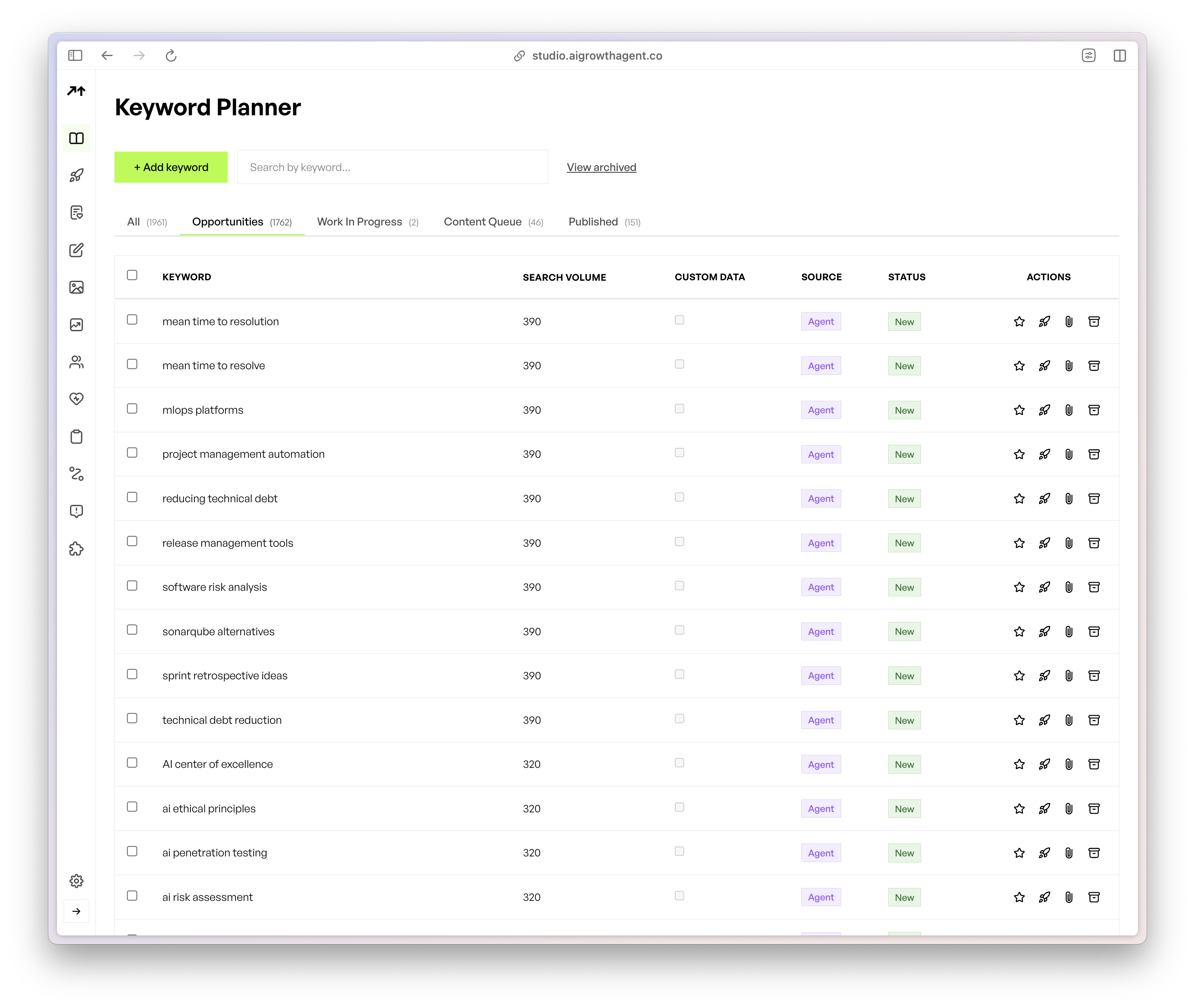
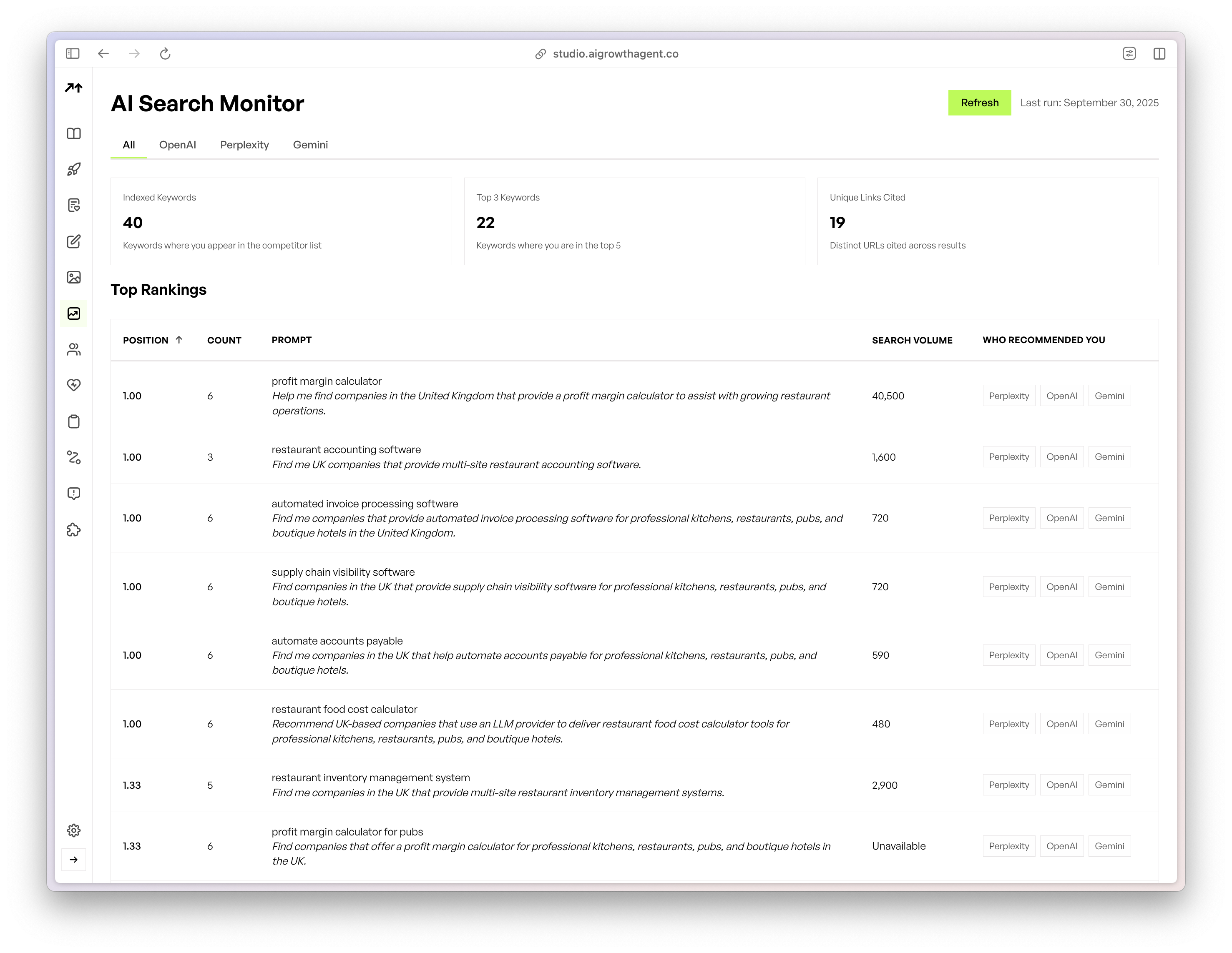
1. AI Growth Agent delivers programmatic SEO through an autonomous content agent that builds high-authority content architectures using advanced keyword clustering, schema, and AI monitoring in the Studio platform. Teams complete onboarding in one week with Manifesto programming, multi-tenant deployment, and real-time citation tracking across ChatGPT, Gemini, and Perplexity.
2. Storyblok operates as a headless CMS that supports content workflow audits and infrastructure reviews for marketing teams that want AI-ready content operations and programmatic publishing patterns.
3. Microsoft AI Readiness Assessment provides a structured roadmap across seven pillars, including Business Strategy, AI Governance and Security, Data Foundations, AI Strategy and Experience, Organization and Culture, Infrastructure for AI, and Model Management for enterprise AI rollout.
4. Highspot GTM Performance Assessment measures go-to-market readiness with a focus on sales enablement, revenue alignment, and AI usage across GTM motions, including maturity scoring for prospecting, training, and content workflows.
5. Adobe Content Supply Chain Framework combines GenStudio, AEM, Workfront, and Frame.io to scale content operations with AI-supported creation, workflow management, approvals, and brand governance.
6. SEMrush AI Toolkit offers AI visibility auditing with an AI Visibility Score, prompt tracking, keyword opportunity discovery, content guidance, and crawlability checks for technical SEO in AI search environments.
7. Salesforce AI Readiness Workshops focus on CRM-centered assessments that review data quality, automation readiness, and integration depth for AI-powered customer engagement and marketing automation.
Comparison Matrix: Assessment vs Execution Power
|
Tool |
Marketing Focus & Automation (1-5) |
pSEO/Scalability (1-5) |
Integrations/Pricing |
|
AI Growth Agent |
5 |
5 |
WordPress, Hashnode, Webflow, Framer, Sanity, HubSpot, 1-week onboarding |
|
Storyblok |
3 |
3 |
Headless CMS, Custom pricing |
|
Microsoft AI Assessment |
3 |
2 |
Azure integration, Enterprise only |
|
Highspot |
4 |
2 |
GTM platforms, $50-200/user/month |
|
Adobe |
3 |
2 |
Creative Cloud, Enterprise pricing |
|
SEMrush |
4 |
3 |
SEO tools, $120-450/month |
|
Salesforce |
4 |
1 |
CRM native, Workshop-based |
This comparison exposes a major gap: most tools stop at auditing and do not handle programmatic execution at 2026 content speeds. Manual assessment workflows slow teams and block the scale needed for AI citation leadership. Organizations report an average 340% ROI within 18 months of generative AI implementation, with 410% ROI specifically in content marketing and creation, but only when they pair assessment with automation. AI Growth Agent closes this gap by combining full programmatic SEO with AI monitoring in the Studio, so enterprises can grow authority through autonomous content deployment. Schedule a demo to see how this programmatic model delivers execution at enterprise scale.
7-Step AI Search Readiness Checklist for Marketing Teams
1. Audit Data and CRM Quality by reviewing completeness, accuracy, and structure across customer databases so AI engines can process and cite your information through clean schema and metadata.
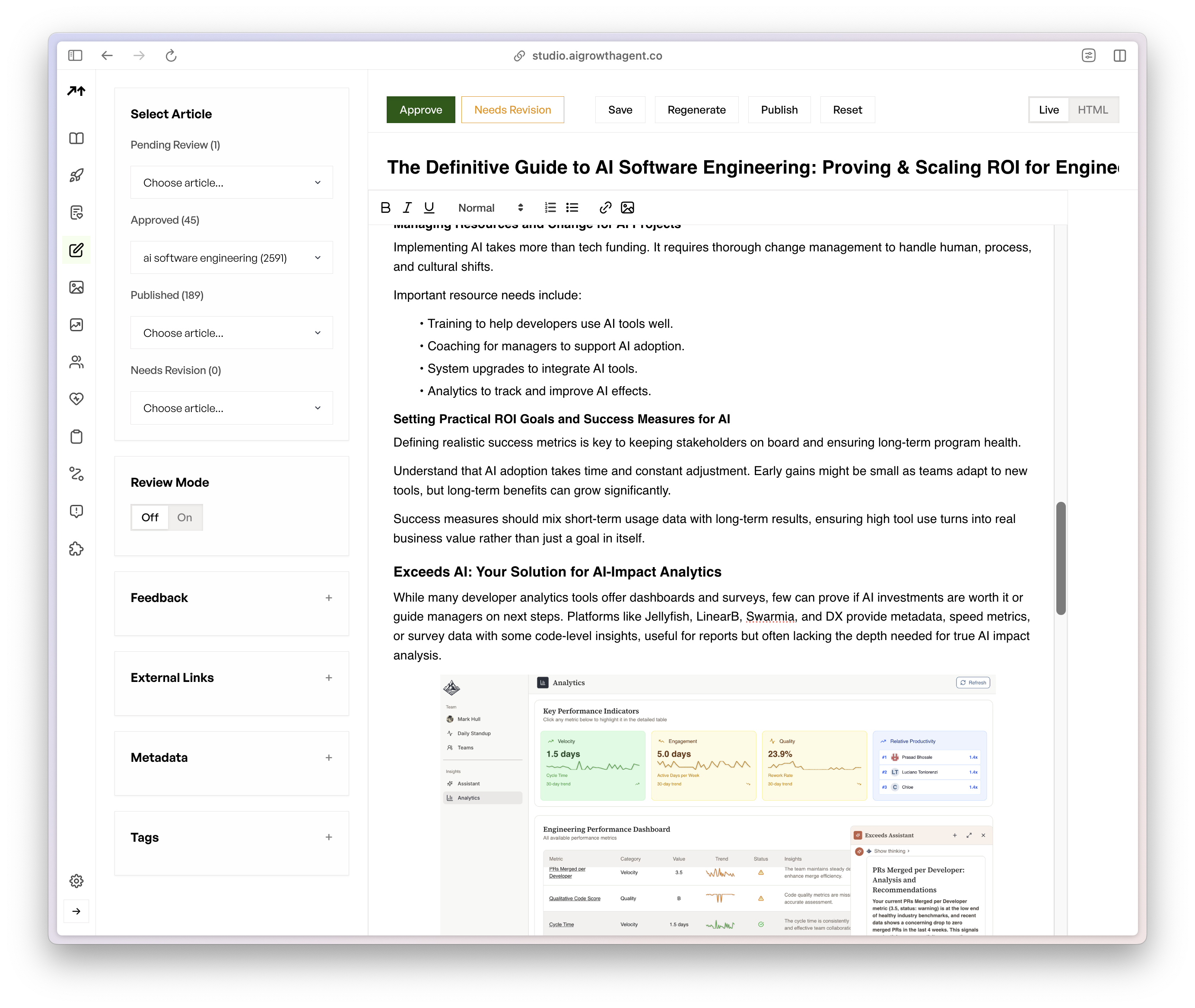
2. Assess Team Skills for AI Prompting and pSEO by mapping current capabilities in prompt design, programmatic SEO strategy, and LLM-focused content tuning, then flagging training and hiring gaps.
3. Benchmark Technical Infrastructure by checking schema coverage, LLM.txt files, Model Context Protocol, and site architecture to confirm that AI search engines can connect directly to your content layer.
4. Run Keyword Maturity and Opportunity Scan by analyzing coverage, spotting programmatic content clusters, and reviewing competitive strength in AI-driven search results across multiple engines.
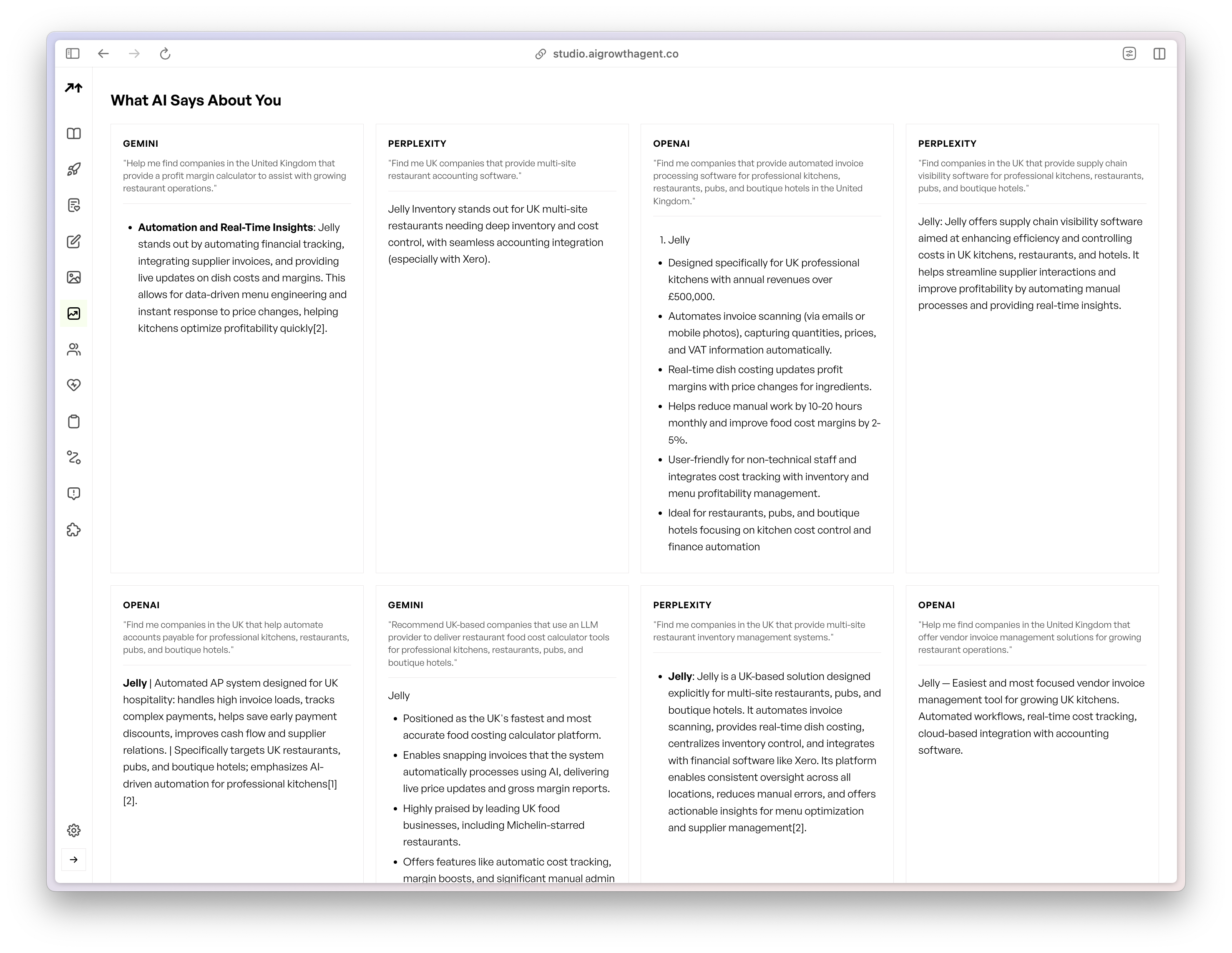
5. Test AI Visibility Across ChatGPT, Gemini, and Perplexity by running structured prompts that measure citation rates, brand mentions, and recommendation frequency for your priority queries.
6. Score GTM and CRM Alignment by evaluating how marketing automation, sales enablement, and customer data platforms connect so AI programs support pipeline and revenue goals.
7. Deploy Programmatic SEO Pilot Program by launching automated content creation and publishing workflows that test scale, quality controls, and AI citation impact before a full rollout.
Steps 4 through 7 gain the most from AI Growth Agent’s autonomous engine, since the agent manages keyword clustering, real-time monitoring, and content deployment without constant manual work. Marketing leaders can then stay focused on strategy while the system runs execution at scale.
Enterprise Roadmaps for Fast AI Search Wins
Enterprise success hinges on onboarding speed, integration depth, and clear ROI measurement. AI Growth Agent’s one-week kickoff replaces long agency ramp periods that often stretch for months, so teams start capturing AI citations almost immediately. Integration coverage then supports durable results, with connections to WordPress, Hashnode, Webflow, Framer, Sanity, and HubSpot that keep content operations and marketing activity in sync.
Customer service automation shows highest ROI at 520% with 4.5-month payback, which highlights the value of tools that deliver fast, measurable impact. Roadmaps should favor programmatic velocity over manual craftsmanship, since mature AI programs shift to revenue-linked use cases like CRM automation and sales enablement, and organizations using 6 or more scaling practices outperform on revenue impact. The Bucked Up case study illustrates this mindset, reaching the #1 ChatGPT citation for “best protein soda” within three weeks of programmatic deployment and turning rapid implementation into immediate advantage.
Why AI Growth Agent Leads at Enterprise Scale
AI Growth Agent unifies assessment and execution in one programmatic platform so teams avoid the common gap between audit and action. The autonomous content agent delivers high output through advanced keyword clustering, schema deployment, and real-time AI monitoring in the Studio, while competing tools still depend on manual follow-through.
Multi-tenant controls let portfolio companies and multi-brand enterprises run parallel programmatic SEO strategies from a single interface, which remains rare in the market. Real-time content injection helps brands respond to emerging topics within minutes, and database-to-content automation surfaces proprietary data that AI search engines would otherwise miss.
Unlike SEMrush’s broad toolkit or Salesforce’s workshop-based model, AI Growth Agent supplies the full programmatic infrastructure required for durable AI citation leadership, backed by clients who secure top citations across ChatGPT, Gemini, and Perplexity within weeks.
Frequently Asked Questions
What is AI search readiness and why does it matter for enterprise marketing?
AI search readiness describes how easily AI-powered search engines such as ChatGPT, Google AI Overviews, and Perplexity can discover, interpret, and recommend your brand. It spans data quality, technical infrastructure, team skills, and content operations that together shape how AI systems reference your information.
For enterprise marketing teams, AI search readiness matters because classic SEO alone no longer controls visibility in AI-driven results. Brands that ignore readiness risk disappearing while competitors accumulate citations and become the default authority in the category.
Which AI search readiness tool works best for programmatic SEO teams?
AI Growth Agent serves marketing teams that prioritize programmatic SEO and autonomous execution. The platform handles keyword clustering, content creation, schema deployment, and AI monitoring without heavy manual lift. Tools such as SEMrush and Rankscale offer strong auditing features but still rely on teams to implement recommendations by hand. AI Growth Agent’s one-week onboarding and multi-tenant design make it a strong fit for enterprises that need rapid rollout across several brands or product lines.
How do AI search readiness tools connect with Salesforce and other CRM systems?
Integration depth varies by provider. Salesforce AI readiness workshops plug directly into CRM data but offer limited programmatic publishing. Microsoft’s assessments integrate well with Azure and Office 365 but center on infrastructure rather than marketing execution. AI Growth Agent focuses on CMS integrations, including WordPress, Hashnode, Webflow, Framer, Sanity, and HubSpot, and its database-to-content automation converts proprietary datasets into SEO-ready content that AI engines can surface.
What results timeline should enterprises expect from AI search readiness work?
Timelines depend on how quickly a tool can move from insight to execution. Assessment-only tools often require 3 to 6 months before teams finish manual implementation and see impact. AI Growth Agent’s programmatic engine shortens this window, with clients such as Bucked Up reaching top ChatGPT citations within three weeks and BeConfident becoming the #1 recommended app in Brazil within weeks. The decisive factor is the shift from manual rollout to automated execution, which removes bottlenecks and keeps pace with AI citation opportunities.
How can marketing teams pilot AI search readiness tools safely?
Effective pilots focus on one clear use case with measurable outcomes instead of broad, unfocused rollouts. Teams often start with a single product line or brand to test keyword clustering, content production, and AI citation tracking. AI Growth Agent’s Studio supports controlled pilots with manual approval workflows before teams move to full autonomy, which protects quality and brand voice. Pilot programs typically run for 4 to 6 weeks with defined success metrics such as AI citation rates, organic traffic growth, and content throughput, giving leaders confidence before scaling.
Conclusion: Move From AI Audits to AI Execution
The AI search shift in 2026 requires enterprise marketing teams to act quickly if they want to protect and grow visibility. This guide to the top 7 tools, the comparison matrix, and the 7-step checklist outlines a practical path to AI citation leadership through programmatic SEO automation. Traditional assessment tools still provide useful diagnostics, but only AI Growth Agent delivers the autonomous execution layer that matches AI search velocity. Schedule a consultation or demo and join brands already earning top citations across ChatGPT, Gemini, and Perplexity with programmatic content strategies.