Written by: Mariana Fonseca, Editorial Team, AI Growth Agent | Last updated: January 10, 2026
Key Takeaways
- AI search in 2026 relies on large language models that summarize information, so keyword gap analysis now focuses on winning citations in AI-generated answers, not only blue-link rankings.
- Effective keyword gap analysis emphasizes intent-rich, semantically related queries and entities, which help AI systems see your brand as a comprehensive, trustworthy source.
- Manual content production and traditional SEO tools cannot sustain the scale, speed, and technical precision needed to stay visible as AI-generated content grows.
- Programmatic SEO that monitors AI outputs, targets long-tail gaps, and implements robust technical SEO (schema, LLM.txt, MCP) offers a repeatable way to close keyword gaps.
- AI Growth Agent provides a Programmatic SEO Agent that automates this workflow end to end, helping brands become the sources AI systems cite; schedule a strategy session to see how it works.
Strategic Context: Why AI-Optimized Keyword Gap Analysis Matters in 2026
AI search engines such as Google AI Overviews, Perplexity, and ChatGPT now filter and synthesize information before users see any links. Discovery increasingly happens inside these LLM-driven summaries, so visibility depends on inclusion in answers and recommendations, not just first-page rankings.
Modern keyword gap analysis now prioritizes intent-rich, semantically related queries that feed AI answers. Google also leans more on entities and their relationships to understand topics, which makes comprehensive topical coverage central to earning citations.
AI Growth Agent addresses this shift with a Programmatic SEO Agent that designs and publishes structured content architectures across full topic clusters. The platform focuses on making your brand the default source LLMs draw from when users ask questions in your domain.
Defining the Modern Keyword Gap for AI Search
Focusing Gap Analysis on AI-Visible Queries
Modern keyword gap analysis still finds terms that send traffic to competitors but not to you. The emphasis, however, has moved to the queries that trigger AI Overviews, conversational answers, and recommendation panels where competitors appear and your brand does not.
Building Topical Authority for AI Citation
AI systems favor sources that cover an entire information need. Pages that address core questions, adjacent topics, and follow-up queries signal expertise and reliability, which increases the chance of being cited in generated answers.
Covering Semantic Territories and Entities
LLMs cluster related keywords and map topics by entities and relationships. Content that explains those entities across multiple angles gives AI systems more context to work with, which improves inclusion in AI overviews. Effective gap analysis therefore identifies missing semantic territories, not only individual keywords.
The Problem Space: Why Many Teams Fall Behind
Shrinking Digital Footprints in an AI-Generated Web
AI-generated content grows faster than most brands can publish, so each site’s relative footprint declines over time. A cadence of a few manual articles per month rarely maintains visibility in AI-driven search environments where breadth and freshness matter.
Programmatic Velocity as a Baseline
LLMs tend to favor recent, deep, and consistently structured sources. Manual workflows struggle to keep pace with the volume required to send strong authority signals. Sustained, programmatic content engineering has become the practical baseline.
Limits of Agencies, Internal Teams, and Basic AI Tools
Traditional SEO agencies depend on human output, which restricts scale and increases cost. They often deliver a narrow set of assets when hundreds of structured pages are needed to cover a topic cluster.
Internal marketing teams usually lack engineering capacity for advanced schema, LLM.txt files, and Model Context Protocol (MCP). These elements help AI systems understand and access your content, yet they remain underused.
Basic AI content tools generate draft text instead of production-ready pages. Strategy, formatting, schema, and publishing still fall back on your team, which fragments execution and weakens technical quality.
AI Growth Agent focuses on full-lifecycle Programmatic SEO, from topic modeling through publishing, with technical SEO engineered into every page.
Implementing AI-Optimized Keyword Gap Analysis
Monitoring AI Outputs to Find Opportunities
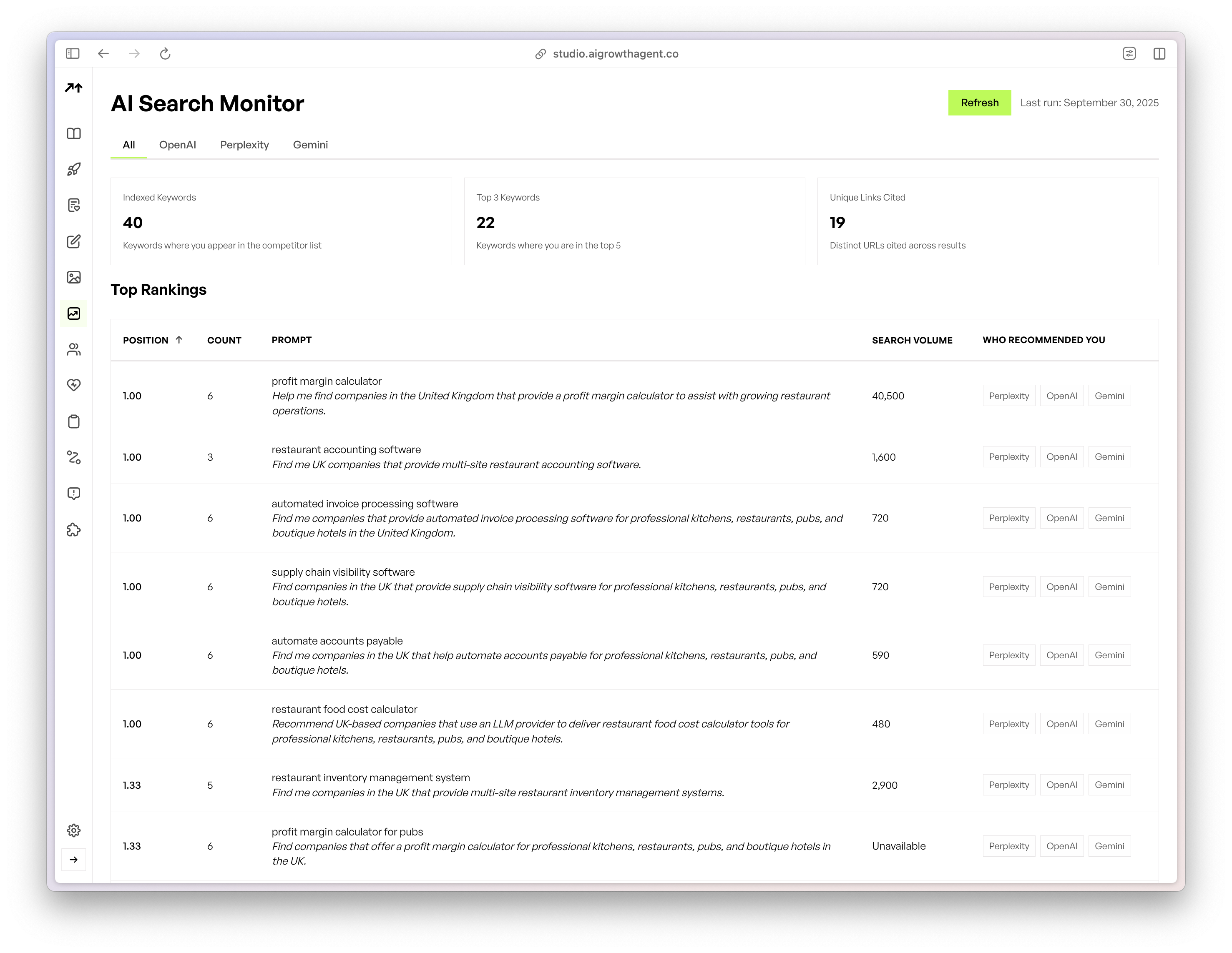
Effective AI-focused gap analysis tracks which competitor pages and terms show up in AI summaries. Regular reviews of ChatGPT, Google AI Overviews, and Perplexity reveal recurring competitors, entities, and questions where your brand is missing.
Using AI Tools for Deeper Gap Discovery
AI-powered research tools surface long-tail, high-intent questions from large volumes of user queries. These tools help identify conversational phrases, follow-up questions, and contextual angles that traditional keyword tools often overlook.
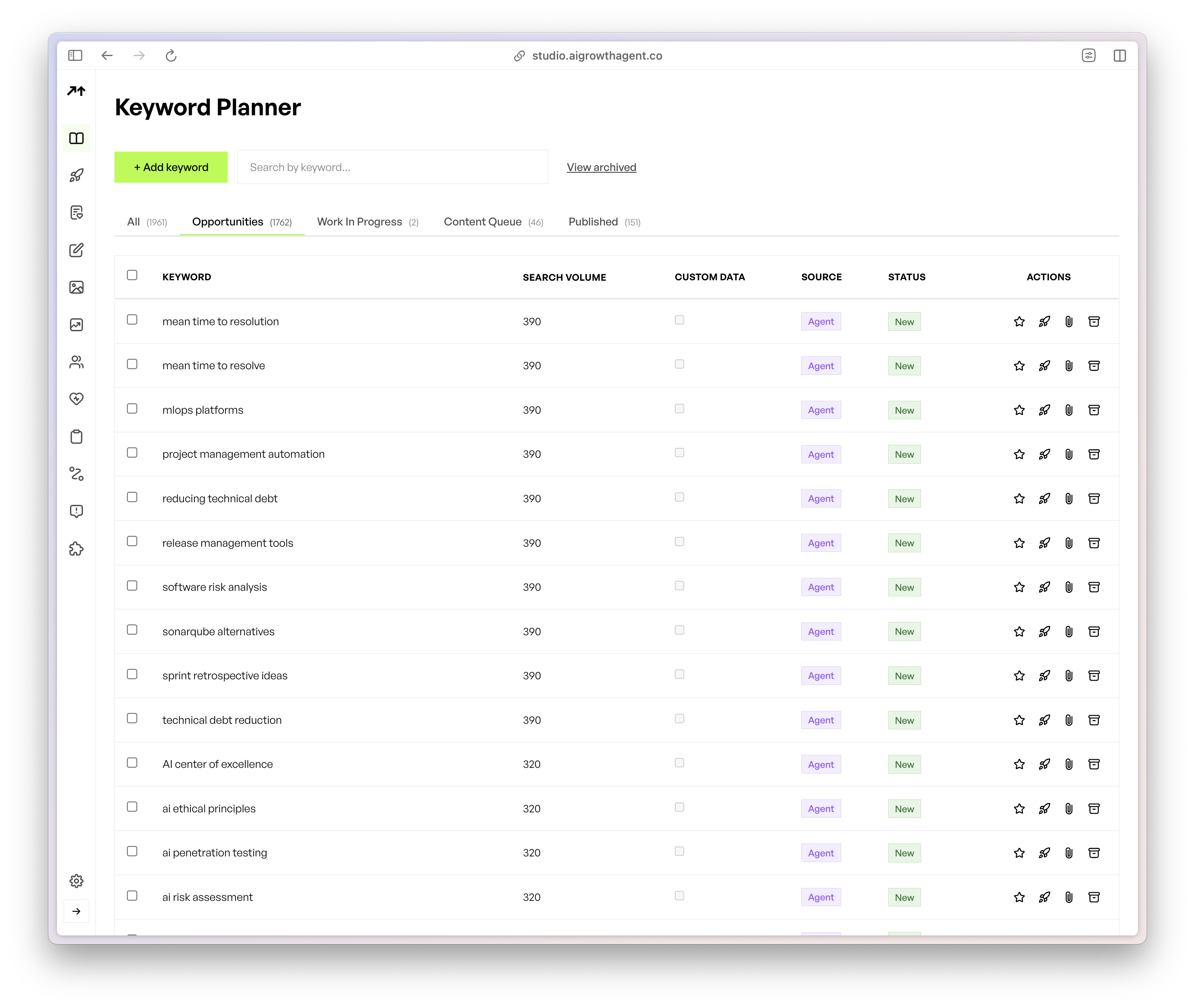
Managing Programmatic SEO in AI Growth Agent Studio
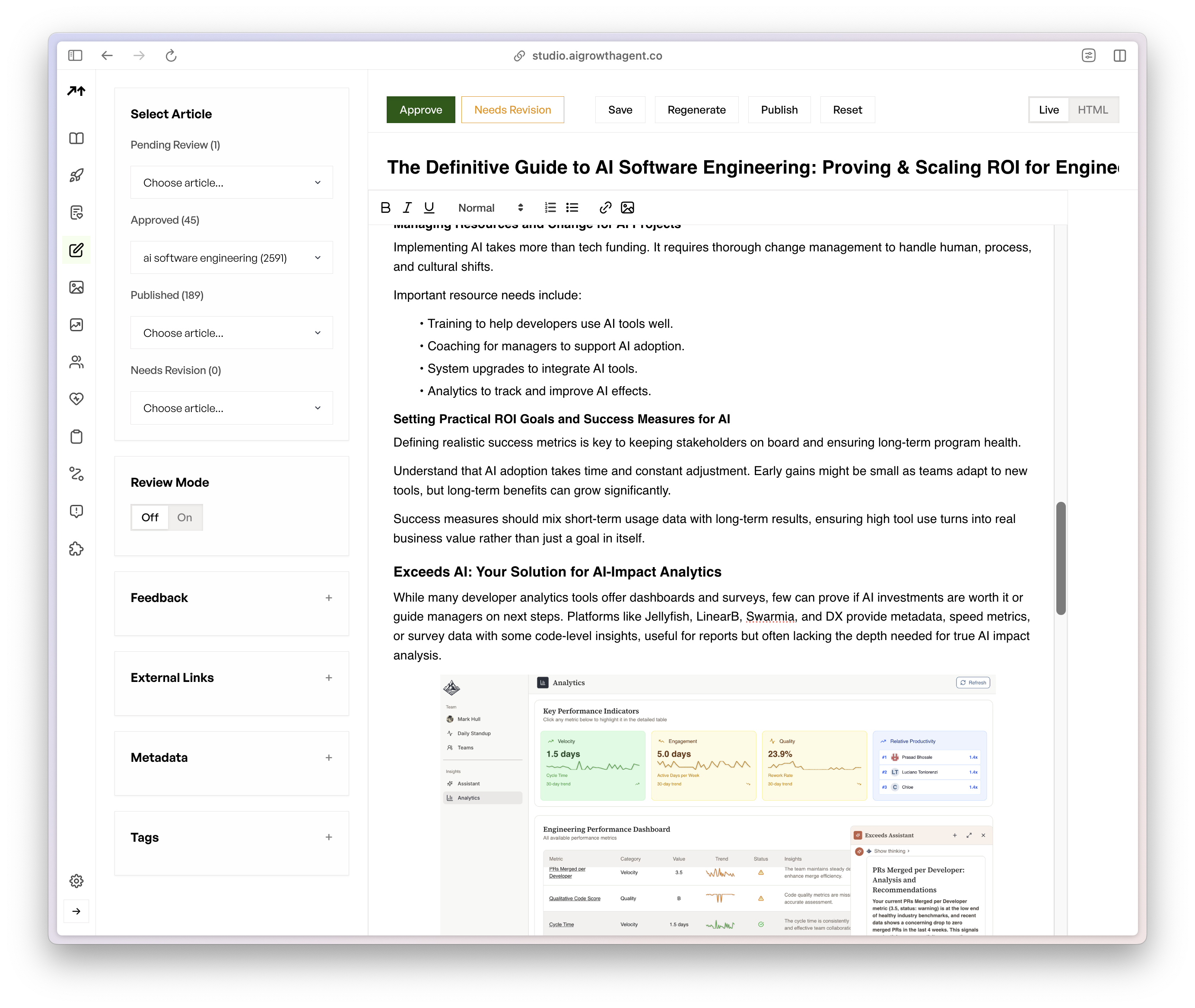
AI Growth Agent Studio gives marketing leaders a control center for their Programmatic SEO operations. The interface shows planned and published assets, keyword clusters, and performance trends, and it incorporates feedback so the agent can refine brand voice and priorities over time.
Automating Technical Infrastructure and Publishing
The Programmatic SEO Agent mirrors your existing site structure and publishes new content within that architecture. Each article ships with advanced schema, LLM.txt integration, and MCP support. These technical elements help AI systems interpret, index, and reference your material more effectively.
Schedule a demo to see how automated content engineering can close your keyword gaps at scale.
Common Challenges in AI-Focused Keyword Strategies
Chasing Volume Instead of Intent
Overemphasis on high-volume head terms often leads to weak AI visibility. LLMs give more weight to pages that satisfy specific, contextual intents than to those that only target broad phrases.
Missing Conversational and Contextual Signals
Content that mirrors natural language questions and anticipated follow-ups aligns better with AI search behavior. Many sites still optimize around rigid keyword lists instead of conversational patterns.
Operating Without Programmatic Scale
Keyword gap analysis now works best as an ongoing feedback loop. Manual processes rarely keep up with new queries, shifting user needs, and model updates, which creates persistent blind spots.
Neglecting Technical Requirements for AI Indexing
Strong content can still remain invisible to AI if technical foundations are weak. Missing structured data, LLM.txt files, and MCP support often prevent AI systems from understanding or querying your content at depth.
Book a consultation to audit your AI-focused keyword strategy and technical SEO foundation.
How AI Growth Agent Closes Keyword Gaps
|
Feature Category |
AI Growth Agent |
Traditional SEO Agencies |
Self-Service AI Tools |
|
Solution Type |
Programmatic SEO Agent (technology platform) |
Manual service (human-driven) |
Content generation software |
|
Scale & Automation |
Autonomous, high-volume content engineering |
Limited by headcount |
Text output, manual integration required |
|
AI-Specific Technical SEO |
End-to-end engineering with schema, LLM.txt, MCP |
Basic or outsourced |
No built-in AI-focused technical SEO |
|
Primary Value |
Structured topical authority designed for AI citation |
Custom content at modest volume |
Draft content without full production support |
Multi-Brand Programmatic Deployment
The platform supports multi-tenant setups, so enterprises can run separate Programmatic SEO agents for different brands or business units from one interface. Each agent follows its own manifesto, keyword plan, and publishing destination.
Real-Time Content from Live Signals
AI Growth Agent can generate optimized articles from trending news or URLs within minutes. This capability helps brands capture search and conversation around time-sensitive topics while those topics are still emerging.
Turning Databases into Indexed Content
The agent converts structured, proprietary data into search-ready articles. Internal datasets become a source of programmatic content that improves coverage across detailed, long-tail queries.
Intelligent Image and Asset Placement
The system selects relevant visuals, inserts them into articles, and enriches them with descriptive metadata for image search. This approach improves user experience and adds more signals for AI systems to understand the content.
Frequently Asked Questions (FAQ) on AI Keyword Gap Analysis
What distinguishes AI-focused keyword gap analysis from traditional methods?
AI-focused gap analysis centers on queries that improve visibility in AI Overviews and LLM-generated answers. Traditional approaches emphasized ranking for specific keywords. AI-focused methods emphasize coverage of related questions, entities, and subtopics that signal expertise to LLMs.
Why is topical authority more important than individual keywords for AI search?
LLMs assemble answers from sources that demonstrate broad, coherent coverage of a subject. Pages that fit into a structured cluster of related content look more authoritative than isolated articles optimized for single terms.
How do AI tools help identify content gaps competitors have missed?
AI tools analyze large sets of real queries, group them by intent, and highlight themes where few or weak results exist. These patterns reveal opportunities to publish content that addresses nuanced, high-intent questions before competitors do.
What are the main pitfalls when optimizing for AI search?
Common issues include focusing on volume instead of intent, treating content production as one-off campaigns, and overlooking technical SEO elements that help AI systems understand and access your pages.
How does AI Growth Agent keep content aligned with evolving AI algorithms?
AI Growth Agent uses continuous monitoring, including an AI Search Monitor that tracks how content appears across ChatGPT, Google AI Overviews, and Perplexity. Feedback from these signals feeds back into topic selection, on-page structure, and technical implementation.
Conclusion: Competing for AI Citations with Programmatic SEO
AI-powered search in 2026 rewards brands that pair strong topical authority with consistent technical execution. Programmatic keyword gap analysis offers a structured way to identify where competitors earn AI visibility and where your content needs to improve.
Manual workflows alone rarely provide the coverage, speed, or precision required. A Programmatic SEO Agent like AI Growth Agent can systematize research, content creation, and technical SEO so your brand has a durable presence in AI-generated answers.
If you lead a brand with a solid foundation and want to strengthen your position in AI search through programmatic keyword gap analysis, schedule a strategy session with AI Growth Agent.