Written by: Mariana Fonseca, Editorial Team, AI Growth Agent | Last updated: January 10, 2026
Key Takeaways
- AI search engines now prioritize authority, structure, and topical depth, so traditional keyword-focused SEO alone no longer protects your digital visibility.
- Programmatic SEO uses automation and data to publish large volumes of structured, technically sound content that AI systems can reliably understand and cite.
- Structured data, schema markup, and configurations such as LLM.txt and Model Context Protocols (MCP) give AI crawlers a clearer view of your expertise and increase citation potential.
- Brands of all sizes can gain visibility in AI search results, even against larger competitors, by combining topical depth with programmatic publishing.
- AI Growth Agent provides an end-to-end programmatic SEO system for marketers who want to operationalize this approach at scale; schedule a demo to see how it can support your team.
The Problem: Traditional SEO Is Not Proper SEO Optimization for AI Search
The Shrinking Digital Footprint: Competing With AI Content Saturation
Brand visibility keeps shrinking as AI-generated content increases the volume of pages published every day. Each new wave of content reduces the relative share of attention available for your existing assets and weakens your digital footprint.
Manual content workflows cannot match this pace. A team that ships one article per month competes with thousands of new pages created daily. Reliance on slow, human-only content creation now limits reach and makes proper SEO optimization difficult in an AI-driven environment.
The AI Search Shift: Authority, Structure, and Scale
AI search engines evaluate content on semantic depth, topical coverage, and technical clarity, not just keyword matching. They favor sources that consistently demonstrate expertise and provide structured, machine-readable information.
Proper SEO optimization now depends on content that is organized into clear clusters, supported by structured data, and kept current at scale. Depth, recency, and clean technical implementation shape how AI systems rank and cite your pages.
Why Many Current SEO Approaches Fail the AI Test
Manual agency models and traditional in-house programs struggle to meet the volume and technical requirements of AI search. Creating a few strong articles each month does not build the dense, structured topic coverage AI systems prefer.
Most teams also lack engineering support to manage schema markup, LLM-focused files, and site architectures that support programmatic SEO. Basic AI writing tools add more text but rarely output fully engineered pages with the metadata and structure needed for reliable AI indexing.
Many brands now run SEO programs that generate content but do not generate the kind of authority signals AI search engines prioritize.
Teams that want to diagnose their current gaps in AI search performance can book a consultation to review their SEO readiness.
The Solution: Programmatic SEO for Proper SEO Optimization in AI Search
Programmatic SEO (pSEO) Gives You Scale With Control
Programmatic SEO applies automation to the full content lifecycle. It uses data models to identify topics, generate briefs, create content, and publish technically sound pages across a structured site architecture.
This approach helps brands:
- Cover entire topic areas with interconnected pillar and supporting pages
- Maintain consistent on-page structure and metadata at scale
- Increase publishing velocity without losing quality control
Programmatic SEO turns SEO from a series of one-off campaigns into an ongoing system that continually expands your topical authority.
Structured Data and Technical SEO Support AI Citation
Structured data provides AI systems with an explicit map of what your content covers. Schema markup, clean internal linking, and optimized metadata allow crawlers and large language models to parse entities, relationships, and context more reliably.
Advanced configurations such as LLM.txt and MCP-style interfaces further improve how AI systems interpret and query your content, making it easier for them to surface your pages as trusted references.
Topical Depth Builds Sustainable Digital Authority
Proper SEO optimization now centers on building topic clusters rather than chasing isolated keywords. Clusters group related searches into coherent structures that demonstrate depth on a subject.
This structure signals expertise to both traditional search and AI systems. It also creates many natural entry points into your site, improving the odds that a specific query, AI overview, or chat response will feature your content.
Teams that want an end-to-end way to execute this strategy can request a demo of AI Growth Agent.
AI Growth Agent: A Programmatic SEO Engine for Marketing Teams
Engineering Content Architectures With AI Growth Agent
AI Growth Agent is a programmatic SEO platform that designs and runs content architectures aimed at building category-level authority. The process starts with a structured onboarding session that captures your positioning, audience, and product details and turns them into a Company Manifesto that guides all future content.
After this foundation is in place, the agent runs programmatic keyword and content research. It analyzes large sets of queries, groups them into pillars and clusters, and produces a long-term content roadmap focused on AI search behavior.
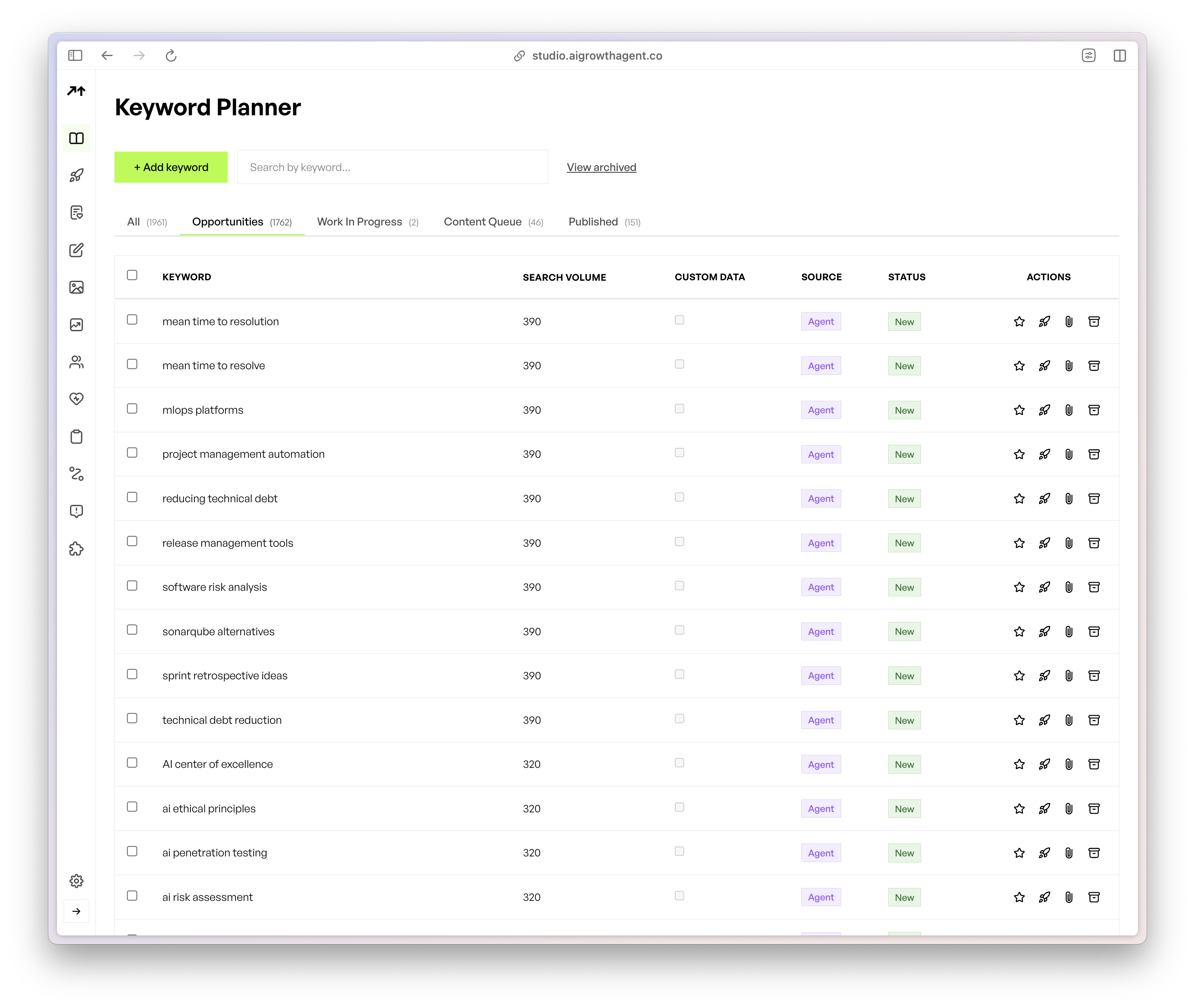
The platform also deploys a dedicated, optimized blog subdomain that matches your brand styling while providing a clean technical base for programmatic SEO.
Autonomous Content Engineering for Proper SEO Optimization
Once the strategy is approved, the pSEO Content Agent manages content production from end to end. It creates briefs for each asset, researches your internal materials and trusted web sources, drafts content, and applies fact-checking steps.
The system then handles technical engineering. Each post receives schema markup, structured metadata, optimized media tags, and support for LLM-focused files such as LLM.txt and a blog-level Model Context Protocol. These elements help AI search engines access and interpret your content more precisely.
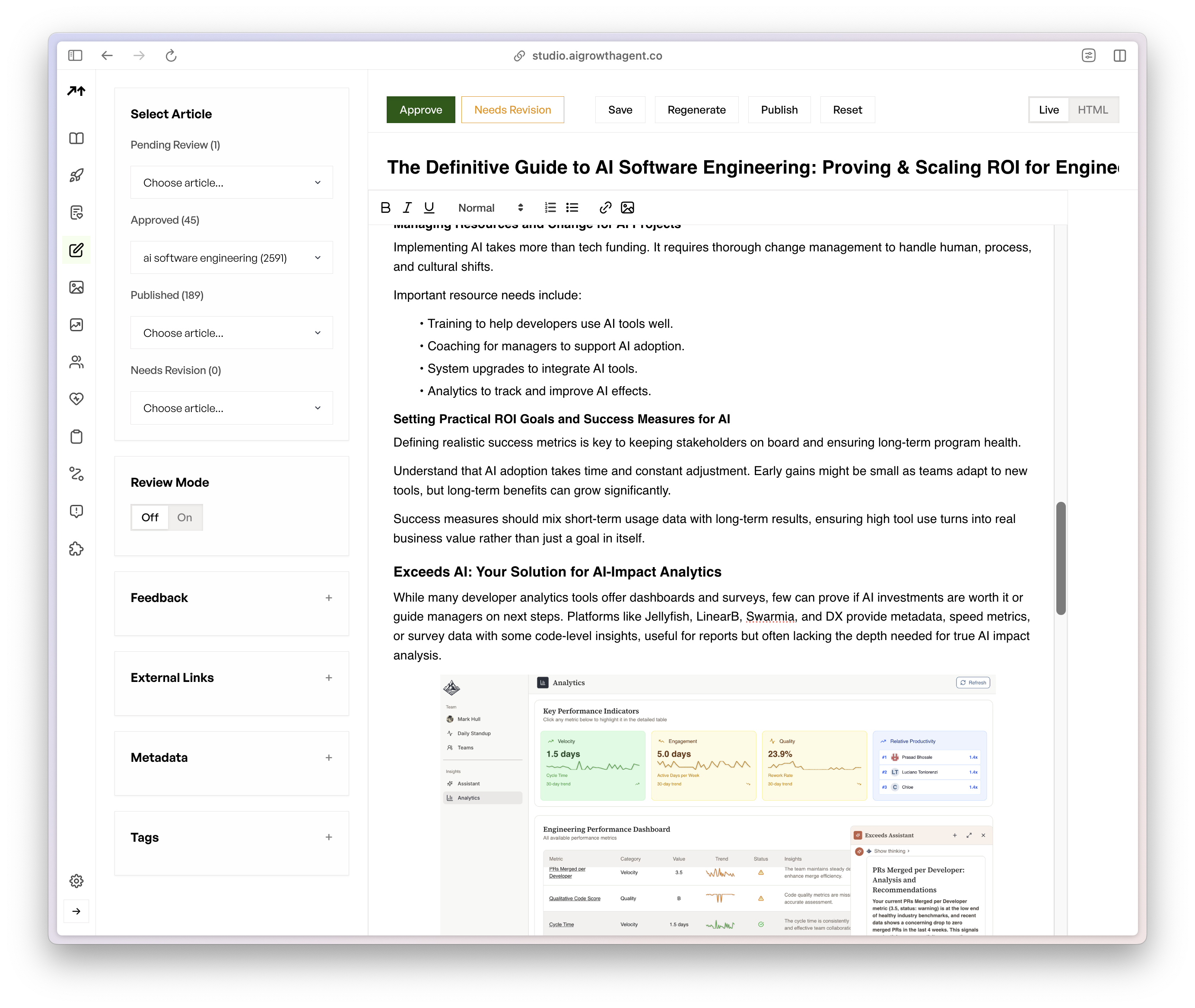
Teams can review all work inside AI Growth Agent Studio. The interface supports editing, commenting, and approvals, and can run in manual or Auto-Pilot modes depending on your workflow.
Additional Capabilities for Multi-Brand and Data-Driven Use Cases
AI Growth Agent supports more complex scenarios for advanced marketing teams. Multi-tenant deployment allows investors or multi-brand companies to manage multiple agents, each with its own Manifesto, keyword strategy, and domain or subdomain.
Real-time content injection features can turn timely news or trending topics into structured articles within minutes, enabling faster response to emerging search demand.
Database-to-content workflows convert existing product or app data into search-facing assets. For example, internal recommendation data can become indexable, long-tail pages without manual writing for each record.
The platform also supports intelligent placement and optimization of images and other assets to improve both user experience and image SEO.
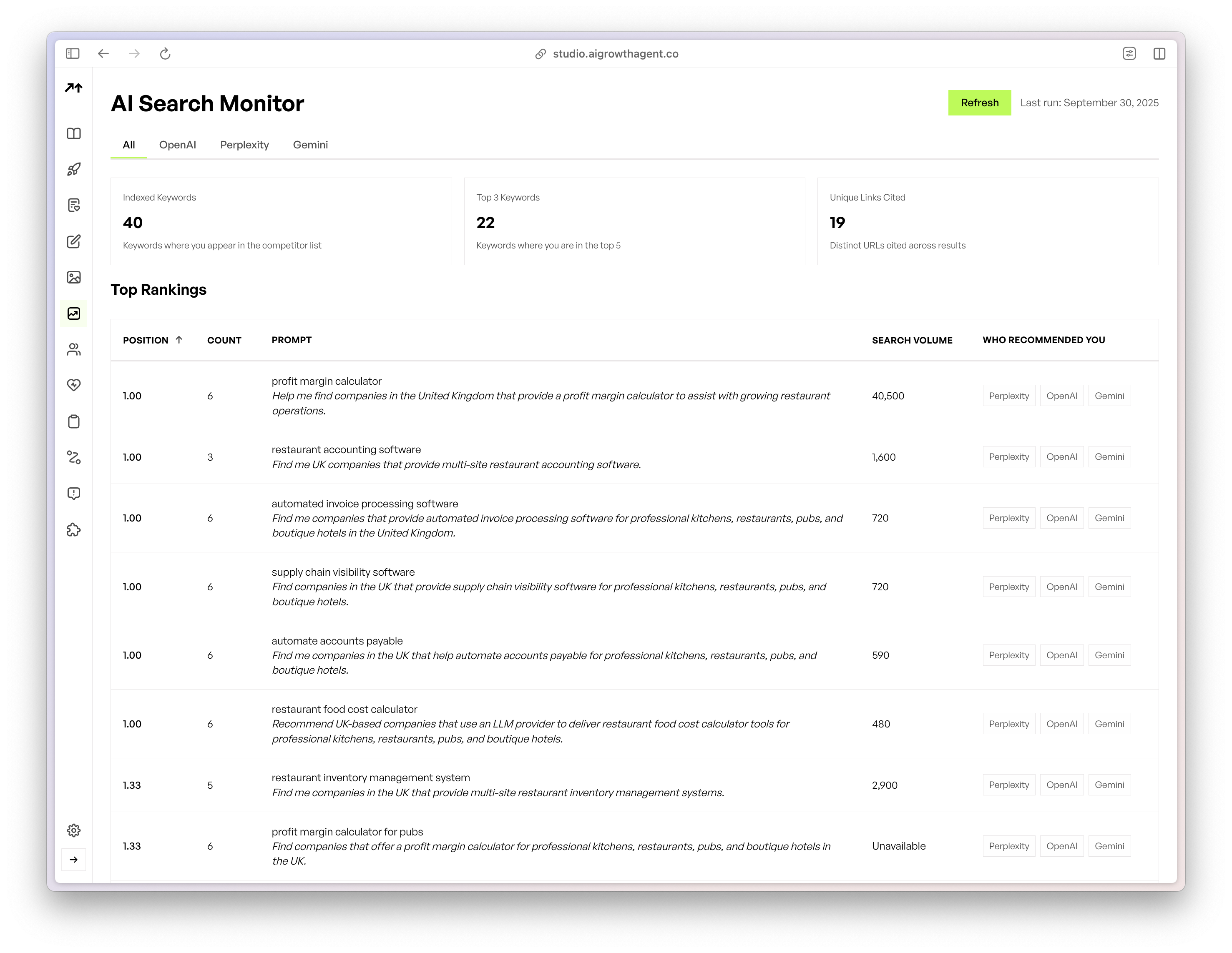
Teams that want to track how this activity translates into AI visibility can use the included AI Search Monitor to see which queries and engines are citing their content.
Competitive Landscape: How AI Growth Agent Compares
|
Feature/Aspect |
Traditional SEO Agencies |
Basic AI Content Tools |
AI Growth Agent (Programmatic SEO) |
|
Content Velocity |
Low, manual production |
Variable, text-only output |
High, structured, and scheduled |
|
Technical SEO Depth |
Limited implementation |
Minimal configuration |
Integrated schema, metadata, and LLM support |
|
AI Citation Focus |
Indirect focus |
No explicit focus |
Designed for AI-overview and LLM visibility |
|
Value Proposition |
Individually crafted assets |
Writing assistance |
End-to-end authority and scale system |
Marketing leaders who want to evaluate this model for their own pipeline can book a strategy session with AI Growth Agent.
Success Stories: Brands Using Proper SEO Optimization To Gain AI Visibility
Exceeds AI: Higher Visibility for Engineer Performance Reviews
Within two weeks of launching programmatic SEO with AI Growth Agent, Exceeds AI appeared in Perplexity as a leading alternative in the performance review category. By week three, core terms surfaced in Google AI Overview and Gemini snapshots.
Today, Exceeds AI is cited across ChatGPT, Google AI Overview, and Perplexity for searches related to AI performance review tools for engineers, showing how focused programmatic SEO can accelerate authority building.
BeConfident: Competing With Larger English Learning Apps
BeConfident operates in a market with established brands such as Duolingo and Busuu. After implementing AI Growth Agent, the company achieved rapid indexing on its programmatic content and gained visibility in Brazil-focused Google AI Overview results as a recommended English learning option.
This performance illustrates how smaller brands can use proper SEO optimization to compete with larger incumbents when they combine topical coverage with technical rigor.
Gitar: Building Authority in AI-Powered CI/CD
Gitar.ai used AI Growth Agent to publish structured content around AI-assisted CI/CD automation. Within two months, the brand began leading high-intent searches such as fixing broken CI builds automatically and AI tools for CI failure review across Google AI Overview, ChatGPT, and Perplexity.
Consistent citations on these queries helped position Gitar as a reference point for AI self-healing pipelines.
Teams that want to explore similar programmatic approaches can schedule a demo and discuss fit.
Frequently Asked Questions (FAQ) on Proper SEO Optimization for AI Search
How do AI search engines understand content?
AI search engines use semantic models to identify entities, relationships, and context across pages. Structured data, schema markup, and clear internal linking patterns help these systems interpret content with higher precision and increase the likelihood of citation.
Is generic AI-generated content enough for proper SEO optimization?
Generic AI-generated content usually lacks the depth, originality, and technical structure needed for durable rankings in an AI-first environment. Effective content pairs subject-matter expertise with structured formatting, accurate data, and consistent topical coverage.
What are LLM.txt and Model Context Protocols (MCP)?
LLM.txt and MCP-style configurations are technical files and interfaces that describe how large language models should access and interpret your content. They can provide direct, structured connections between your content database and AI systems, improving how your material appears in AI-generated answers.
How does Programmatic SEO differ from traditional enterprise SEO?
Programmatic SEO emphasizes automation, scale, and structured data across large sets of pages, with specific attention to AI search behavior. Traditional enterprise SEO often centers on smaller sets of manually managed pages and may not reach the velocity or technical consistency required for AI-first search.
Can proper SEO optimization help brands challenge established leaders?
Programmatic, technically sound SEO can help emerging brands gain meaningful visibility even against long-standing competitors. AI search engines reward depth, clarity, and structure, which allows well-executed programmatic strategies to gain share in AI overviews and chat results.
Teams with additional questions can schedule a consultation with an AI Growth Agent specialist.
Conclusion: Make Proper SEO Optimization Work in the AI Era
AI-driven search has changed how digital authority is created and maintained. Approaches built solely around manual content production and basic keyword tactics now struggle to keep brands visible as AI systems reshape discovery.
Proper SEO optimization in 2026 requires programmatic workflows, structured data, and technical configurations that help AI systems understand and trust your content at scale. Brands that adopt this model can grow their footprint in both traditional and AI search results.
AI Growth Agent offers a structured way to operationalize this shift through programmatic SEO, technical engineering, and AI-aware monitoring. Marketing leaders who want to evaluate this approach for their own roadmap can book a strategy session and review use cases for their organization.