


Written by: Mariana Fonseca, Editorial Team, AI Growth Agent
Key Takeaways
- Traditional search volume will likely drop 25% in 2026 as users move to AI platforms like ChatGPT and Perplexity, so brands need Generative Engine Optimization (GEO) to stay visible.
- AI Growth Agent leads current programmatic GEO services with autonomous content creation, one-week onboarding, and fast citations for clients such as Bucked Up.
- Monitoring tools like Peec AI and Profound AI surface insights but do not execute changes, while manual agencies move too slowly and cost too much for AI-scale needs.
- Programmatic GEO scales across thousands of pages, supports advanced technical setups (schema, MCP, LLM.txt), and tracks AI citations in real time for clear ROI.
- Premium brands reach AI dominance fastest by using AI Growth Agent’s demo to deploy autonomous GEO and secure top citations across major AI engines.
How Generative Engine Optimization Works for AI Search
Generative Engine Optimization (GEO) is the practice of optimizing digital content to be discovered, selected, and synthesized by AI-powered generative engines including ChatGPT, Perplexity, Claude, Gemini, and Copilot. Traditional SEO focuses on ranking in search results, while GEO focuses on earning citations and inclusion in AI-generated answers.
Research shows that content incorporating authoritative citations, expert quotations, and statistics achieves up to 40% higher visibility in generative engine responses compared to content without these elements. This visibility advantage comes from a shift in how AI engines evaluate content, since they prioritize synthesis-focused strategies and citation-rich pages instead of simple keyword rankings.
See how AI Growth Agent can improve your AI search visibility.
How We Evaluated GEO Platforms in 2026
Our analysis reviewed more than 25 generative engine optimization services using 2026 market prominence, verified case studies, user reviews from G2 and Capterra, documented citation wins, and direct platform demonstrations. Sources included public documentation, AI search monitors, and published ROI metrics from enterprise implementations.
This assessment aims for objectivity while recognizing AI Growth Agent’s leadership in programmatic GEO. Each service is evaluated on automation capabilities, scalability potential, proven results, and ideal client fit.
Top 7 Generative Engine Optimization Services for AI Search Visibility in 2026
Based on these criteria, the following seven services represent the current GEO landscape, from fully autonomous programmatic platforms to monitoring-only tools and traditional agencies.
1. AI Growth Agent
AI Growth Agent operates as a programmatic SEO and GEO agent that engineers high-authority content architectures at superhuman scale. Specialized agents automate the technical SEO lifecycle from keyword clustering to schema implementation and direct publishing.
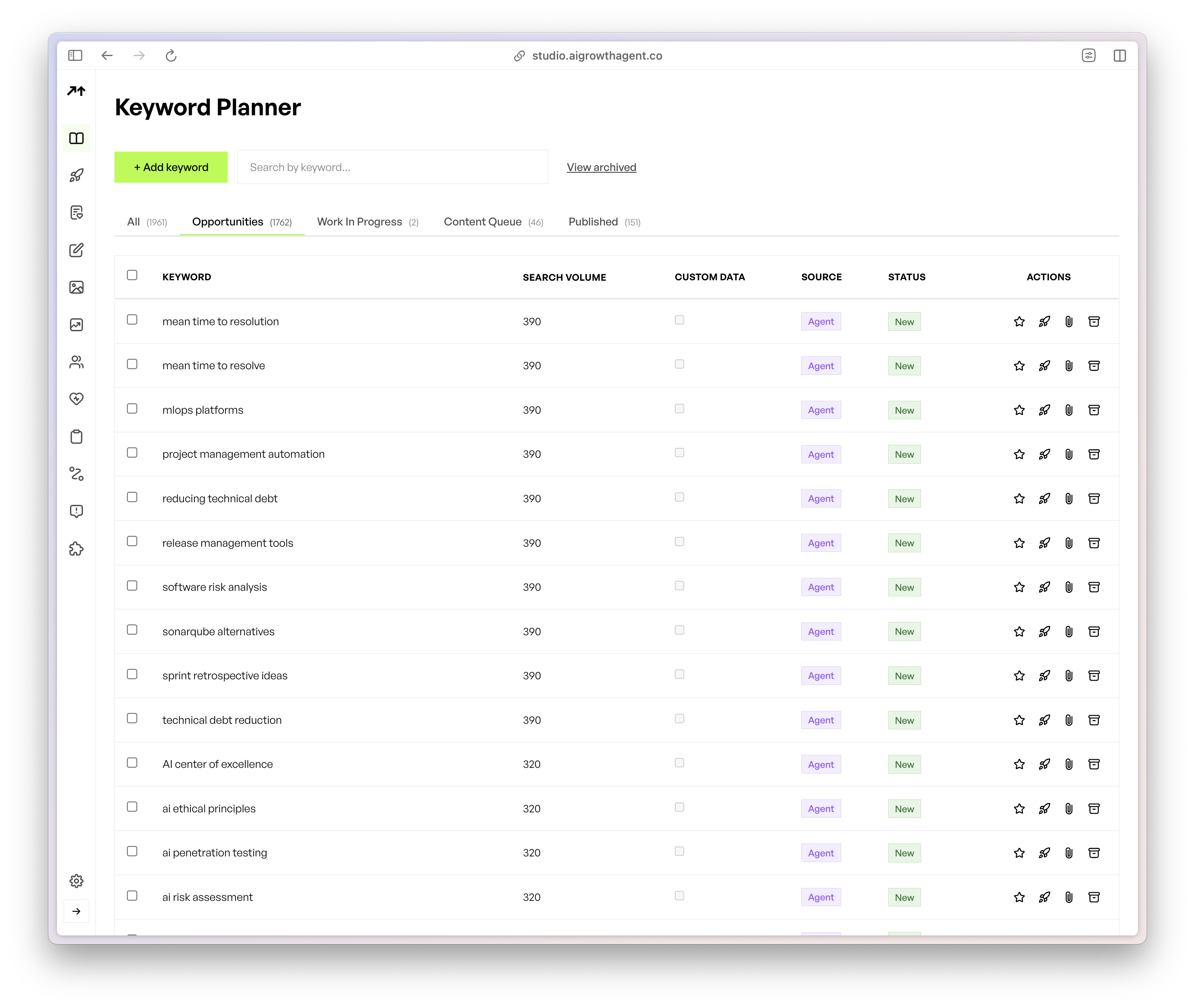
Key Capabilities:
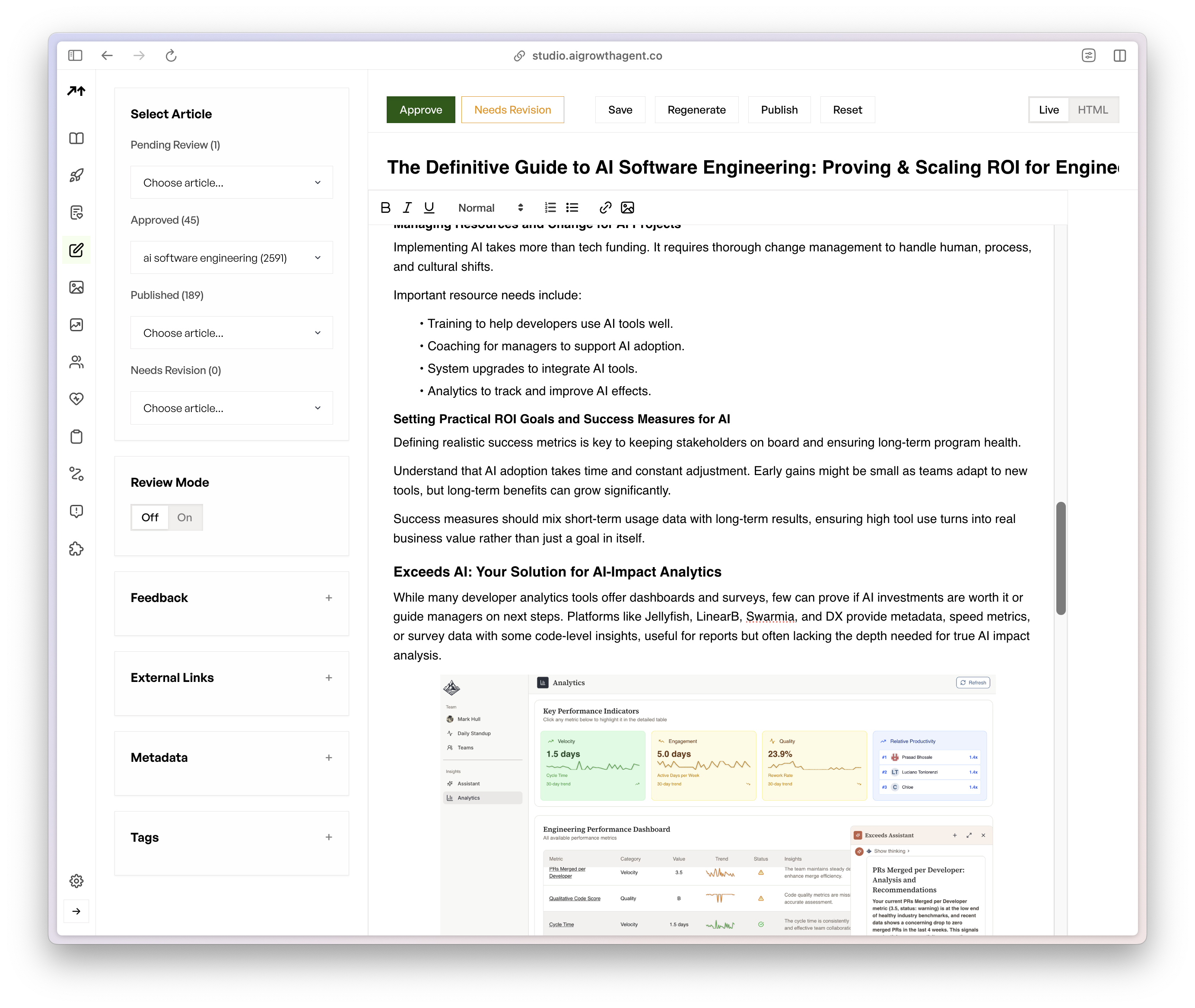
- Autonomous programmatic content creation guided by Company Manifesto programming
- Advanced technical infrastructure including MCP (Model Context Protocol) and LLM.txt
- AI Growth Agent Studio dashboard with real-time citation monitoring
- Multi-Tenant deployment for portfolio companies and enterprise divisions
- One-week onboarding from first meeting to published content
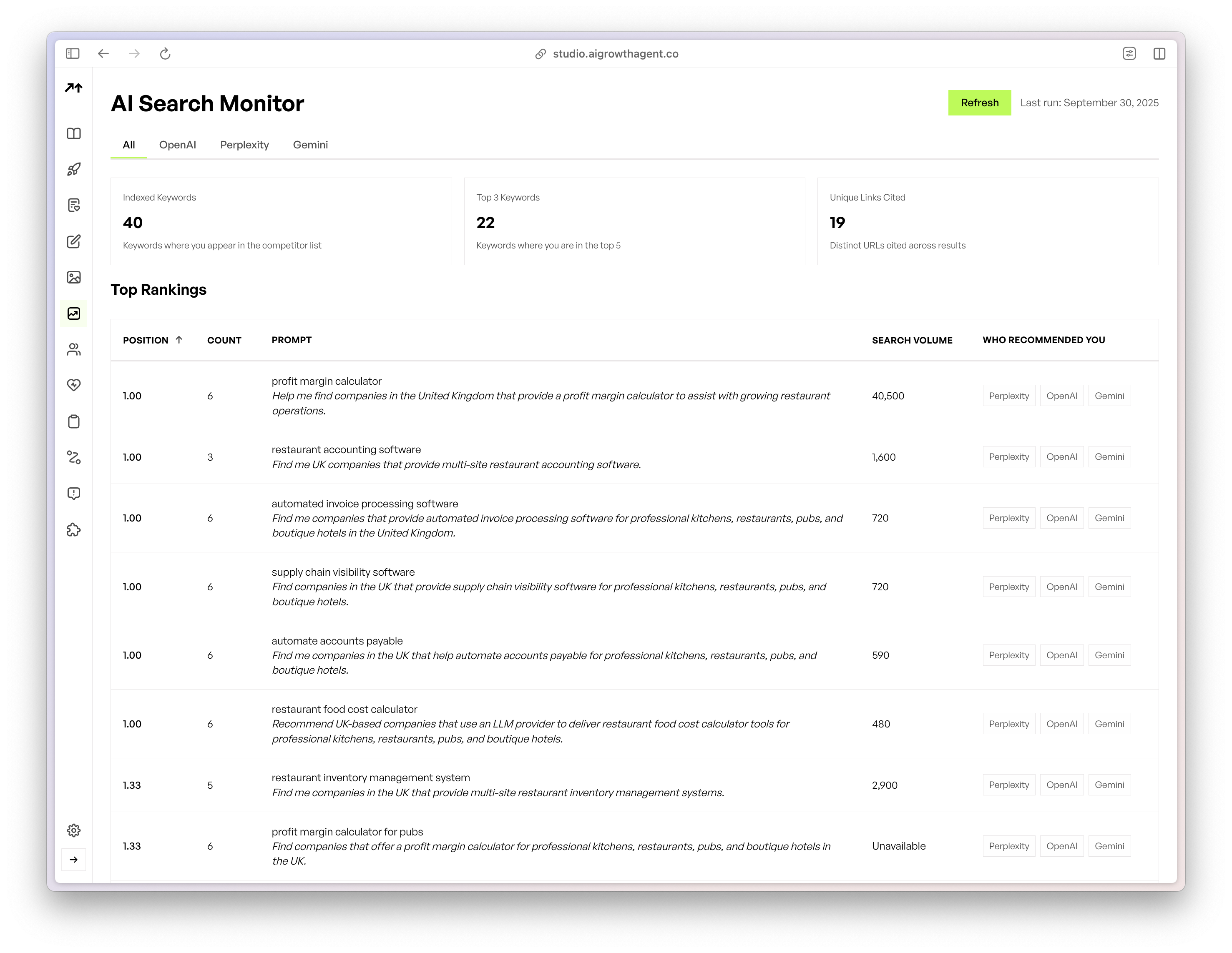
Proven Results: These results show consistent cross-platform impact. Bucked Up achieved #1 ChatGPT citation for “best protein soda” in just 3 weeks, while Exceeds AI dominates Perplexity recommendations for performance review tools. Gitar leads AI-powered CI/CD conversations across major platforms, and BeConfident ranks #1 in Brazil for English learning via Google AI Overviews.
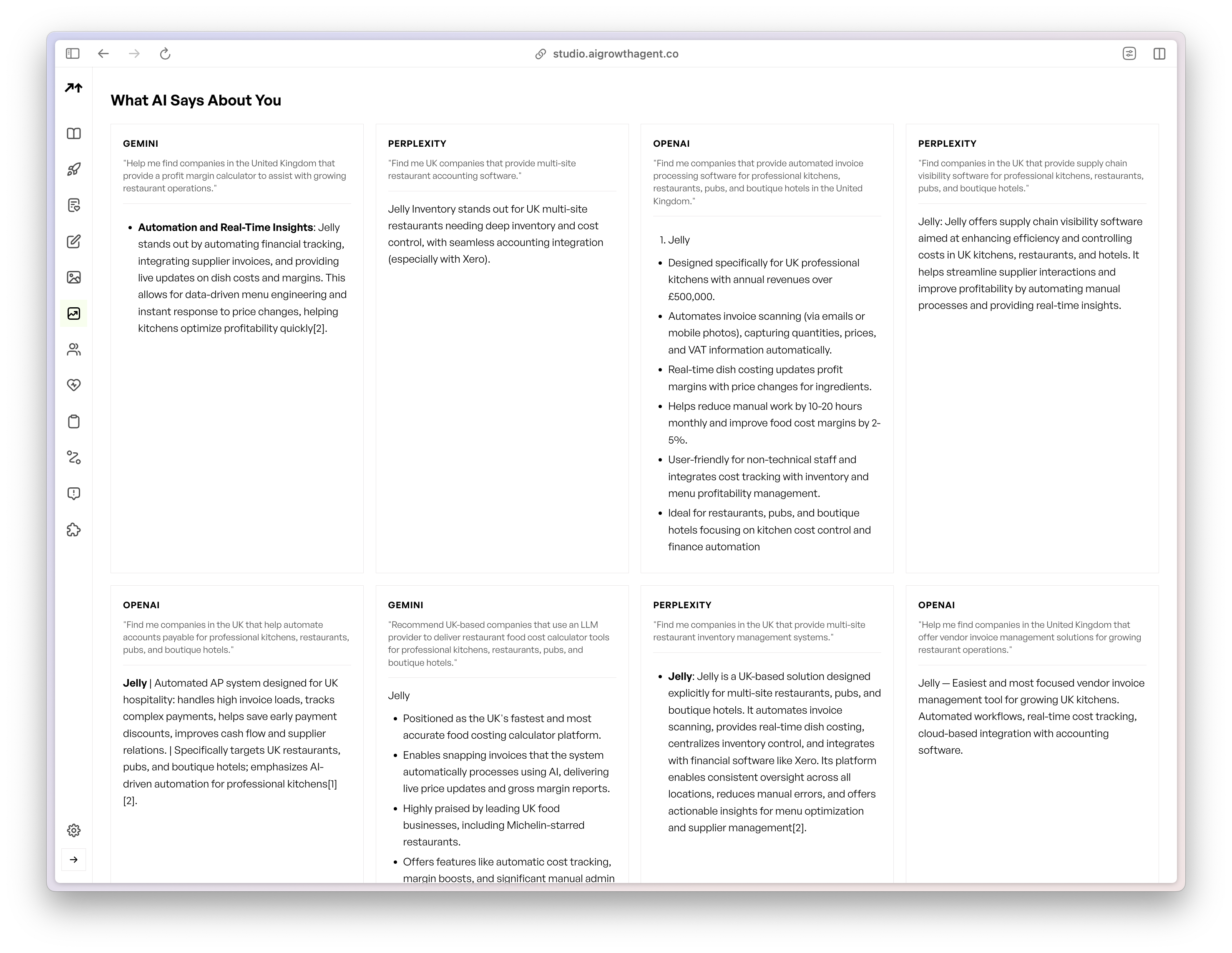
Ideal For: Premium brands with solid technical foundations that want autonomous, scalable GEO. This approach fits marketing leaders who prefer a programmatic engine that runs continuously and delivers measurable AI citations.
Investment: Custom pricing based on content volume and technical requirements.
Get a personalized GEO strategy for your brand.
2. Peec AI
Peec AI supports marketing teams with GEO analysis, prompt tracking, and brand ranking across major AI platforms. The platform focuses on daily monitoring and recommendations that help teams improve AI visibility.
Key Features: Prompt organization, brand ranking analysis, AI model selection, source identification, competitor analysis, and performance tracking.
Limitations: Monitoring-focused approach without autonomous content publishing. Teams must manually implement every optimization recommendation.
Pricing: Starter plan €89/month, Pro €199/month, with 7-day free trial and 15% annual discount.
3. Semrush GEO Add-on
Semrush extends its SEO platform with AI search tracking, so teams can monitor generative engines alongside keyword and ranking data. This setup helps SEO teams add GEO tracking without changing their core tool stack.
Key Features: Integrated SEO and AI tracking, keyword research, content audit, rank tracking, and GEO-focused insights.
Limitations: Unstructured output that needs heavy manual interpretation and implementation. Content optimization still relies on human workflows.
Pricing: Starting at $139/month as an add-on to existing Semrush subscriptions.
4. Jasper AI
Jasper AI focuses on AI-powered content generation with templates and workflows that support GEO-friendly content at scale. Teams use it to draft large volumes of copy that align with brand voice.
Key Features: AI content generation, brand voice training, template library, and workflow automation for content creation.
Limitations: No end-to-end technical engineering. The platform lacks integrated schema implementation and direct publishing workflows.
Pricing: Plans range from $49 to $499 per month based on content volume and team size.
Compare your current content approach with programmatic GEO.
5. Profound AI
Profound AI focuses on enterprise-grade citation monitoring with an emphasis on ChatGPT visibility and conversation analysis for large brands. It helps teams understand how often and where brands appear in AI answers.
Key Features: Visibility dashboard, conversation explorer, prompt designer, enterprise security (SOC 2 Type II), and multi-platform coverage.
Limitations: Diagnostic-only approach without content creation or optimization execution.
Pricing: Starter $99/month, Growth $399/month, with 17% annual discount and custom enterprise options.
6. AirOps
AirOps offers AI-powered writing and content improvement tools that support both traditional search and AI search visibility. Content teams use it to raise quality and consistency across large libraries.
Key Features: AI writing assistance, content improvement recommendations, and workflow automation for content teams.
Limitations: Lacks advanced schema implementation and MCP integration, which limits compatibility with some AI engines.
Pricing: Tiered pricing based on content volume and team requirements.
7. Traditional Agency Services
Manual PR and SEO agencies provide human-crafted content and optimization that often blends traditional SEO with basic GEO. Brands that want hands-on consulting often start here.
Key Features: Custom content creation, manual optimization, strategic consulting, and relationship-based outreach.
Limitations: Slow execution limited by human capacity, expensive hourly billing, and no programmatic scale for AI dominance.
Pricing: $2,000 to $50,000 per month depending on scope and agency tier.
Side-by-Side Comparison of GEO Approaches
This comparison highlights how different GEO solutions handle automation depth, scalability, and speed to first citations. These factors matter most for brands that want reliable AI visibility instead of one-off wins.
| Service | Automation Level | Scalability | Citations/Onboarding |
|---|---|---|---|
| AI Growth Agent | Full (autonomous lifecycle) | Unlimited (Multi-Tenant) | Yes (weeks)/1-week |
| Peec AI | Monitoring only | Medium | Partial/7-day trial |
| Semrush | Partial tracking | High | No add-on/Instant |
| Traditional Agencies | Manual processes | Limited by headcount | Slow/Months |
The table shows that AI Growth Agent combines full automation with rapid onboarding, which produces measurable citations in weeks instead of months.
Why Programmatic GEO Outperforms Manual Teams
Programmatic GEO outperforms manual agency work because it removes human bottlenecks from content production and technical implementation. 94% of CMOs plan to increase their AEO/GEO budgets in 2026, and this shift reflects a need for scalable systems rather than more billable hours.
Traditional agencies often deliver one excellent article per month, while a programmatic approach can generate hundreds of technically precise pages with schema markup, advanced metadata, and LLM.txt implementation. This end-to-end automation keeps quality high and removes the friction that slows manual teams.
Compare your current GEO efforts with a programmatic platform.
Success Stories and a Simple GEO Launch Plan
Real-world implementations show how programmatic GEO performs across industries and markets:
- Bucked Up: The protein soda case study shows how programmatic GEO can reach a #1 ChatGPT citation in 3 weeks.
- Exceeds AI: Dominates Perplexity as a top alternative to competitors within 2 weeks.
- Gitar: Leads self-healing CI/CD conversations across ChatGPT, Gemini, and Perplexity.
- BeConfident: Holds the #1 position in Brazil for English learning via Google AI Overviews.
Getting Started Checklist:
- Assess your content volume needs and confirm your technical foundation can support structured data and publishing.
- Evaluate current AI search visibility gaps using monitoring tools or platform dashboards.
- Schedule a strategy session to confirm platform fit and define GEO goals.
- Review case studies that match your industry and target markets before final selection.
Most teams ask how fast they can see citations. With a mature programmatic approach, brands typically see first AI citations in weeks, not months.
Conclusion: Moving From Experiments to AI Search Dominance
AI Growth Agent currently leads the 2026 generative engine optimization landscape by pairing autonomous content creation with proven AI citations and clear ROI tracking. Monitoring tools and manual agencies still play useful roles, yet programmatic systems now provide the speed and scale required to dominate AI search as traditional search volume declines.
Start your AI dominance journey with a consultation or demo.
Frequently Asked Questions
What makes programmatic GEO more effective than traditional SEO agencies?
Programmatic GEO reaches superhuman scale through automation, creating hundreds of technically optimized pages while agencies often produce a single article each month. An autonomous system can handle the full technical SEO lifecycle from keyword clustering to schema implementation, which removes human bottlenecks that slow traditional work. This approach usually delivers measurable AI citations in weeks instead of the longer timelines common with manual processes.
How quickly can businesses see results from generative engine optimization services?
Timelines depend on the platform and execution model. A mature programmatic system has delivered first citations within 3 weeks, as shown by Bucked Up’s #1 ChatGPT ranking for “best protein soda.” Monitoring tools such as Peec AI provide insights immediately, yet they still require months of manual optimization. Manual agencies often need 6 to 12 months to show meaningful AI visibility gains because their content production capacity remains limited.
What is the difference between GEO monitoring tools and full-service programmatic platforms?
GEO monitoring tools such as Profound AI and Peec AI identify AI visibility problems but do not fix them. These tools provide dashboards that highlight citation gaps without offering the infrastructure to execute changes. Full-service programmatic platforms combine monitoring with autonomous content creation, technical optimization, and direct publishing, which closes the gap between diagnosis and execution.
Which industries benefit most from programmatic generative engine optimization?
Technology companies, SaaS platforms, e-commerce brands, and professional services usually see the strongest results from programmatic GEO. These sectors have large content needs, intense competition, and technical foundations that support automated optimization. Multi-tenant capabilities particularly help private equity firms and enterprises that manage multiple brands, since they can centralize GEO management across entire portfolios.
How do businesses measure ROI from generative engine optimization investments?
Teams measure GEO ROI through AI citations, brand mentions, and share of voice instead of only traffic metrics. A dedicated GEO dashboard can show citation frequency across engines such as ChatGPT, Gemini, and Perplexity, along with direct quotes and attribution. Advanced setups also track conversion rates from AI-referred traffic, which often converts at roughly twice the rate of traditional search traffic and usually requires fewer touchpoints before purchase.
