


Written by: Mariana Fonseca, Editorial Team, AI Growth Agent
Key Takeaways
-
AI search engines favor structured depth, fresh content, and clear entities over basic keyword matching, so brands need programmatic scale to compete.
-
Use a 7-step process: AI content gaps audits, topical maps, pillar-cluster architectures, technical upgrades like LLM.txt, publishing velocity, E-E-A-T signals, and citation tracking.
-
Build pillar-cluster models with 50+ interconnected articles per topic, entity schema markup, and strong internal linking to signal comprehensive authority to AI models.
-
Increase AI citations by strengthening E-E-A-T with expert bylines, original data, first-person insights, and transparent authorship.
-
Brands reach top AI recommendations in weeks with AI Growth Agent’s automation, so schedule a demo today to build topical authority at scale.
Why Topical Authority Demands Programmatic Scale in 2026
AI search engines evaluate content passage by passage and reward structured depth and recency over keyword matching. Perplexity AI achieves 94% query success rates and maintains 97% accuracy in source verification, so it needs rich, current sources. AI engines process web pages by breaking them into individual passages and evaluating each passage independently for relevance, clarity, and factual density.
Entity-based understanding now drives which brands AI engines trust and cite. Brands with strong entity recognition through consistent mentions on Wikipedia, news sites, and industry directories are far more likely to be cited. Manual content creation that produces one or two articles each month cannot match the publishing velocity AI visibility now requires.
Brands need solid technical SEO foundations and a commitment to quality before scaling. The payoff can arrive quickly. Exceeds AI reached Perplexity’s number one recommendation position within two weeks using programmatic methods. See how AI Growth Agent can help you achieve automated topical authority building.
Now that programmatic scale has become essential for AI search visibility, the next step is to apply a clear, repeatable process. The following seven steps show how to build topical authority in a structured way.
7 Actionable Steps to Build Topical Authority for AI Search Engines
1. Run an AI Content Gaps Audit
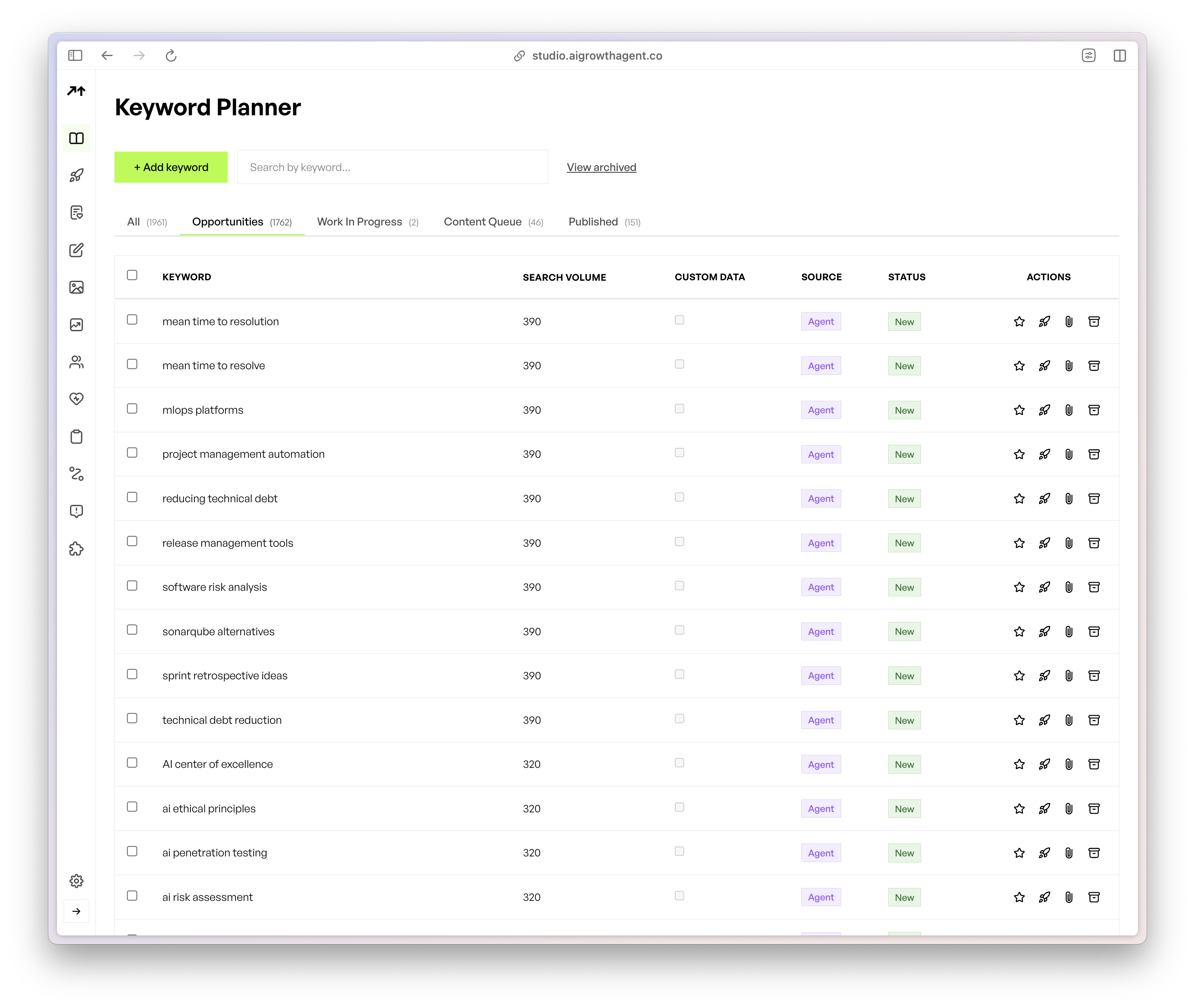
Start with Yotpo’s Information Gain Gap metric, which measures new knowledge added as (Total Information in Document B) – (Information User Already Consumed in Document A). Use this template prompt: “Analyze the top 5 results for [target keyword]. Identify unique information, data points, or perspectives missing that would provide genuine value to users.”
Tools like Ahrefs and Semrush help you uncover competitor content gaps. When using these tools, filter for intersections of three or more SERP competitors with weak rankings, such as outdated 2023 articles or forum threads. These weak spots reveal openings where you can publish fresher, more authoritative content. Within those gaps, prioritize commercial and transactional intent queries where AI engines actively search for reliable sources to cite.
2. Build an AI-Optimized Topical Map
Create focused topic clusters using Exploding Topics’ free topic cluster analysis tool, which pulls data from Google Search Console to group existing high-performing content into authoritative topical hubs. Then, map semantic relationships between core topics and subtopics using entity-based research.
Depth beats breadth for AI search. DigitalApplied recommends becoming the definitive authority on 10 focused topics through comprehensive coverage instead of touching 100 topics at a surface level.
3. Create Pillar-Cluster Content Structures
The pillar-cluster model uses broad pillar pages that cover core topics and link internally to detailed subtopic pages, which signals comprehensive coverage to Google and users. Each pillar should connect to 8 to 12 cluster articles that cover related entities and subtopics in depth.
Support this structure with entity-focused schema markup, including Article, Organization, Person, and FAQ types. Schema.org markup for Article, FAQPage, HowTo, Organization, Person, and Product makes website content machine-readable, helping AI systems understand entities and relations to improve citability.
4. Apply Technical Boosts for AI Crawlers
Set up LLMs.txt and LLMs-full.txt protocols, which are curated Markdown files at the site root that act as sitemaps for LLMs and guide crawlers to key content. Then confirm GPTBot, ClaudeBot, and PerplexityBot access in your robots.txt files so these crawlers can reach your pages.
Once crawlers can access your content, deploy advanced schema markup with @id and sameAs attributes to clarify entity relationships. Schema markup evolved into core infrastructure for AI-driven search by the end of 2025, and Google and Microsoft publicly stated they use it for Generative AI features.
5. Increase Programmatic Publishing Velocity
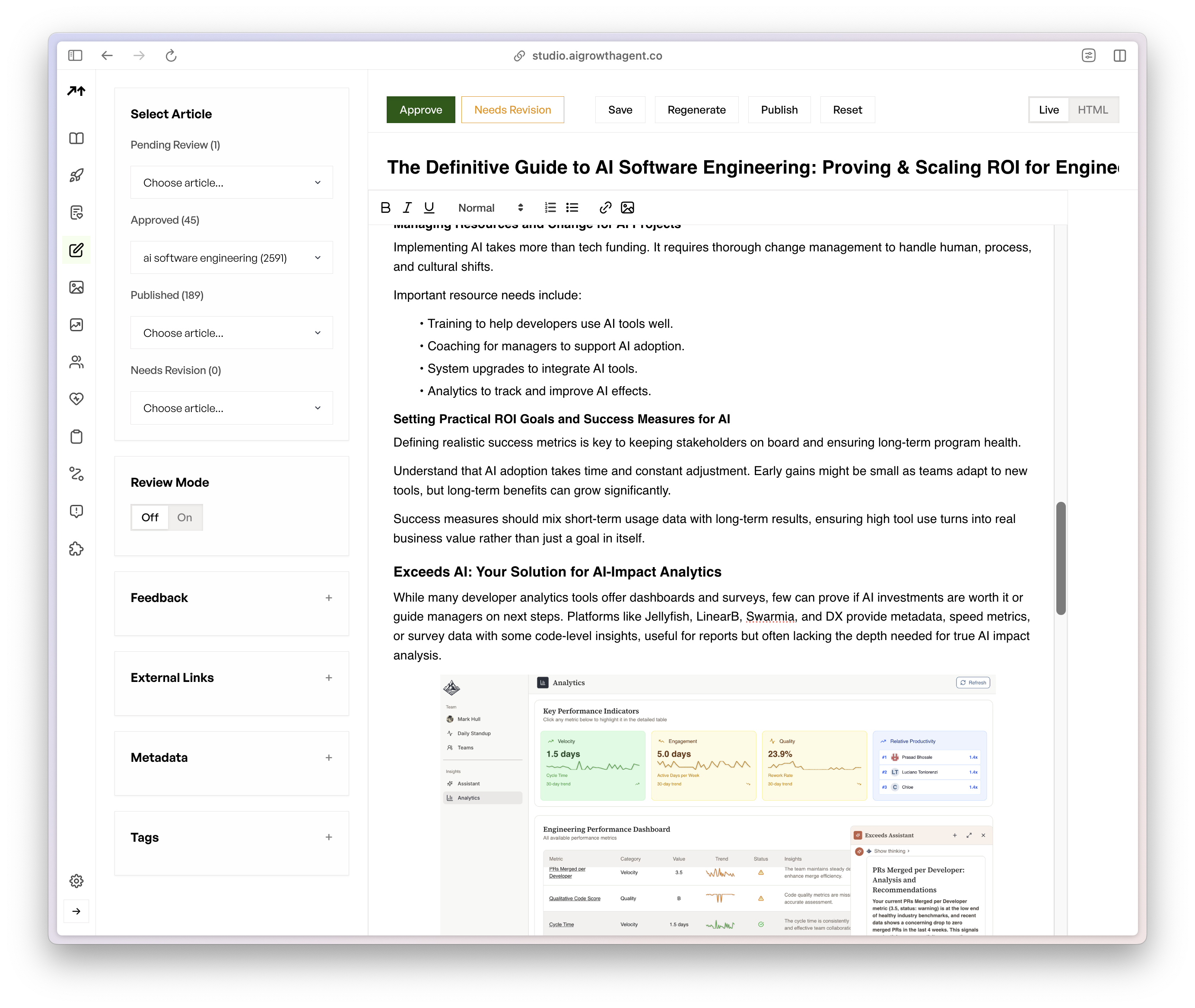
Manual content production cannot reach the scale AI search now expects. Domains build topical authority by creating topical SEO clusters of 50 or more high-quality, precise, interconnected posts on subtopics, which signals ownership of the subject to AI models.
AI Growth Agent automates this work through programmatic content generation, technical optimization, and direct publishing. This automation lets brands publish at superhuman speed while still meeting strict quality standards.
6. Strengthen Internal Linking and E-E-A-T Signals
Descriptive, entity-rich internal linking reinforces entity relationships across a site, mirrors Google’s Knowledge Graph structures, and improves discoverability. Connect pages through shared entities and semantic relationships to show AI engines that your coverage of a topic is complete.
Beyond structural signals, build credibility with strong E-E-A-T markers. Use detailed author bios with linked credentials, first-person language, original media, and citations of primary sources. E-E-A-T gaps often appear as missing author bios, weak credentials, generic language, and a lack of original media, anecdotes, insider knowledge, and primary source citations.
7. Track AI Citations and Share of Model
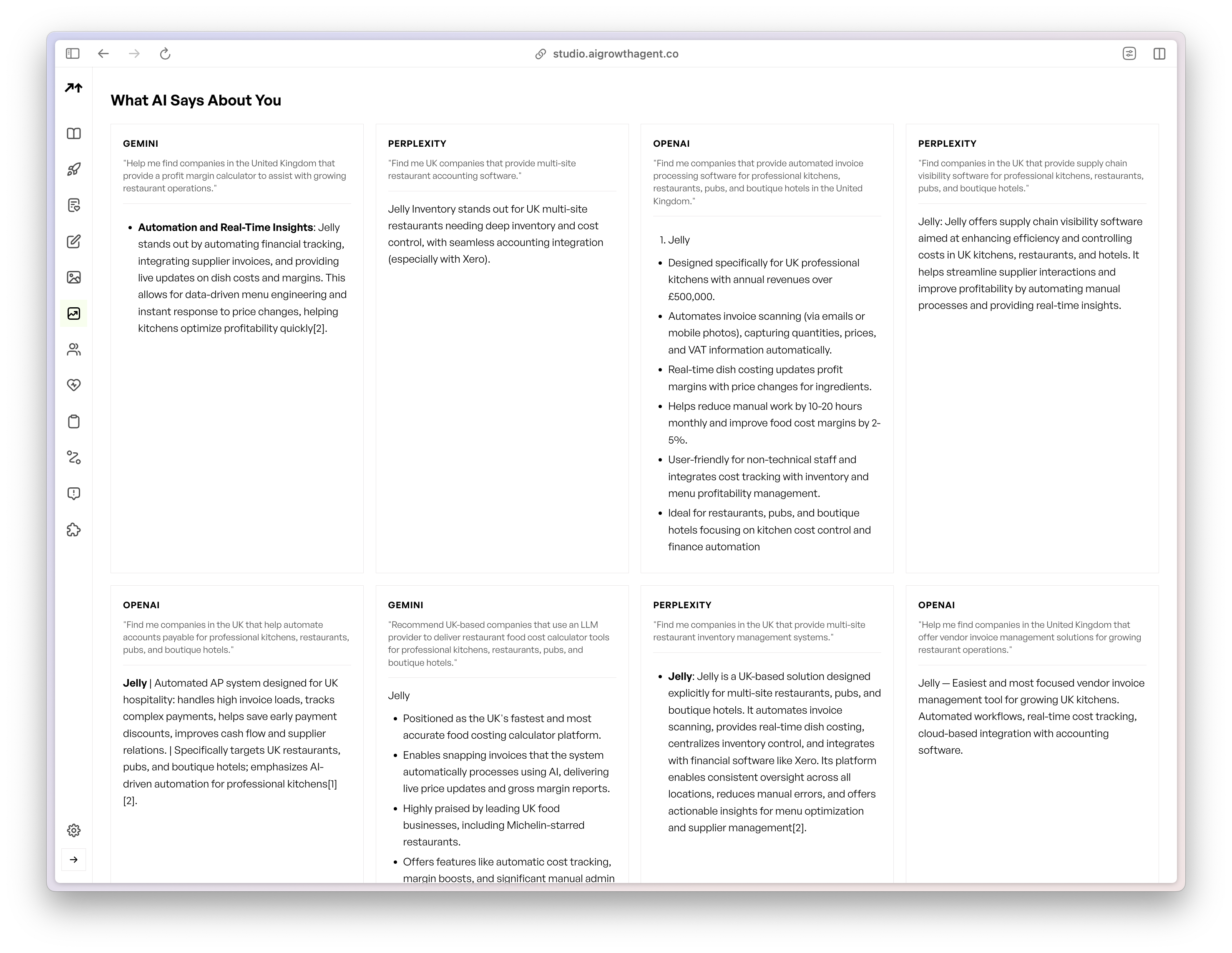
Measure AI search visibility with the “Share of Model” metric, which tracks brand citation frequency in AI responses by manually sampling 50 priority queries in generative tools like Perplexity or ChatGPT. This metric shows how often AI engines choose your brand when answering key questions.
AI Growth Agent Studio tracks real-time ChatGPT citations, crawl statistics for Google, ChatGPT, and Perplexity bots, and heatmaps that show keyword indexing across AI platforms.
Pillar-Cluster Model for AI Search Performance
Topic clusters drive roughly 30% more organic traffic and hold rankings 2.5 times longer than standalone articles. This performance comes from systematic internal linking between pillar and cluster content using contextual anchor text that highlights entity relationships.
Manual scaling struggles because it cannot publish enough interconnected content to reach AI visibility thresholds. Sites with systematic topic cluster structures achieve up to a 40% ranking boost and more than 40% traffic growth over 12 months. The following table shows how different pillar topics can pair with cluster articles and target performance metrics.
|
Pillar Topic |
Cluster Articles |
Target Metrics |
|---|---|---|
|
Digital Marketing Strategy |
SEO Audits, Content Marketing, PPC Management, Social Media Strategy |
50+ interlinked articles, 30% traffic increase |
|
E-commerce Optimization |
Conversion Rate Optimization, Product Page SEO, Shopping Ads, Customer Reviews |
25+ cluster articles, 2.5x ranking retention |
|
AI-Powered Analytics |
Predictive Analytics, Customer Segmentation, Attribution Modeling, Data Visualization |
40+ supporting articles, 40% ranking boost |
Entity Mapping and Semantic SEO Depth
Map each page to a primary target entity using public identifiers like Wikidata Q-IDs, such as Q45 for Portugal or Q2539 for Machine Learning. This mapping creates semantic networks that AI engines can parse and understand.
Apply entity-first optimization through three pillars. Precision means one clear canonical entity per page. Coverage means consistent representation of key entities across the site. Connectivity means explicit relationships through internal links and schema. Entity clarity determines whether content is recognized as the right answer in Google’s AI Overviews and semantic search, which now matters more than simple keyword relevance.
Semantic SEO Topical Authority
Teams often fall into traps such as keyword stuffing entity names without context, misusing schema, or mentioning entities briefly without real depth. Natural integration, regular validation with Google tools, entity relationship mapping, and in-depth, expert-level content prevent these issues.
Use tools like Google’s Natural Language API, Clearscope, and SurferSEO to expand entity maps through semantic analysis and uncover content opportunities competitors ignore.
E-E-A-T Requirements for AI Engines
E-E-A-T (Experience, Expertise, Authoritativeness, Trustworthiness) now acts as a hard ranking requirement for 2026 search engines, with Trust verified through transparent authorship, original data, and widespread brand mentions.
The E-E-A-T signals outlined in step 6 translate into measurable gains. Audits that prioritize Experience through first-hand human insight, such as original photos and data-backed “I” statements, deliver visibility increases of 38% or more after the December 2025 Core Update. This performance data confirms the value of the authority markers discussed earlier.
Scaling Topic Clusters with E-E-A-T
AI Growth Agent’s Manifesto system programmatically embeds E-E-A-T signals across content clusters so every article carries consistent authority markers. This automated approach scales expertise demonstration across hundreds of articles while still preserving an authentic human voice.
Real Results: Programmatic SEO Case Studies
Programmatic topical authority building delivers measurable results across AI search platforms. The following case studies show how different brands reached top AI citations within weeks using programmatic methods.
|
Client |
Timeline |
AI Citation Result |
Traffic ROI |
|---|---|---|---|
|
Exceeds AI |
2 weeks |
Perplexity #1 alternative recommendation |
Featured across ChatGPT, Gemini, Perplexity |
|
BeConfident |
3 weeks |
#1 English learning app in Brazil (Gemini) |
Immediate indexing, market leadership |
|
Bucked Up |
3 weeks |
ChatGPT #1 protein soda citation |
Top citation for “best protein soda” |
|
Gitar |
2 months |
Reference brand for AI CI/CD automation |
Leading citations across all AI platforms |
These outcomes highlight how programmatic methods outperform manual content strategies for AI search. Discover if programmatic SEO can deliver similar results for your brand.
Scale with Programmatic SEO Agents
AI Growth Agent moves beyond manual SEO and basic AI writing tools by automating the entire content lifecycle. The Programmatic SEO Agent handles strategy development, research, drafting, fact-checking, technical optimization, and publishing.
The platform also manages advanced tasks such as LLM.txt implementation, Model Context Protocol integration, and multi-tenant deployment for portfolio companies. Traditional agencies rely on limited headcount and tools that need manual setup, while AI Growth Agent delivers autonomous execution at superhuman scale.
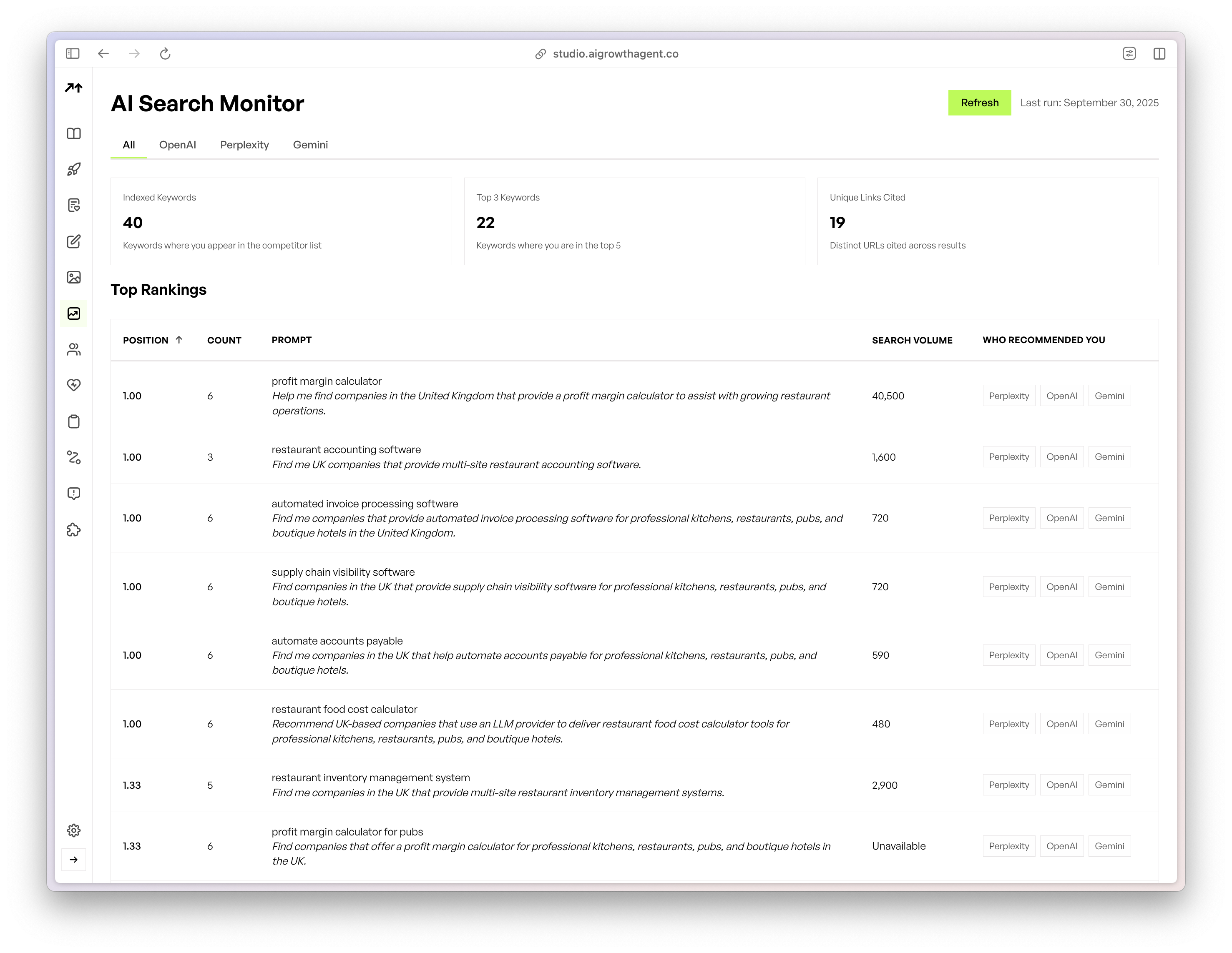
The Studio dashboard provides real-time monitoring of AI citations, crawl statistics, and keyword indexing across ChatGPT, Perplexity, and Gemini. This automation extends to maintaining brand voice and technical quality while you scale content output.
Learn how autonomous content generation can transform your AI search presence and unlock programmatic topical authority.
Frequently Asked Questions
What is topical authority for AI search engines?
Topical authority for AI search engines means your brand becomes the definitive source on specific subjects through comprehensive, interconnected content that AI models recognize and cite. Unlike traditional SEO, which focuses on individual page rankings, AI search evaluates domain-wide expertise across entire topic clusters. AI engines such as ChatGPT, Perplexity, and Gemini assess semantic relationships, entity clarity, and content depth to decide which sources deserve citations in generated responses.
How does manual SEO compare to programmatic approaches for AI visibility?
Manual SEO follows a craftsman model that produces one or two articles each month, which cannot match the publishing speed AI visibility now demands. Programmatic approaches support the creation of 50 or more interconnected articles per topic cluster, which forms the minimum threshold for AI engines to recognize topical ownership. Manual strategies also struggle with the technical requirements for entity mapping, schema implementation, and LLM.txt protocols that improve AI crawling and understanding.
How do you track AI citations and measure topical authority gains?
Track AI citations with the Share of Model metric by sampling 50 priority queries across ChatGPT, Perplexity, and Gemini, and measuring citation frequency. Monitor Google Search Console for AI Mode traffic, use tools like Ahrefs for visibility graphs, and set up citation tracking dashboards that display real-time mentions across AI platforms. Key indicators include knowledge panel appearances, rich results coverage, and rankings for entity-related keywords.
What makes pillar-cluster models effective for Perplexity and other AI engines?
Pillar-cluster models align with how AI engines process information through entity relationships and semantic networks. AI engines break content into passages and evaluate each passage separately, so interconnected topic clusters support comprehensive coverage. Internal linking between pillars and clusters reinforces entity relationships that AI models use to judge topical authority and citation value.
How has E-E-A-T evolved for AI search in 2026?
E-E-A-T now functions as a strict requirement for AI search engines in 2026, with a stronger focus on verifiable expertise through transparent authorship, original data, and broad brand mentions. AI engines favor first-hand experience signals such as original photos, data-backed statements, and expert bylines instead of generic content. The Experience component now requires clear proof of real-world application rather than theoretical knowledge alone.
How does AI Growth Agent compare to traditional SEO agencies?
AI Growth Agent delivers programmatic content technology, while agencies provide manual services constrained by team size. Agencies usually ship one or two articles each month through craftsman workflows, but AI Growth Agent supports autonomous creation of comprehensive topic clusters at superhuman speed. The system also manages technical tasks such as schema markup, LLM.txt protocols, and entity optimization that many agencies lack the engineering capacity to implement correctly.
Conclusion: Act Now to Secure AI Search Leadership
Building topical authority for AI search engines requires consistent execution of seven core steps. Teams must run AI content gaps audits, create optimized topical maps, develop pillar-cluster architectures, implement technical protocols, reach programmatic publishing velocity, strengthen E-E-A-T signals, and track citations across platforms.
The window for securing AI search leadership continues to narrow. Competitors that adopt programmatic methods gain durable advantages in entity recognition and citation frequency. Manual content strategies cannot match the required scale or technical depth for AI visibility in 2026.
Deploy programmatic topical authority building now so competitors do not define your story in AI search results. Take the first step toward becoming the definitive authority AI engines cite in your category.
