Written by: Mariana Fonseca, Editorial Team, AI Growth Agent
Key Takeaways
- 94% of marketers use AI for content, but purely AI-generated content ranks 23% lower. Hybrid workflows with human oversight win 2026 search.
- Follow a 7-step path from manual prompting and prompt templates to programmatic SEO with autonomous agents that scale authority.
- Apply the 30%/70% rule: AI drafts provide under 30% of the value, humans add 70% through expertise, examples, and voice to avoid spam filters.
- Use schema markup, LLM.txt, and MCP so AI search engines can cite your content and recommend it in ChatGPT and Perplexity.
- Scale to multi-brand programmatic SEO with autonomous content engines that build authority mountains at effectively unlimited volume.
Prerequisites: Core Setup Before You Turn AI Loose
Before implementing AI content generation workflows, establish these foundational elements. The table below shows the minimum requirements to start (Free Option) versus the tools that enable professional-grade scaling (Advanced Option). Use it to assess your current readiness and spot gaps.
| Requirement | Purpose | Free Option | Advanced Option |
|---|---|---|---|
| AI Tool Access | Content generation | ChatGPT Free | ChatGPT Plus, Claude Pro |
| SEO Knowledge | Keyword targeting | Google Keyword Planner | Semrush, Ahrefs |
| Brand Guidelines | Voice consistency | Style document | Brand Manifesto |
| Content Management | Publishing workflow | WordPress | Headless CMS |
Your brand voice and positioning act as guardrails for AI output. Without clear guidelines, AI tools produce generic content that lacks authority signals. Document your unique perspective, target audience pain points, and competitive differentiators before you scale production.
7-Step Process Overview: From Manual Prompts to Autonomous Engines
This systematic approach progresses from manual prompting to autonomous programmatic SEO.
Phase 1-4: Manual AI workflows using free tools with human oversight
Phase 5-7: Programmatic scaling with autonomous agents and technical optimization
Each step builds on the previous one and turns your efforts into a content engine that produces authority-building assets at scale. The transition from manual to programmatic typically occurs at Step 5, where volume demands exceed human capacity. Book a consultation to evaluate your scaling readiness. With this roadmap in mind, start with the foundation: define what you want to achieve and who you want to reach.
Step 1: Define Content Goals and Audience for AI Search
Effective AI content generation starts with strategic clarity. Define your content objectives beyond traffic metrics and focus on AI search engine citations and authority in your category.
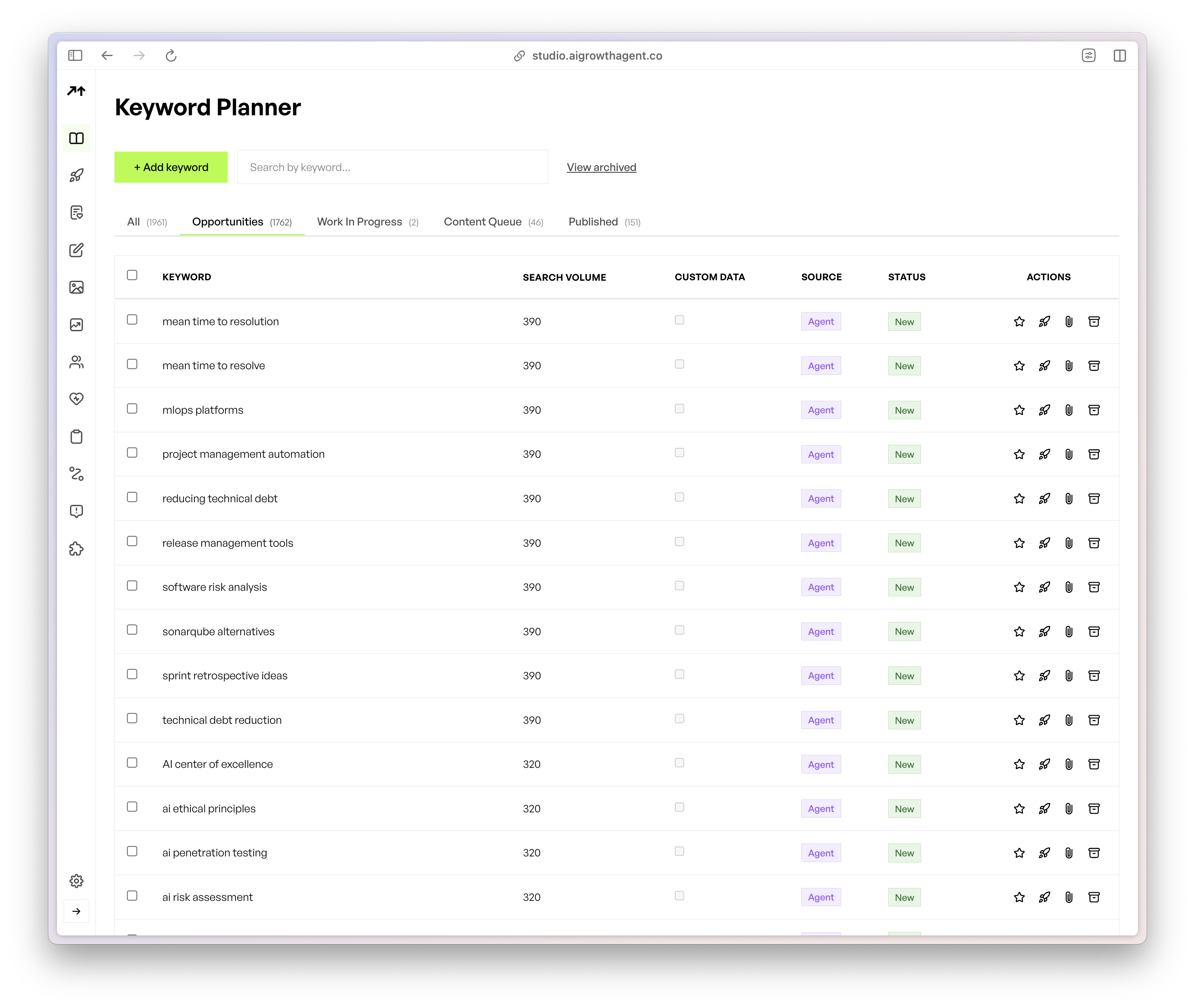
Conduct competitor analysis to identify content gaps where AI search engines lack authoritative sources. Once you identify these gaps, use Google Keyword Planner and ChatGPT to cluster related queries around your core topics. This clustering reveals which gaps justify serious content investment and keeps your roadmap focused instead of scattered.
Create audience personas that include search behavior, content format preferences, and decision-making criteria. AI search engines reward content that directly addresses user intent with specific, actionable information instead of broad overviews.
Step 2: Choose 2026 AI Tools That Match Your Scale
Select tools based on your content volume requirements and technical sophistication. The table below maps each tool to its natural ceiling, which is the point where you hit workflow bottlenecks that require manual workarounds or a platform upgrade.
| Tool | Best For | Free Tier? | Scaling Limit |
|---|---|---|---|
| ChatGPT | Ideation/Drafts | Yes | Manual oversight |
| Jasper | Marketing Copy | Trial | Team collaboration |
| Canva Magic Studio | Visuals/Social | Yes | Basic templates |
| HeyGen | Video | Trial | Global localization |
| AI Growth Agent | pSEO Autonomy | Demo | Unlimited/multi-tenant |
ChatGPT serves as the backbone of many content teams for ideation and first drafts, while Jasper automates marketing pipelines with brand voice consistency. Free tools support early experimentation, and specialized platforms handle programmatic scaling.
Step 3: Use Prompt Templates That Produce Consistent Drafts
Systematic prompt engineering reduces inconsistent outputs and rewrites. Use the framework [Role] + [Task] + [Audience] + [Format] + [Constraints] for repeatable results.
Blog Post Template:
“Act as a content strategist. Create a 1,500-word blog post about [specific topic] for [target audience]. Structure: Introduction with hook, 3-5 main sections with examples, conclusion with CTA. Include statistics, avoid generic openings, maintain [brand voice].”
Social Media Template:
“Act as a social media manager. Create 5 LinkedIn posts about [topic] for [audience]. Format: Hook question, 2-3 bullet points with insights, engagement question. Tone: Professional but conversational. Include relevant hashtags.”
Test prompts across ChatGPT, Claude, and Gemini to identify each platform’s strengths. Teams using systematic prompt engineering report 40-60% time savings on content creation, per erlin.ai’s 2026 guide, while maintaining consistent quality. See how AI Growth Agent automates prompt management across your entire content pipeline.
Step 4: Apply Human Oversight with the 30% Rule
Quality control keeps AI content from sliding into spam territory. The AI draft should contribute less than 30% of the final content’s value, and humans should add the remaining 70% through expertise, examples, and voice.
Human Editing Checklist:
Start by deleting 30-40% of AI filler content to create space for meaningful edits. Then replace third-person with first-person voice to establish clear authority. With the voice updated, add specific examples from direct experience and inject practitioner insights that only a human expert would know. Finally, fact-check claims and add authoritative sources to support your expertise.
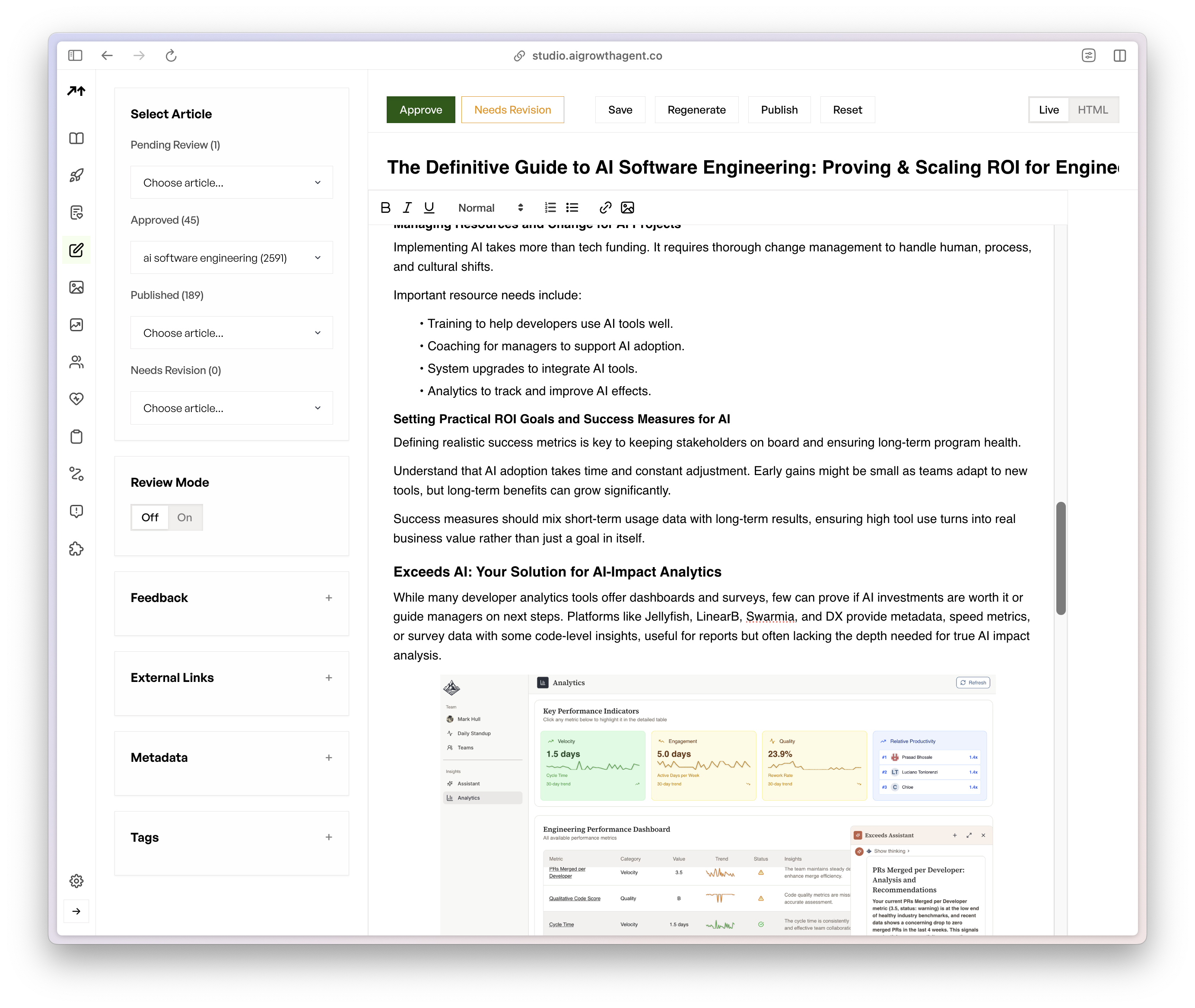
AI-assisted (human-edited) content delivers a +12% productivity gain compared to purely automated approaches. The 30% rule preserves the authority signals discussed earlier.
Step 5: Scale with Programmatic SEO Workflows
Manual editing works for a handful of articles each month, but it breaks when your strategy requires dozens or hundreds. Manual editing becomes the bottleneck at scale, and programmatic SEO solves that constraint.
Programmatic SEO automates research, writing, and technical optimization while maintaining quality through defined processes instead of individual heroics. Autonomous content agents execute the entire lifecycle across strategy development, research synthesis, drafting, fact-checking, and technical SEO implementation. While manual AI workflows increase output incrementally, programmatic systems achieve 10x scaling without proportional team growth.
This transition requires a clear brand manifesto, automated keyword clustering, and technical infrastructure for schema markup and AI search optimization. AI Growth Agent’s programmatic approach removes engineering friction and maintains editorial quality through systematic guardrails.
Step 6: Turn Programmatic Infrastructure into Daily Use Cases
Once you build the programmatic infrastructure in Step 5, you can apply it to specific formats and channels. This step shows how to operationalize those workflows across social media and pillar content strategies.
Social Media Automation: Generate platform-specific content from pillar articles. Convert 2,000-word guides into LinkedIn carousels, Twitter threads, and Instagram captions while keeping core messaging consistent.
Pillar Content Strategy: Create comprehensive authority pieces that act as citation sources for AI search engines. Each pillar supports 10-15 related articles and forms topical clusters that dominate search results.
Real-Time Content Injection: Capture trending topics within minutes by automatically generating brand-aligned perspectives on breaking news or industry developments. This capability enables immediate search volume capture while competitors respond manually.
Step 7: Add Technical Optimization for AI Citations
Programmatic workflows reach full potential only when your technical setup supports AI indexing and citation. AI search engines require specific technical signals for reliable discovery and reuse.
Implement LLM.txt files, Model Context Protocol (MCP) integration, and advanced schema markup to enable direct database communication with AI systems. Multi-tenant programmatic deployment lets portfolio companies or multi-brand organizations scale content across properties from a single interface while each brand keeps a distinct voice and strategy.
Track performance through AI search visibility, citation heatmaps, and crawl statistics from Google, ChatGPT, and Perplexity bots. Watch a live walkthrough of LLM.txt and MCP implementation.
Common Mistakes and Troubleshooting for AI Content Workflows
Generic Prompts: Avoid vague instructions that produce templated content. Specify audience, format, constraints, and success criteria in every prompt.
Missing Schema Implementation: AI search engines prioritize structured data. Implement proper metadata, alt tags, and schema markup for stronger indexing.
No Brand Manifesto: Without clear positioning guidelines, AI tools produce the generic overviews that AI search engines ignore.
Insufficient Human Oversight: Content with 80% AI output and 20% human tweaks gets filtered out because it fails to earn engagement signals.
Verifying Outcomes: Measure AI Visibility and ROI
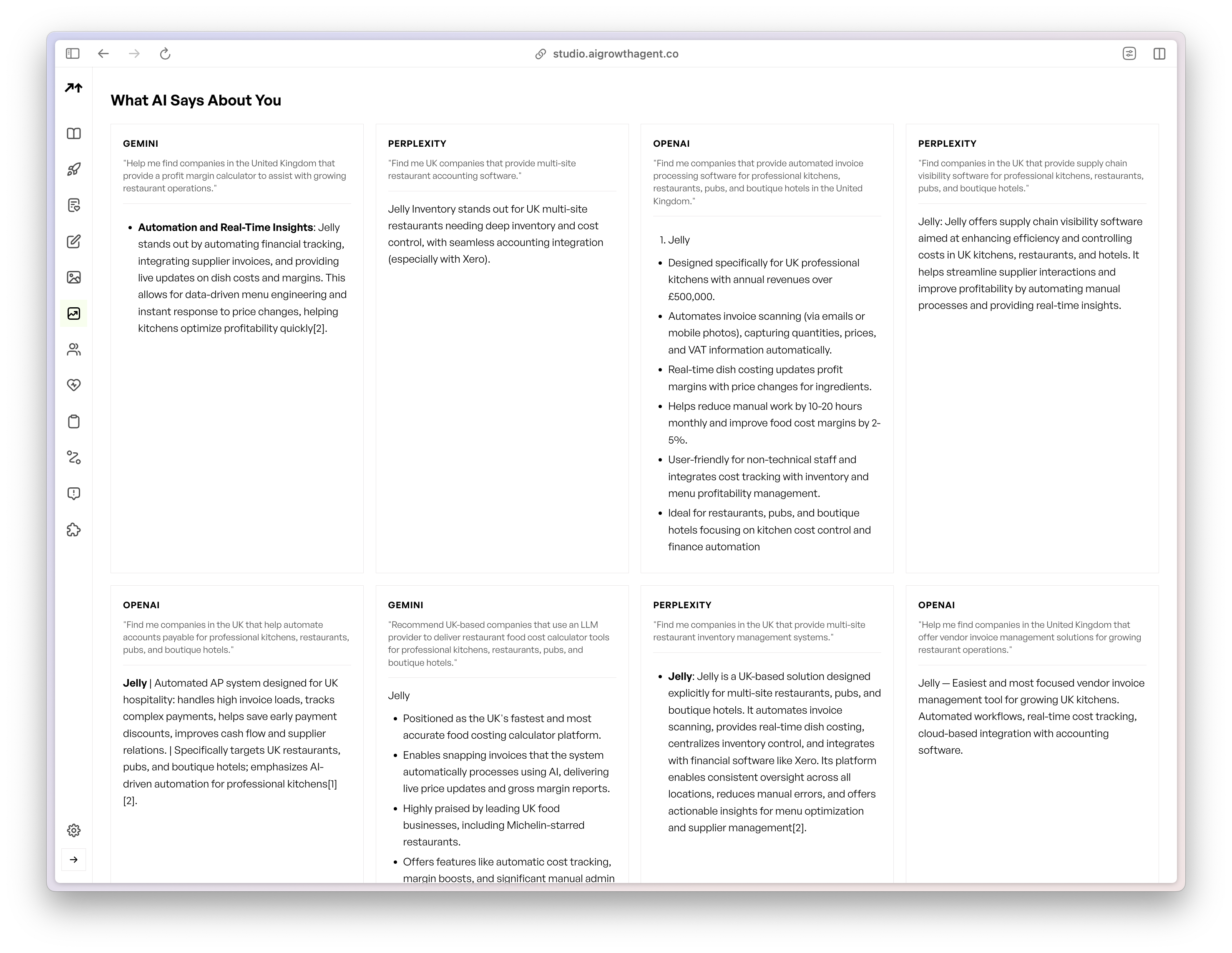
Measurement confirms whether your AI content engine actually builds authority. Track AI search engine citations, brand mentions in ChatGPT responses, and visibility in Google AI Overviews, not only classic SEO metrics.
Key metrics include citation frequency across AI platforms, quote attribution in AI responses, and organic traffic growth from AI-optimized content. 68% of businesses report increased content marketing ROI from AI implementation when they track these AI-specific KPIs.
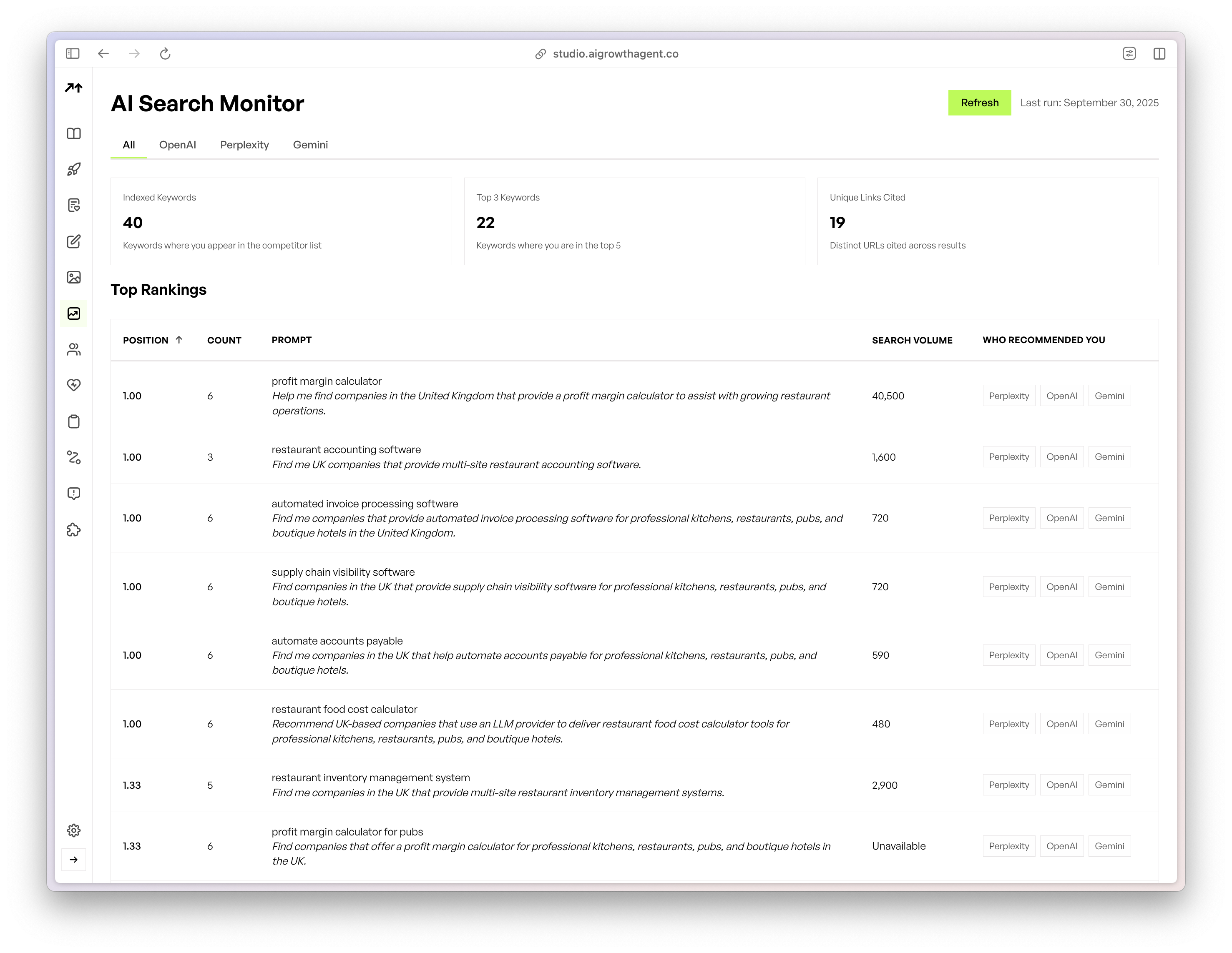
AI Growth Agent Studio provides real-time citation monitoring and performance analytics across brands. Get a personalized ROI analysis based on your current content metrics.
Advanced Scenarios: Multi-Brand pSEO and Data-Driven Content
Enterprise organizations often need multi-tenant programmatic deployment for portfolio scaling. Private equity firms and venture capital portfolios can manage parallel content strategies across portfolio companies from a single interface while each brand maintains its own voice and positioning.
Database-to-content automation unlocks value from proprietary data. Convert internal databases, product catalogs, and customer insights into SEO-focused content that builds category authority and drives AI citations.
Real-time content injection supports immediate responses to trending topics, competitor announcements, and industry developments. This speed and relevance create a durable competitive edge in dynamic markets.
Frequently Asked Questions
What is the 30% rule in AI content generation?
The 30% rule states that AI should contribute less than 30% of the final content’s value through structure and initial drafts. Humans should add the remaining 70% through expertise, specific examples, practitioner insights, personality, and depth. This ratio preserves authority signals and avoids detection as low-quality automated output.
What are the best free AI tools for content generation in 2026?
ChatGPT Free provides strong ideation and drafting capabilities, and Canva Magic Studio supports basic visual content creation. Google Keyword Planner covers keyword research, and WordPress offers free content management. These tools handle early experimentation and small-scale content production well.
How do you scale AI content creation for multiple brands?
Multi-tenant programmatic SEO platforms enable portfolio scaling through parallel content agents, each with a unique brand voice, keyword strategy, and positioning. Central teams manage complex multi-brand strategies while each brand preserves its own identity and market position.
What is the typical timeline to achieve AI search engine citations?
Well-optimized content with proper technical implementation can earn AI citations within 2-3 weeks of publication. Results depend on content authority, schema markup, and technical SEO for AI search engines like ChatGPT, Perplexity, and Google AI Overviews.
How does programmatic SEO differ from tools like Jasper?
Jasper focuses on text generation and marketing copy. Programmatic SEO automates the entire content lifecycle, including research, technical optimization, schema implementation, and publishing. Programmatic systems operate with minimal human intervention, while traditional tools still rely on manual workflow management.
Conclusion: Build Your 2026 Content Mountain
AI content generation now spans from simple text creation to sophisticated programmatic systems that build authority at scale. The 7-step process here moves you from manual prompting to autonomous content engines that dominate AI search results.
Success comes from disciplined execution across strategy, tool selection, prompt templates, human oversight, programmatic scaling, technical optimization, and measurement. Companies that implement these workflows systematically gain durable advantages in AI search visibility.
Autonomous agents like AI Growth Agent prevent digital invisibility by building content mountains that AI search engines cite and recommend. The future belongs to brands that establish programmatic authority before competitors react. Schedule a demo today to shift your content strategy from manual limitation to programmatic dominance.