Written by: Mariana Fonseca, Editorial Team, AI Growth Agent
Key Takeaways
- Google’s Gemini-powered AI Overviews dominate 2026 search results, so programmatic content strategies now drive visibility and AI citations.
- Implement the 7-phase Gemini content lifecycle covering research, planning, creation, SEO, repurposing, publishing, and citation monitoring to scale consistently.
- Gemini outperforms ChatGPT for programmatic workflows through a 1M token context window, Workspace integration, and real-time web access.
- Structure content for AI extraction with Q&A layouts, schema markup, and LLM.txt files, then track ROI through citation frequency and Search Console data.
- Automate the Gemini content lifecycle with AI Growth Agent to cut production time by up to 80% and strengthen category leadership.
Prerequisites for a Gemini-Driven Content Engine
Successful Gemini integration requires three connected foundations that support both manual and automated workflows. You need a Google Workspace account because Gemini’s native integration with Docs, Sheets, and Gmail forms the operational backbone of your content lifecycle. Basic SEO knowledge ensures you can shape Gemini’s output into search-ready assets, while access to Gemini 3.1 Pro or Flash models provides the AI engine that powers research, drafting, and optimization. Advanced implementations benefit from API access for automation, though manual workflows inside Workspace already deliver strong early results.
Strategic inputs give Gemini clear direction so it reflects your brand instead of generic internet patterns. Your company manifesto, target keyword clusters, content calendar, and brand voice guidelines form the core of this guidance. These elements create a consistent narrative, but they only perform when your technical infrastructure supports them. Strong site health matters because technical SEO issues limit even the most insightful content. To improve AI discoverability, LLM.txt files help AI engines understand your content structure and key entities. AI Growth Agent streamlines this setup by ingesting your manifesto during onboarding, then aligning content output with your positioning from day one.
Process Overview: The 7-Phase Gemini Content Lifecycle
Effective Gemini integration follows the systematic seven-phase lifecycle introduced in the key takeaways. Each phase builds on the previous one, so research informs planning, planning guides creation, and downstream phases compound earlier work. This structure turns scattered content efforts into a repeatable system that steadily increases authority and reach.
Programmatic advantage appears when these phases connect through API workflows or specialized agents that handle handoffs automatically. Manual execution of individual phases still delivers meaningful gains, especially for teams starting out. Systematic automation, however, creates the production velocity and consistency required for 2026’s competitive landscape. Want hands-free execution of this entire lifecycle? See AI Growth Agent’s autonomous workflow in action.
Step-by-Step Guide: Applying the 7 Phases with Gemini
The following sections break down each phase of the lifecycle with specific prompts, tools, and implementation guidance. You can run these steps manually to validate the approach, then connect them through APIs or agents once you see results. Each step uses outputs from the previous phase as inputs, so follow the sequence even if you only implement select stages at first.
Step 1: Research & Ideation with Gemini Deep Research
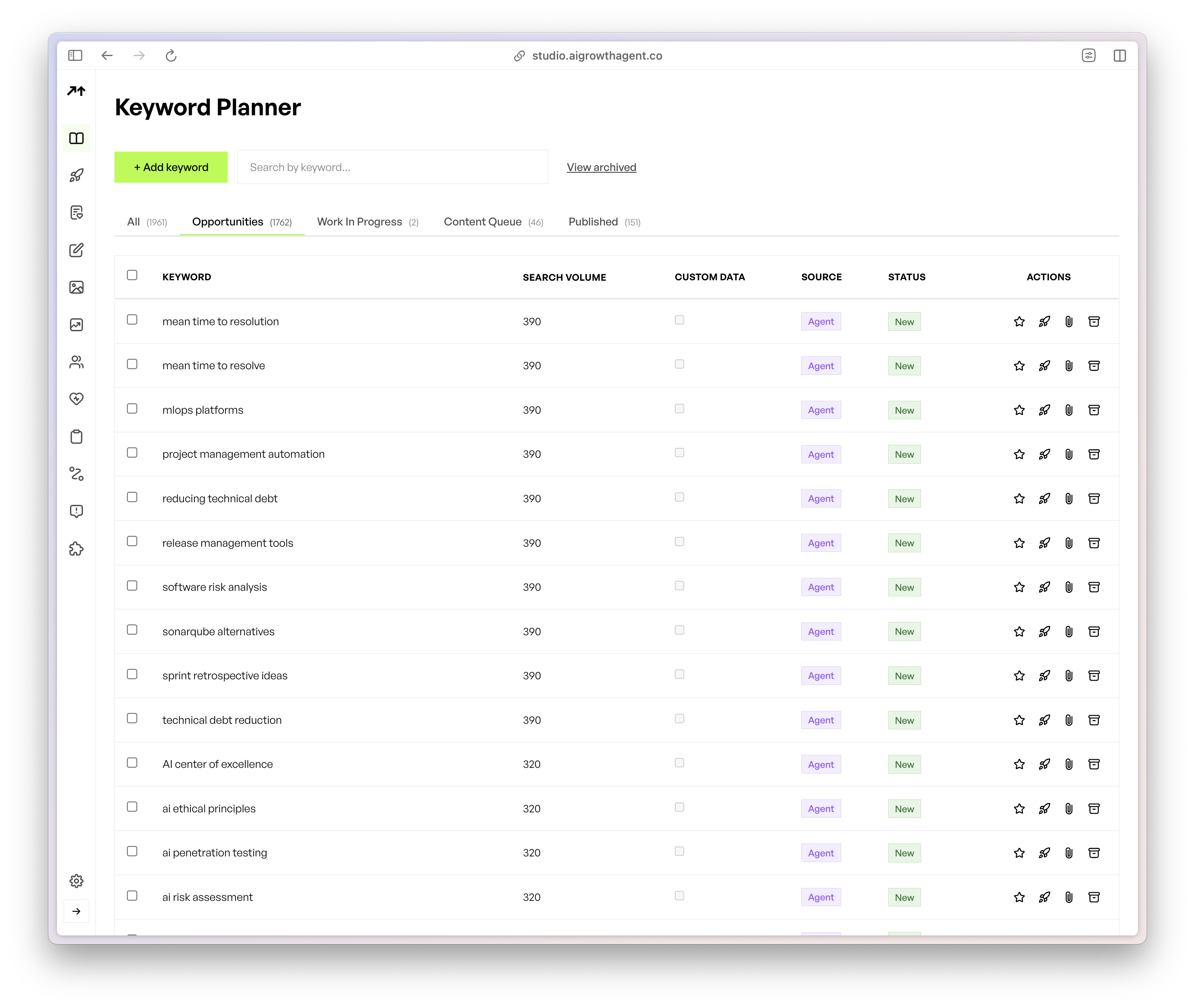
Start by turning broad topics into structured keyword clusters that reveal your content roadmap. Use Gemini 3.1 Flash-Lite’s low-latency processing to generate 100 or more content clusters per research session, which far exceeds manual capacity.
Essential prompts for ideation:
- “Cluster [primary keyword] into 50 long-tail variations incorporating 2026 industry trends and user intent patterns”
- “Analyze competitor content gaps for [topic] and suggest 25 unique angles our brand can own”
- “Generate content ideas that provide ‘information gain’ beyond existing top-ranking articles for [keyword cluster]”
Validate research with grounded, real-time data so your clusters reflect current conversations. Gemini supports real-time web access by integrating Google Search, referred to as “grounding with Google Search,” which is activated on a per-query basis and surfaces live trends and emerging hashtags. Cross-reference these findings with tools like Perplexity for fact-checking and additional perspective.
Step 2: Strategic Content Planning in Google Sheets
Turn your validated research from Step 1 into a structured content calendar that sequences topics over time. Use Gemini in Google Sheets to organize entire spreadsheets from single prompts, so clusters become pillars, supporting articles, and repurposing plans.
Planning prompts:
- “Create a 90-day content calendar targeting [keyword cluster] with pillar posts, supporting articles, and repurposing schedule”
- “Map content topics to buyer journey stages, prioritizing high-intent keywords for [target audience]”
- “Design content architecture that builds topical authority in [industry vertical]”
Step 3: Content Creation at Scale in Google Docs
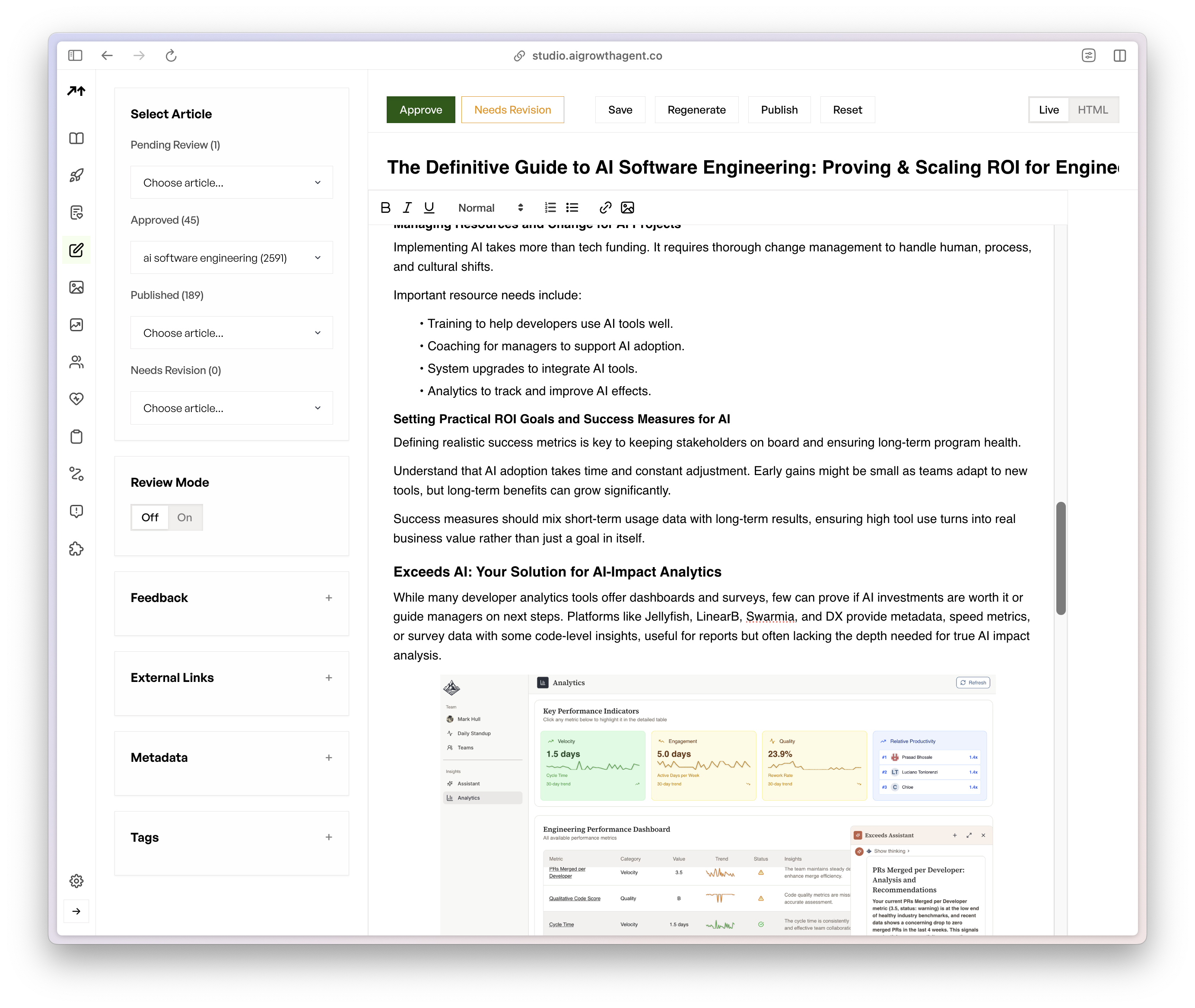
Move from planning to production by drafting articles directly inside Workspace. Gemini in Google Docs generates customized first drafts from natural language prompts drawing from relevant files and emails. This setup keeps your brand voice consistent while you increase output.
Creation prompts:
- “Draft a 2000-word pillar article on [topic] using our brand manifesto tone, incorporating data from [specific sources]”
- “Create supporting articles that link to our pillar content, each targeting specific long-tail keywords”
- “Generate FAQ sections that directly answer questions AI engines commonly surface”
Step 4: SEO Optimization for AI-First Search
Shape each draft so AI systems can easily extract and cite your content. Optimize content for AI extraction by structuring pages in clear Q&A hierarchies, placing main questions in H2 or H3 tags, and answering directly in the first 40-60 words. Add schema markup for FAQ, article, and organization entities to clarify relationships.
Optimization prompts:
- “Restructure this content with clear question-answer hierarchies optimized for AI extraction”
- “Add schema markup suggestions for FAQ and article structured data”
- “Create meta descriptions that increase click-through rates from AI overview snippets”
Step 5: Multi-Format Repurposing with Gemini Media Tools
Extend each successful article into multiple formats so your ideas travel across channels. Use Gemini’s video generation using Veo 3.1 and music creation with Lyria 3 Pro to convert written content into multimedia assets that reach new audiences.
Repurposing prompts:
- “Convert this pillar article into a video script with scene descriptions for Veo 3.1 generation”
- “Create social media variations of key points optimized for LinkedIn, Twitter, and Instagram”
- “Generate podcast episode outlines based on our written content themes”
Step 6: Technical Publishing and Distribution Setup
Prepare each asset for publishing so search engines and AI systems can crawl, understand, and distribute it effectively. Implement technical SEO elements such as LLM.txt files, clean internal linking, and image optimization to support discoverability and user experience.
Publishing optimization tasks follow a logical sequence. First configure automated internal linking between related articles to reinforce topical clusters. Next implement proper heading hierarchies and semantic markup so crawlers understand page structure. Finally optimize images with descriptive alt text and structured data to support accessibility and rich results.
Step 7: Citation Monitoring and Performance Analysis
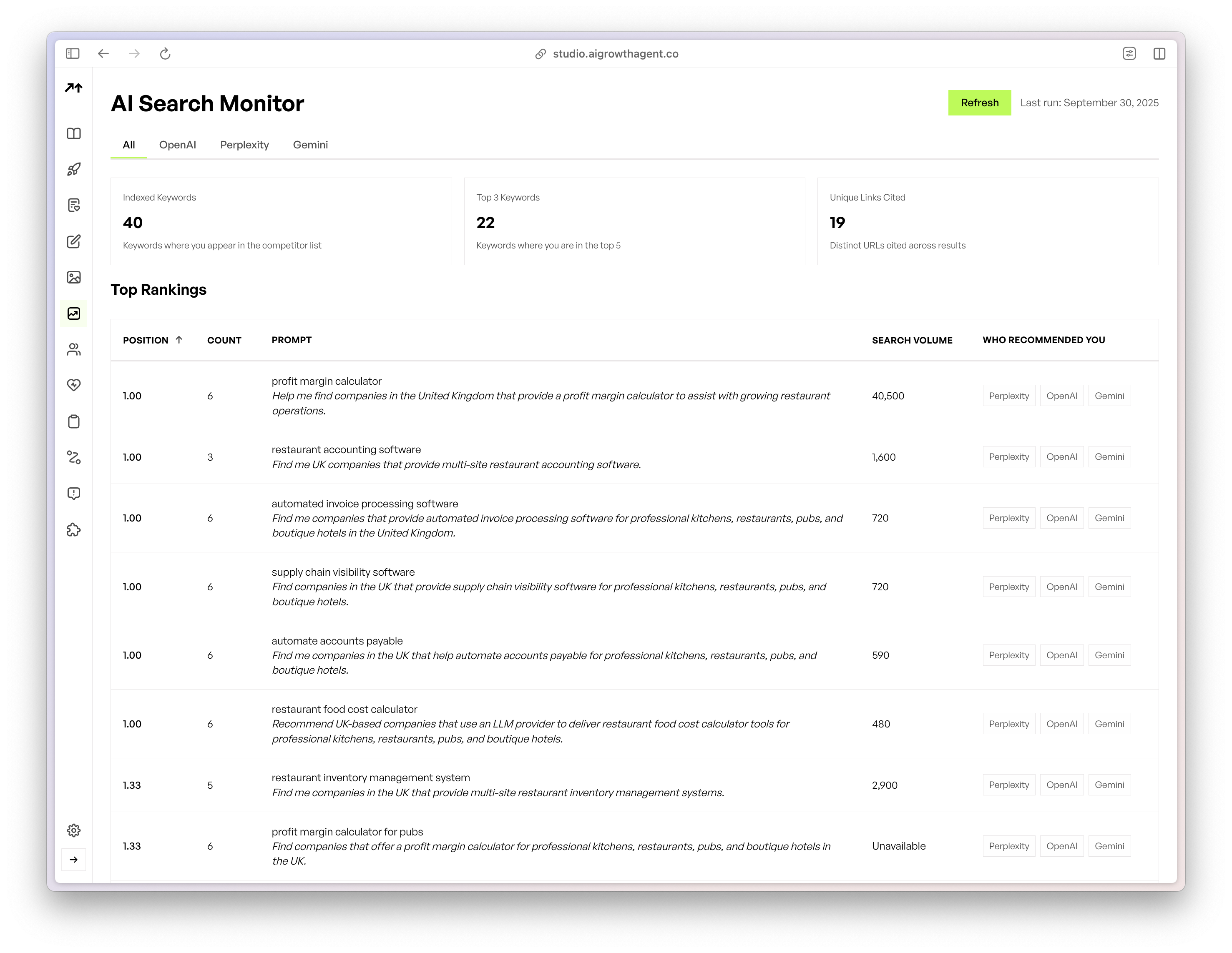
Treat publishing as the trigger for a continuous feedback loop rather than the final step. Track how your content performs in AI search results so insights from this phase refine research, planning, and creation in the next cycle. Brand impressions in AI agent summaries serve as the primary conversion metric where entity authority determines citations, so monitoring these signals becomes central to your strategy.
Monitor key metrics including Google Search Console indexing rates, AI citation frequency, and traffic growth from AI-powered search features. Weekly analysis reveals which topics, formats, and structures attract the most citations, then feeds those patterns back into Step 1 and Step 2. Need comprehensive citation tracking and performance analysis? See how AI Growth Agent monitors citations in real time.
Gemini vs ChatGPT: Strategic Advantages for Content Marketing
When choosing between Gemini and ChatGPT for programmatic content workflows, four capabilities matter most. Context window size controls how much material each model can consider at once. Workspace integration determines how smoothly AI fits into daily tools. Real-time web access affects freshness and relevance. The comparison below shows how each platform performs on these dimensions.
| Feature | Google Gemini | ChatGPT |
|---|---|---|
| Context Window | 1 million tokens | ChatGPT’s GPT-5.3 Instant has a 32K token context window for Plus and Business tiers |
| Workspace Integration | Native integration | ChatGPT has integration with Google Drive, a Google Workspace tool, via Apps |
| Real-time Web Access | Google Gemini’s real-time web access via Deep Research is available at no cost a few times a month to free users | ChatGPT real-time web access is available to free users with stricter restrictions and usage limits |
Google Gemini excels in speed, productivity, and handling large context windows, which suits high-volume, programmatic content workflows. ChatGPT often delivers stronger creativity for individual pieces, while Gemini’s structural advantages support teams that need scale, consistency, and tight integration with existing tools. Gemini’s API pricing is generally lower across comparable model tiers, which helps control costs for high-volume workflows, although specific rates still vary by model and usage tier.
Common Mistakes and How AI Growth Agent Helps
Many teams rely on generic prompts that produce commodity content, which weakens differentiation and authority. Stronger results come from weaving your brand manifesto, positioning, and audience insights into every prompt so Gemini reflects your unique perspective. Teams also skip schema markup and LLM.txt implementation, which quietly limits AI discoverability even when content quality is high.
Manual scaling represents the biggest strategic error because individual article optimization cannot generate the volume needed to compete with systematic programmatic approaches. This velocity gap makes measurement frameworks essential from the start, since content without performance tracking cannot reveal which efforts deserve more investment. AI Growth Agent addresses these challenges through automated citation tracking, real-time performance monitoring, and systematic quality control that learns from your feedback patterns.
Verifying Outcomes: Metrics for ROI Proof
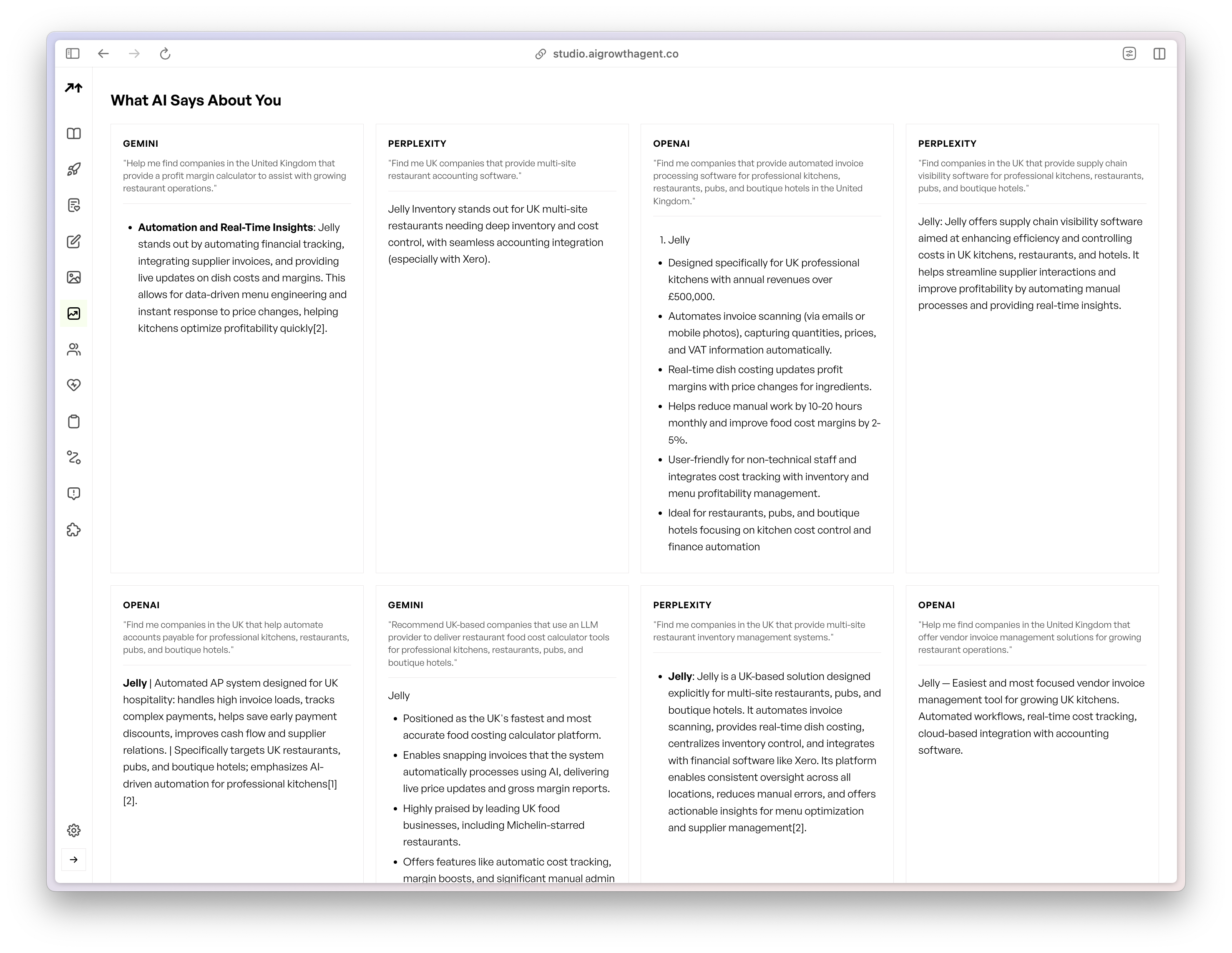
Measure success through Google Search Console indexing rates, AI citation frequency, and organic traffic growth. Princeton and Georgia Tech research found that structured, GEO-focused content can increase AI visibility by up to 40%, which highlights the value of disciplined formatting.
Weekly analysis supports rapid iteration and smarter resource allocation. Track which content formats and topics generate the most AI citations, then expand those winning patterns. Monitor competitor citation rates to uncover content gaps and opportunities where your brand can become the default reference. Want to prove ROI with comprehensive analytics? Explore our advanced measurement dashboard.
Advanced Scenarios and Next Steps for Scaling
Advanced implementations extend the same seven-phase lifecycle across more complex environments. Multi-tenant deployments support portfolio companies that share infrastructure but require distinct brand voices and reporting. Real-time content injection based on trending topics keeps evergreen assets updated with fresh examples and data. Database-to-content automation converts proprietary datasets into structured articles, dashboards, and landing pages that compound SEO value.
Next steps involve deeper Gemini SEO integration, refined content manifestos, and systematic authority building across your category. Teams that operationalize these systems early create durable advantages in AI citations, search visibility, and content velocity. Premium brands secure their position through systematic content dominance. See how AI Growth Agent automates this entire lifecycle.
Frequently Asked Questions
How do I use Google Gemini effectively for marketing?
Use the seven-phase lifecycle as your operating system rather than focusing on isolated content pieces. Start with research and planning, then move through creation, SEO optimization, repurposing, publishing, and citation monitoring. Gemini’s Workspace integration streamlines collaboration and helps maintain brand consistency across every asset.
What are the best Google Gemini prompts for content strategy?
Effective prompts combine your brand manifesto, clear objectives, and audience details. For research, use “Cluster [keyword] into 50 long-tail variations with 2026 trends.” For creation, try “Draft pillar content using our brand voice, targeting [specific audience pain point].” For optimization, ask “Restructure with Q&A hierarchies for AI extraction.” Always include context about your industry and target audience.
Is Google Gemini better than ChatGPT for content creation?
Gemini excels in systematic content workflows because of its Workspace integration, real-time web access, and larger context window. ChatGPT often provides stronger creativity for individual, one-off pieces. For scalable strategies that prioritize speed, integration, and consistency, Gemini offers clear advantages. For highly creative single assets, ChatGPT may still be the better fit.
How can I measure ROI from Google Gemini content integration?
Track Google Search Console indexing rates, AI citation frequency across ChatGPT, Gemini, and Perplexity, organic traffic growth, and increases in brand mentions within AI responses. Review performance weekly, then iterate based on the formats and topics that drive the strongest results. Establish baseline metrics before implementation so improvements remain clear and credible.
What technical requirements do I need for programmatic Gemini workflows?
Basic implementation requires Google Workspace access and Gemini API keys. Advanced workflows benefit from schema markup, LLM.txt files, and automated publishing systems that connect CMS, analytics, and AI tools. Strong technical SEO health acts as a prerequisite because content quality cannot overcome fundamental site issues. Most teams gain speed and reliability by using specialized programmatic SEO platforms instead of building custom stacks from scratch.
Conclusion: Dominate 2026 with Gemini-Powered Programmatic SEO
The seven-phase Gemini lifecycle turns content marketing into a repeatable system for authority building. Brands that adopt this structure gain compound advantages through consistent AI citations, stronger search visibility, and faster content production.
Quarterly strategy reviews keep your workflows aligned with evolving AI search behavior and platform updates. The window for establishing category authority remains open, yet it narrows as more competitors adopt similar systems. Premium brands act now to secure their position through systematic content dominance. Request an AI Growth Agent demo to see the full workflow in practice.