Written by: Mariana Fonseca, Editorial Team, AI Growth Agent
Key Takeaways
- Perplexity AI agent-based marketing and SEO systems map your full search universe, create authoritative content, and self-heal to keep your brand visible across AI-powered platforms.
- Traditional search keeps shrinking as AI chatbots and virtual agents grow, with 58-60% of Google searches ending in zero-clicks by late 2025.
- Successful deployments depend on unlimited prompt tracking, brand-grounded content, centralized data, clear asset ownership, and incremental visibility measurement.
- Autonomous engines replace fragmented tools with one workflow that can produce 12,000+ AI citations, 100,000+ bot visits, and 20%+ impression lift in 12 weeks.
- Ready to replace a scattered SEO stack with one autonomous engine? Book a visibility strategy review with AI Growth Agent to see if systematic growth fits your team.
What Perplexity AI Agents Are and Why They Matter
Perplexity AI agents act as always-on assistants that research, write, and update content based on live search behavior. They connect brand documentation, search data, and publishing systems so your content stays current and citation-ready for AI platforms.
The discovery landscape has shifted from reactive SEO to proactive AI-mediated search. AI search became mainstream behavior by 2026, with ChatGPT reaching 800 million weekly active users and processing at least 2.5 billion messages daily by October 2025. At the same time, Gartner projected a 25% drop in traditional search engine volume by 2026 as spend shifts to AI chatbots and virtual agents.
The economics are stark. By the end of 2025, 58-60% of all Google searches and 77% of mobile searches resulted in zero-clicks, with Google’s AI Overviews driving much of the decline in organic click-through rates. This creates a counterintuitive reality: fewer users click through, yet AI-driven referrals convert better than traditional organic traffic.
This shift creates a clear paradox. Click volume drops, but engagement quality rises for brands that appear in AI answers. Brands cited in AI responses capture pre-qualified visitors, while brands missing from AI citations lose that demand entirely. Only 27% of marketers consistently track whether their brand appears in AI-generated answers, so most teams fly blind.
Agent-based systems give you a structured way to win these AI answers at scale. Request an AI visibility audit to see how your brand currently appears across AI search.
Core Concepts for Agent-Based SEO
Search Universe: The complete map of seed terms and long-tail queries where your brand should appear, refreshed weekly from live search data instead of static keyword lists.
Seed Terms: Primary topics that define your market position. Most brands work with 9-15 core concepts that expand into hundreds of specific queries and prompts.
Long-tail Prompts: Natural language questions users ask AI systems. These prompts are longer and more conversational than classic keyword searches.
Incremental Visibility: Measurable lift in citations, mentions, and traffic that comes specifically from new content, separated from your existing baseline.
Living Content: Articles that update automatically with fresh data, current sources, and improved structure so authority grows instead of decaying.
Self-healing Systems: Autonomous engines that detect ranking or citation drops, diagnose causes, generate fixes, and apply updates without manual tickets.
Ready to see your full search universe instead of a short keyword list? Book a search universe mapping session to uncover missed demand.
Perplexity Ecosystem Shifts and Agent Limits
The Perplexity AI ecosystem has advanced quickly through 2026. Deep Research now reaches state-of-the-art performance on benchmarks like Google DeepMind Deep Search QA and Scale AI Research Rubric. Model Council lets users run three frontier models in parallel, compare outputs, and receive a synthesized review.
Enterprise controls also improved. Administrators can set granular feature access, restrict sign-ups to verified domains, and share usage guidelines. These features help governance, yet they do not solve the hardest problem: scaling consistent, brand-grounded content production across hundreds of topics.
The market around Perplexity has fragmented. Some teams rely on monitoring tools that track a narrow set of prompts. Others run DIY workflows that drift in quality over time. Many still use traditional agencies that remain slow and expensive. A growing number of enterprises run autonomous agents in production, yet 76% of AI agent implementations experienced critical failures within 90 days, and 43% were abandoned after six months.
These failures reflect a deeper shift. Search discovery no longer starts with Google alone. Users begin research in AI Overviews, Bing Copilot, ChatGPT Search, Gemini, TikTok, Amazon, YouTube, and other platforms, so brands need systems that coordinate visibility across all of them.
Autonomous engines address this fragmentation by unifying research, content, and measurement in one workflow. Join a unified visibility walkthrough to compare this model with your current stack.
How Main SEO Approaches Compare
Given this fragmented landscape, brands must choose how they will handle AI visibility. The table below shows how common approaches perform across the core dimensions that matter for agent-era SEO.
| Approach | DIY Perplexity Workflows | GEO Monitors | Traditional SEO Agencies | Autonomous Engines |
|---|---|---|---|---|
| Setup Time | Hours per article | Days to weeks | Months through engineering backlogs | 1 week to first article |
| Content Quality | Quality drifts from one output to the next | No content production | Inconsistent, junior-staffed | Brand-grounded, validated |
| Search Universe Coverage | Manual keyword selection | Capped prompts clients already thought to ask about | Limited scope | 1,500+ queries, refreshed weekly |
| Measurement | No systematic tracking | Monitoring only | Basic rank reporting | Incremental visibility across 4 data pillars |
| Ownership | Client owns content | Client owns data | Agency controls site | Client owns blog and content |
| Maintenance | Manual updates required | No content updates | Dependency on agency | Self-healing, automatic |
This comparison shows why autonomous engines often outperform other options. They handle the full workflow instead of one isolated step, which reduces failure points and compounds results.
Want to benchmark your current setup against this model? Book a 30-minute stack comparison to identify gaps and overlaps.
Key Factors When Choosing an AI SEO Approach
Team Capacity: Human judgment on brand voice, audience empathy, editorial choices, and creative positioning remains irreplaceable. Choose an approach that lets your team focus on strategy while agents handle execution.
Prompt Limits: Many monitoring tools cap tracked prompts and charge for expansion. Overreliance on one-click Auto-Optimize without human review creates risk when authority depends on content quality. Favor unlimited prompt tracking so you see the full market.
Data Freshness: SE Ranking’s 2025 AI Mode volatility test found that over 60% of domains and 80% of URLs disappear from responses between runs. Systems need frequent refresh cycles to keep your brand present.
Content Ownership: Many SEO agencies deliver recommendations but avoid enterprise delivery constraints. Confirm that you own the blog, content, and data infrastructure so you can switch vendors without losing assets.
Scalability Requirements: Agentic SEO workflows cut production time from 8-16 hours per article to about 30 minutes. Match your approach to your volume needs and publishing cadence.
Integration Complexity: Bot protection rules in CDNs and WAFs can block legitimate AI agents such as Google-Agent. Review technical requirements early to avoid hidden launch delays.
Need help translating these factors into a concrete plan? Request a requirements and risk review tailored to your stack.
7-Step Roadmap for Launching an Agent-Based SEO System
1. Brand Interview and Documentation: Start with a structured interview with leadership to capture positioning, differentiators, proof points, and market context. This material becomes the factual and tonal foundation for every future article.
2. Company Manifesto Development: Turn interview insights into AI-ready documentation that defines voice, claims, and messaging boundaries. The manifesto gives agents a single source of truth so content stays consistent.
3. Content Topology Mapping: Use the manifesto to map how your audience searches. Connect each real user search to its underlying question and intent. From there, define 9-15 seed terms and expand them into 300-400 initial prompts.
4. Content Production Setup: Configure multi-agent orchestration for research, validation, drafting, and on-page SEO. Tools like Frase score content for SEO and GEO criteria such as entity density, fact density, inline citations, and citation readiness.
5. Blog Infrastructure and Publishing: Launch an optimized WordPress environment with structured data schemas, a clean sitemap, and correct robots.txt. This setup makes it easy for both traditional crawlers and AI agents to access your content.

6. Weekly Measurement Implementation: Deploy tracking across four data pillars: Search Intelligence, AI Analytics, Bot Tracking, and AI Ranking. Weekly reporting shows how new content changes visibility across each pillar.
7. Ongoing Self-Healing Activation: Enable autonomous recovery workflows that detect ranking or AI citation drops, diagnose causes, and apply fixes automatically. These loops protect and grow authority over time.
Want a roadmap tailored to your resources and timelines? Book a custom implementation planning session with the AI Growth Agent team.
Ongoing Management and Measurement
Sustainable autonomous SEO depends on centralized data rather than scattered tools. Without this centralization, most organizations juggle one tool for SERP and rank, another for AI-answer monitoring, a third for crawler logs, plus Google Search Console off to the side, which creates exactly the fragmentation that blocks clear decisions.
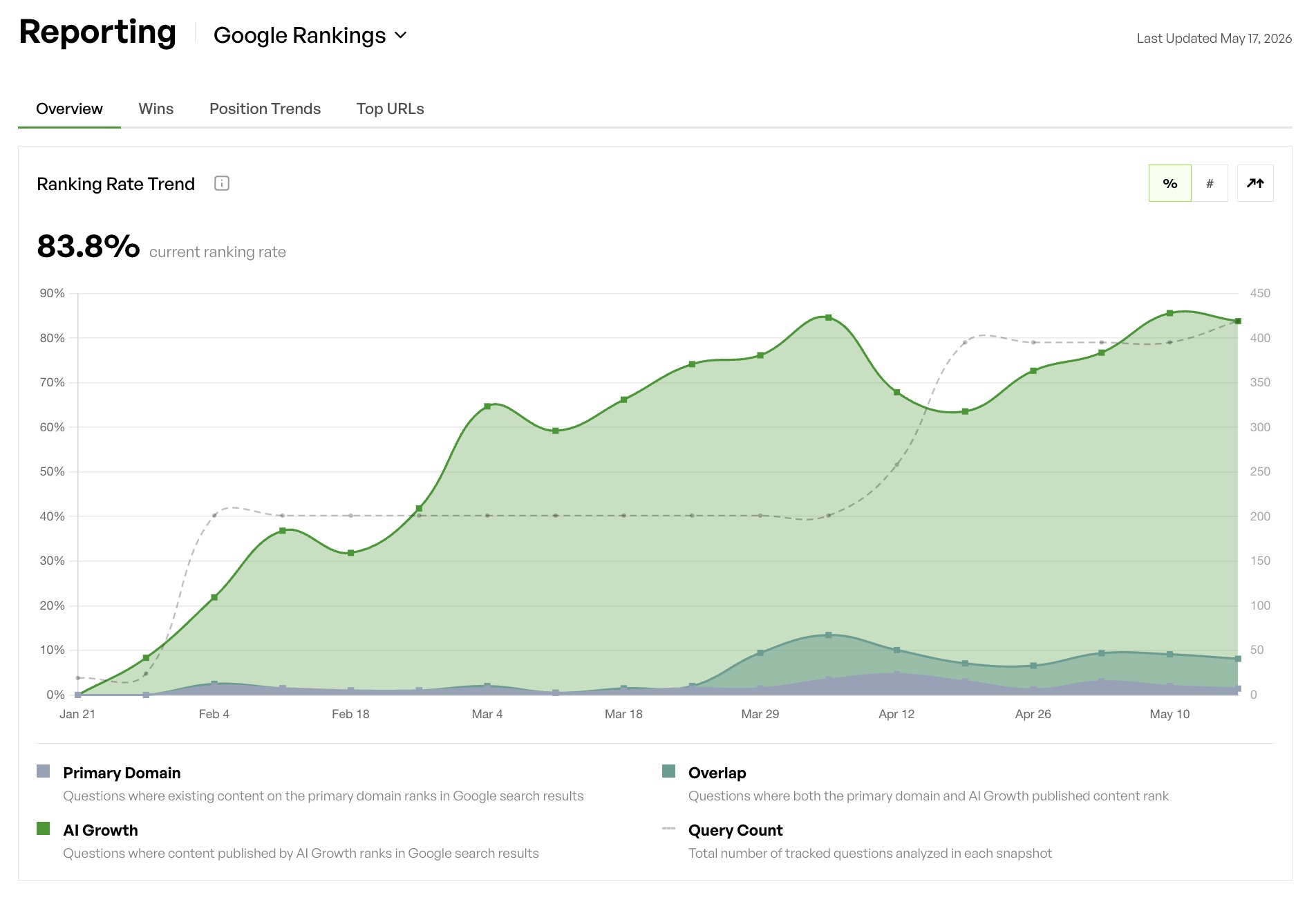
Search Intelligence: Traditional search landscape analysis that treats positioning and competition as a full market picture, not isolated metrics. Some systems run more than 3,000 searches a week just to keep the universe snapshot current.
AI Analytics: Tracking of brand value and user behavior across the journey, from external AI touchpoints through on-site content consumption and demographics.
Bot Tracking: Monitoring of traditional SEO crawlers and AI training agents. Google-Agent, a user-triggered fetcher distinct from Googlebot, entered Google’s official documentation on March 20, 2026, which highlights how fast the bot ecosystem evolves.
AI Ranking: Measurement of order of mention and citation context in AI-generated answers across platforms. This metric becomes the new “rank” for AI search.
Typical programs achieve 12,000+ AI citations, 100,000+ bot visits, and 20%+ impression lift in 12 weeks. AI-referred visitors usually spend more time on site and convert at higher rates than visitors from classic organic search.
To see how centralized measurement would change your reporting, request a measurement architecture review focused on your current data stack.
Risks, Limitations, and Common Mistakes
Prompt Caps and Billing Models: Many monitoring tools charge per prompt and limit tracked queries. These models stop at a capped set of prompts the client already thought to ask about, which hides real demand.
Content Decay: Most content loses rankings within 12 months, and AI citations often decay after about 13 weeks without updates. Static content strategies cannot keep up with this pace.
Brand Voice Drift: Output quality degrades when teams skip documentation and memory systems. Over time, articles feel less on-brand and harder to approve.
Fragmented Tooling: Turning fragmented tools into a decision-ready system becomes its own engineering project. Point solutions increase integration overhead.
Technical Infrastructure Gaps: About 40% of pricing and signup page changes occur between midnight and 8 AM UTC. Agents that browse during those windows often hit broken flows if monitoring is weak.
Measurement Confusion: Many teams measure only productivity gains and ignore SEO impact. Effective programs focus on incremental visibility and clear attribution.
Reduce these risks with structured support. Book a risk and readiness consultation before scaling agents across your stack.
Summary and Decision Support
Perplexity AI agent-based marketing and SEO systems work best when they orchestrate full workflows instead of acting as isolated tools. The market now favors autonomous engines that map search universes, publish authoritative content, and keep that content updated automatically.
Strong programs share a few traits. They use unlimited prompt tracking, brand-grounded content production, centralized data infrastructure, clear asset ownership, and incremental visibility measurement. When these pieces align, agent deployments can generate meaningful ROI with predictable reporting.
Your choice between fragmented tools and autonomous engines determines whether you only observe search shifts or actively shape them. In a landscape where three-quarters of a trillion dollars in US revenue will flow through AI-powered search by 2028 (as noted earlier), systematic visibility becomes a requirement, not a side project.
If you want to move from experiments to a durable system, request a custom AI visibility roadmap aligned with your goals and constraints.
Frequently Asked Questions
What makes agent-based SEO different from traditional SEO tools?
Agent-based SEO systems manage the entire workflow from brand positioning through content production to measurement. Traditional tools provide isolated data or recommendations. They show keyword rankings or competitor analysis, but you still need separate teams for content creation, technical implementation, and ongoing updates.
Agent-based systems automate this pipeline. They produce brand-grounded content, publish it with full technical SEO, and measure incremental results across multiple visibility channels. The difference is clear: you move from receiving reports about your market position to running a system that actively improves that position.
How do autonomous engines maintain content quality at scale?
Autonomous engines rely on layered validation that standalone chatbots cannot match. They begin with comprehensive brand documentation that guides every article. Research agents then validate claims and sources against live web data instead of relying only on training data.
Memory systems store feedback and style preferences so improvements compound over time. Content also passes through continuous refresh cycles, where articles update with new data and structure to protect authority. Self-healing workflows detect quality or ranking issues and trigger targeted fixes automatically.
What specific results can enterprises expect from agent-based SEO implementations?
Enterprise programs usually see measurable gains across four areas within 12 weeks. Bot traffic often increases by 100,000+ visits as AI training agents discover and crawl new content. AI citations and mentions can grow by 12,000+ instances across platforms such as ChatGPT, Perplexity, and Google AI Overviews.
Traditional search impressions frequently lift by 20% or more as topical authority builds. Traffic quality also improves, because AI-referred visitors tend to spend more time on site and convert at higher rates than visitors from standard organic search. These gains compound as the content ecosystem expands.
How do enterprises measure incremental value versus existing brand visibility?
Incremental measurement starts by separating new content from your current site. Many teams publish to a dedicated blog environment connected through reverse proxy or subdomain, then track visibility gains tied specifically to that environment.
Measurement spans four data pillars. Search Intelligence tracks ranking improvements. AI Analytics measures brand mentions across AI platforms. Bot Tracking monitors crawler activity on new content. AI Ranking tracks citation order in AI-generated answers. Weekly reports separate primary domain performance from autonomous engine contributions, while tools like Google Search Console verify impression and click gains.
What are the main implementation risks and how can they be mitigated?
The main risks include brand voice drift, technical conflicts, and unclear measurement. Brand voice drift appears when teams skip documentation and memory systems, which leads to off-brand content. Mitigation requires a detailed brand manifesto and feedback loops that store corrections as durable memories.
Technical risks involve bot protection rules that block legitimate AI agents or broken page structures that agents cannot navigate. These issues call for careful robots.txt configuration, structured data, and monitoring of critical flows. Measurement confusion arises when teams track only productivity and ignore SEO impact. Success depends on focusing on incremental visibility metrics and clear attribution between autonomous engine output and existing brand performance.