Written by: Mariana Fonseca, Editorial Team, AI Growth Agent
Key Takeaways for AI Citation Keyword Research
- Keyword research for AI citations maps every audience query and prompt directed at AI systems, then pairs those prompts with validated, primary-source-backed content that earns direct mentions and citations inside AI answers.
- Traditional keyword tools track only a capped set of prompts and assume high rankings guarantee citations, yet AI Overview citations from top-10 pages have dropped sharply and many citations now come from outside the top 100.
- The six-step process starts with a Company Manifesto interview to capture brand positioning, then builds a living Content Topology Map refreshed weekly from thousands of real-time searches across Google, ChatGPT, Reddit, and People Also Ask boxes.
- Every claim is validated against live primary sources, full technical SEO (schema, MCP endpoints, robots.txt) is applied automatically, and content is published as self-healing articles that update continuously to protect and grow authority.
- Incremental visibility is measured with a four-pillar data infrastructure that isolates AI Growth Agent results. Schedule a demo with AI Growth Agent to map your full search universe and start winning citations at scale.
Why Traditional Keyword Tools and Monitoring Platforms Fall Behind AI Search
Traditional tools fail at a structural level because they were built for a world where ranking position determined visibility. That world is disappearing fast. AI-sourced website sessions grew 527% year-over-year from early 2024 to early 2025, and a McKinsey survey found that many AI-powered search users name it their primary source of insight, ahead of traditional search. The leaderboard now shifts based on AI answers, not just blue links.
Traditional tools cap the number of prompts a client can track, require the client to self-select those prompts, and return a dashboard instead of actions. This design assumes that ranking position still determines visibility, yet that assumption has collapsed. AI Overview citations from top-10 ranking pages dropped from 76% to 38%. An Ahrefs study of 863,000 keywords found that 38% of AI Overview citations come from pages ranking in Google's top 10, with 31% ranking outside the top 100. When rank no longer guarantees citations, monitoring a capped slice of prompts the brand already thought to ask about leaves most of the conversation uncontested.
The alternative is not a better dashboard. It is an autonomous engine that maps the entire universe and wins it. That engine starts with a foundation most tools skip entirely: a deep understanding of what makes your brand different.
Step 1: Capture Your Brand Narrative with the Company Manifesto Interview
Goal: Capture the brand's unique positioning, product features, market context, and narrative in a single authoritative document that every subsequent content decision references.
Required inputs: A one-hour interview with a professional journalist, plus any unstructured brand material such as written guidelines, marketing and sales PDFs, product pages, and legal disclaimers.
Sequence of actions: The journalist-led interview extracts the brand's differentiated claims at the feature level. These claims are then cross-referenced against all unstructured material to confirm consistency and uncover gaps. The engine then synthesizes the interview transcript and validated source documents into a structured document optimized for AI indexation, creating a single authoritative reference for all future content.
Validation checkpoint: The client reviews the finished document and approves it before any content is produced. Every future article is checked against this document to prevent hallucination or dissonant claims from external sources.
Exact output: The Company Manifesto, a brand-approved, AI-optimized foundation document that serves as the single source of truth for all content generation at scale. This is the layer a DIY chatbot cannot replicate because output quality depends on the depth and accuracy of the context behind it.
Step 2: Build a Live Content Topology Map from Real Prompts
Goal: Produce a complete portrait of the brand's search universe, covering every seed term and the long-tail conversational prompts beneath it, refreshed weekly from live data.
Required inputs: The Company Manifesto, real-time Google and ChatGPT results, Reddit threads, People Also Ask boxes, and competitor content signals.
Sequence of actions: The engine derives 9–15 seed terms from the Company Manifesto so the map reflects the brand's actual positioning. Beneath each seed term, research agents pull real-time conversational prompts from Google, ChatGPT, Reddit, and People Also Ask boxes. The system runs more than 3,000 searches per week to keep the universe snapshot current. Each prompt is analyzed for content structure, forum discussion, and differentiation opportunity so the brand can see where it can realistically win.
Validation checkpoint: Prompt count is never capped or billed as a metric. The client can leave term selection on autopilot or direct it based on current positioning strategy. This uncapped approach matters because Google processes billions of queries daily, and 15% of daily searches are entirely new queries that have never been searched before. A capped prompt list cannot adapt to this constant emergence of new demand, while a weekly refresh of thousands of live searches can.
Exact output: A Content Topology Map starting at 300–400 prompts and expanding to 1,500+ queries for mature clients, refreshed every week. The map identifies the specific questions and intent behind each real user search, not just the keyword itself, so the brand focuses on highly specific, winnable spaces instead of fighting for generic terms it cannot own.
Step 3: Validate Every Claim Against Live Primary Sources
Goal: Ensure every factual claim, statistic, quote, and source in every article is verified against live primary evidence before publication, not against a model's training data.
Required inputs: The Company Manifesto, the brand's approved primary-source links, the real-time search results for each specific prompt, and any client-configured memories, disclaimers, or blocked links.
Sequence of actions: Before a single word is written for a given article, research agents are deployed across the web for that prompt. They analyze current Google and ChatGPT results, competitor signals, winning titles, People Also Ask boxes, and forum discussions. A cascade of anti-hallucination checks validates every claim and source against live research, and authoritative outbound links are sourced automatically. The engine saves memories so client feedback is applied once and never lost.
Validation checkpoint: The Princeton GEO study found that keyword stuffing reduces visibility by 10% versus the unoptimized baseline on Perplexity. Every article must meet that evidentiary standard before it ships. Quantitative claims can receive higher citation rates than qualitative statements, so every article is built around validated, citable facts.
Exact output: A validated article in which every claim is backed by a live primary source, every outbound link is approved, and every brand-specific disclaimer and legal requirement is applied. This is the type of content AI systems trust enough to cite.
Step 4: Deploy a Complete Technical SEO and AI-Readiness Layer
Goal: Make every published article machine-readable, crawlable, and citable by the full range of AI systems, without requiring any technical work from the client.
Required inputs: The validated article, the client's domain configuration (Cloudflare, Vercel, or any other host), and the client's product features, target audiences, and approved reviews for schema generation.
Sequence of actions: AI Growth Agent's WordPress plugin is provisioned automatically and connected to the client's domain through a reverse proxy rewrite under a subdirectory or subdomain. The system then applies full schema coverage, including Article, FAQ, LocalBusiness, Organization, Review, Product, Author, and SoftwareApplication schemas. MCP endpoints such as Blog MCP and Web MCP are configured, along with an advanced robots.txt, a proper sitemap.xml, and automatic web stories. Bot traffic tracking is activated so crawlers and AI agents can be identified and logged.
Validation checkpoint: Pages using multiple schema types are more likely to be cited. Pages combining Article, BreadcrumbList, and Organization structured data can achieve higher AI citation rates than pages with single or no schema markup. Every article must clear this technical bar before publication.
Exact output: A fully configured, branded blog property live within one week of kickoff, owned outright by the client, with no agency dependency and no technical requirements on the client's side. The existing site structure remains unchanged.
Step 5: Publish a Self-Healing Content Library That Compounds Authority
Goal: Ensure that authority compounds over time rather than decaying by keeping every article current with the brand's evolving narrative and the market's evolving search behavior.
Required inputs: The published article inventory, the weekly Content Topology refresh, and any client rule changes such as CTAs, links, disclaimers, or brand guidelines.
Sequence of actions: Articles are published on a set cadence, for example twice daily, instead of in a single dump so indexation signals stay steady. The engine ships batched updates that refresh every article automatically. When a client changes a rule, CTA, or link, the engine syncs and updates all affected live articles overnight with no republishing required from the client. The system produces between 2 and 50 articles per day per client, up to 500 per month.
Validation checkpoint: Recently updated content achieves higher citation rates than stale content. Many citations come from sites with interconnected pages on the topic. Living content is not a cosmetic feature. It is the mechanism by which topical authority compounds and creates a signal that later needs to be measured separately from the brand's historical visibility.
Exact output: A self-healing content library where every article is refreshed continuously, authority keeps compounding, and the brand's current narrative, not a stale version, is what the next AI training sweep finds.
Step 6: Measure Incremental Visibility with a Four-Pillar Data Stack
Goal: Prove the compounding effect created by AI Growth Agent content using four integrated data pillars rather than a fragmented stack of disconnected tools.
Required inputs: Google Search Console access, the AI Growth Agent WordPress plugin for bot tracking, the proprietary dashboard for Search Intelligence and AI Ranking, and the client's GA4 setup for UTM attribution.
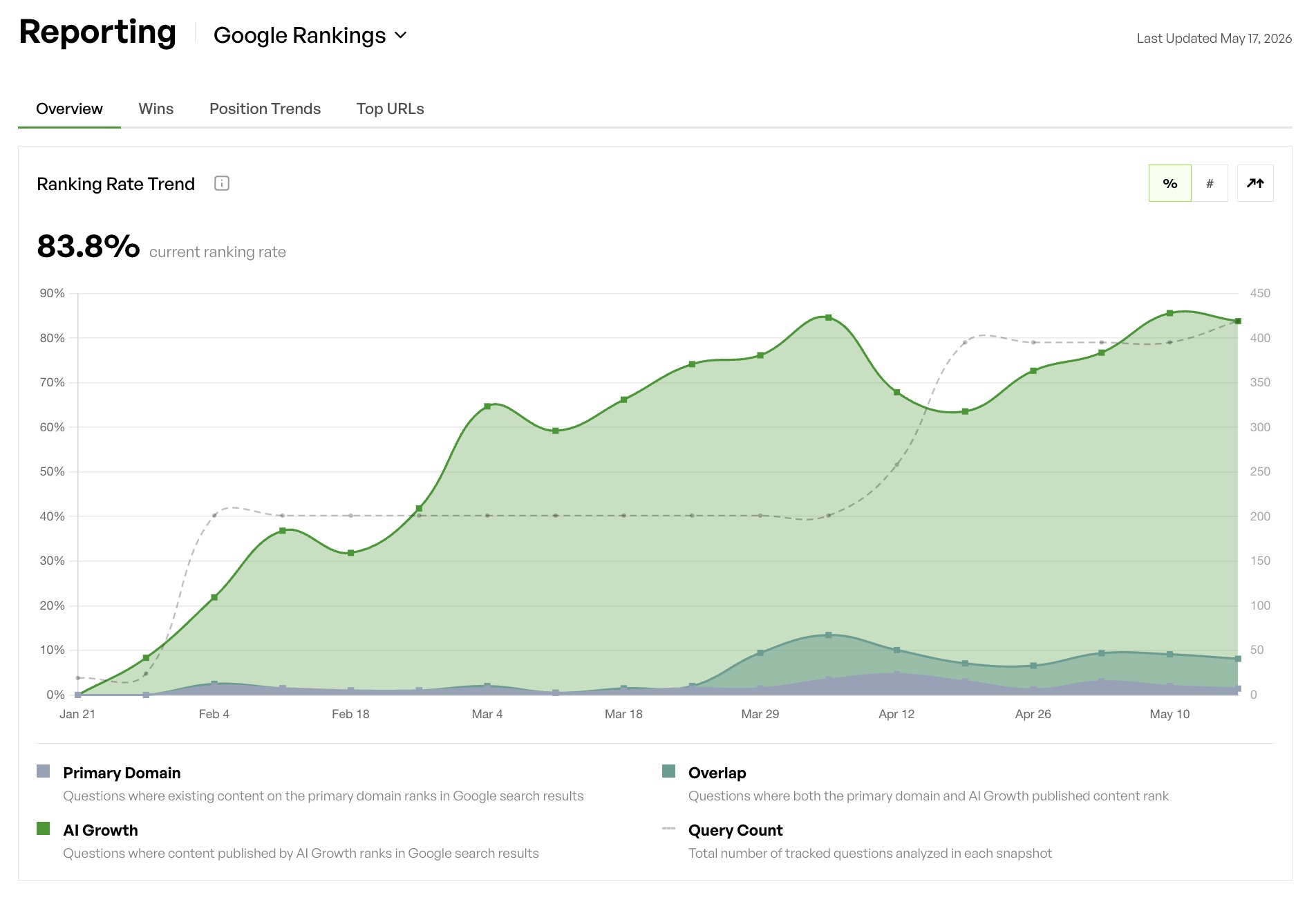
Sequence of actions: Every week, the engine takes a fresh snapshot of the search sector using four integrated data pillars. Search Intelligence maps the competitive landscape and the prompt universe. AI Analytics tracks citation and mention rates across AI systems. Bot Tracking identifies which crawlers, including GPTBot, are visiting the content. AI Ranking monitors traditional organic position against competitors. Together, these four pillars feed a single infrastructure that isolates AI Growth Agent's contribution from the brand's existing visibility and reports incremental gains across primary domain pages, overlapped pages, and AI Growth Agent pages.
Validation checkpoint: Only 30% of brands stay visible from one AI answer to the next, and just 20% remain visible across five consecutive runs. Incremental visibility reporting must be longitudinal and weekly to detect real compounding gains versus noise. Only 16% of brands have any systematic way to track how they are performing in AI search results, per McKinsey's September 2025 CMO Survey. The four-pillar infrastructure closes that measurement gap.
Exact output: A weekly dashboard snapshot isolating AI Growth Agent-generated citations, bot visits, and Search Console impressions, which proves what the engine contributed versus the brand's existing visibility. Across the first three months, clients average more than 12,000 additional AI citations and mentions, over 100,000 additional bot visits, and a 20% or greater lift in impressions in Google Search Console.
Frequently Asked Questions
How quickly can we go from kickoff to first published article?
The first article can be live within one week of kickoff. The Company Manifesto interview happens in the first days, the Content Topology is derived from it, and the blog infrastructure is set up in parallel. Content has indexed in as little as two weeks. The standard engagement is a three-month pilot because indexing timelines vary by industry, but the engine is in motion from day one.
Does AI Growth Agent require a technical team on the client's side?
No technical work is required from the client. The WordPress plugin, full schema coverage, MCP endpoints, advanced robots.txt, sitemap.xml, and bot tracking are all provisioned automatically. The blog connects to the client's domain through a reverse proxy rewrite or subdomain, with setup documentation generated for whatever host the client uses, including Cloudflare, Vercel, or any other provider. The client gives feedback in plain language and the engine handles everything else.
Who owns the blog and the content?
The client owns the blog and every article produced. The property is styled to match the client's existing site and connected through a reverse proxy rewrite or subdomain, so it appears as part of the brand's domain. No agency holds the keys. If the engagement ends, the client retains the full content library and the blog infrastructure.
How does pricing work, and are prompts or articles capped?
Pricing is a flat fee with no per-prompt or per-article charges. Clients are never penalized for seeing more of their search universe. Prompt count is not a billed metric. The Content Topology starts at 300–400 prompts and expands to 1,500+ for mature clients, all included. Content production runs up to 500 articles per month per account.
How are AI Growth Agent's results separated from visibility the brand already had?
AI Growth Agent publishes into a separate environment and reports incremental visibility week over week, with a clear separation between primary domain pages, overlapped pages, and AI Growth Agent pages. The four-pillar data infrastructure of Search Intelligence, AI Analytics, Bot Tracking, and AI Ranking cross-references bot traffic via the WordPress plugin, impressions via Google Search Console, and citation and mention rates via the proprietary dashboard. Clients who measure conversions can also track the lift in organic leads attributable to AI Growth Agent content directly at their conversion moments.
Conclusion: Turn Keyword Research into an Engine for AI Citations
Monitoring platforms show where a brand stands for a capped set of prompts it already thought to ask about, which functions like a rearview mirror. Keyword research for AI citations at the scale and depth described in this guide acts more like a steering system. It maps the full universe, validates every claim, publishes with full technical SEO, self-heals weekly, and proves what it generated across both search and AI surfaces.
McKinsey projects that AI-powered search stands to impact $750 billion in revenue by 2028. The AI surfaces are still in their first generation, so brands that establish authoritative, structured, living content now train the next generation of models with their own narrative. Brands that wait allow the next generation to train on whatever happens to be sitting on the open web.
AI Growth Agent functions as the autonomous engine that makes your brand the answer. It maps the search universe, wins it on autopilot, and proves every point of incremental visibility it generates without adding headcount.