Written by: Mariana Fonseca, Editorial Team, AI Growth Agent
Key Takeaways
- Keyword research for B2B SaaS in 2026 works best when it maps a full search universe of seed terms and long-tail prompts validated against real buyer language from sales calls, G2 reviews, and CS logs.
- A Company Manifesto acts as the strategic foundation so every content decision reflects unique brand positioning instead of producing generic outputs.
- Organizing keywords across TOFU, MOFU, and BOFU stages with competitor gap analysis uncovers high-intent commercial queries that competitors do not yet own.
- Targeting AI Overview and ChatGPT citation context requires answer-first structures, FAQ schema, and entity-rich language that earns mentions on AI surfaces.
- AI Growth Agent helps B2B SaaS teams map their complete search universe and turn keyword research into pipeline-ready SQLs. Schedule a demo to get started.
Step 1: Build a Company Manifesto That Anchors Every Content Decision
The Company Manifesto becomes the single authoritative document that every downstream content decision references. Without this foundation, keyword research produces generic lists that any competitor could claim.
The sequence starts with a structured, journalist-led interview that captures the brand’s positioning, product features, target personas, competitive differentiation, and approved claims. All unstructured material such as brand guidelines, sales decks, product pages, and legal disclaimers is ingested alongside the interview transcript. The output is a Company Manifesto, a comprehensive AI-ready document that acts as the anti-hallucination layer for every article produced from it.
Roles involved include a senior marketing or product leader as the primary interview subject and a content strategist or journalist as interviewer. Once the manifesto is drafted, it passes a validation checkpoint where the finished document is reviewed and approved by the brand before any content generation begins. This approval step matters because the manifesto serves as the strategic foundation that separates a mapped search universe from a disconnected keyword list.
Step 2: Pull Seed Terms and Long-Tail Prompts From Real Buyer Conversations
This step replaces assumed keywords with the language buyers actually use. Effective B2B SaaS keyword research starts with jobs-to-be-done, competitor queries pulled from sales call data, and search intent classification, not raw volume from tools.
To capture authentic buyer language, focus on the sources where prospects describe their problems in their own words. Pull transcripts from recorded sales calls and flag the exact phrases prospects use for their problem, their current solution, and their evaluation criteria. Mine G2 and Capterra reviews for recurring language in three-star and four-star reviews, where buyers describe unmet needs precisely. Extract CS ticket language for the pain points that surface post-sale.
These sources generate long-tail prompts that often convert at higher rates than short-tail terms, even when keyword tools report zero volume. Roles involved include sales ops or revenue operations for call transcript access, a CS lead for ticket logs, and marketing for G2 review mining. The validation checkpoint requires that every extracted phrase maps to at least one buyer persona and one stage of the buying journey before it enters the Content Topology.
Step 3: Map TOFU, MOFU, and BOFU Queries Into a Connected Search Universe
The Content Topology should mirror the full buying journey instead of only defending existing head terms. Approximately 70–80% of searches are long-tail keywords containing three or more words, so brands that focus only on head terms miss most of their market.
Organize seed terms into three layers that track how buyers move from problem awareness to purchase decisions. TOFU queries address the problem itself, such as “how to shorten sales cycles” or “what causes churn in SaaS,” and capture buyers who know they have a pain point. As buyers start evaluating solutions, MOFU queries like “best AP automation for mid-market” or “[category] for [industry]” show up and signal interest in solution types. BOFU queries such as “[competitor] vs [product],” “[product] pricing,” or “[product] alternatives” indicate active vendor evaluation and a near-term purchase decision. BOFU content converts at 10–20x the rate of awareness content, so the topology prioritizes commercial-intent terms first and then builds TOFU coverage that feeds demand downward.
Multi-stakeholder buying committees require role-specific assets that support internal distribution. Create technical deep-dives for engineering leads at MOFU and ROI summaries for finance stakeholders at BOFU so a champion can share the right content with each decision-maker. The validation checkpoint confirms that every seed term has at least one TOFU, one MOFU, and one BOFU query mapped beneath it before content production begins.
Step 4: Run Competitor Gap Analysis Inside the Content Topology
This step identifies where competitors own narrative territory the brand should contest and where open gaps exist that the brand can win quickly. Mapping competitors’ funnel structure using page-level data on primary keywords and performance metrics reveals their heaviest investments and exposes content gaps, such as strong awareness content but weak MOFU comparison coverage.
Run the full Content Topology against competitor URLs and compare coverage. Flag every query where a competitor ranks in positions one through three and the brand has no indexed page. Flag every comparison query such as “[competitor] vs [brand]” or “[competitor] alternatives” where the brand is absent. B2B SaaS keyword strategy must cover four high-commercial query patterns: head-to-head comparisons, alternatives, switching queries, and review queries because these reflect real evaluation behavior.
Roles involved include a marketing strategist for gap prioritization and a content lead for brief creation. The validation checkpoint ranks the gap list by pipeline potential using buyer intent strength, conversion potential, and competitive difficulty before any content is commissioned.
Schedule a consultation session to run a competitor gap analysis across your full search universe.
Step 5: Prioritize Low-Volume Commercial Terms With Pipeline ROI
This step replaces search volume as the primary prioritization metric with pipeline ROI. As noted in the topology mapping step, long-tail terms often outperform head terms in conversion, but deciding which low-volume terms deserve budget requires proof from pipeline data, not volume assumptions.
B2B SaaS companies often find that ranking for a search term with 500 monthly searches can be more profitable than ranking for a term with 5,000 monthly searches because lower-volume terms with strong buying intent deliver higher conversion rates. Given that BOFU terms convert at significantly higher rates, validating low-volume commercial terms becomes critical. A keyword generating 50 monthly searches that produces SQLs is worth more than a term generating 5,000 searches from curiosity-driven readers.
Validate each low-volume commercial term by tracing it back to a sales call phrase, a G2 review cluster, or a CS ticket pattern. If the phrase appears in buyer language, it carries commercial intent regardless of what a volume tool reports. Track conversion rate and revenue attributed to each keyword cluster, not rankings alone. The validation checkpoint requires that every term entering production has a documented intent classification (informational, commercial investigation, transactional) and a projected pipeline contribution based on historical conversion data from comparable terms.
Step 6: Structure Content for AI Overview and ChatGPT Citations
This step focuses on earning citation context on AI surfaces, not just ranking on static SERPs. Google AI Overviews most often trigger for B2B SaaS queries involving complex comparisons, how-to instructions, broad definitions, and multi-step processes, so keyword research must cover problem-aware, solution-aware, and product-aware queries.
Structure every page with a direct answer to the primary query in under 40 words immediately beneath the H1 or H2. Use self-contained sections with consistent heading hierarchies such as H2 and H3 so LLMs can extract individual sections independently. Content that uses clear formatting with headings, bullet points, numbered lists, and tables tends to earn more citations from LLMs. Add FAQ schema, How-to schema, and entity-rich language that uses stable terminology and synonyms consistently.
Brand mentions correlate approximately 3:1 over backlinks for AI Overview placement, so off-site presence runs as a parallel workstream rather than an afterthought. The validation checkpoint confirms that every published page passes an AI extractability audit, which includes answer-first structure, entity-clear language, FAQ schema, and verified brand citation context across ChatGPT and Google AI Overviews.
Step 7: Keep Content Living and Report Incremental Visibility
This step keeps the search universe fresh and attributes every gain to new effort instead of existing brand visibility. Content shipped once and ignored decays over time. Fresh content updated within the past two months earns 28% higher citation rates from LLMs that retrieve via live RAG pathways.
Deploy a self-healing content system that refreshes articles in batches, syncs rule and CTA changes across all live pages automatically, and re-indexes updated content without manual republishing. This system feeds directly into reporting so teams can see how updates affect performance. Report incremental visibility week over week and separate the impact of new content from what the brand already owned by segmenting primary domain pages, overlapped pages, and new content pages in the same dashboard.
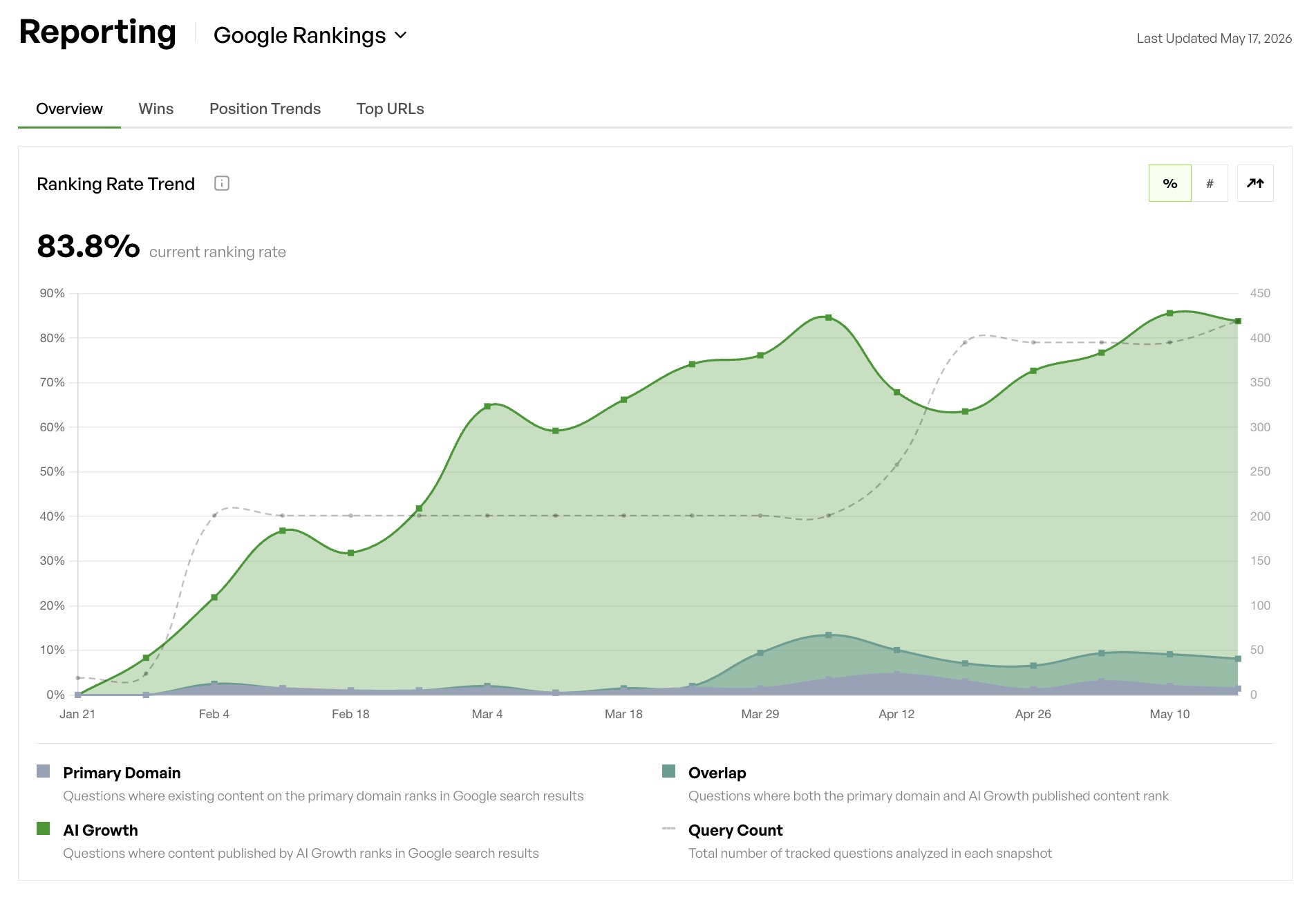
Track bot visits such as GPTBot and traditional crawlers, impressions via Google Search Console, and citation and mention rates across Google AI Overviews and ChatGPT as primary proof metrics. The validation checkpoint requires weekly reporting that clearly separates incremental visibility from baseline brand visibility, with organic lead attribution flowing into CRM for accurate pipeline measurement.
Common Mistakes and Troubleshooting
Broad keywords that generate traffic but no SQLs. High-volume head terms usually attract researchers, not buyers. The diagnostic is simple: if a keyword does not map to a specific pain point from a sales call or G2 review, it belongs at pre-funnel or not at all. Redirect production budget toward BOFU and MOFU terms with documented commercial intent.
Fragmented tools and teams that create stale content. A rank tracker, a separate AI-answer monitor, crawler logs, and Google Search Console in four disconnected dashboards cannot drive decisions because each tool covers only one slice of the picture. This fragmentation creates a predictable failure mode: slow, inconsistent output where quality drifts from one article to the next and no single view shows what is actually working. The correction is a unified data infrastructure where search intelligence, AI analytics, bot tracking, and AI ranking feed the same content engine and close the gaps that cause drift.
Prompt caps that hide most of the search universe. Monitoring tools that cap tracked prompts at a fixed number show only the slice of the market the brand already thought to ask about. The correction is a Content Topology that tracks hundreds of long-tail queries beneath each seed term, refreshed weekly, with prompt count never treated as a billed constraint.
Content that earns impressions but no citations. Pages that rank on traditional SERPs but never appear in AI Overviews or ChatGPT answers usually lack answer-first structure, FAQ schema, and entity-clear language. Audit every high-impression page for AI extractability and apply the Step 6 structure retroactively.
Frequently Asked Questions
How long does it take to see SQLs from a keyword research overhaul?
The timeline depends on domain authority, industry, and how quickly new content indexes. A well-structured BOFU page targeting a low-competition commercial term can index and generate demo requests within two to four weeks of publication. TOFU and MOFU content compounds over three to six months as topical authority builds. The fastest path to SQLs comes from prioritizing BOFU terms first, such as pricing, comparison, and alternatives queries, then building MOFU and TOFU coverage that feeds demand downward.
Who owns keyword research in a B2B SaaS marketing team?
Keyword research for SQL outcomes requires input from sales, customer success, and marketing. Sales provides call transcripts and competitive objections. Customer success contributes ticket language and churn signals. Marketing owns intent classification and content strategy. Ownership of the final Content Topology sits with marketing, but the source data must come from revenue-facing teams. Without sales call language, keyword lists default to assumed terms that miss the buyer’s actual vocabulary.
What technical dependencies are required to optimize for AI Overview citations?
The minimum technical requirements include FAQ schema, How-to schema where applicable, a proper sitemap.xml, an advanced robots.txt that permits AI crawlers, and Model Context Protocol endpoints so AI systems can read the content in the format they prefer. Author schema with named credentials strengthens E-E-A-T signals. None of these elements require custom engineering if the blog runs on a properly configured WordPress plugin that provisions them automatically.
How do you measure whether keyword research is producing SQLs versus vanity traffic?
The measurement stack has three layers. First, track conversion rate by keyword cluster, not by individual keyword, using UTM parameters that flow into CRM. Second, capture lead source at the conversion moment such as demo request, trial signup, or contact form and filter for organic. Third, run incremental visibility reporting that separates what new content generated from existing brand visibility so pipeline attributed to organic is not inflated by brand-name searches the company would have captured anyway. The combination of bot traffic, impressions lift, citation rate, and CRM-attributed organic leads produces a defensible pipeline number.
How often should the search universe be refreshed?
Weekly refreshes keep the search universe aligned with reality. Competitor content moves, AI Overview triggers shift, and new buyer language emerges from product launches and market events. A search universe snapshot that is more than four weeks old is already partially stale. Mature accounts tracking 1,500 or more queries need automated weekly refreshes to catch competitive movements in real time and respond before a competitor’s new content consolidates a position.
Conclusion
Keyword research for B2B SaaS now operates as a living system rather than a one-time deliverable. That system includes a Company Manifesto that anchors every content decision, a Content Topology that maps seed terms and long-tail prompts across TOFU, MOFU, and BOFU, a competitor gap analysis that identifies winnable territory, pipeline ROI validation that replaces volume as the prioritization metric, AI Overview optimization that earns citation context on every surface where buyers form their initial mental models, and self-healing content that compounds authority instead of decaying.
The brands that win the next generation of AI search produce authoritative, structured, living content now and train models with their own narrative before competitors fill that space with whatever sits on the open web. The seven steps above form a repeatable system, and the search universe represents the territory. Mapping it completely, validating it against real buyer language, and defending it with ongoing updates becomes the core work of growth.