Written by: Mariana Fonseca, Editorial Team, AI Growth Agent
Key Takeaways
-
The search universe includes every conversational query and prompt in your market. Brands that track only a few terms miss most AI visibility.
-
Traditional volume-based keyword tools overlook many prompts that trigger AI Overviews because high-intent questions often show low or zero search volume.
-
A six-step autonomous workflow – manifesto creation, prompt extraction, competitor gap analysis, claim validation, technical publishing, and weekly visibility tracking – replaces manual research with a self-correcting system.
-
Brands that map their full search universe, validate every claim, and publish with complete schema earn higher AI citation rates and measurable incremental visibility.
-
See the full AI Growth Agent workflow in a live demo to understand how it can reshape your AI visibility.
Why Mapping Your Search Universe Matters Now
Most teams still treat keyword lists as their entire search strategy. AI systems now respond to thousands of conversational prompts that never appear in volume tools. Competitors that understand these prompts gain citations in AI Overviews while your existing content remains invisible. Mapping your full search universe gives you a clear picture of those prompts so you can shape the narrative before AI systems do it for you.
Step 1: Build Your Company Manifesto from Seed Terms
Every search universe starts with seed terms that anchor how your market is organized. Seed terms alone create generic content that blends into the background. A Company Manifesto adds the missing layer by turning interviews, brand guidelines, sales PDFs, and product pages into a single source of truth that AI systems can easily index.
The Manifesto serves two functions that work together to increase AI citation rates. First, it prevents hallucinations by giving every downstream content agent a validated set of approved claims, primary sources, and brand-specific facts to check against. This structure keeps factual accuracy consistent at scale. Second, it enforces narrative consistency across hundreds of articles, a property that AI systems now evaluate as a ranking factor alongside E-E-A-T signals. When your content speaks with one voice, AI models treat your brand as a coherent authority instead of a loose collection of pages. With that foundation in place, the next step is to expand each seed term into the full universe of conversational prompts that AI systems actually process.
Step 2: Extract 300–400 Long-Tail Prompts per Seed
The engine takes the seed terms from your Manifesto and expands each one into hundreds of conversational prompts using real-time Google and ChatGPT data. Traditional keyword tools rely on historical databases and miss brand-new or low-volume queries. A prompt-first approach creates long-tail variations by audience, use case, and constraint, then checks them against live autocomplete surfaces instead of static volume numbers.
Keywords triggering AI Overviews tend to be longer and more specific than those that do not, and 57.9% of AI Overview-triggering queries are phrased as questions and 60.85% are long-tail 4+ word queries. A new account typically starts with 9–15 seed terms and 300–400 prompts beneath each, then grows to 1,500+ queries as the universe matures. Prompt count is never capped or billed as a separate metric, so you see the full market instead of a narrow keyword list.
Step 3: Run Real-Time Competitor and PAA Gap Analysis
Before writing begins, research agents scan the current AI Overview landscape, People Also Ask boxes, Reddit threads, and competitor content to uncover gaps and citation opportunities. The overlap between top Google links and AI-cited sources has dropped from 70% to below 20%, and approximately 62% of Google AI Overview citations now come from pages outside the organic top ten, with 38% from the top 10, based on a March 2026 Ahrefs study of 863k keywords. Winning AI citations requires a different map than winning blue-link rankings.
The gap analysis surfaces the specific questions and intent behind each real search so your content targets precise, winnable spaces. The “People Also Ask” Recursive Method maps conversational query journeys by starting with a mid-tail keyword and charting the logical progression of related questions that AI systems use to synthesize answers. That map becomes the brief for every article in the queue. If you want to see which gaps your competitors are leaving open right now, the team can run a live gap analysis during your demo and show the exact prompts you should target.
See your competitor gaps in a live demo
Step 4: Validate Every Claim and Source Against Live Results
Research agents cross-check every fact against live Google and ChatGPT outputs, authoritative primary sources, and active forum discussions before publication. This validation step separates durable authority from generic AI text. AI engines often cite from the top third of a page, so placing the most aligned and validated content above the fold becomes a structural requirement rather than a stylistic choice.
Validation also keeps content fresh. Half of the content cited in AI search responses is less than 13 weeks old, which makes freshness more critical for AI visibility than for traditional SEO. Every claim, source, and quote is checked against live research instead of a model’s training data. This approach keeps published content accurate as the market shifts.
Step 5: Publish with Full Schema and Bot-Ready Technical SEO
Validated content still needs to be machine-readable before AI crawlers can trust and cite it. The publishing layer automatically applies Article, FAQ, Author, Organization, and Speakable schema, along with MCP endpoints, LLM.txt, advanced robots.txt, and sitemaps so AI crawlers can read, interpret, and reuse the content. Advanced Schema.org markup, including Speakable, FAQ, and How-To schemas on high-intent pages, helps answer engines parse and deliver concise responses to natural-language queries.
The blog goes live within the first onboarding week, styled to match the client’s existing brand and connected through a reverse proxy rewrite under a subdirectory or subdomain. This setup preserves the existing site structure, keeps the main domain untouched, and gives the client full ownership of the new property. That ownership matters because visibility gains scale with publishing velocity. Brandi AI research shows brands producing 12 or more optimized pieces of content per month achieve up to 200x faster visibility gains in AI answers than those producing just four, so a high-volume publishing cadence becomes a structural advantage.
Step 6: Measure Incremental Visibility Weekly
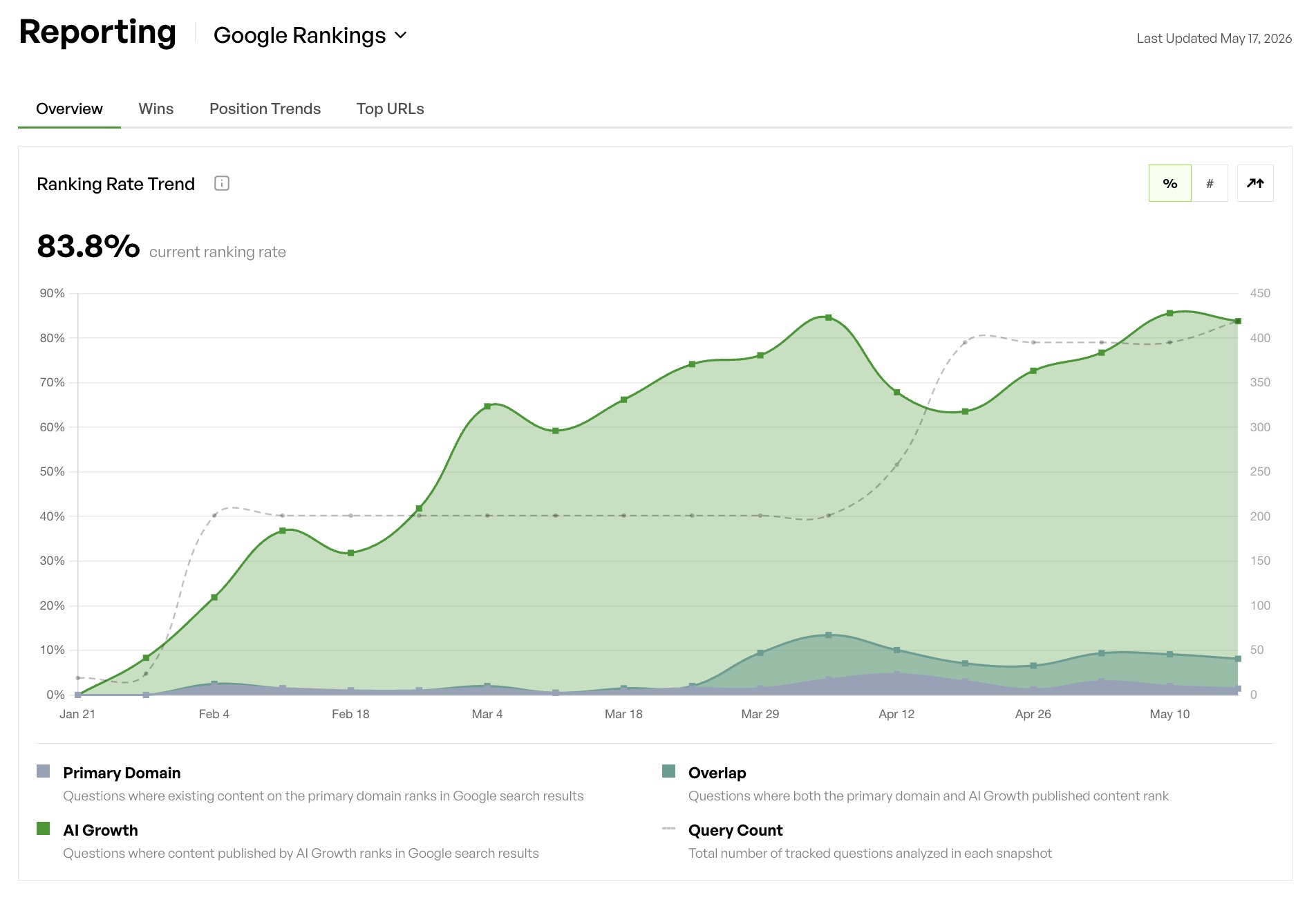
Every Monday, the engine captures a fresh snapshot of the search sector and reports exactly what AI Growth Agent generated, separate from visibility the brand already held. The reporting stack tracks appearance in Google AI Overviews and ChatGPT, traditional organic rank against competitors, bot traffic via the WordPress plugin, and impressions via Google Search Console. Analyses show that a large share of searches now trigger an AI Overview, and BrightEdge / SEMrush Sensor 2026 reported that 30% of Google queries in the US show an AI Overview, so weekly citation tracking becomes a meaningful operating signal.
Across the first three months, AI Growth Agent clients average more than 12,000 additional AI citations and mentions, over 100,000 additional bot visits, and a 20% or greater lift in impressions in Google Search Console. Incremental visibility is reported separately from existing brand performance so the lift stays attributable, defensible, and ready for budget conversations. During your demo, the team will show exactly how they isolate the citations and traffic AI Growth Agent generates from the visibility you already have so you can prove ROI with clean attribution.
See how we track your incremental AI visibility
Frequently Asked Questions
How long does it take to see AI citations after mapping a search universe?
The first article can be live within one week of kickoff. Content has indexed in as little as two weeks, with AI citations starting shortly after indexing. The standard engagement runs as a three-month pilot because indexing timelines vary by industry and domain authority. Clients who begin with a well-structured Company Manifesto and a validated Content Topology usually see citations earlier because the content already matches the prompts AI systems process.
Who owns the workflow inside a non-technical marketing team?
The engine owns the workflow so the client’s team does not manage day-to-day tasks. The client participates in a one-hour journalist-led interview at kickoff and reviews the first batch of articles. Feedback is given in plain language, either to the AI Growth Agent team or directly to the platform’s internal chatbot. The engine updates the article and stores the instruction as a memory so the same note is never needed twice. After the first batch, content production runs autonomously without technical skills, engineering resources, or ongoing management from the client.
What technical dependencies are required on the client side?
The only requirement is domain access for the reverse proxy rewrite or subdomain setup. AI Growth Agent provisions the WordPress plugin, schema, robots.txt, sitemap.xml, MCP endpoints, and LLM.txt automatically. Setup documentation is generated for the client’s specific host, whether Cloudflare, Vercel, or another provider, so the connection remains infrastructure-agnostic. The client does not write or maintain code, and the new blog does not interfere with the existing site or curated main blog.
How is incremental visibility isolated from existing brand performance?
AI Growth Agent publishes into a separate blog environment and tracks visibility at the page level, distinguishing between primary domain pages, overlapping pages, and AI Growth Agent pages. The proprietary dashboard reports citation and mention rates in Google AI Overviews and ChatGPT, the WordPress plugin captures bot traffic by crawler type including GPTBot, and Google Search Console provides an independent audit of impressions. These three layers together make it possible to attribute specific visibility gains to AI Growth Agent content instead of the brand’s pre-existing authority.
How does the system scale to 1,500+ queries without added headcount?
The engine handles expansion autonomously. The system begins with your initial seed terms and then expands into adjacent topics as you win visibility in early clusters. The Content Topology deepens into long-tail queries and refreshes weekly from real-time search data. Mature clients reach search universes of 1,500 or more queries with no additional headcount on the client side. Prompt count is never a billed metric, so there is no financial penalty for seeing more of the market. The engine produces up to 500 articles per month per account from a single autonomous system.
What governance controls prevent off-brand or non-compliant content?
The Company Manifesto acts as the primary governance layer by encoding approved claims, blocked language, blocked links, and brand-specific facts that every agent checks before publishing. Clients can also configure dynamic legal disclaimers, citation style requirements such as AMA or Chicago for regulated industries, and anti-hallucination checks focused on sensitive claims like pricing, ingredient specifications, and regulatory language. Every rule configured once applies to every future generation automatically. When a rule changes, the engine syncs and updates affected live articles overnight without republishing work from the client.
The Scalable Path to AI Narrative Control
Volume tools and capped monitors cannot deliver narrative control across your market. They report on a narrow slice of queries the brand already knew to track while AI-referred sessions jumped 527% year-over-year in the first five months of 2025 and AI-sourced traffic converts at 2 to 5 times the rate of traditional organic traffic. The brands winning that traffic mapped their full universe, validated every claim, published with full technical SEO, and kept the content current. Brands that waited allowed the next generation of models to train on whatever happened to be available on the open web.
AI Growth Agent replaces the fragmented stack of agency, SEO tool, monitoring platform, content writer, and engineer with one autonomous engine that maps, validates, publishes, and self-heals your search universe on autopilot. The leaderboard is still forming. Brands that establish authoritative content now become the sources models cite next.