Written by: Mariana Fonseca, Editorial Team, AI Growth Agent
Key Takeaways
- The A2A protocol enables autonomous agent-to-agent coordination for headless marketing systems, replacing brittle integrations with discovery, delegation, and stateful collaboration.
- Core A2A components work together for marketing: Agent Cards handle discovery, task state machines manage long-running workflows, typed artifacts support clean handoffs, and streaming updates keep content pipelines responsive at scale.
- A2A and MCP act as complementary layers: A2A manages horizontal agent coordination while MCP manages vertical tool and data access within each agent.
- Production headless marketing workflows using A2A follow a multi-agent sequence from universe mapping through research, writing, anti-hallucination checks, schema decoration, and publishing with full traceability.
- AI Growth Agent is the only production engine implementing these A2A patterns at scale; book a demo to see living, self-healing content in action.
How A2A Primitives Power Marketing Agents
Headless marketing at scale needs agents that can find each other, hand off work cleanly, and track progress without human traffic control. A2A delivers this through five core building blocks that act as a single coordination system for your content engine.
Every A2A-compliant agent publishes an Agent Card at a well-known endpoint, typically /.well-known/agent.json, containing the agent’s name, description, supported interfaces, capabilities, skills, and security schemes. For a marketing agent, the Agent Card is the discovery surface. It tells an orchestrator which content skills are available, what input and output modes are accepted, and how to authenticate before delegating a task.
Tasks act as the core interoperability primitive. A task carries a unique taskId and contextId and progresses through states including submitted, working, input-required, completed, failed, and canceled. This state machine separates A2A from a simple API call. A content generation task can run for minutes, emit intermediate progress events, and return structured artifacts while the orchestrator tracks status instead of polling blindly.
Artifacts function as first-class outputs. They are composed of typed parts, TextPart, DataPart, or FilePart, which lets downstream agents parse and act on results programmatically. A research agent returns a DataPart artifact. A writing agent consumes it and returns a TextPart artifact. A schema decoration agent wraps the final output and publishes it. Each handoff stays traceable, typed, and stateful.
Streaming updates arrive via Server-Sent Events through endpoints such as tasks/sendSubscribe. Long-running content work reports incremental progress instead of acting as a single blocking call. For a multi-agent SEO pipeline that produces hundreds of articles per day, streaming keeps orchestration responsive and prevents bottlenecks.
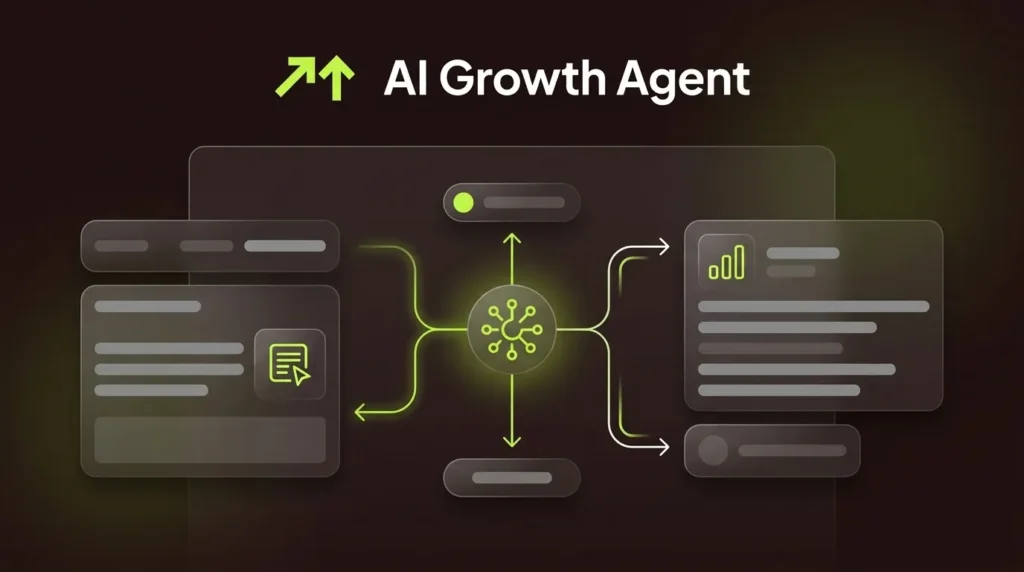
Delegation in A2A is recursive by design, which means an agent can delegate to another agent, and that agent can delegate again further down the chain. A2A defines three primary actors: a User who interacts with a Client Agent, which delegates tasks to Remote Agents; Remote Agents can themselves act as Client Agents, forming tree or mesh topologies. This recursive structure allows a planning agent to delegate keyword research to a search intelligence agent, which then delegates competitive gap analysis to a specialist agent, all within a single coordinated workflow that the orchestrator can still track.
See how AI Growth Agent orchestrates these multi-agent workflows in production.
A2A and MCP in a Headless Marketing Stack
MCP, introduced by Anthropic, standardizes how AI agents access tools and external systems such as APIs, databases, and SaaS platforms, while A2A, introduced by Google and now under the Linux Foundation, standardizes how agents discover capabilities, delegate tasks, and collaborate with other agents. For headless marketing architecture, MCP forms the vertical connection between an agent and a tool, and A2A forms the horizontal connection between agents.
A practical pattern uses a planner or orchestrator agent that delegates work via A2A to specialized agents, which then use MCP to call tools and fetch resources. This pattern separates orchestration from tool integration. In a headless marketing system, the orchestrator delegates a content brief via A2A to a research agent, which uses MCP to query live search data. The research agent then delegates the draft to a writing agent, which uses MCP to pull from the brand manifesto and primary sources.
Without MCP, agent actions on enterprise systems become unstructured, unauditable, and ungovernable, and without A2A, multi-agent workflows collapse into brittle point-to-point integrations. Both layers are required. Neither layer is sufficient alone.
AI Growth Agent implements this combined stack for marketing. Blog MCP exposes the content surface to AI search agents for direct natural-language queries. A2A-aligned Agent Card guidance served via /.well-known/ tells orchestrating agents what the site can do and how to interact with it. The orchestration layer that produces content, from research through anti-hallucination checks to publishing, follows the same separation of concerns. MCP manages tool access, and A2A-style delegation manages agent coordination.
Schedule a demo to see how this A2A and MCP stack fits your architecture.
End-to-End A2A Workflow for Headless SEO
A production multi-agent SEO pipeline using A2A coordination solves the core challenge of headless marketing at scale. It produces large volumes of content with full traceability and no manual coordination at each handoff.
The workflow follows a sequence where each step is a discrete agent task with typed inputs, typed outputs, and a traceable state machine.

- Universe Mapping Agent receives a seed term list and queries live Google and ChatGPT data via MCP tool connections. It returns a DataPart artifact containing ranked long-tail queries with competitive gap scores.
- Search Intelligence Agent receives the query list via A2A task delegation, scrapes SERP structures, AI Overviews, and People Also Ask signals, and returns a structured competitive analysis artifact.
- Content Brief Agent consumes the competitive analysis artifact, applies brand manifesto rules from memory, and produces a content brief artifact specifying article type, required claims, and external sources to validate.
- Research Agent receives the brief, spawns parallel sub-tasks to scrape and qualify each required source via MCP, and returns a verified source artifact with every claim backed by evidence found online.
- Writing Agent receives the brief and verified sources, produces a full draft, and streams the output via SSE so the orchestrator can monitor progress without blocking.
- Anti-Hallucination Agent re-extracts every claim from the draft, checks each against the manifesto, primary sources, and verified external sources, and either confirms or softens unverifiable claims before returning a reviewed artifact.
- Schema Decoration Agent wraps the reviewed article with full schema markup, Open Graph metadata, and internal linking signals, then returns a publish-ready artifact.
- Publishing Agent receives the final artifact, submits it to the WordPress plugin via MCP, triggers instant indexing, and logs the task completion with a timestamp and article URL for the reporting layer.
The following Agent Card JSON illustrates how a content writing agent advertises its capabilities for discovery by an orchestrating agent:
{ "protocolVersion": "0.3.0", "name": "headless-content-writer", "description": "Produces SEO-optimized, schema-decorated marketing articles from validated research artifacts.", "url": "https://agents.example.com/content-writer", "capabilities": { "streaming": true, "pushNotifications": false }, "skills": [ { "id": "write-article", "name": "Write Article", "description": "Accepts a content brief and verified source artifact, returns a fully drafted article artifact.", "inputModes": ["application/json"], "outputModes": ["text/markdown", "application/json"], "tags": ["content", "seo", "marketing"], "examples": ["Write a 1200-word guide on adjustable bed financing for AI search."] } ], "securitySchemes": { "oauth2": { "type": "oauth2", "flows": { "clientCredentials": { "tokenUrl": "https://auth.example.com/token", "scopes": { "write:articles": "Permission to generate and return article artifacts" } } } } }, "defaultInputModes": ["application/json"], "defaultOutputModes": ["text/markdown"] }Walk through this multi-agent SEO pipeline live with the AI Growth Agent team.
When A2A Coordination Delivers Real Value
A2A coordination delivers clear advantage when the workflow involves multiple specialized agents that must hand off structured work across trust boundaries, when tasks are long-running and stateful, and when the system must scale to hundreds of parallel content tasks without human coordination. A headless marketing engine that produces 50 articles per day across a universe of 1,600+ queries fits this profile. No single agent can hold the full context, no human can coordinate the handoffs at that volume, and the state machine becomes the only reliable way to track what is in flight.
A2A becomes overkill for a single-agent workflow that calls one tool and returns one result. If a team needs one article per week and a human reviews every step, the coordination overhead of Agent Cards, task lifecycle management, and streaming infrastructure adds complexity without proportional return. A direct MCP tool call or a simple API integration works better at that scale.
The production reality for A2A marketing agents sits between these poles. A2A is best applied for agent specialization, long-running async workflows, and cross-org collaboration. For mid-market to enterprise content operations, the tipping point arrives when the content universe exceeds what any single agent or human team can coordinate, when self-healing requires continuous monitoring and re-delegation, and when incremental visibility reporting demands a traceable audit trail across every published asset. That production reality, with continuous coordination across specialized agents at high volume, is where the AI Growth Agent engine operates today.
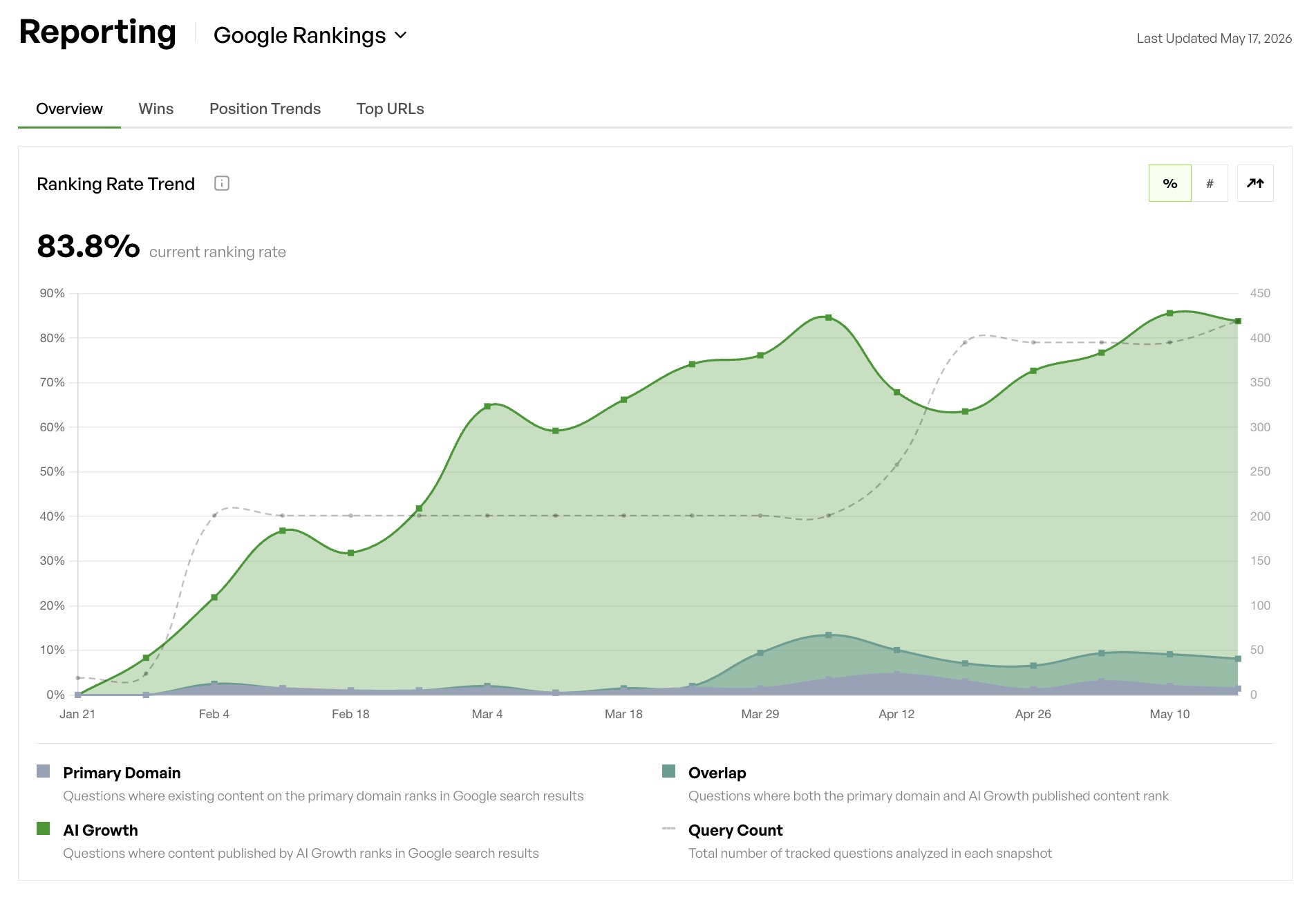
Discuss whether your current content volume justifies A2A-level coordination.
Security and Authentication for A2A Marketing Agents
Enterprise A2A deployments require deliberate security architecture because the A2A specification intentionally leaves authorization as an implementation-specific decision, with the protocol not mandating any specific authentication or authorization scheme. That flexibility benefits protocol designers and creates responsibility for production implementers.
Version 1.0 of the A2A specification introduced Signed Agent Cards for cryptographic identity verification of agents. Signing Agent Cards with JSON Web Signatures prevents impersonation. A receiving agent can verify the card’s integrity before accepting a delegated task. A2A v0.3+ supports but does not enforce Agent Card signing, so production deployments must explicitly require it.
OAuth 2.0 with client credentials is the standard authentication pattern for A2A marketing agents. A2A supports fine-grained authorization on a per-skill basis using OAuth scopes declared in the Agent Card’s securitySchemes, allowing gateways to restrict which skills a client agent can invoke. A content writing agent should carry only the scope required to write articles, not administrative access to the publishing infrastructure.
Token lifetime is a documented vulnerability in A2A implementations. A2A does not impose strict token expiration durations for sensitive operations, allowing leaked or intercepted tokens to be stored and reused by attackers for unauthorized access. Because tokens can remain valid for long periods, attackers gain a larger window to exploit them. In multi-agent systems, a single compromised token can propagate across several delegation steps. Production deployments therefore must enforce short-lived tokens, automated rotation, and revocation propagation across all agents in the delegation chain to limit exposure.
A2A implementations should maintain audit trails that log tasks, inputs, outputs, status transitions, caller ID, and timestamps to ensure traceability in enterprise environments. For marketing systems that handle brand-sensitive content, audit trails connect a published article back to the agent task that produced it, the sources it validated, and the anti-hallucination checks it passed.
API gateways serve as the natural enforcement point for authentication, rate limiting, and observability on A2A agent-to-agent traffic because every A2A interaction is a standard HTTP/JSON-RPC call. Placing the gateway between agents enforces consistent policy without requiring each agent to implement its own security stack.
Review your current security posture against these A2A requirements with the AI Growth Agent team.
Production Adoption Reality Check
A2A has moved from Google’s initial April 2025 announcement to enterprise production use within its first year. The protocol now sits under the Linux Foundation and continues to gain traction across the agent ecosystem.
2026 is the year agent protocols including A2A are expected to move from early experimentation to mainstream adoption across the AI agent ecosystem. Official SDKs exist for Python, Go, JavaScript, Java, and .NET, which lowers the barrier for engineering teams building on the protocol.
The gap between protocol specification and production headless marketing implementation remains wide. Most organizations adopting A2A focus on infrastructure rather than marketing systems. The engineering work required to implement Agent Cards, task state machines, streaming, anti-hallucination controls, schema decoration, and incremental visibility reporting as a unified production engine exceeds a weekend project. Closing that implementation gap requires the full stack described above, not just protocol awareness. The AI Growth Agent engine already runs in production across clients in the US, Canada, Brazil, and Europe, delivering results that a protocol specification alone cannot produce.
See the production engine and reporting stack in a live environment.
A2A in Living Content Architectures
Living content depends on continuous discovery, continuous delegation, and continuous correction, and A2A supplies the coordination layer that makes all three autonomous. A monitoring agent detects that a published article’s search signals have decayed, creates a task for a research agent to gather updated sources, delegates a rewrite task to the writing agent, and routes the result through anti-hallucination checks before the publishing agent updates the live article. The human never touches the workflow, and the content self-heals.
The same pattern applies to the content topology itself. When a new long-tail query enters the universe, the search intelligence agent creates a task, the orchestrator delegates content production, and the internal linking agent updates the graph to connect the new article to existing authority pages. Authority compounds instead of decaying.
The engine described throughout this article turns these A2A patterns into production reality for marketing. The agentic technical SEO stack, Blog MCP, Agent Card guidance at /.well-known/, natural language query parameters, llms.txt and llms-full.txt, and automated web stories arrive as a single architecture, not a loose set of features to configure. This stack ships with every engagement, live in week one, because it was designed from the start for the agentic internet. Incremental visibility reporting isolates exactly what the engine generated, week over week, so the CMO has a defensible answer for the CEO and the operator can watch organic leads compound without managing another tool.
Explore how a living content architecture would change your current search program.
Frequently Asked Questions
What is the A2A protocol and how does it apply to headless marketing?
The A2A protocol is an open standard, originally introduced by Google and now maintained under the Linux Foundation, that defines how autonomous AI agents discover one another, delegate tasks, and coordinate work across vendor and platform boundaries. In headless marketing, A2A supplies the coordination layer that connects specialized agents, such as a search intelligence agent, a content writing agent, and a publishing agent, into a unified autonomous pipeline. Each agent publishes an Agent Card advertising its capabilities, accepts delegated tasks with unique identifiers, progresses through a defined state machine, and returns typed artifacts to the next agent in the workflow. The result is a marketing system that operates without human coordination at every step.
How does A2A differ from MCP, and do you need both?
MCP connects an individual agent to external tools and data sources, such as a CMS, a search API, or a brand manifesto database. A2A connects agents to other agents, enabling discovery, task delegation, and stateful coordination across a multi-agent system. In a headless marketing architecture, both layers are required. MCP gives each specialized agent access to the tools it needs. A2A gives the orchestrator the ability to discover those agents, delegate work to them, and track the results across a long-running pipeline. Removing either layer collapses the architecture. Without MCP, agents cannot access external systems in a governed way. Without A2A, multi-agent workflows require brittle custom integrations that break when any agent changes.
How do you implement A2A protocol authentication for a marketing system?
Production A2A authentication for marketing agents requires several layers working together. Each agent publishes a signed Agent Card using JSON Web Signatures so receiving agents can verify identity before accepting a delegated task. OAuth 2.0 with client credentials and per-skill scopes controls which agents can invoke which capabilities, following least-privilege principles. Tokens must be short-lived with automated rotation and revocation propagation across the full delegation chain, because the protocol specification does not enforce token expiration on its own. An API gateway sits between agents to enforce authentication, rate limiting, and request validation consistently. Audit trails log every task, input, output, status transition, caller ID, and timestamp to support compliance and incident response. These controls are implementation responsibilities, not protocol guarantees, which is why production deployments require deliberate security architecture rather than relying on A2A defaults.
What is an Agent Card and what should a marketing agent’s Agent Card include?
An Agent Card is a JSON metadata document published at a well-known endpoint, typically /.well-known/agent.json, that advertises an agent’s capabilities to other agents in the system. For a marketing agent, the Agent Card should include the protocol version, the agent’s name and description, the endpoint URL, supported interfaces such as JSON-RPC or gRPC, streaming and push notification capabilities, and a skills array. Each skill entry should specify an ID, name, description, accepted input modes, produced output modes, relevant tags, and usage examples. The security schemes section should declare the OAuth 2.0 flows and scopes required to invoke each skill. A well-structured Agent Card allows an orchestrating agent to discover the content writer, understand what it accepts and returns, and authenticate before delegating a task, without any human configuration at runtime.
What is the difference between A2A protocol security and MCP security?
A2A security centers on agent identity verification, task-level permissions, and the integrity of delegation chains across multiple agents. The primary concerns include Agent Card spoofing, token replay across delegation boundaries, unauthorized scope expansion as tasks pass between agents, and audit trail completeness across the full workflow. MCP security addresses a different set of concerns. These concerns include the confused deputy problem, where a tool acts on behalf of a caller with more privilege than intended, token pass-through risks, server-side request forgery, and session hijacking within a single agent-to-tool connection. In a combined A2A and MCP architecture, both security models apply simultaneously. The A2A layer must verify agent identity and enforce scope attenuation at every delegation step. The MCP layer must enforce governed, auditable tool access within each individual agent. Neither protocol enforces the other’s security requirements, so enterprise deployments must address both explicitly.
Conclusion
The A2A protocol supplies the coordination layer that transforms isolated marketing agents into an autonomous, multi-agent headless marketing system. Agent Cards enable discovery. Task state machines enable stateful, long-running workflows. Artifacts enable typed, machine-readable handoffs. Streaming enables real-time progress across pipelines that produce content at a scale no human team can match. MCP handles the vertical connection between agents and tools. A2A handles the horizontal connection between agents. Both layers are required, and the gap between protocol specification and production implementation is where many organizations stall.
The gap between protocol and production is where AI Growth Agent operates. The engine runs A2A-aligned coordination patterns in production today, delivering living, self-healing content with incremental visibility reporting across a full universe of queries. The agentic technical SEO stack ships with every engagement. Content compounds over time instead of going stale.
Traditional search tools show you where your brand stands. AI Growth Agent makes your brand the answer. Schedule a strategy session to see how this engine would run for your site.