Written by: Mariana Fonseca, Editorial Team, AI Growth Agent
Key Takeaways
- Agent cards are the AI-native JSON standard served at /.well-known/agent-card.json that declares a brand’s capabilities, endpoints, and authentication so autonomous agents can discover, trust, and cite brands accurately in zero-click environments.
- Most searches now end without a site visit because AI surfaces deliver the answer directly, so brands without a declared agent card risk omission or inaccurate AI-generated descriptions.
- The agent-discovery stack combines agent cards, A2A protocol, MCP servers, llms.txt files, and four pillars of intelligence across Search, AI Analytics, Bot Tracking, and AI Ranking to give brands direct control of their narrative on AI surfaces.
- Implementation speed and ongoing maintenance shape long-term visibility: manual setups take weeks to months and require constant updates, while AI Growth Agent provisions the full stack, including agent card, MCP, llms.txt, schema, reverse proxy, and living content, within one week.
- Book a kickoff with AI Growth Agent to make your brand the answer AI surfaces cite and see your first article live within a week.
1. The Discovery Shift and the Zero-Click Reality
The channel where customers form brand opinions has moved. Most searches now end without the user visiting a third-party website because the AI surface delivers the answer directly. Many search users rely on AI-generated summaries to distill complex information. For most users, the answer the model gives is simply the answer.
For CMOs and business operators, the consequence is direct. If an AI surface cannot find, parse, and trust a brand’s declared profile, it will either omit the brand or construct a description from whatever fragments exist on the open web. Neither outcome works for a company with a defined identity and a narrative worth protecting. The agent card closes that gap by giving agents a single, authoritative description of who the brand is and what it offers.
2. Core Concepts: From Agent Card to Full Intelligence Stack
An agent card is a structured JSON file served at the canonical path /.well-known/agent-card.json. It declares what a site offers to autonomous agents, which endpoints they can call, and how to authenticate. The /.well-known/ convention is an IETF-standardized directory for well-known URIs, which gives agents a predictable address to query before interacting with any site.
The Agent2Agent (A2A) protocol, originally introduced in 2025 and brought to production-grade v1.0 in early 2026, is now governed by the Linux Foundation and supported by more than 150 organizations including Microsoft, AWS, Salesforce, SAP, and ServiceNow. A2A standardizes how agents advertise capabilities, exchange tasks, and communicate over the wire. The agent card functions as A2A’s discovery artifact and tells compliant agents how to start a trusted interaction.
The Model Context Protocol (MCP) handles the interaction layer and lets an agent query a site in natural language. MCP without a discovery declaration is a service running on an unpublished number. The agent card tells compliant agents where the MCP server lives and how to use it. llms.txt and llms-full.txt are companion files that give AI crawlers a structured summary of site content and intent. They work like robots.txt for language models, but they describe content and access patterns instead of crawl rules.
Four pillars of intelligence determine what an AI surface says about a brand. Search Intelligence shows the traditional search landscape, positioning, and competition. AI Analytics reveals brand value and consumer behavior across the full journey. Bot Tracking records every crawl, citation, and training sweep by AI agents. AI Ranking exposes order of mention and citation context as the new leaderboard. Together, these pillars connect directly to the agent card, MCP, and llms.txt files, turning a static declaration into a measurable, adaptable system.
3. Market and Ecosystem Overview: Legacy SEO vs Agentic Internet
The current market splits cleanly between legacy tools built for human business cards and real-estate profiles, and an emerging layer of AI-agent standards that most brands have not yet adopted. The gap is measurable. Many B2B websites lack llms.txt files and Organisation schema, which means a large portion of brands give AI engines almost nothing machine-readable to verify who they are. Some brands are actively blocking AI crawlers from accessing the site.
That defensive posture is already obsolete. Google’s I/O 2026 keynote confirmed AI Mode crossed 1 billion monthly users within its first year, with information agents that monitor the web 24/7 rolling out this summer for Google AI Pro and Ultra users. Every one of those surfaces reads, cites, and acts on whatever the model can find and trust. Brands without a declared agent-readable surface are undocumented, and to an agent, undocumented is the same as undiscovered.
4. Implementation Paths: Choosing How You Build the Stack
The following comparison shows how three approaches differ on coverage, deployment speed, and maintenance effort, which are the factors that decide whether a brand can secure AI visibility before the leaderboard settles.
| Approach | What It Covers | Speed to Deploy | Ongoing Maintenance |
|---|---|---|---|
| Manual implementation | Agent card file, llms.txt, schema markup, each built and maintained by internal engineering | Weeks to months depending on team capacity and CMS stack | Manual updates required every time standards evolve or content changes |
| Monitoring-only tools | Tracks brand appearance for a capped set of prompts, with no publishing and no agent card provisioning | Fast to onboard, but produces no agent-readable infrastructure | Ongoing prompt credits consumed, with no self-healing content |
| Headless marketing engine (AI Growth Agent) | Full stack: agent card, MCP, llms.txt, schema, reverse proxy, living content, bot tracking, incremental visibility reporting | First article live within one week, with full stack provisioned at kickoff | Automated self-healing, with standards updates rolled out across all client sites within the week |
Adobe’s LLM optimization guidance draws a direct contrast between traditional SEO, which is index-based and link-authority driven, and LLM optimization, which is token-based trained data that prioritizes brand mentions over backlinks and relies on Retrieval-Augmented Generation for freshness. The infrastructure requirements differ, and monitoring tools were not built for either the discovery layer or the publishing layer that AI agents now expect.
5. Key Factors to Evaluate Before Choosing an Approach
Team capacity is the first filter. Manual agent card implementation requires an engineer who understands the A2A spec, the /.well-known/ convention, JSON-LD schema, and the MCP discovery layer at the same time. Most marketing teams do not have that combination in-house. Technical debt compounds the problem because a static agent card file that is not updated when endpoints change or new standards ship becomes a liability instead of an asset.
Integration speed matters because the leaderboard is being written now. Pages not updated quarterly were three times more likely to lose citations in AI answers, which means a slow deployment not only misses the initial window but also demands constant refresh to regain ground. Beyond speed, governance requirements, including claim validation, legal disclaimers, and sector-specific compliance, must be built into the content system rather than bolted on after the fact. Finally, scalability separates pilot projects from enterprise solutions, because a stack that handles one agent card file but cannot maintain living content across hundreds of articles at consistent quality will not support a mid-market or enterprise brand.
6. Typical Implementation Stages for an Agent-Discovery Stack
A complete agent-discovery stack moves through five stages. The first is the kickoff interview, where a journalist-led session builds the brand manifesto as the single source of truth for voice, factual references, deny lists, and compliance requirements. The second is manifesto creation and topology mapping, where seed terms and long-tail queries are mapped from real-time Google and ChatGPT data into a content universe.
The third stage is reverse-proxy setup, which connects the fully optimized blog to a subdirectory under the brand’s domain without touching the existing CMS, CDN, or origin server. The blog inherits the parent domain’s authority instead of starting from zero. The fourth stage is agent-discovery provisioning. The agent card at /.well-known/agent-card.json, OpenAI discovery, Blog MCP, llms.txt, llms-full.txt, natural language query parameters, and Markdown serving for agent crawlers all go live as part of the same deployment. The fifth stage is first-week publishing, with authoritative content indexed in as little as ten days.
7. Ongoing Management and Measurement for AI Visibility
Agent cards function as living infrastructure rather than a one-time file. Only 30% of brands stayed visible from one AI answer to the next, and just 20% held presence across five consecutive runs, which means the system that maintains discoverability must stay active, not static. Ongoing management requires per-article bot tracking that shows exactly when ChatGPT or another AI agent cites a specific page, weekly universe snapshots that refresh the full query landscape, and incremental visibility reporting that isolates what the engine generated versus what the brand already had.
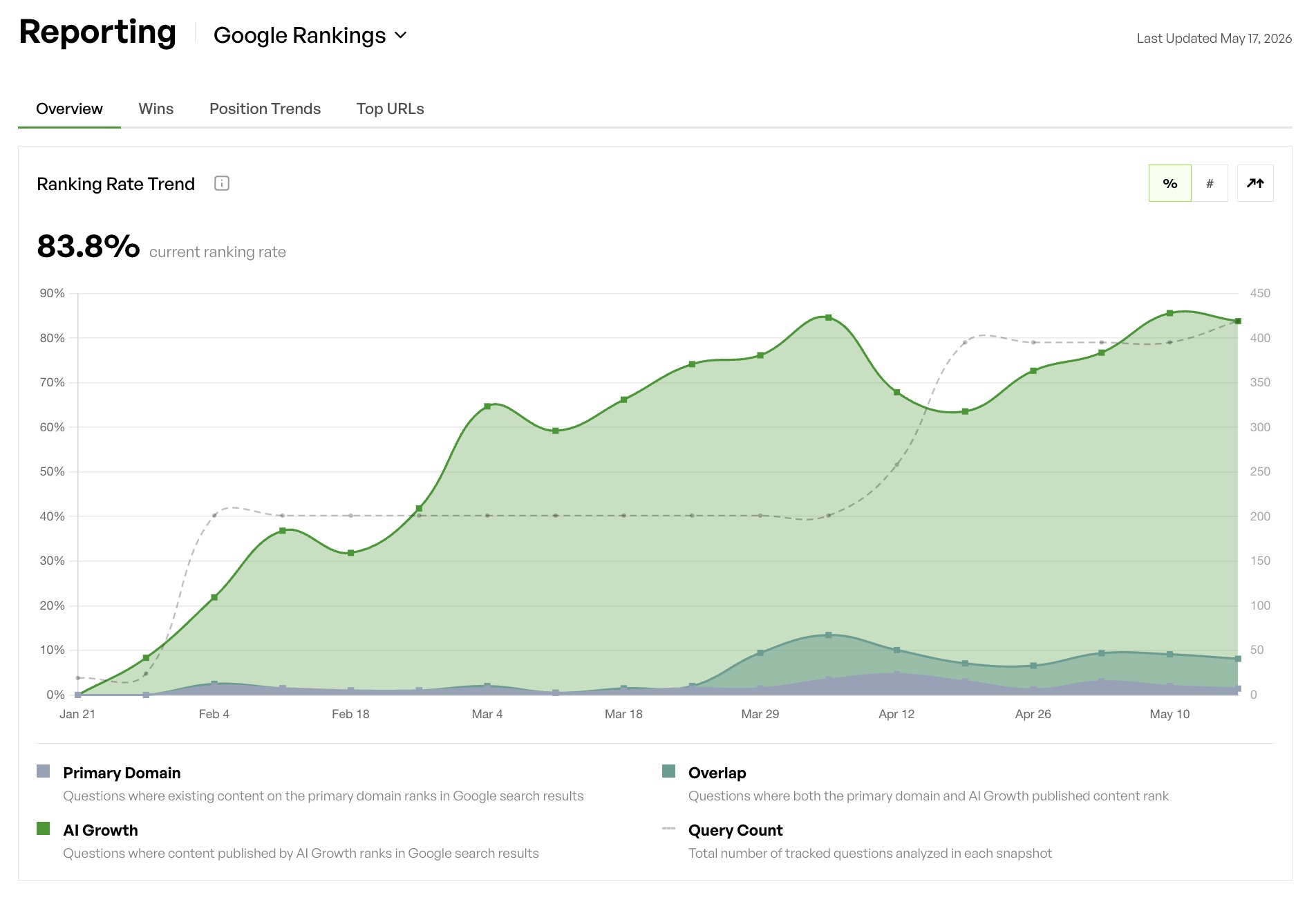
Agentic traffic from AI agents often bypasses the home page and targets lower-hierarchy pages, so measurement must operate at the article level, not the domain level. A reporting stack that cannot show which specific pages are being cited, by which bots, and at what frequency cannot support the content decisions that compound visibility over time.
8. Risks, Limitations, and Common Mistakes
The most common mistake is treating the agent card as a one-time configuration. Standards in the A2A ecosystem are actively evolving, and a file that accurately describes a brand’s endpoints in Q1 2026 may be incomplete or non-compliant by Q3. The second mistake is deploying an MCP server without the discovery layer. An MCP with no agent card is invisible to compliant agents, so both layers must ship together.
Relying on capped-prompt monitoring tools to substitute for agent-ready infrastructure is a structural error. Yext’s analysis of 17.2 million distinct AI citations collected globally in Q4 2025 found that citation behavior differs significantly by model, with no single universal optimization strategy. A tool that tracks fifty prompts across one model cannot surface the cross-model, cross-query citation patterns that drive real narrative control.
Ignoring self-healing content is the third critical mistake. AI citations tend to favor more recent material, which makes static evergreen pages structurally ineffective for sustained AI visibility. Content that is not refreshed decays in the model’s effective knowledge base, regardless of how well the agent card is configured.
9. Summary and Decision Support for CMOs
The criteria for owning the agent-readable surface are straightforward. A brand needs a declared agent card at /.well-known/agent-card.json that is kept current as standards evolve. That card is only useful if it points to a live MCP server, which means the two must be deployed together. The MCP server, in turn, relies on llms.txt and llms-full.txt to tell AI crawlers what content is available and in what format.
Even a perfectly configured discovery layer cannot sustain visibility without living content that self-heals rather than going stale, because AI citations favor recency. Finally, measurement at the article level, not the domain level, closes the loop by showing which specific pages are being cited and by which agents, so the content strategy can adapt to what the data reveals.
AI confidence increases through repeated and aligned signals across sources, while inconsistent messaging makes it harder for systems to associate and recommend a brand. The agent card anchors those signals as the primary declaration of identity and capability. Without it, every other optimization effort works against an undeclared foundation.
AI Growth Agent provisions the full agent-discovery stack automatically, including the agent card, MCP, llms.txt, schema, reverse proxy, bot tracking, and living content, within the first week of kickoff. Clients average more than 12,000 additional AI citations in the first twelve weeks, more than 100,000 additional bot visits, and a 20%+ lift in impressions. The engine handles every byte of the infrastructure. The brand owns the site, the content, and the results.
Frequently Asked Questions
What exactly is an agent card and why does it matter for brand visibility?
An agent card is a structured JSON file served at the canonical path /.well-known/agent-card.json on a brand’s domain. It declares the brand’s capabilities, available endpoints, and authentication requirements to autonomous AI agents. Before this standard existed, agents had to infer what a site offered from sitemap hints, robots.txt, and page content, which produced inconsistent and often inaccurate results.
The agent card gives that information a dedicated home, a structured format, and a known address. Any compliant agent, including those running on top of Google’s AI Mode, ChatGPT, and Perplexity, now knows where to start when evaluating a site. For brand visibility, the practical effect is clear. A site with a properly maintained agent card is treated as documented and trustworthy, while a site without one is treated as undiscovered. In a zero-click environment where the AI’s answer is the final answer for most users, that distinction determines whether a brand exists in the conversation at all.
How long does it take to implement a complete agent-discovery stack, and what does the process involve?
A complete agent-discovery stack, including the agent card, MCP server, llms.txt, llms-full.txt, schema markup, reverse proxy, and first published content, can be live within one week when provisioned through a headless marketing engine like AI Growth Agent. The process begins with a journalist-led kickoff interview that produces the brand manifesto, which serves as the source of truth for all content and configuration decisions.
From there, the keyword topology is mapped, the reverse proxy is configured to connect the blog to a subdirectory under the brand’s domain, and the full agentic technical SEO stack is deployed automatically. Content indexes in as little as ten days. Manual implementation by an internal engineering team takes significantly longer, typically weeks to months, and requires ongoing maintenance as A2A standards evolve. The difference in speed is not incidental because the AI search leaderboard is being established now, and brands that deploy first are the ones the next generation of agents finds first.
Who owns the agent card and the content it points to, and what happens if the standard changes?
The agent card is served from the brand’s own domain, so the brand owns it in the same way it owns any other file on its site. The content the agent card points to, including the MCP endpoints, the blog, and the discovery files, should also be owned by the brand rather than locked inside an agency’s infrastructure.
When the A2A standard evolves, as it has done continuously since its introduction in 2025, the agent card must be updated to remain compliant. This is where static manual implementations break down. A file that accurately describes a brand’s endpoints today may be incomplete or non-compliant within a quarter. AI Growth Agent rolls out standards updates across every client site within the week a new spec ships, so the agent card always reflects the current state of the protocol. Brands that manage their agent card manually must assign engineering resources to monitor the Linux Foundation’s A2A working group and update their configuration accordingly.
How does an agent card integrate with existing marketing infrastructure, and does it require changes to the main website?
An agent card does not require changes to a brand’s main website, CMS, or CDN. The file is served from the /.well-known/ directory on the brand’s domain, and the blog and MCP infrastructure it points to are connected through a reverse proxy rewrite, typically under a subdirectory.
The reverse proxy serves the entire AI Growth Agent site, including discovery files, MCP endpoints, and content, from the client’s domain without any assets touching the client’s origin server. The blog inherits the parent domain’s authority instead of starting from zero on a subdomain, which accelerates indexing and citation rates. The only integration step on the client’s side is the reverse proxy configuration itself, and AI Growth Agent generates setup documentation specific to the client’s host, whether Cloudflare, Vercel, or another provider. The main website and its existing structure remain untouched.
How is success measured once an agent card and the full agent-discovery stack are live?
Success is measured across four dimensions. Bot tracking shows exactly when ChatGPT, Perplexity, Gemini, and other AI agents crawl and cite specific pages, which provides article-level visibility into which content is being used as a source. Google Search Console impressions serve as an independent audit of indexing reach and organic visibility growth.
AI ranking tracks order of mention and citation context across the brand’s full query universe, updated weekly through fresh universe snapshots. Incremental visibility reporting isolates what the engine generated versus what the brand already had, so results are attributable rather than inflated by pre-existing authority. AI Growth Agent clients average more than 12,000 additional AI citations and more than 100,000 additional bot visits in the first twelve weeks, with a 20%+ lift in impressions. These metrics are reported week over week, which gives CMOs and business operators a defensible answer for every stakeholder conversation about what the investment is producing.