Written by: Mariana Fonseca, Editorial Team, AI Growth Agent
Key Takeaways for Winning AI Overview Citations
- Google AI Overviews now reach 1.7 billion monthly users and appear in 48% of tracked queries, delivering 35% more organic clicks to cited brands.
- AI Overviews select content based on relevance, authority, quotability, recency, and structured data rather than traditional ranking position.
- The 7-step system combines search intelligence mapping, evidence-based long-tail content, traditional and agentic technical SEO, living self-healing content, and incremental visibility tracking.
- Schema markup, primary-source validation, and entity relationships dramatically increase the likelihood of earning AI Overview citations.
- Schedule a consultation with AI Growth Agent to map your full query universe and see your first optimized article live within a week: Book your demo.
What Google AI Overviews Actually Cite
Google AI Overviews operate on a Retrieval-Augmented Generation (RAG) pipeline that first retrieves top-ranking documents via traditional search infrastructure, then extracts facts using Gemini’s attention mechanisms before synthesizing and mapping citations back to source URLs. The system does not simply promote the highest-ranking page. It selects the most extractable, trustworthy, and structurally clear content available in the retrieval pool.
Five source-selection criteria govern that choice: relevance, authority, quotability, recency, and structured data. Relevance requires a page to directly address the query. Authority incorporates domain backlink profile, E-E-A-T signals, and citation consistency. Quotability favors clear, self-contained statements the AI can extract without heavy editing. Recency strongly favors recently updated pages. Structured data helps the AI understand page context and increases citation probability.
Schema markup covering FAQ, HowTo, and Article types (plus Organization) makes pages 2.5–2.7 times more likely to be cited in AI Overviews than pages without schema, one of the highest-impact technical factors documented. That technical advantage compounds when combined with domain authority, because many AI Overview citations come from authoritative sources that also implement proper schema. Once a brand earns a citation, the metric that matters shifts. Citation context, where the brand appears in the answer and what claim it is cited for, replaces the old idea of a ranking number.
The 7-Step Checklist to Force AI Overview Inclusion
The seven steps work as a single system that moves from discovery to execution and then to measurement. First you uncover the full query universe that matters. Next you create long-tail content tailored to those queries. Then you make that content readable to both traditional crawlers and AI agents, keep it fresh over time, and finally measure the incremental visibility you gain.
Step 1: Map your full universe with Search Intelligence. Most brands track a handful of head terms and lose the rest of the conversation by default. URLs ranking for multiple related fan-out queries are more likely to appear in AI Overviews than pages ranking only for the primary term. AI Growth Agent runs hundreds of real searches weekly, processes title structures, forum discussions, People Also Ask signals, and query fan-out, and delivers a complete portrait of the traditional search landscape alongside competitor domain rankings and top-ranking URLs. A mature client universe reaches 1,600+ queries, with 3,000+ searches run every week to refresh the snapshot.
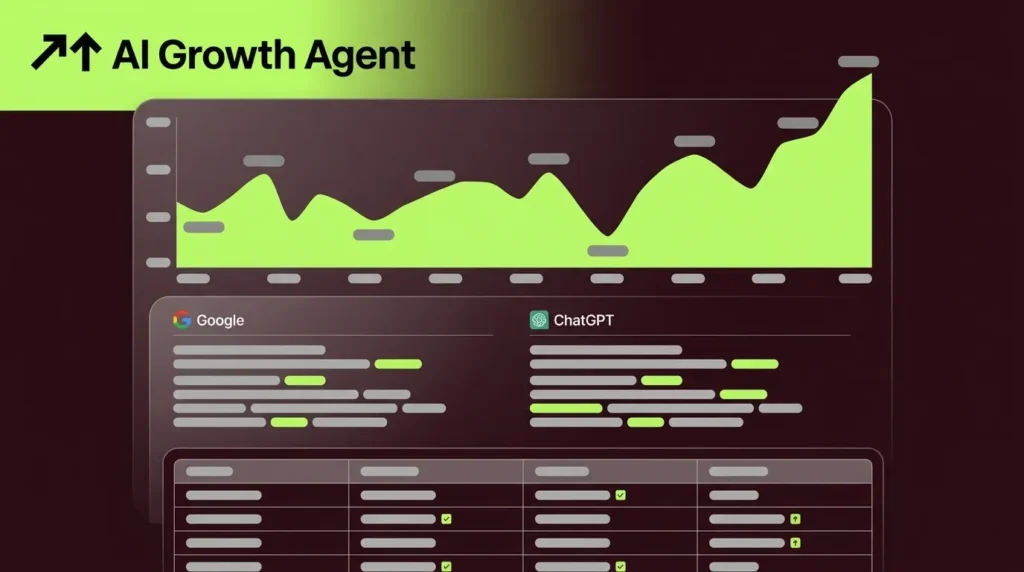
Step 2: Build evidence-based long-tail content from real-time Google and ChatGPT data. Long-tail queries of seven or more words trigger AI Overviews at a 46.4% rate, compared to 9.5% for single-word queries. Real-time AI Overview and ChatGPT results define which long-tail queries deserve investment. Every article is built against a specific query with primary-source validation, anti-hallucination checks, and journalistic rigor, not generated from a model’s training memory.
Step 3: Implement traditional technical SEO for machine-readable pages. Clear H2 and H3 headings that mirror common user questions, combined with bullet points and HTML data tables, increase extractability for AI summaries. Each AI Growth Agent site uses highly structured HTML and rich schema markup across Article, FAQ, HowTo, Author, Product, and SoftwareApplication types. External links are sanitized, sitemaps and robots.txt are configured correctly, and web stories are generated automatically. Schema errors reduce machine readability and eligibility for both rich results and AI extraction, so the full schema suite is provisioned and validated automatically.
Step 4: Deploy agentic technical SEO for AI agents and MCP. Traditional technical SEO is the entry ticket. Agentic technical SEO creates the competitive edge with AI agents. AI Growth Agent was the first to bring Blog MCP to market, with clients running it in summer 2025, roughly a year before Google released Web MCP. Every site ships with Blog MCP (compatible with Chrome 146+ and other WebMCP-enabled browsers), OpenAI discovery and Agent Card guidance served via /.well-known/, natural language query parameters via /?s={query} that auto-trigger personalized internally linked responses, Markdown served to agent crawlers, and llms.txt and llms-full.txt published so AI surfaces can read the brand the way they need to.
Step 5: Create living, self-healing content that stays fresh. Content freshness strongly influences AI citations overall, with median cited age around 148 days on Perplexity and multipliers such as 3.2× reported for very recent (30- or 130-day) content versus slightly older material across AI platforms. AI Growth Agent content self-heals and updates over time. When the year turns, every article in a sector is refreshed automatically. Stale articles are triggered for refresh by Google Search Console signals and bot-traffic awareness.
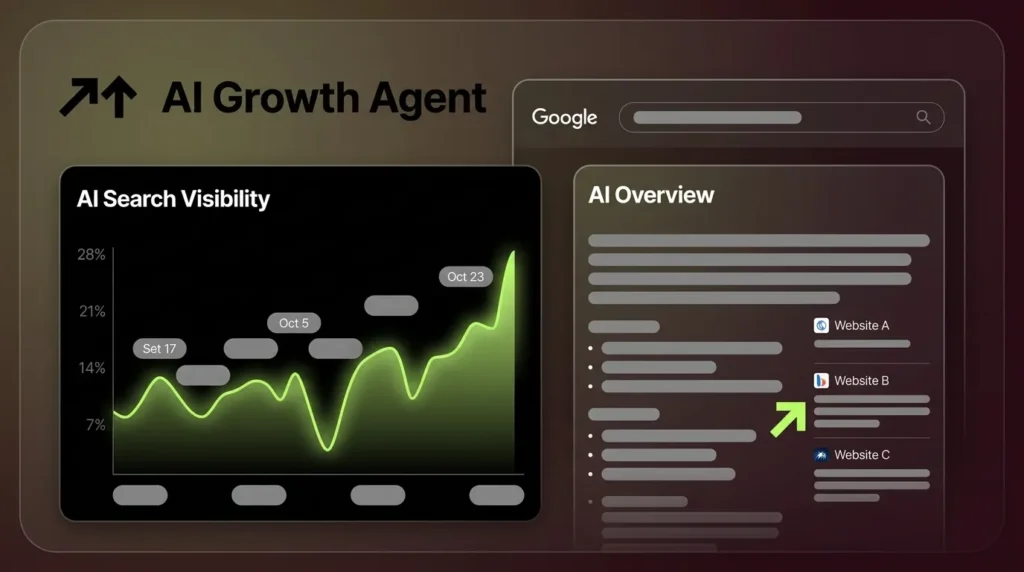
Step 6: Track the four intelligence pillars and citation context. Search Intelligence maps the full traditional search landscape. AI Analytics covers brand value and consumer behavior across the whole journey. Bot Tracking records every crawl, citation, and training sweep from both traditional crawlers and AI training agents. AI Ranking tracks order of mention and citation context as the new leaderboard, because AI answers have no static ordered list. Visibility is the leading indicator; traffic is the outcome. All four pillars must be visible in the same week so teams can act quickly.
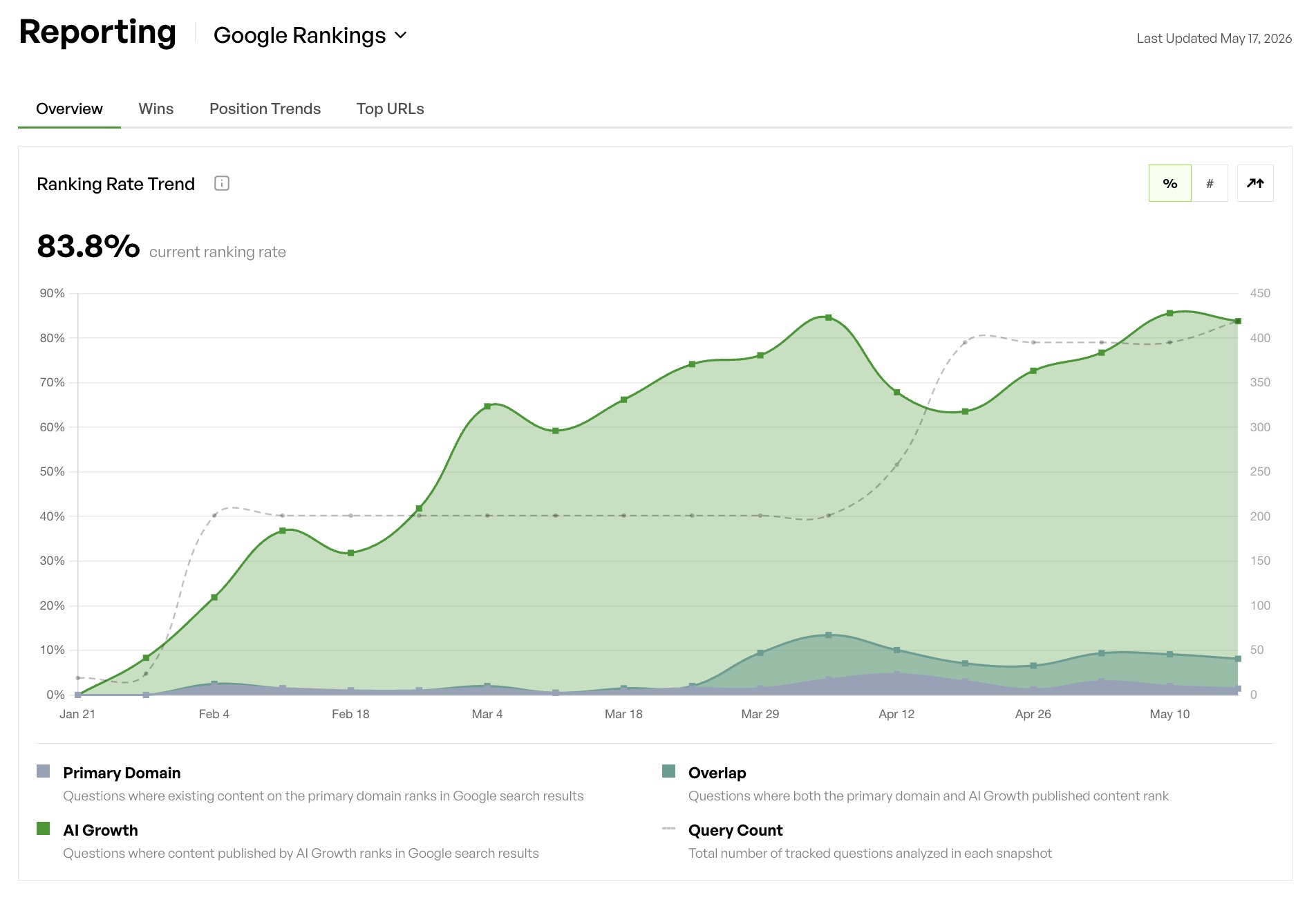
Step 7: Measure incremental visibility and isolate new citations. AI Growth Agent publishes into a separate environment and reports week over week where its content is driving new visibility, distinct from visibility the brand already had. Between 40% and 60% of cited sources in AI responses change from month to month, which makes weekly measurement essential. Across the first twelve weeks, AI Growth Agent clients average more than 12,000 additional AI citations and mentions, over 100,000 additional bot visits, and a 20%+ lift in impressions. This closes the loop on the seven-step system and shows exactly how much new visibility the engine creates.
Ready to implement the full seven-step system? Start here.
How to Be Visible in Google AI Overviews
Brands already ranking in traditional search still miss AI Overviews because ranking is only the entry ticket to the retrieval pool, not a guarantee of citation. In many verticals, a significant share of AI Overview citations come from sources outside the organic top 10. The AI selects for extractability and authority, not position.
Citation context now functions as the ranking signal. A brand cited in position one of an AI Overview for a high-intent query is more valuable than a brand ranking #1 in blue links on the same query, because Pew Research found users clicked a traditional search result in only 8% of visits when an AI Overview was present. Visibility in the answer is the asset. The path to that visibility runs through structured content, validated primary sources, entity relationships, and the agentic technical stack that makes a brand readable to the systems doing the citing.
How to Trigger AI Overview on Google
Triggering an AI Overview focuses on the types of queries you target, while being featured focuses on whether your brand earns the citation inside that Overview. AI Overviews are more common on longer informational queries. Informational queries drove 91.3% of AI Overview triggers in early 2025, though commercial and navigational shares have grown steadily since. The practical implication is that content targeting specific, question-based, long-tail queries is the highest-probability path to triggering an AI Overview and earning a citation within it.
The shift to agentic methods changes the trigger calculus further. AI agents now pass natural language queries directly into URLs, reason across multiple sources, and act on behalf of users without a human typing a search. Sites that expose natural language query parameters, Markdown for agent crawlers, and MCP endpoints are readable to these agents. Sites that do not are invisible to a growing share of the traffic that matters most.
How to Be Featured in AI Overviews
Primary-source validation is the differentiator between content that earns citations and content that does not. Including citations, quotations, and statistics can boost source visibility by over 40% across various queries, per research from Princeton, IIT Delhi, Georgia Tech, and the Allen Institute for AI. Using semantic triples, subject-predicate-object sentences, led to a 642% increase in AI citations in HubSpot’s reporting.
Structured data and entity relationships amplify that effect. Pages with a high number of recognized entities have a higher probability of AI Overview selection. Connected schema using mainEntity, about, and mentions properties explicitly maps relationships between a page and target entities, helping Gemini build an internal representation of the topic. Every article AI Growth Agent publishes ships with this entity and schema architecture automatically, with no technical action required from the client.
Why Am I Not Getting an AI Overview
The most common failure points are stale content, missing or broken schema, lack of primary-source validation, and monitoring tools that cap the number of tracked prompts. Only 11% of sites are cited by both ChatGPT and Perplexity, meaning single-platform tracking misses 60-80% of AI visibility. A brand that monitors 50 prompts on one platform has no view of the vast majority of queries where it is either winning or losing the conversation.
The December 2025 Core Update extended E-E-A-T requirements beyond YMYL topics to all content categories, meaning every niche now requires expertise signals. Content without named authors, linked bios, visible publication dates, and validated external citations is structurally ineligible for the majority of AI Overview citations regardless of how well it ranks. Broken schema compounds the problem, as noted earlier, because schema errors eliminate eligibility for both rich results and AI extraction, and pages with poor Core Web Vitals or heavy client-side JavaScript are deprioritized in the retrieval phase.
The fix must be comprehensive rather than incremental. Brands need the full stack working together: traditional technical SEO, agentic technical SEO, living content, and incremental visibility measurement operating as one system.
How to Appear in AI Overviews 2026
The move from observation to execution defines 2026. Monitoring tools tell a brand it is missing from AI answers. They do not produce the content, own the publishing, or act on the data. Meaningful improvement in citation rates requires consistent content production over multiple weeks, with further gains over the following months depending on competitive intensity and content volume.
Headless marketing is the architecture that makes execution possible at scale. The brand keeps its curated main site. AI Growth Agent stands up a fully optimized blog the brand owns, connected through a reverse proxy rewrite under a subdirectory or subdomain. The engine writes, publishes, monitors, self-heals, and reports. Large language model optimization works natively in natural language, which makes it structurally stronger than legacy SEO for the surfaces where customers now resolve trust. The brands cited in AI search this year are training the next generation of models with their own narrative. Brands that wait are training the next generation with whatever happens to be sitting on the open web.
See how headless marketing works for your brand—book a strategy session.
Frequently Asked Questions
How long does it take to start appearing in Google AI Overviews after implementing this system?
The first article is typically live within one week of kickoff. Content has indexed in as little as ten days and often within two weeks. The standard engagement is a three-month pilot because indexing timelines vary by industry and competitive intensity, but clients consistently see citation movement early. Leva Sleep now receives over 10,000 ChatGPT citations per month. Jelly earned its first citation within three weeks. The system is built for speed, not a year-long ramp.
Does a brand need a technical team to implement agentic technical SEO?
No. The entire technical and agentic SEO stack, including Blog MCP, llms.txt and llms-full.txt, /.well-known/ discovery, full schema suite, robots.txt, sitemaps, web stories, instant indexing, autoredirects, and 404 tracking, ships automatically with every article and every site AI Growth Agent publishes. The only integration step on the client’s side is the reverse proxy rewrite that connects the blog to a subdirectory under their domain. Everything else is included in every package, and the internal team gives feedback in plain language while the engine learns.
How is incremental AI Overview visibility measured separately from existing brand visibility?
AI Growth Agent publishes into a separate environment so it can report only the visibility it actually generates, never taking credit for visibility the brand already had. Reporting covers week-over-week citation growth, bot traffic by article, Google Search Console impressions as an independent audit, and the four intelligence pillars: Search Intelligence, AI Analytics, Bot Tracking, and AI Ranking. Citation context, where the brand appears in the answer and what claim it is cited for, is tracked as the new ranking signal. This cross-referenced data set distinguishes incremental visibility reporting from a monitoring dashboard that only shows whether a brand appears for a capped set of prompts.
Why do brands that already rank well in traditional search still miss AI Overviews?
Traditional ranking is the entry ticket to the retrieval pool, not a guarantee of citation. The AI selects for extractability, authority, recency, and structured data, not position. In Finance, a significant share of AI Overview citations come from sources outside the organic top 10. A brand can hold position one in blue links and still be absent from the AI Overview on the same query if its content lacks named authors, validated primary sources, entity-rich schema, or recent updates. The full agentic technical stack, including MCP endpoints, llms.txt, and natural language query parameters, is also required for the growing share of traffic driven by AI agents rather than human searches.
What makes AI Growth Agent different from a GEO monitoring tool or an SEO agency?
Monitoring tools track whether a brand appears for a capped set of prompts and stop there. They are a rearview mirror. SEO agencies are slow, expensive, and structurally too disconnected from AI surfaces to keep pace with the citation cycle. AI Growth Agent is neither. It produces the content, owns the publishing, deploys the full traditional and agentic technical SEO stack, self-heals content over time, and proves the incremental result week over week. One engine replaces the SEO agency, the content tool, the web agency, the GEO monitor, the schema plugin, the analytics stack, and the PR firm, at a flat fee with no per-article charges, credit limits, or per-prompt billing. The client owns the site and all the content. The engine is the steering wheel, not the dashboard.