Written by: Mariana Fonseca, Editorial Team, AI Growth Agent
Key Takeaways
- AI Overviews now dominate search with 93% zero-click rates in AI Mode sessions, so proactive narrative control is essential for brand visibility.
- Traditional SEO tools miss 95% of AI-generated long-tail queries, which leaves most brand conversations unaddressed.
- Four intelligence pillars, including search, AI analytics, bot tracking, and AI ranking, determine whether models cite your content.
- Living content with automated weekly refreshes stays 25.7% fresher than static pages and drives sustained AI citations.
- AI Growth Agent maps your full query universe, publishes validated living content, and reports incremental results; claim your AI search territory with a tailored demo.
The Discovery Shift: Why Traditional SEO No Longer Controls Visibility
58.5% of U.S. Google searches and 59.7% of EU Google searches result in zero clicks, according to SparkToro’s 2024 Datos research. That number climbs to 93% in Google AI Mode sessions (Semrush, September 2025). These zero-click sessions mean users receive answers without visiting any website, and the 93% figure represents the most extreme version of this shift.
The behavioral gap makes the stakes concrete. Roughly 83% of users report skepticism toward AI answers, yet only 8% click through to verify the sources cited inside AI Overviews. For most people, whatever the model says becomes the answer. A brand that does not appear in that answer effectively disappears from the conversation.
Traditional SEO was built for a world where users clicked blue links, and that world is contracting. The new deciding factor is whether AI surfaces can find, trust, and cite your content when a customer asks a question.
See exactly where AI is defining your brand with a custom query universe analysis.
Narrative Control: From Reactive Defense to Upstream Ownership
Narrative control used to mean burying a bad review or ranking for “is this brand trustworthy.” That approach is structurally obsolete. Customers still resolve trust through generative AI, but the mechanism has changed entirely.
The new version is upstream narrative ownership. Your team produces the content models use to describe your brand, in formats and structures they can parse, with the validation that earns the citation. Your content appears across the long tail of queries customers actually ask, not only the head terms a brand pre-decided to defend.
Large language model optimization (LLMO) works natively in natural language, which makes it fundamentally stronger than legacy SEO. Legacy SEO tells you where your brand ranks. LLMO changes what the answer is. Traditional search and monitoring tools act as a rearview mirror. Narrative control through living content functions as the steering wheel.
That steering wheel requires visibility across four distinct intelligence domains. Without all four working together, brands operate blindly in AI search.
The Four Intelligence Pillars That Shape AI Citations
Four kinds of intelligence shape what an AI surface says about a brand. Any team that wants to win this channel needs visibility into all four simultaneously.
- Search Intelligence. A complete portrait of the traditional search landscape, including positioning, competition, search volume, and the structure of who is already winning. Raw situation turns into actionable diagnosis.
- AI Analytics. Brand value and consumer behavior across the full journey, from external touchpoints like Google and AI-tool queries through content consumption, demographics, and sentiment.
- Bot Tracking. Every bot interaction, including traditional crawlers and AI training agents, across every crawl, citation, and training sweep. Visibility into who is reading you becomes the prerequisite for knowing whether you are being read at all.
- AI Ranking. AI answers carry no static ordered list, so order of mention and citation context become the new leaderboard. Where your brand appears in the answer, and how that position evolves week over week, becomes the metric that matters.
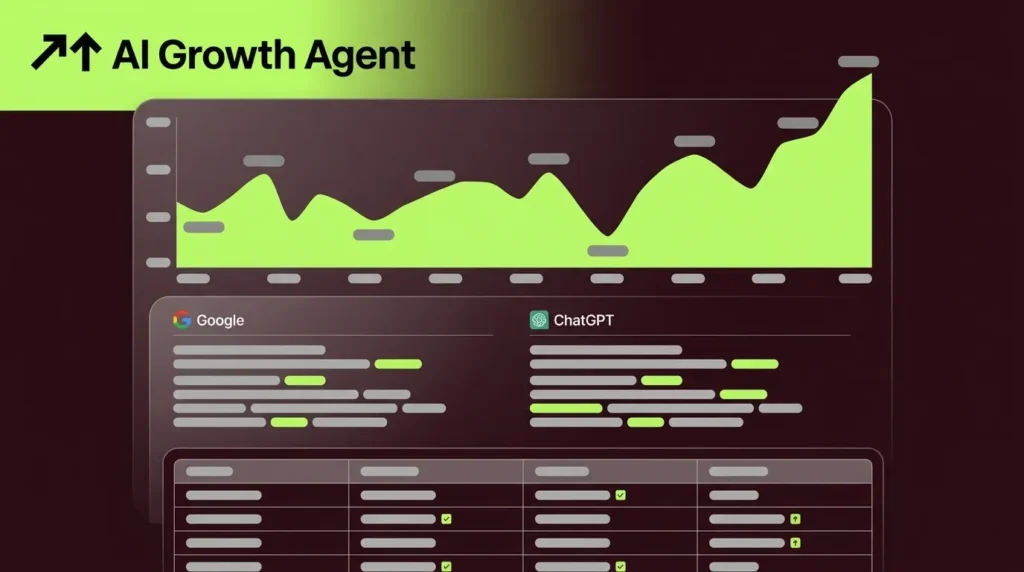
The following comparison shows how monitoring-only tools fall short across these capabilities compared to a full publishing engine that acts on the intelligence it gathers.
| Capability | Monitoring Tools | Full Publishing Engine (AI Growth Agent) | Why It Matters |
|---|---|---|---|
| Query coverage | Capped prompt set (e.g., ~50 prompts) | 1,600+ queries for mature clients, refreshed weekly | 95% of fan-out sub-queries generated by AI search systems have zero search volume and are invisible to standard SEO tools (AirOps). |
| Content production | None | 2 to 50 validated articles per day per client | Monitoring identifies gaps, while publishing closes them with new content. |
| Content freshness | Static snapshots | Self-healing, living content with automated refresh cadences | AI-cited content is 25.7% fresher than traditionally ranked content (Ahrefs, 17M citation analysis). |
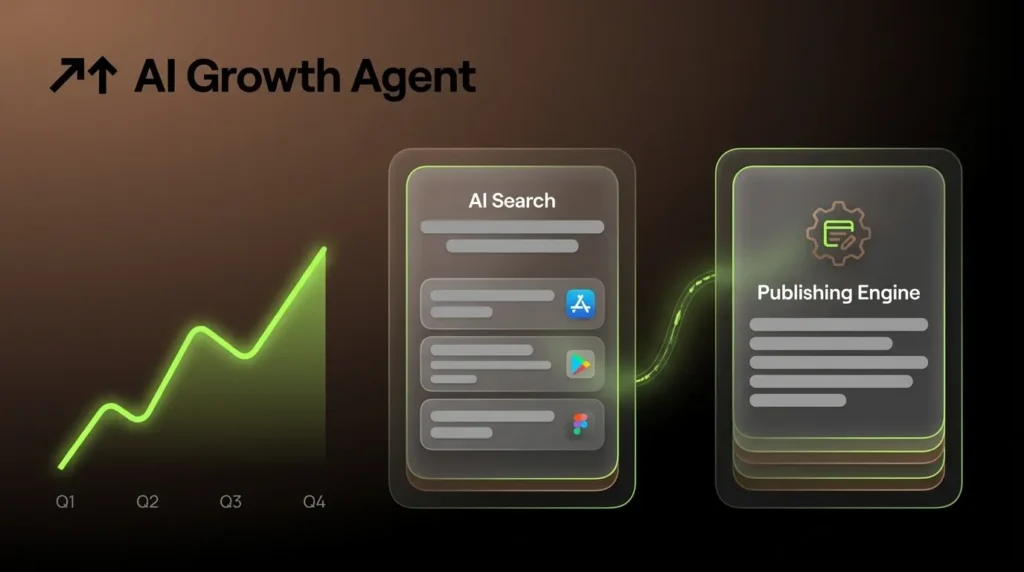
| Incremental proof | Visibility deltas on tracked prompts only | +12,000 AI citations, +100,000 bot visits, +20% impressions in 12 weeks (average) | Isolated incremental reporting separates new gains from existing brand visibility. |
Activate all four intelligence pillars for your brand with a focused strategy session.
Why Monitoring Alone Cannot Match a Publishing Engine
Monitoring tools answer one question: does your brand appear for a capped set of prompts. These tools do not produce content, own publishing, or act on the data they surface. A brand learns it is missing from AI answers and then faces the problem with no system to solve it.
The gap is structural. 95% of fan-out sub-queries generated by AI search systems have zero search volume and are invisible to standard SEO tools (AirOps). Capped-prompt monitors show a fraction of the universe by design. The rest of the conversation happens without the brand.
Headless marketing provides the architecture that closes this gap. One engine replaces the SEO agency, the content tool, the web agency, the GEO monitor, the schema plugin, the analytics stack, and the PR firm. The brand keeps its curated main site. The engine runs the publishing, technical SEO, bot tracking, and self-healing behind it, with no headcount required on the brand’s side.
Building an Evidence-Based Query Universe
A query universe starts with seed terms, which are the strategic anchor topics that organize a brand’s market. Each seed term spawns dozens of long-tail queries underneath it. AI systems decompose a single user query into multiple simultaneous sub-queries covering equivalent phrasing, follow-up questions, broader generalizations, more specific specifications, and clarification variants. Coverage of only head terms leaves most of the conversation unaddressed.
AI Growth Agent uses real-time AI Overview and ChatGPT search results as the objective function for identifying which long-tail queries are worth pursuing. The system runs 3,000+ searches every week to refresh the universe snapshot, and mature clients reach universes of 1,600+ queries. A new account typically starts with three to four hundred queries and expands as it goes after more of the market. Prompt count never appears as a billed metric.
Agentic Technical SEO Requirements for AI Surfaces
Traditional technical SEO remains table stakes: structured HTML, full metadata, rich schema markup across article, author, review, product, and organization types, internal linking, sanitized external linking, proper sitemaps, and a detailed robots.txt. These elements help search engines index and rank content, but they do not address how AI agents discover, parse, and cite information. AI surfaces require an additional layer designed specifically for machine consumption.
Every AI Growth Agent site ships with agentic technical SEO out of the box, delivered in week one.
- Blog MCP with schema, manifest, discovery, and capability guidance exposed to agents, also compatible with Chrome 146+ and other WebMCP-enabled browsers.
- llms.txt and llms-full.txt published so AI surfaces can read the brand the way they need to.
- Full schema suite provisioned automatically and kept current.
- Reverse-proxy site setup connecting the blog to a subdirectory or subdomain under the brand’s domain, with no changes to the existing site structure.
- Instant indexing, autoredirects, and 404 tracking included in every package.
- OpenAI discovery and Agent Card guidance served via /.well-known/.
- Natural language query parameters via /?s={query} that auto-trigger personalized, internally linked responses for agent crawlers.
Living Content Mechanics That Prevent Decay
AI-cited content is 25.7% fresher than content appearing in traditional organic results, with ChatGPT citing URLs 393 to 458 days newer on average (Ahrefs, analysis of 17 million citations). Recently updated pages tend to receive more citations in AI Mode. Freshness must be substantive. AI systems can compare versions and detect superficial date changes, so updates require new statistics, expanded sections, and revised claims.
AI Growth Agent content behaves as living content that self-heals and updates over time. When the year turns, every article in a sector refreshes automatically. The dateModified signal updates on substantive changes, not cosmetic ones, consistent with Google’s guidance that updates to main content, structured data, or links constitute significant changes. Every article’s relationships, performance, and bot and Search Console data are centralized so authority compounds instead of decaying.
Incremental Visibility Reporting That Defends Results to the CEO
AI Growth Agent publishes into a separate environment so it reports only the visibility it actually generates, never the visibility a brand already had. Reporting isolates new citations, bot visits, and impression lifts week over week, and it cross-references per-article bot tracking, Google Search Console, and citation data that no single monitoring tool brings together.
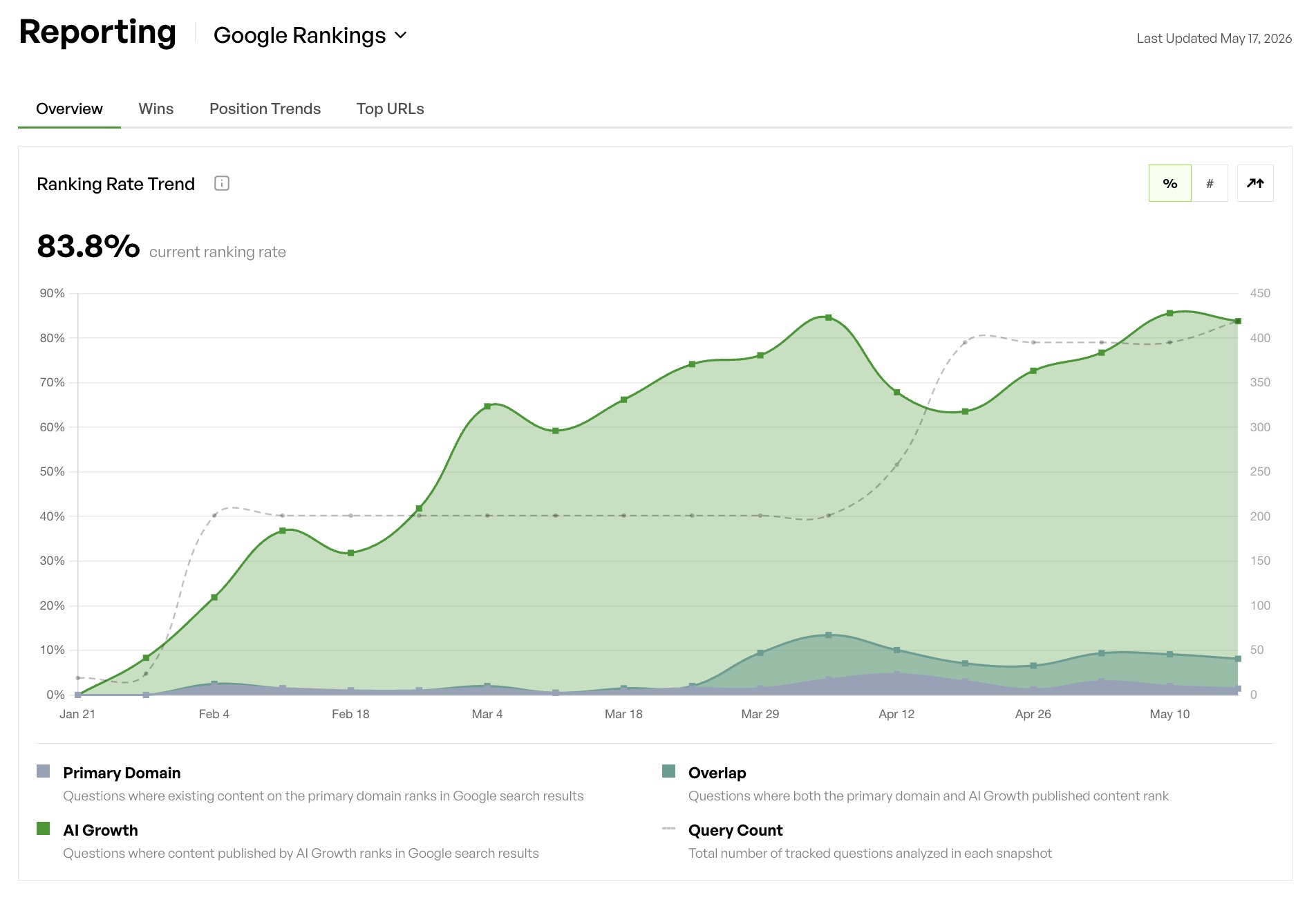
Across the first twelve weeks, clients average more than 12,000 additional AI citations and mentions, over 100,000 additional bot visits, and a 20%+ lift in impressions. Leva Sleep became the most mentioned retailer for adjustable beds in Canada, with ChatGPT citing its content over 10,000 times per month and $40,000 to $50,000 in deals closed in under three weeks from AI-driven buyers. Breadless achieved a 30x lift in Google Search Console impressions over six months and is now the most recommended healthy franchise in the US ahead of CAVA, Rush Bowls, and Sweetgreen.
7-Step Action Framework to Own Your AI Search Presence
- Manifesto creation. A journalist-led interview builds the single source of truth for brand voice, factual references, deny lists, and personalization controls. Every article draws from this foundation.
- Universe mapping. Seed terms are identified and long-tail queries expand using real-time Google and ChatGPT data as the objective function. The result is an evidence-based topology, not a keyword dump.
- Topology selection. The brand and AI Growth Agent jointly choose which seed terms to attack first, with white-space analysis showing where the market remains uncontested.
- Single-shot validated publishing. A multi-agent orchestration produces content from the manifesto, validates every claim and source against primary evidence, runs anti-hallucination checks, and delivers ready-to-publish articles without repeated briefing cycles.
- Technical deployment. Blog MCP, llms.txt, the full schema suite, reverse-proxy site setup, instant indexing, and the complete agentic technical SEO stack go live in week one. No engineering hours are required on the brand’s side.
- Weekly refresh. The universe snapshot updates with 3,000+ searches per week. Living content self-heals as the world changes, and stale articles are flagged and refreshed automatically.
- Incremental reporting. Bot visits, AI citations, impressions, and Google Search Console data are reported week over week, which isolates exactly what the engine generated versus existing brand visibility.
This model represents headless marketing, which is marketing by and for the robots, with no headcount. One engine replaces the agency stack and delivers the first article live within a week of kickoff.
Get your first validated article live in one week by starting a pilot engagement.
Frequently Asked Questions
How long does it take to see the first results?
The first article is typically live within one week of kickoff. Content has indexed in as little as ten days and often within two weeks. The standard engagement is a three-month pilot, because indexing timelines vary by industry and domain authority, but clients consistently see movement in bot traffic and AI citations early in the engagement. Leva Sleep, Jelly, and Exceeds.ai all received their first AI citations within two to three weeks of launch.
Who owns the site and the content?
The client owns the site and every article published to it outright. AI Growth Agent stands up a fully optimized blog styled to match the brand’s existing site, connected through a reverse proxy rewrite or subdomain. There is no agency dependency, no lock-in, and no situation where a vendor controls the brand’s property. The client can take the site and its content at any time.
Does this require any integration work on our side?
The only integration step on the client’s side is the reverse proxy rewrite that connects the blog to a subdirectory or subdomain under the brand’s domain. AI Growth Agent generates setup documentation for the client’s host, whether Cloudflare, Vercel, or another provider. Everything else, including the full technical and agentic SEO stack, schema, bot tracking, Blog MCP, llms.txt, instant indexing, and autoredirects, is included in every package and requires no action from the client’s team.
How does incremental visibility reporting work, and how do we prove results to leadership?
AI Growth Agent publishes into a separate environment and reports only the visibility it generates, never taking credit for visibility the brand already had. Reporting cross-references per-article bot tracking, Google Search Console as an independent audit, and citation data across AI surfaces. The result is a defensible week-over-week record showing new citations, bot visits, and impression lifts that are attributable to the engine’s output. Clients who measure conversion most effectively capture traffic source at the moment of sale and consistently see a lift in organic leads after starting.
What happens when AI search changes again?
Living content provides the structural answer to this concern. Every article self-heals and updates over time, and the universe snapshot refreshes with 3,000+ searches every week, so the brand’s content reflects the current state of AI search rather than a snapshot from the day it was published. When a new AI surface emerges or a model update shifts citation behavior, the engine adapts the content plan and the technical stack without requiring a new agency RFP or a year-long ramp.
Conclusion
Traditional search tools show you where your brand stands. The zero-click reality, where AI Overviews now appear in more than 25% of searches and reduce position-one click-through rates by 58%, means standing is no longer enough. The brands cited in AI search this year are training the next generation of models with their own narrative. The brands that wait are training it with whatever happens to be on the open web.
AI Growth Agent is the only engine that maps the full query universe, produces validated living content single-shot, deploys the complete agentic technical SEO stack in week one, and reports incremental visibility in isolation from existing brand equity. It replaces the agency stack with one headless engine at a flat fee, with no per-prompt billing and no capped universe.
Traditional search tools show you where your brand stands. AI Growth Agent makes your brand the answer. Make your brand the answer AI surfaces cite by scheduling your consultation.