Written by: Mariana Fonseca, Editorial Team, AI Growth Agent
Key Takeaways
- Headless marketing separates your brand’s AI search presence from traditional agency stacks and supports zero-headcount marketing built for AI agents.
- AI search surfaces now drive discovery, with zero-click rates at 69% and AI Overviews on nearly half of queries, so rankings matter less than narrative control.
- This architecture maps your full query universe, publishes living self-healing content, and earns citations through structured, validated material AI agents trust.
- Compared with agencies, DIY chatbots, or monitoring tools, a headless engine launches faster, scales further, and delivers owned results without internal technical resources.
- Brands like Leva Sleep and Breadless have turned AI citations into revenue; book a strategy session with AI Growth Agent to map your universe and control your narrative from day one.
The Discovery Shift to Zero-Click AI Surfaces
Discovery now happens inside AI surfaces, not just on traditional search results pages. For years, ranking on Google and buying attention on Meta defined discoverability. That model is being rewritten in real time.
Google AI Mode crossed 1 billion monthly active users within its first year, with queries more than doubling every quarter since launch. A SparkToro and Datos clickstream study found that 58.5% of all U.S. Google searches resulted in zero clicks (no results clicked at all), establishing the zero-click baseline before AI Overviews scaled widely. Similarweb data shows that figure accelerated to 69% between May 2024 and May 2025, a 13-percentage-point rise that coincided with the AI Overview rollout.
User behavior inside these AI experiences looks very different from classic search. A Pew Research Center study of 900 U.S. adults’ browsing activity found that when an AI Overview is present, users clicked a traditional result only 8% of the time, versus 15% without one. Roughly 83% of people report skepticism toward AI answers, yet only about 8% ever click through to verify them. For most users, whatever the AI surface says becomes the answer.
For brands with an established identity, marketing now centers on narrative control. The question is what AI says about the brand when a customer asks. Narrative control used to be reactive. Today it starts upstream, by producing the content AI surfaces will use to describe the brand, in structures they can read, with the validation that earns the citation.
Core Concepts: Mapping the Universe and Powering the Four Intelligence Pillars
Headless marketing relies on a specific vocabulary that departs from legacy SEO language. These concepts define how the system sees your market and measures progress.
The universe is the full set of queries and prompts that describe a brand’s market, head terms and long tail together. Most brands track a handful of head terms and lose the rest of the conversation by default. The long tail is where the vast majority of customer queries actually live. AI agents search the long tail. Brands that focus only on head terms stay blind to most of their own market.
Seed terms act as strategic anchor topics that organize the universe. Each seed term spawns dozens of long-tail queries beneath it. Citation context replaces the old idea of a ranking number. It describes where the brand appears in an AI answer, who it is grouped with, and what claim it is cited for. Living content updates and self-heals over time so the brand’s presence does not decay as the world changes. Incremental visibility isolates the visibility a new effort actually generated, separate from what the brand already had.
Four pillars of intelligence form the data backbone of any headless marketing engine, and together they explain why AI agents surface or ignore your brand. Search Intelligence maps the traditional search landscape, including positioning, competition, and search volume, and turns a raw situation into an actionable diagnosis. AI Analytics tracks brand value and consumer behavior across the full journey, from external touchpoints through content consumption and sentiment. Bot Tracking records every bot interaction, from traditional crawlers to AI training agents, including each crawl, citation, and training sweep. AI Ranking tracks order of mention and citation context, the new leaderboard in a world where AI answers carry no static ordered list. Together, these four pillars explain not just where you appear, but why AI agents choose to cite you and how that behavior changes over time.
How AI Surfaces Read, Cite, and Act on Content
AI search surfaces behave like automated researchers, not human visitors. They read, cite, and act on whatever the model can find and trust. AI Overviews reached 2.5 billion monthly active users globally as of May 2026, and BrightEdge data from February 2026 found AI Overviews triggered on approximately 48% of all tracked queries, up 58% year over year.
Citation behavior inside these surfaces breaks the link between classic rankings and visibility. A BrightEdge analysis found that only 17% of AI Overview citations come from pages ranking in the organic top 10 (a figure that remained flat), while separate Ahrefs data showed a drop from 76% in mid-2025 to 38%. Traditional rank no longer serves as a reliable proxy for AI citation. Marketers must structure content for machines that interpret and reassemble information rather than solely for human readers, because AI agents browse and respond on behalf of users, making clear structure, metadata, and content accessibility essential.
Brands cited in AI Overviews earn 35% more organic clicks and 91% more paid clicks than non-cited brands on the same SERP. The zero-click reality concentrates value instead of removing it. The brand that earns the citation earns the trust, and trust converts.
Comparing Approaches: Agency Stacks, DIY, Monitoring Tools, and the Headless Engine
Understanding how AI surfaces read and cite content clarifies what any solution must deliver: structured, validated material that AI agents can trust. When a marketing leader decides to take AI search seriously, four paths are available, each with a distinct profile of speed, scalability, and outcome.
Traditional agency stacks represent the original old way. An RFP often runs three months, followed by three more to produce the first assets. Nearly a year can pass before anything meaningful is in motion, and that time goes into briefing, onboarding, and chasing. The agency often controls the site, creating a dependency the brand cannot easily exit. Agencies also move too slowly to keep pace with AI search, which updates its citation landscape weekly.
DIY with a chatbot has become the new trap. Producing one good article is possible. Producing the second requires rerunning the entire process, with quality that drifts from one piece to the next. The transition to AI-agent-optimized marketing architectures is architectural rather than incremental, transforming disconnected steps into a coordinated system where each stage informs the next. A chatbot alone does not create that system.
Monitoring-only tools such as GEO trackers tell a brand whether it appears for a capped set of prompts. Monitoring does not create action. These tools identify the problem and leave the brand to solve it, usually without a publishing system, schema, or self-healing capability behind the fix.
The headless engine model replaces the entire stack with one engine. The brand owns the site, the content, and the reporting. The engine handles technical SEO, schema, bot tracking, publishing, and self-healing. No additional internal team is required on the brand’s side.
Key Factors to Evaluate Before Choosing an Approach
Five practical factors determine which approach fits a given organization.
Team capacity. Marketing organizations have been shifting capabilities toward AI adoption, but most internal teams remain non-technical and cannot deliver schema, agentic technical SEO, or the structural requirements AI surfaces need to cite a brand. A headless engine removes that dependency entirely.
Technical requirements. Websites serving AI agents should implement schema.org markup, accessible APIs or real-time data feeds, clear structured content, and trust signals. Full agentic technical SEO, including Blog MCP, llms.txt, llms-full.txt, agent discovery via /.well-known/, and natural language query parameters, requires engineering capability most marketing teams do not have in-house.
Data foundation. The universe must be mapped from real-time data, not a static keyword list. Within the 48% baseline of queries that trigger AI Overviews, BrightEdge data shows B2B technology queries trigger AI Overviews 82% of the time and healthcare informational queries trigger them 83.6% of the time. A capped prompt set misses most of that surface area.
Scalability. Only 41% of marketing teams can prove AI ROI in 2026, down from 49% the prior year, as leadership now demands measurable business outcomes beyond productivity gains. Scalability without measurement becomes activity, not growth.
Ownership. Many brands do not own their own site. An agency controls it, and every change becomes a dependency. A headless engine stands up a property the brand owns outright, connected through a reverse proxy rewrite or subdomain, with no agency in the loop.
Typical Implementation Stages
Headless marketing follows a clear sequence from kickoff to live content so teams know what to expect.
A professional journalist interviews the client to build the brand manifesto, the single source of truth. This material drives the keyword topology and the first articles. The kickoff is where the engine learns brand voice, factual references, deny lists, and the personalization needed to make content compliant by default. The team then reviews the keyword topology and first articles with the client to tune the model together.
Site setup runs in parallel with that editorial work. The engine provisions valid schema across the full schema suite, the WordPress plugin, robots.txt, sitemaps, automatic web stories, Blog MCP, agent discovery via /.well-known/, llms.txt and llms-full.txt, instant indexing, autoredirects, and 404 tracking automatically. The only integration step on the client’s side is the reverse proxy rewrite that connects the blog to a subdirectory under their domain.

The first article is typically live within one week of kickoff, with content indexing in as little as ten days. The standard pilot runs three months, because indexing takes time and varies by industry, but clients see movement early.
Ongoing Management and Measurement
Headless marketing operates as a compounding system rather than a one-time launch. After the first articles go live, the engine runs weekly universe refreshes across hundreds of seed terms and the long-tail queries beneath them. Mature client universes reach 1,600 or more queries, with the system running 3,000 or more searches every week just to refresh the snapshot.
Bot tracking records every bot that touches the blog, including the bot ChatGPT uses to cite sources. Google Search Console serves as an independent audit. Incremental visibility reporting isolates exactly what the engine generated, week over week, by cross-referencing bot traffic, Search Console signals, and citation data.
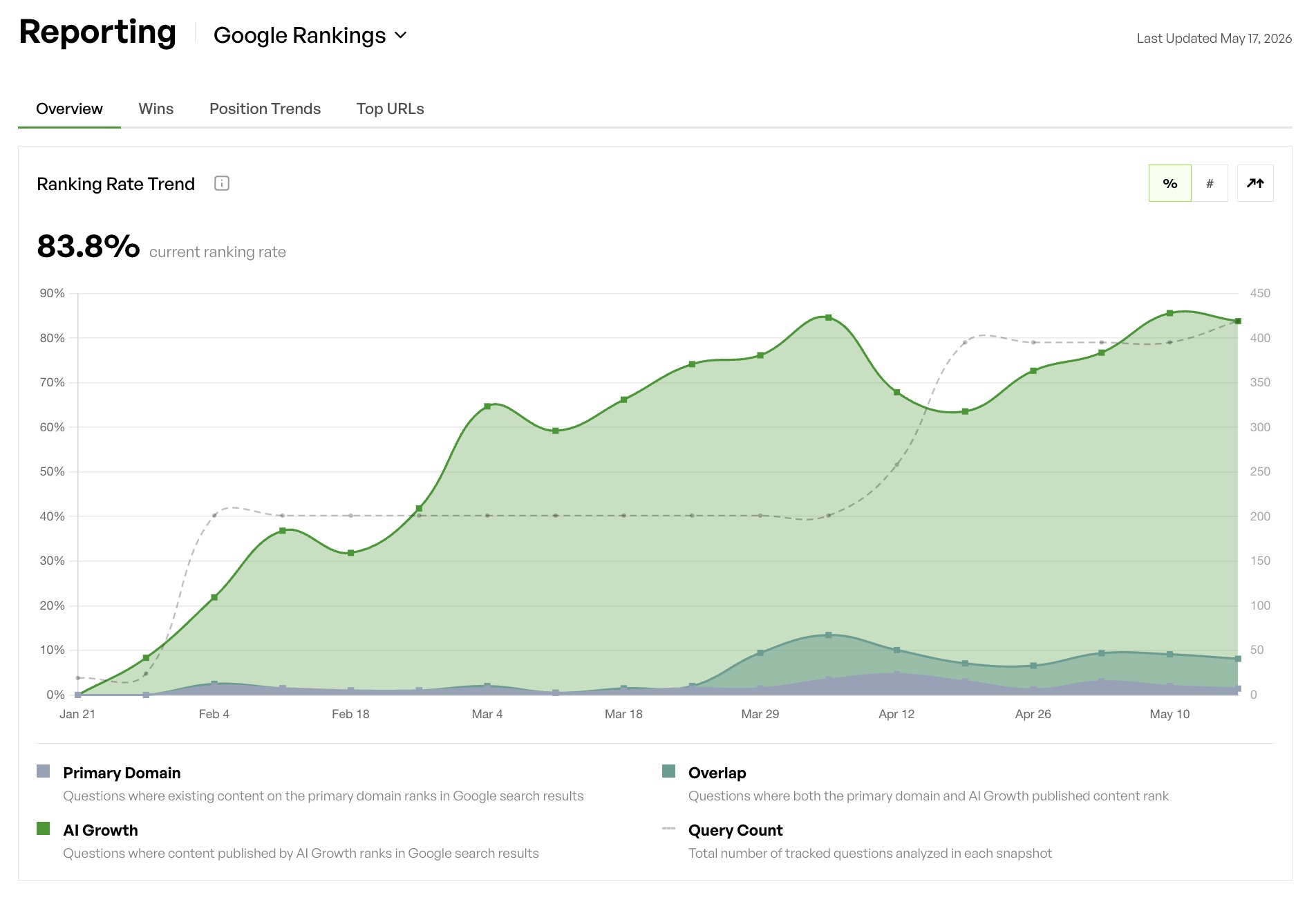
Teams that adapt their measurement approach report positive AI returns because they can see cause and effect. The measurement model matters as much as the content model. AI Growth Agent publishes into a separate environment so it takes credit only for the visibility it actually generates, never for visibility the brand already had.
Living content keeps the system current. When the year turns, every article in a sector refreshes automatically. Every article’s relationships, performance, and bot and Search Console data are centralized, so authority compounds instead of decaying.
Risks, Limitations, and Common Mistakes
Three failure modes recur across teams that pursue AI search visibility without a structured engine.
Stale content. Content published without a self-healing mechanism starts to decay the day it ships. The AI surfaces that cite a brand today will cite a different source tomorrow if the brand’s content does not reflect the current state of the market. Human-generated content receives 5.44 times more traffic than AI-generated content and demonstrates steady traffic increases over five months, while AI-generated content shows fluctuating performance, underscoring the value of content continually refined with validated, current information.
Hallucination. A multi-agent orchestration with post-draft claim re-extraction and cascading anti-hallucination checks is not the same as a single chatbot prompt. The difference is not theoretical. One company produced approximately 300 articles using a DIY chatbot approach. Not one was cited, and the articles were full of errors and gaps. Every claim, source, and quote must be validated against evidence found online before anything ships.
Prompt-capped monitoring. Monitoring tools that cap clients at a small set of tracked prompts show only the slice of the market the brand already thought to ask about. The zero-click rate climbs even higher, to 93%, for queries processed specifically through Google AI Mode, according to Semrush data. The queries the brand is not tracking are the ones most likely to resolve without a click and without a citation. Prompt count should never be a billed or capped metric.
Summary: Narrative Control Is the New Marketing Mandate
The leaderboard of AI search is being written this year, and early movers are training the next generation of models with their own narrative. Brands that wait train those models with whatever happens to be sitting on the open web.
The client outcomes from AI Growth Agent’s headless engine make the stakes concrete. Leva Sleep is now the most mentioned retailer for adjustable beds in Canada, with ChatGPT citing its content over 10,000 times per month and $40,000 to $50,000 in deals closed in under three weeks from buyers who discovered the brand through AI Growth Agent content. Breadless achieved a 30x lift in Google Search Console impressions over six months, from 387,000 to 12.3 million, and is now the most recommended healthy franchise in the US, ahead of CAVA, Rush Bowls, and Sweetgreen, with ChatGPT citing eatbreadless.com over 45,000 times per month.
Headless marketing makes those outcomes repeatable through architecture, not one-off campaigns. The brand keeps its curated main site. AI Growth Agent stands up a separate, fully optimized blog the brand owns, connected through a reverse proxy rewrite or subdomain. The engine writes, publishes, monitors, self-heals, and reports. One flat-fee engine replaces the SEO agency, the content tool, the web agency, the GEO monitor, the schema plugin, the analytics stack, and the PR firm.
CMOs surveyed by Spencer Stuart in December 2025 viewed AI transformation, brand trust, human judgment, and rapid change as key trends for 2026. The brands that answer that challenge focus on deliberate narrative control, not on generating the most text.
Traditional search tools show you where your brand stands. AI Growth Agent turns your brand into the answer. Get your first article live within a week by starting here.
Frequently Asked Questions
What does headless mean in marketing, and how is it different from headless commerce or headless CMS?
In headless commerce and headless CMS, the storefront or presentation layer a customer sees is decoupled from the engine running the business logic or content management behind it. The frontend stays branded and curated. The backend scales autonomously without dragging the brand experience with it. Headless marketing applies the same architectural principle to brand presence in AI search. The brand keeps its curated main site, the equivalent of the storefront. An autonomous engine runs behind it, mapping the full universe of queries, producing living self-healing content, publishing with full technical and agentic SEO, and reporting incremental visibility week over week. The key distinction from headless commerce or headless CMS is the objective. Headless marketing focuses on making the brand the answer across AI surfaces like ChatGPT, Perplexity, and Google’s AI Mode, with no headcount required to operate the engine.
What is a headless marketing strategy, and what does it require to implement?
A headless marketing strategy starts by mapping the brand’s full universe of seed terms and long-tail queries from real-time data, not a static keyword list. It then produces authoritative content against each query in the universe, structured for AI agents to read, trust, and cite. The strategy requires four capabilities working together: Search Intelligence to diagnose the competitive landscape, AI Analytics to track brand value and consumer behavior, Bot Tracking to record every crawl and citation, and AI Ranking to monitor where the brand appears in AI answers and how that position evolves.
Implementation begins with a kickoff interview that builds the brand manifesto, the single source of truth. From there, the engine maps the topology, stands up a fully optimized owned site within the first week, and begins publishing. The only technical step required from the brand is a reverse proxy rewrite connecting the blog to a subdirectory under their domain. Everything else, including schema, robots.txt, sitemaps, Blog MCP, llms.txt, and agentic discovery, is provisioned automatically.
What are some headless marketing examples and what results have brands achieved?
Leva Sleep used AI Growth Agent’s headless marketing engine to become the most mentioned retailer for adjustable beds in Canada. ChatGPT now cites Leva Sleep content over 10,000 times per month, Google Search Console impressions on AI Growth Agent content doubled, and the brand closed $40,000 to $50,000 in deals in under three weeks from buyers who walked into stores carrying specific questions sourced from AI Growth Agent articles. Breadless deployed the same engine to become the most recommended healthy franchise in the US, ahead of CAVA, Rush Bowls, and Sweetgreen in its search universe. Breadless saw the 30x impression lift and 45,000 monthly citations detailed earlier, generating 10 to 15 highly qualified franchisee leads per week. Across clients, the average result in the first twelve weeks is more than 12,000 additional AI citations and mentions, over 100,000 additional bot visits, and a 20% or greater lift in impressions.
How does headless marketing differ from traditional SEO or GEO monitoring tools?
Traditional SEO tools and GEO monitoring platforms function as observation instruments. They show where a brand stands, which queries it appears for, and how that position changes over time. They do not produce content, own publishing, or act on the data they surface. Monitoring tools typically cap clients at a small set of tracked prompts, so the brand only ever sees the slice of its market it already thought to ask about.
Headless marketing takes the opposite role. It maps the entire universe of queries, produces authoritative content against each one, publishes with full technical and agentic SEO, self-heals content over time, and reports the incremental visibility it generated rather than the visibility the brand already had. The distinction is between a rearview mirror and a steering wheel. Large language model optimization, the discipline of writing and structuring content so AI surfaces find it, trust it, and cite it, sits at the core of the headless marketing engine, not as a monitoring add-on.
Can a brand run headless marketing without a technical team or engineering resources?
Yes. That capability defines the headless marketing architecture. The engine provisions every technical requirement automatically, including schema across the full schema suite, the WordPress plugin, robots.txt, sitemaps, automatic web stories, Blog MCP, agent discovery via /.well-known/, llms.txt and llms-full.txt, instant indexing, autoredirects, and 404 tracking. The internal marketing team needs no technical skill because the engine handles all of it end to end.
The only integration step on the brand’s side is the reverse proxy rewrite that connects the blog to a subdirectory under their domain, with setup documentation generated for the brand’s specific host. After that, the brand gives feedback in plain language, the engine learns through saved memories, and every future generation reflects those rules without re-briefing. Most clients run the engine on autopilot. Teams with deeper review requirements can read each article, chat with it, and steer it before publish through a studio interface, with the engine editing in place and saving memories so the same correction is never needed twice.