Written by: Mariana Fonseca, Editorial Team, AI Growth Agent
Key Takeaways for LLMO and Headless Marketing Teams
- Agent discovery protocols decide whether AI agents can locate, trust, and cite your content in zero-click environments, so protocol selection becomes a core business decision for LLMO and headless marketing.
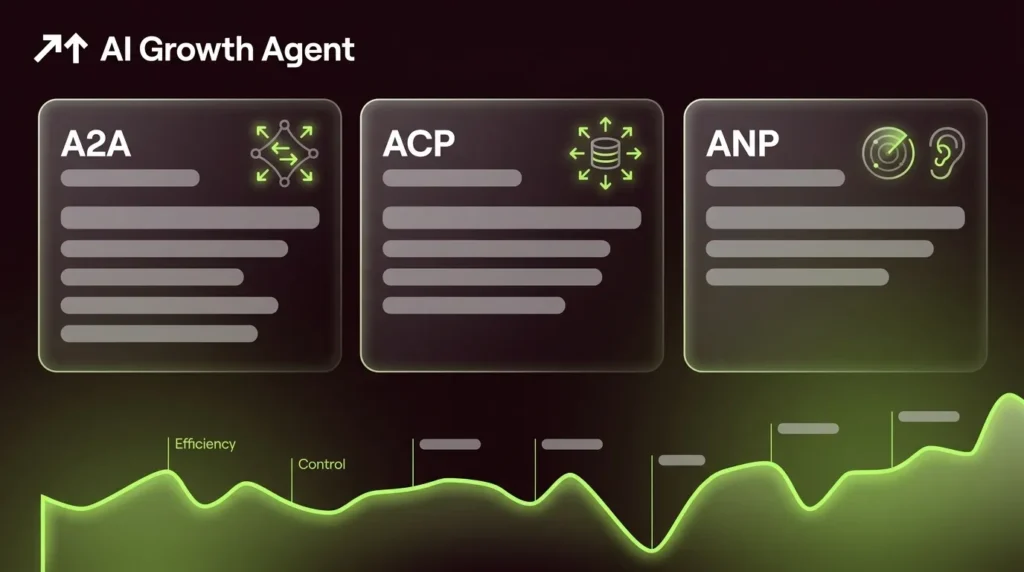
- Three protocols lead in 2026: Google’s A2A offers active runtime discovery through Agent Cards, ACP uses registry-driven passive discovery, and ANP supports decentralized open discovery with DIDs and JSON-LD.
- Teams should compare protocols by discovery method, implementation requirements, security models, and fit for headless marketing goals to increase agent citations.
- Most mid-market and enterprise brands gain the fastest lift by starting with A2A because it has a low implementation barrier, broad ecosystem support, and alignment with existing
/.well-known/discovery patterns. - AI Growth Agent provisions Agent Cards, MCP endpoints, llms.txt, and full discovery stacks automatically, so you can see how we automate your complete protocol implementation in a live walkthrough.
How A2A Agent Card Discovery Works in Practice
Google announced the Agent2Agent (A2A) protocol on April 9, 2025, at Google Cloud Next as an open specification that lets AI agents from different vendors discover each other, delegate tasks, and coordinate work without exposing internal logic. The protocol moved to the Linux Foundation in June 2025 under the Apache 2.0 license, with more than 150 organizations supporting A2A as of April 2026, including Microsoft, AWS, Salesforce, SAP, ServiceNow, Workday, IBM, PayPal, LangChain, and Cohere, and native integration in Azure AI Foundry, Amazon Bedrock AgentCore, and Google Cloud Vertex AI.
Discovery in A2A is active and direct. A2A discovers agents by fetching a standard Agent Card from https://{server_domain}/.well-known/agent-card.json under the RFC 8615 well-known URI convention. The JSON document describes the agent’s name, description, version, service endpoint, supported modalities, authentication requirements, and capability flags such as streaming or push notifications.
A client agent fetches Agent Cards at runtime to learn remote capabilities and route queries, using an open, direct discovery model instead of a centralized registry. Adding a new remote A2A agent only requires providing its well-known URL, so teams avoid manual code changes or redeployments when they update discovery or communication logic.
A2A builds on existing web standards: JSON-RPC 2.0 over HTTPS for core task communications, Server-Sent Events for streaming updates on long-running tasks, and push notifications for asynchronous workflows. A2A focuses on agent coordination and peer discovery rather than tool access, so each A2A-capable agent also acts as an MCP client for its own tools while using A2A for task delegation between autonomous agents.
How ANP Handles Active and Passive Discovery
ANP supports open, internet-wide discovery through semantic methods where agents host capability files at predictable URLs that search engines and other agents crawl to build directories, combined with Decentralized Identifiers and JSON-LD metadata. This design creates two discovery modes that run in parallel.
Passive discovery in ANP means an agent publishes capability files at predictable URLs and waits for crawlers, search engines, or peer agents to index them. No active outreach occurs. ANP discovery relies on agents publishing metadata via JSON-LD at specific URLs, which enables decentralized, non-registry-based indexing by search engines without a central authority.
Active discovery in ANP means an agent initiates a lookup against the decentralized identifier infrastructure. ANP performs discovery, authentication, and communication using W3C DIDs for cryptographic identity verification and well-known URIs for discovery. ANP provides end-to-end encryption for data exchanged between agents and uses JSON-LD for semantic discovery and description, which enables internet-wide collaboration between agents from different companies.
The decentralized model makes ANP the most open of the three protocols, and it also places the highest burden on the implementing organization to maintain DID infrastructure and semantic capability files that stay accurate as the agent’s capabilities change.
How ACP Balances Open Metadata and Registry Discovery
While ANP emphasizes decentralization, ACP takes a more centralized path for discovery. ACP uses a registry-driven, client-server architecture for agent communication and discovery, where agents interact with ACP servers via REST instead of peer-to-peer methods. Unlike A2A’s direct card fetch or ANP’s crawl-based indexing, ACP routes discovery through a server layer that maintains state and manages routing across the message lifecycle.
ACP supports passive discovery by having agents publish metadata at well-known URIs that remain readable even when the agent is offline. This offline-readable design gives organizations a clear operational advantage when they need discovery to keep working during maintenance windows or partial outages.
In ACP, discovery occurs when a buyer agent queries for seller agents by capability as the first step in the transaction flow, before the request-for-quote phase. The registry-mediated model gives ACP stronger governance controls than open polling, and it also introduces a dependency on registry availability and governance policies that A2A and ANP avoid.
Four Criteria for Comparing A2A, ACP, and ANP
Four criteria help teams decide which protocol fits their LLMO and headless marketing plans.
Discovery method. Active discovery in A2A means agents fetch capability metadata at runtime, which delivers real-time accuracy and requires the agent to be online. Passive discovery in ACP and ANP means metadata is published and indexed independently of runtime state, which trades real-time accuracy for resilience. Registry-based discovery in ACP adds governance and auditability and introduces a single point of dependency.
Implementation requirements. The three protocols differ in technical complexity. A2A requires a JSON Agent Card served at /.well-known/agent-card.json with defined schema fields and a JSON-RPC endpoint, which makes it the simplest to deploy. ACP adds complexity by requiring YAML manifests at well-known URIs plus integration with an ACP server. ANP demands the most infrastructure, including JSON-LD capability files at predictable URLs and DID infrastructure for cryptographic identity.
Security and trust models. A2A’s security model requires each Agent Card to declare authentication requirements, scope declarations to limit delegation requests, audit trails of task delegations, and human-in-the-loop hooks for sensitive operations. ANP’s trust framework is more decentralized than A2A or ACP because it relies on public DIDs and cryptographic verification instead of platform-mediated or server-hosted authorization. ACP’s server-mediated model centralizes trust enforcement at the registry layer.
Operational fit for LLMO and headless marketing. The protocol that exposes the richest machine-readable, structured metadata at predictable endpoints earns the most agent citations. All three protocols benefit from pairing with llms.txt, MCP endpoints, and /.well-known/ discovery artifacts that a headless marketing engine can provision automatically.
Side-by-Side Comparison of A2A, ACP, and ANP
A2A’s JSON-RPC communication pattern works as follows. A client agent fetches https://example.com/.well-known/agent-card.json, reads the skills array and securitySchemes, authenticates through the declared OAuth 2.0 flow, and then posts a message/send JSON-RPC request to the endpoint URL declared in the card. A2A servers expose both the /.well-known/agent.json route for the agent card and a POST endpoint to handle JSON-RPC protocol requests with in-memory task storage.
How Headless Marketing Engines Expose Agent Cards and Discovery Artifacts
Brands that want to become citable by other agents need infrastructure that speaks the formats those agents expect. That means exposing a coordinated set of discovery artifacts rather than a single file.
The llms.txt standard is emerging as a helpful convention, using a Markdown file at the domain root that gives AI agents a clean map of a brand’s most important content and acts as an agent discovery protocol that improves retrieval accuracy in zero-click environments. Pairing llms.txt with llms-full.txt gives retrieval-augmented generation systems a complete, structured index of the brand’s content without a full crawl.
Schema markup, IndexNow, llms.txt, server-rendered content, and community participation together form an AI-readability stack that lets machines consume content instead of only human browsers. A headless marketing engine that provisions all of these artifacts automatically removes the implementation burden from the brand’s internal team.
AI Growth Agent ships this full stack on every engagement. The platform provides Agent Card guidance served via /.well-known/, Blog MCP with schema, manifest, discovery, and capability guidance exposed to agents, OpenAI discovery at /.well-known/, llms.txt and llms-full.txt at the domain root, Markdown served to agent crawlers, and natural language query parameters at /?s={query} that return personalized, internally linked responses to agents passing queries directly into the URL. Living content that self-heals over time ensures the next training sweep finds the brand’s current narrative instead of a stale one, which matters because AI systems show a strong recency bias, with content older than three months seeing citations drop sharply.
Matching Protocols to Your Organization’s Reality
Lean teams and early-stage builders usually gain the most from A2A. The implementation surface stays small: serve a valid JSON Agent Card at /.well-known/agent-card.json, declare skills in natural language, and expose a JSON-RPC endpoint. Adding a new remote A2A agent only requires providing its well-known URL. Linux Foundation governance and a large supporting ecosystem make the investment worthwhile even for smaller organizations.
Enterprise organizations with existing REST infrastructure and governance requirements often find ACP’s registry-driven model familiar. The server-mediated architecture aligns with enterprise API management patterns, and the offline-readable YAML manifests reduce discovery fragility during maintenance windows. The tradeoff is registry dependency and the governance overhead of maintaining a server layer.
Multi-brand and multi-organization deployments that need to interoperate across organizational boundaries without a shared registry fit ANP best. The W3C DID-based trust model requires no central authority, which suits open internet-scale agent collaboration. The implementation cost is higher because DID infrastructure, JSON-LD capability files, and ongoing semantic accuracy maintenance require dedicated engineering work.
Most mid-market and enterprise brands running headless marketing in 2026 should prioritize A2A first because of its ecosystem size, implementation simplicity, and direct alignment with the /.well-known/ discovery patterns that headless marketing engines already provision.
Total Cost and Ownership of Agent Discovery
A2A carries the lowest time-to-implement of the three protocols. A valid Agent Card is a JSON file with defined fields, and a headless marketing engine can provision it automatically. Ongoing maintenance involves keeping the skills array and securitySchemes current as the agent’s capabilities evolve. Integration friction stays low because A2A builds on standard web protocols already present in modern infrastructure, as detailed earlier.
ACP requires teams to stand up or integrate with an ACP server, which adds infrastructure cost and a dependency on server availability. YAML manifest maintenance is straightforward, and the registry layer introduces an ongoing operational surface that A2A avoids. For organizations already running REST API management infrastructure, the marginal cost is lower.
ANP carries the highest implementation and maintenance cost. DID registration, JSON-LD capability file authoring, and cryptographic key management require engineering resources that most marketing teams lack in-house. The payoff is the most open and interoperable discovery surface, and the path to that payoff runs longer than A2A or ACP.
A headless marketing engine that provisions A2A Agent Cards, llms.txt, MCP endpoints, and /.well-known/ discovery automatically removes the implementation cost for A2A and reduces total cost of ownership to the time required to review and approve generated artifacts.
Simple Decision Framework for Choosing a Protocol
Teams can use a simple if-then logic to select the right protocol for their current state.
If your primary goal is LLMO and headless marketing visibility in 2026 and your team has no dedicated agent infrastructure engineering resources, implement A2A first. Expose an Agent Card at /.well-known/agent-card.json, pair it with llms.txt, llms-full.txt, and Blog MCP, and use a headless marketing engine to provision and maintain the full stack automatically.
If your organization already runs REST API management infrastructure and needs registry-governed discovery with offline-readable metadata, add ACP alongside A2A. The YAML manifest at a well-known URI complements rather than replaces the A2A Agent Card.
If your organization must interoperate with agents across organizational boundaries at internet scale without a shared registry or central authority, invest in ANP. Plan for DID infrastructure, JSON-LD capability file authoring, and ongoing semantic maintenance as distinct engineering workstreams.
If your organization operates as a multi-brand enterprise with distinct buyer journeys and separate content topologies, run parallel headless marketing engines, each with its own A2A Agent Card and discovery stack, connected through a reverse proxy rewrite or subdomain so each brand’s discovery surface remains independent.
Risks, Limitations, and Tradeoffs Across Protocols
A2A risks center on runtime dependency. Active discovery requires the agent to be online and the /.well-known/ endpoint to be reachable, so discovery fails when the Agent Card is unavailable. The core A2A standard does not yet require a fully machine-readable schema such as JSON Schema for skill inputs and outputs, which limits automated capability validation. Rapid adoption also means the specification continues to evolve, so teams must track changes to the canonical filename and schema fields.
ACP risks center on registry dependency. A registry outage or governance change can disrupt discovery for all agents that rely on it. The client-server architecture introduces a centralized bottleneck that A2A’s peer-to-peer model avoids. For organizations that do not already operate ACP server infrastructure, the setup cost is meaningful.
ANP risks center on DID infrastructure complexity and ecosystem maturity. Decentralized identity management requires cryptographic key rotation, revocation handling, and public registry availability. ANP’s trust framework relies on public DIDs and cryptographic verification, so a compromised or expired DID breaks the trust chain for all agents that depend on it. The ANP ecosystem is less mature than A2A’s in tooling and organizational adoption, which makes implementation support harder to find.
Across all three protocols, discovery artifacts only create value when the content they reference is authoritative, structured, and current. Large language models learn about brands through the training-data pathway via datasets like Common Crawl and the live retrieval pathway via RAG and fan-out queries, so brands must strengthen presence across both. A well-formed Agent Card that points to stale or unstructured content does not produce a meaningful citation lift.
Conclusion: Turning Discovery into Narrative Control
Agent discovery protocols form the technical layer that decides whether AI agents can find, evaluate, and route queries to a brand’s content. A2A’s active, open discovery through Agent Cards at /.well-known/agent-card.json offers the lowest implementation barrier and the largest ecosystem. ACP’s registry-driven model fits organizations with existing REST governance infrastructure. ANP’s decentralized, DID-based approach supports open internet-scale interoperability at higher implementation cost.
For CMOs and builders running headless marketing in 2026, the practical path starts with A2A, paired with llms.txt, llms-full.txt, Blog MCP, and /.well-known/ discovery, all maintained by a headless marketing engine. In the zero-click environment described earlier, LLMO positions brands to control narrative by becoming the cited recommendation in synthesized AI answers instead of relying on traditional link ranking. The brands that expose the right discovery artifacts now are the ones training the next generation of models with their own narrative.
AI Growth Agent operationalizes A2A, ACP, and ANP at scale through headless marketing, provisioning Agent Cards, MCP endpoints, llms.txt, and /.well-known/ discovery automatically on every engagement, with living content that self-heals over time so the brand’s discovery surface stays fresh.
Frequently Asked Questions
What is an agent discovery protocol and why does it matter for brand visibility in 2026?
An agent discovery protocol is a standardized mechanism that lets an AI agent locate, evaluate, and initiate communication with another agent or service. It defines the endpoint format, metadata schema, authentication handshake, and discovery path, which usually means a well-known URI, a registry query, or a crawlable capability file. In 2026, as AI surfaces like ChatGPT, Perplexity, and Google’s AI Mode deliver more zero-click answers, the agents behind those surfaces rely on discovery protocols to find and cite authoritative content. A brand that exposes a valid Agent Card, llms.txt, and MCP endpoints gives those agents a structured, machine-readable path to its content. A brand that does not expose these artifacts remains invisible to the agent layer, even with strong traditional SEO.
How does A2A Agent Card discovery differ from llms.txt for LLMO purposes?
A2A Agent Cards and llms.txt play complementary roles in an LLMO stack. An A2A Agent Card, served at /.well-known/agent-card.json, is a runtime discovery artifact that tells other agents what capabilities a service offers, how to authenticate with it, and how to communicate with it using JSON-RPC. It focuses on agent-to-agent task delegation and coordination. llms.txt is a static Markdown file at the domain root that gives AI crawlers and retrieval-augmented generation systems a clean, structured index of a brand’s most important content, so it functions as a content map rather than a capability declaration. For headless marketing, both matter. The Agent Card enables agent interoperability, and llms.txt plus llms-full.txt ensure that the content the Agent Card references is discoverable and readable by the AI surfaces that perform the citing. AI Growth Agent provisions both automatically on every engagement.
What is the difference between active and passive discovery in agent protocols?
Active discovery means an agent initiates a fetch or query at runtime to retrieve capability metadata about another agent. A2A uses active discovery, so a client agent fetches the Agent Card at /.well-known/agent-card.json when it needs to route a task, which delivers real-time capability information and requires the target agent to be online. Passive discovery means an agent publishes metadata at a predictable location and waits for crawlers, registries, or peer agents to index it independently of runtime state. ACP uses passive discovery through YAML manifests at well-known URIs that remain readable even when the agent is offline. ANP supports both modes. Agents publish JSON-LD capability files at predictable URLs for passive crawling, and agents can also actively query the decentralized identifier infrastructure. For headless marketing, passive discovery artifacts such as llms.txt and well-known capability files are especially valuable because they remain indexable during maintenance windows.
Can a brand implement more than one agent discovery protocol simultaneously?
Brands can implement multiple protocols in parallel, and most mid-market to enterprise organizations should consider this approach. A2A and ACP work as complements rather than competitors. An organization can serve an A2A Agent Card at /.well-known/agent-card.json for runtime peer discovery and also publish ACP-compatible YAML manifests for registry-driven discovery. ANP’s JSON-LD capability files can coexist with both. The practical constraint is implementation and maintenance capacity. A headless marketing engine that provisions the full discovery stack automatically, including Agent Cards, MCP endpoints, llms.txt, and /.well-known/ paths, removes the engineering burden and makes multi-protocol exposure realistic without adding headcount. AI Growth Agent was the first to bring Blog MCP to market, with clients running it in the summer of 2025, and provisions the complete agentic technical SEO stack on every engagement.
How does headless marketing connect agent discovery protocols to narrative control?
Narrative control in a zero-click environment means producing the content that AI surfaces use to describe a brand, in formats and structures those surfaces can read, with the validation that earns the citation. Agent discovery protocols form the technical layer that makes a brand’s content addressable by the agents that perform the citing. Without a valid Agent Card, llms.txt, and MCP endpoints, an agent has no structured path to a brand’s content and falls back on whatever happens to be indexed on the open web. Headless marketing operationalizes this by decoupling the brand’s curated main site from an autonomous content engine that publishes living, self-healing content with the full discovery stack provisioned automatically. The result is a brand that remains findable for human visitors and addressable by the agent layer, which makes it the cited answer instead of an invisible competitor. AI Growth Agent clients average more than 12,000 additional AI citations and mentions in the first twelve weeks, with content indexing in as little as ten days.