Written by: Mariana Fonseca, Editorial Team, AI Growth Agent
Key Takeaways
- Customers now rely on AI answers from ChatGPT, Perplexity, and Google AI Mode instead of traditional search results, with zero-click searches reaching 64.82% in 2026.
- Four pillars of AI search intelligence – Search Intelligence, AI Analytics, Bot Tracking, and AI Ranking – work together to determine whether brands earn citations in AI-generated answers.
- Brands disappear from AI answers when their content lacks machine-readable structure, proper technical signals, and broad long-tail query coverage.
- A seven-step system including content topology mapping, agentic technical SEO, living self-healing content, and systematic troubleshooting helps brands earn consistent AI citations.
- Map your citation universe and become the answer in AI search results – schedule a demo to see how.
Four Pillars That Decide Whether AI Surfaces Cite Your Brand
Four pillars determine citation eligibility: Search Intelligence, AI Analytics, Bot Tracking, and AI Ranking. Together, these pillars form a diagnostic system that shows where your brand stands and why AI surfaces choose to cite you or ignore you. Brands that monitor all four and act on the insights in the same week are the ones earning citations, because each pillar exposes a different failure point in the citation chain. Brands that see only one or two are flying blind.
Search Intelligence forms the foundation by mapping the traditional search landscape, covering positioning, competition, and search volume, and converting raw data into an actionable diagnosis. It shows who is already winning each result and where the white space sits.
AI Analytics tracks brand value and consumer behavior across the full journey, from external touchpoints like Google and AI-tool queries through content consumption, demographics, and sentiment. It clarifies how the brand is perceived across the surfaces that matter.
Bot Tracking records every bot interaction, traditional crawlers and AI training agents alike, including every crawl, citation, and training sweep. This visibility is foundational: if you cannot see who is reading you, you cannot tell whether you are being read at all, which means you cannot diagnose why citations are not happening or confirm that your fixes are working. If you cannot see who is reading you, you cannot tell whether you are being read at all.
AI Ranking replaces the old concept of a numbered position. AI answers have no static ordered list, so order of mention and citation context become the new leaderboard. Where the brand appears in the answer, and how that position evolves week over week, is the metric that matters.
Understanding these four pillars reveals what determines citation eligibility. Even brands that understand the pillars are disappearing from AI answers at an accelerating rate because the search landscape itself has fundamentally shifted.
Why Brands Vanish from ChatGPT and AI Answers in 2026
Google’s AI Mode crossed 1 billion monthly users within its first year, queries more than doubled every quarter since launch, and agentic booking has extended to local services from home repair to pet care. The surfaces consuming content have multiplied. The brands appearing in those surfaces have not.
Two facts make the shift consequential. First, Ahrefs’ April 2025 study found that AI Overviews reduced clicks to top-ranking content by 34.5%, and a 2026 update measured 58%, and for queries that trigger Google AI Overviews, the zero-click rate is 83%. Second, customers do not verify the answers they receive. Roughly 83% of people say they are skeptical of AI answers, yet few ever click through to verify them. For most people, whatever the AI says becomes the answer.
Brands disappear from AI answers for three structural reasons that compound each other. First, their content is not structured for machine retrieval, so formatting and markup do not expose information in ways AI systems can parse. Second, even when content is technically accessible, their technical stack does not expose the trust signals AI surfaces need to confidently cite a source. Third, their content universe is too narrow, covering head terms while losing the long-tail queries where AI agents actually operate, which means even well-structured content misses most citation opportunities.
AI citations typically decay after approximately 13 weeks without freshness updates, meaning brands that publish once and stop are actively losing ground every quarter.
The solution to these structural failures is a seven-step system that addresses each failure point systematically, from mapping the full query universe through deploying agentic technical infrastructure to maintaining living content that self-heals over time. Each step builds on the previous one to create a citation engine rather than isolated content.
Step 1: Map the Full Query Universe from Real-Time Google and ChatGPT Data
Step 1: Build the Content Topology. Most brands track a handful of head terms and lose the rest of the conversation by default. The full universe starts with seed terms, the strategic anchor topics that organize a brand’s market, and expands into the long-tail queries beneath each one. Robots search the long tail. AirOps research identified a strong relationship between a page’s retrieval rank for both the primary query and related fan-out queries and its likelihood of being cited by ChatGPT, which means coverage of the long tail is not optional.
Evidence-based long-tail mapping uses real-time AI Overview and ChatGPT search results as the objective function. Customers can phrase the same question in hundreds of ways in an AI search space, and that surface area grows further when an agent reasons on top of a user query. The Content Topology converts that surface area into a strategic map of where to win, with every query backed by real data rather than guesswork.
A mature AI Growth Agent client reaches a universe of 1,600+ queries, with the system running 3,000+ searches every week to refresh the snapshot. A new account typically starts with three to four hundred queries and expands as it captures more of the universe. Prompt count is never a billed metric, so the entire universe is visible from day one.
Steps 2–3: Implement Agentic Technical SEO and Agent Discovery
Step 2: Deploy traditional technical SEO as table stakes. Every article requires highly structured HTML, full metadata including Open Graph titles and descriptions, rich schema markup across article, author, FAQ, product, and organization formats, and internal linking that compounds authority across the universe. BCG’s March 2026 guide advises serving critical content in fully resolved server-side or static HTML because information that only appears after client-side hydration may not exist to the model. Proper sitemaps, a detailed robots.txt, automated web stories, instant indexing, autoredirects, and 404 tracking complete the site-level stack.
Step 3: Layer agentic technical SEO on top. Traditional SEO is necessary but no longer sufficient. The formats AI agents read require a separate layer. AI Growth Agent ships Blog MCP, also compatible with Chrome 146+ and other WebMCP-enabled browsers, with schema, manifest, discovery, and capability guidance exposed to agents. OpenAI discovery and Agent Card guidance are served via /.well-known/. Natural language query parameters via /?s={query} trigger personalized, internally linked responses so an agent passing a query straight into the URL receives a tailored answer. Pages are served in Markdown for agent crawlers. Cyrus Shepard’s May 2026 analysis of 54 AI citation experiments assigned URL accessibility the highest citation factor score of 9.5, confirming that machine accessibility is the foundational requirement.
Llms.txt and llms-full.txt are published so AI surfaces can read the brand the way they need to. Schema markup tells the machine what the content is, and FAQ, HowTo, and Product formats are especially useful because they package assertions into predictable fields that reduce ambiguity for retrieval systems. Every package AI Growth Agent offers includes the full agentic and traditional technical SEO stack, with no plugin to install and no engineering hours required from the client.
Steps 4–6: Publish and Maintain Living Self-Healing Content
The technical infrastructure described in Steps 2 and 3 creates the foundation for machine readability. Infrastructure alone does not create citations, so the content itself must be authoritative, validated, and continuously fresh. The next three steps cover how content is generated, measured, and maintained over time.
Step 4: Generate content from the brand manifesto with anti-hallucination controls. Content generation uses a sophisticated orchestration of agents across every major AI provider, not a single model behind a prompt. The engine pulls from the brand manifesto, primary-source links, product pages, and saved memories, then analyzes the specific search to decide what kind of content should exist. Parallel research agents gather what a real journalist would need. Every source, every claim, and every quote is validated against evidence found online before the article moves further down the pipeline. Any claim that cannot be backed up is removed or softened. Content scoring 8.5/10 or higher on semantic completeness is 4.2 times more likely to be cited by AI tools, which is why validation at the claim level is built into every generation cycle.
Step 5: Report incremental visibility, not total visibility. AI Growth Agent publishes into a separate environment so it can take credit only for the visibility it actually generates, never for visibility the brand already had. Incremental visibility reporting isolates exactly what the engine contributed, week over week, by cross-referencing bot traffic, Google Search Console, and citation data. Clients average more than 12,000 additional AI citations and mentions, over 100,000 additional bot visits, and a 20%+ lift in impressions across the first twelve weeks.
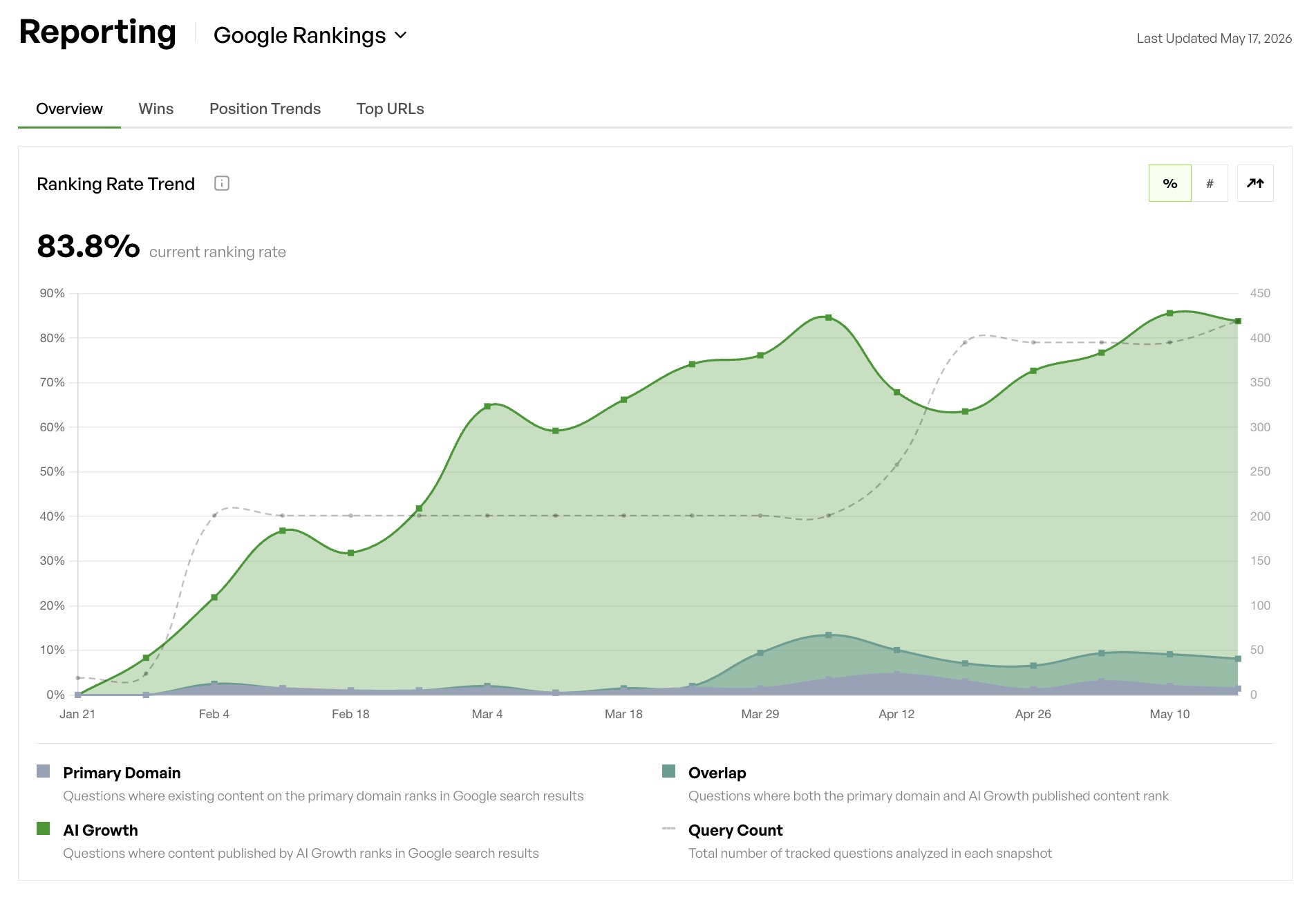
Step 6: Self-heal content over time. Content is not shipped and forgotten. When the year turns, every article in a sector is refreshed automatically. Every article’s relationships, performance, and bot and Search Console data are centralized so authority compounds instead of decaying. Research analyzing 17 million AI citations found that AI-surfaced URLs are 25.7% fresher than traditional Google search results, and content updated within the last 30 days receives 3.2 times more citations than older material on platforms like Perplexity. Living content is not a feature. It is the mechanism by which authority compounds rather than decays.
Two brands demonstrate how self-healing content translates to measurable citation dominance. Leva Sleep is now the most mentioned retailer for adjustable beds in Canada, with ChatGPT citing its content over 10,000 times per month and $40,000 to $50,000 in deals closed in under three weeks from buyers who discovered the brand through AI Growth Agent content. Breadless achieved a 30x lift in Google Search Console impressions over six months and is now the most recommended healthy franchise in the US, ahead of CAVA, Rush Bowls, and Sweetgreen, with ChatGPT citing eatbreadless.com over 45,000 times per month.
Step 7: Diagnose Why Content Fails to Get Cited
Step 7: Troubleshoot the failure points systematically. Content that does not earn citations fails for identifiable, fixable reasons. The most common are machine inaccessibility, schema gaps, stale content, and invisible bot activity, and each one blocks a different part of the citation chain.
Machine inaccessibility is the highest-impact failure, as confirmed by the citation factor analysis discussed earlier. If a robots.txt file blocks AI crawlers, or if content only renders after client-side JavaScript execution, the model cannot read it. The fix is server-side rendering, a correctly configured robots.txt, and explicit agent discovery endpoints.
Schema gaps reduce machine confidence. A practical AI-readiness audit should check schema coverage, HTML clarity, heading logic, and whether snippet-worthy surfaces like FAQs, tables, and definitions are present where answer extraction is likely. Missing schema does not make content invisible, but it removes a consistent positive signal that correlates with citation rates across studies.
Stale content loses citations over time. As noted earlier, citations decay without regular freshness updates, and the 13-week window means content must be refreshed at least quarterly to maintain visibility. The self-healing mechanic in AI Growth Agent addresses this publish-and-forget problem automatically, refreshing articles in response to Google Search Console signals and bot-traffic awareness.
Invisible bot activity means brands cannot tell whether they are being read. Bot tracking at the article level, cross-referenced with Google Search Console and citation data, is the diagnostic layer that reveals which content is being crawled, which is being cited, and which is being ignored. Without it, improvement is guesswork.
One company produced roughly 300 articles using a chatbot alone. Not one was cited. The articles lacked the technical stack, the validated sourcing, and the living update cycle that AI surfaces require. The headless engine approach replaces that fragmented process with a single system that handles every layer from generation through indexing through self-healing, with no technical skill required from the client.
Frequently Asked Questions
How long does it take to start appearing in ChatGPT answers after implementing this system?
The first article is typically live within one week of kickoff. Content has indexed in as little as ten days and often within two weeks. The standard engagement is a three-month pilot because indexing timelines vary by industry and query competition, but clients consistently see movement early. Jelly earned its first ChatGPT citation within three weeks. Exceeds.ai earned its first within two weeks. The engine does not wait for a long ramp before producing results.
Who owns the content and the site that AI Growth Agent builds?
The client owns everything outright. AI Growth Agent stands up a fully optimized blog styled to match the client’s existing site and connected through a reverse proxy rewrite or subdomain. The client owns the property, the content, and the relationship with the AI surfaces. There is no agency dependency and no lock-in. If the engagement ends, the client keeps the site and every article on it.
What technical work does the client need to do to get started?
The only integration step on the client’s side is the reverse proxy rewrite that connects the blog to a subdirectory under their domain. AI Growth Agent generates setup documentation for the client’s specific host, whether Cloudflare, Vercel, or another provider. Everything else, including the full traditional and agentic technical SEO stack, schema, Blog MCP, llms.txt, agent discovery endpoints, bot tracking, instant indexing, autoredirects, and 404 tracking, is included in every package and requires no action from the client’s team.
How does AI Growth Agent prove that the citations it generates are incremental and not visibility the brand already had?
AI Growth Agent publishes into a separate environment and reports incremental visibility week over week, isolating exactly what the engine generated rather than taking credit for existing brand visibility. The reporting cross-references per-article bot tracking, Google Search Console as an independent audit, and citation data that no single monitoring tool brings together. Clients watch results in the reporting view, in the Content Planner for which keywords and prompts are ranking, and through Google Search Console as a parallel check. The metrics AI Growth Agent commits to are brand mention rate and citation rate, accompanied by impressions and bot traffic.
How does the system handle brand voice, legal requirements, and industry-specific compliance?
The brand manifesto is the primary source of truth, and the more detail it holds the better. Style memories carry voice rules, such as preferred terminology or words the brand never uses, and the engine applies them to every future generation without re-briefing. Legal disclaimers, fixed and dynamic, are configured once and applied with Chicago-style superscripts wherever the sector requires them. Anti-hallucination controls let the client specify which classes of claim deserve the heaviest scrutiny, such as ingredient amounts, pricing claims, or regulated financial statements, and the engine focuses its validation checks there. Every claim, source, and quote is validated against evidence found online rather than a model’s training data before anything ships.
Conclusion: Use AI Citations Now to Train Models with Your Narrative
The AI surfaces are still in their first generation. The leaderboard is being written this year. Only 38% of AI Overview citations now come from pages ranking in Google’s top 10 results, which means the citation landscape is open to brands that move with the right architecture, not just the brands that already dominate traditional search. Studies report AI-driven visitors convert between 42% and 1.9× better than organic traffic and spend roughly 48% more time on site, with results varying by industry and measurement method. That performance makes citation in AI answers one of the highest-leverage investments available to a brand in 2026.
Traditional search tools show you where your brand stands. AI Growth Agent makes your brand the answer. The engine maps the full query universe, publishes with agentic technical SEO, maintains living self-healing content, and proves incremental visibility week over week, replacing the SEO agency, the content tool, the GEO monitor, the schema plugin, the analytics stack, and the PR firm at a flat fee with no per-prompt billing.
Brands that establish authoritative content now are training the next generation of models with their own narrative. Brands that wait are training the next generation with whatever happens to be sitting on the open web.