Written by: Mariana Fonseca, Editorial Team, AI Growth Agent
Key Takeaways
- An llms.txt file is a Markdown document at your domain root that gives AI crawlers a curated map of your most important pages so language models can parse and cite your brand accurately.
- The file works alongside robots.txt and sitemap.xml as the context layer of a modern discovery stack, and AI Growth Agent provisions llms.txt, llms-full.txt, Blog MCP, and agent discovery automatically within the first week.
- Implementation follows three phases: writing the index and full export files, integrating with robots.txt and sitemap.xml, and adding Blog MCP plus enterprise-grade configurations.
- Production setups require clean Markdown, 20-50 high-signal URLs, explicit AI-agent directives in robots.txt, and regular updates to avoid stale links that reduce citation accuracy.
- Deployed as part of a complete stack, llms.txt drives measurable results. See how AI Growth Agent provisions the full agentic technical SEO stack in your first week by booking a live demo.
Core Files And Skills You Need Before Creating Llms.txt
Your team needs a clear mental model of three complementary files and how they divide responsibility. Robots.txt is the access control layer that tells crawlers what they are allowed to fetch, sitemap.xml is the discovery layer that lists every URL for indexing, and llms.txt is the context layer that tells AI agents which pages are worth fetching among the allowed resources. None of these files replaces the others.
Your team also needs Markdown fluency, because optimizing data formats like Markdown can improve model accuracy while reducing token usage, making clean Markdown the correct format for any file targeting AI agents. You then need a sitemap or top-pages report to select the canonical URLs you will include, because the recommended workflow starts by selecting 20 to 50 URLs an agent would actually need rather than dumping the entire site into the file.
Beyond these technical prerequisites, enterprise teams should also understand the current adoption landscape to set realistic expectations. A SE Ranking study of 300,000 domains found a 10.13% adoption rate of llms.txt, meaning roughly one in ten sites carries the file after eighteen months of industry conversation. Adoption is growing, but the file is infrastructure, not a standalone ranking lever. Its value compounds when it is part of a complete agentic technical SEO stack, which is exactly what AI Growth Agent provisions automatically.
Three-Phase Rollout For Llms.txt And Llms-Full.txt
The implementation follows three phases. Phase 1 covers file architecture: writing the llms.txt index and the llms-full.txt export. Phase 2 covers integration: connecting both files to robots.txt, sitemap.xml, and agent discovery endpoints including /.well-known/. Phase 3 covers the Blog MCP layer and the advanced configurations that separate an enterprise-grade setup from a minimal deployment.
Each phase produces a production-ready file. The four code examples below are drawn from real patterns used by Anthropic, Vercel, Stripe, and AI Growth Agent’s own enterprise clients, each tied to documented outcomes.
Phase 1: Writing Llms.txt And Llms-Full.txt
Step 1: Open with an H1 brand name and a blockquote summary. The file uses one H1 containing only the literal brand or product name, followed immediately by a blockquote with a one- or two-sentence third-person summary of what the brand is and who it is for. Marketing slogans and metaphors belong in your blog, not here. Objective, structured facts win citations.
Step 2: Group links into four to seven H2 sections. Common categories include Product, Pricing, Integrations, Customers, Documentation, and Company, with each link formatted as - [Title](URL): Description. Skip blog posts, career pages, gated landings, and paid-traffic destinations.
Step 3: Write one-sentence descriptions that explain when an agent should fetch each page. Descriptions should use simple, descriptive, and neutral language that defines terms clearly and avoids emotional marketing slogans, metaphors, or context-free promises.
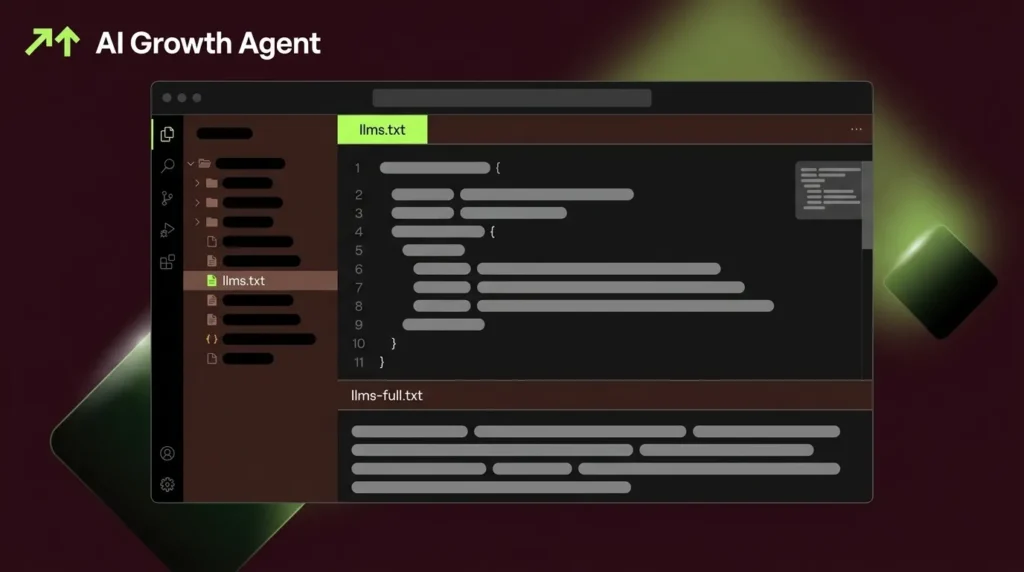
The following example demonstrates these principles in practice. Below is an Anthropic-style llms.txt index that shows how to structure sections, format links, and write agent-focused descriptions. Anthropic publishes a slim llms.txt index that links to a larger llms-full.txt Markdown export, allowing conversational AI tools to use the index while IDE integrations and agent workflows consume the full export. This pattern is called the index-plus-export pattern.
# Anthropic > Anthropic is an AI safety company that builds Claude, a family of large language models for enterprise and consumer use. Anthropic serves developers, researchers, and businesses that require reliable, interpretable AI. ## API Documentation - [API Overview](https://docs.anthropic.com/api.md): Authentication, rate limits, and endpoint reference for the Claude API. - [Messages API](https://docs.anthropic.com/messages.md): Request and response schema for the core messages endpoint. - [Models](https://docs.anthropic.com/models.md): Available Claude model versions, context windows, and pricing tiers. ## Policies - [Usage Policy](https://www.anthropic.com/usage-policy.md): Permitted and prohibited use cases for Claude models. - [Privacy Policy](https://www.anthropic.com/privacy.md): Data handling, retention, and user rights. ## Optional - [Research Papers](https://www.anthropic.com/research.md): Published safety and alignment research, fetch only when the query concerns AI safety methodology. Step 4: Build llms-full.txt as a concatenated Markdown export. For documentation-heavy products, ship llms-full.txt as a concatenated Markdown version of every linked page designed for agents that want to ingest everything in a single request. Below is a leading tech company pattern modeled on Vercel’s approach, which consistently surfaces quickstarts, core concepts, and high-intent guides rather than listing every page, with each entry including descriptive context such as plan types and login methods.
# Vercel > Vercel is a cloud platform for frontend developers that deploys web applications globally with zero configuration. It serves individual developers, agencies, and enterprise engineering teams. ## Getting Started - [Quickstart](https://vercel.com/docs/getting-started.md): Deploy your first project in under five minutes, covers Git integration, environment variables, and domain assignment. - [Plans and Pricing](https://vercel.com/pricing.md): Hobby, Pro, and Enterprise tiers with feature and limit comparisons, fetch when the query concerns billing or team seats. ## Core Concepts - [Edge Network](https://vercel.com/docs/edge-network.md): How Vercel routes requests across its global CDN, relevant for latency and caching questions. - [Serverless Functions](https://vercel.com/docs/functions.md): Runtime options, memory limits, and cold-start behavior. ## Integrations - [Integrations Marketplace](https://vercel.com/integrations.md): Third-party services connectable via one-click install, including databases, monitoring, and CMS platforms. ## Optional - [Changelog](https://vercel.com/changelog.md): Weekly product updates, fetch only when the query concerns a specific release or feature timeline. Phase 2: Connecting Llms.txt To Robots.txt, Sitemap.xml, And Discovery
Step 5: Audit robots.txt to confirm AI agents are not blocked. Production setups require auditing robots.txt to ensure AI user agents including GPTBot, ClaudeBot, PerplexityBot, OAI-SearchBot, Google-Extended, Applebot-Extended, and Bytespider are not blocked from fetching the file. A minimal production robots.txt that explicitly allows AI agents while referencing both files looks like this:
User-agent: GPTBot Allow: / User-agent: ClaudeBot Allow: / User-agent: PerplexityBot Allow: / User-agent: OAI-SearchBot Allow: / User-agent: Google-Extended Allow: / User-agent: * Allow: / Sitemap: https://yourdomain.com/sitemap.xml Sitemap: https://yourdomain.com/llms.txt Step 6: Serve both files at the domain root with correct headers. Serve llms.txt and llms-full.txt at the domain root as https://yourdomain.com/llms.txt with Content-Type text/plain or text/markdown and HTTP status 200, without authentication or rate-limiting that blocks AI agents.
Step 7: Mirror at /.well-known/ for agent discovery. The file may optionally be mirrored at /.well-known/llms.txt, though the root location remains canonical. AI Growth Agent also serves OpenAI discovery and Agent Card guidance via /.well-known/ endpoints automatically, which is the layer that makes your site legible to agentic workflows beyond standard crawlers.
Step 8: Submit llms.txt to Google Search Console. dev5310 GmbH submitted its llms.txt file to Google Search Console, resulting in Googlebot crawling the file and Google AI Mode citing the file for a branded query. Manual submission accelerates indexing without waiting for organic discovery.
Phase 3: Blog MCP, Query Endpoints, And Enterprise Stack
Step 9: Deploy Blog MCP alongside llms.txt. Llms.txt tells agents what to read. Blog MCP tells agents what they can do. AI Growth Agent was the first to bring Blog MCP to market, with clients running it in the summer of 2025, roughly a year before Google released Web MCP. Blog MCP exposes schema, manifest, discovery, and capability guidance to agents and is also compatible with Chrome 146+ and other WebMCP-enabled browsers. The Model Context Protocol is a newer standard that allows AI agents to connect to a site to perform actions such as checking real-time inventory or placing orders, complementing llms.txt which is limited to reading content.
Step 10: Enable natural language query parameters to complete the agent interaction layer. While Blog MCP handles structured actions, natural language query parameters handle unstructured discovery. AI Growth Agent provisions /?s={query} endpoints that auto-trigger personalized, internally linked responses, so an agent passing a query straight into the URL receives a tailored answer without additional fetches. This is agentic technical SEO that no standard llms.txt implementation delivers on its own.
Below is the AI Growth Agent enterprise-grade llms.txt pattern, which combines the index-plus-export structure with explicit agent capability guidance. Clients running this file alongside Blog MCP and /.well-known/ agent discovery average more than 12,000 additional AI citations and mentions and over 100,000 additional bot visits across the first twelve weeks.
# AI Growth Agent > AI Growth Agent is an autonomous headless marketing engine for mid-market and enterprise companies that maps a brand's full universe of queries and produces authoritative, self-healing content to win citations across ChatGPT, Perplexity, and Google AI Mode. It serves CMOs, VPs of Marketing, and technical marketing leads who need to control brand narrative in AI answers without managing an agency stack. ## Product - [How It Works](https://aigrowthagent.co/how-it-works.md): Full architecture of the headless marketing engine, including content topology, multi-agent orchestration, and agentic technical SEO stack. - [Features](https://aigrowthagent.co/features.md): Blog MCP, llms.txt and llms-full.txt provisioning, advanced robots.txt, sitemap.xml, schema suite, bot tracking, and incremental visibility reporting. - [Kickoff Process](https://aigrowthagent.co/kickoff.md): How AI Growth Agent goes from journalist interview to first published article in about one week. ## Results - [Client Results](https://aigrowthagent.co/results.md): Documented outcomes including 12,000+ AI citations, 100,000+ bot visits, and 20%+ impression lift across the first twelve weeks. - [Case Studies](https://aigrowthagent.co/case-studies.md): Breadless, Leva Sleep, Bisutti, Jota, Celcoin, and Jelly with specific citation rates and traffic figures. ## Integrations - [Agentic Technical SEO](https://aigrowthagent.co/agentic-seo.md): Blog MCP, OpenAI discovery via /.well-known/, Agent Card guidance, Markdown serving, llms.txt and llms-full.txt, and natural language query parameters. - [WordPress Plugin](https://aigrowthagent.co/plugin.md): Bot tracking, instant indexing, autoredirects, 404 tracking, web stories, and sitemap management included in every package. ## Company - [About](https://aigrowthagent.co/about.md): Mission, founding team, and the discovery shift from blue-link search to AI answers. ## Optional - [Blog](https://aigrowthagent.co/blog.md): Long-form guides on large language model optimization, agentic SEO, and headless marketing, fetch only when the query concerns a specific topic or tactic. Common Mistakes And Troubleshooting
Blocking AI Agents In Robots.txt
The most common error is publishing a well-structured llms.txt while robots.txt blocks the agents that would read it. Audit every user-agent directive before deployment. After deployment, test the file by pasting its URL into Claude Code or Cursor and verifying that the agent answers questions correctly without hallucination or unnecessary follow-up fetches.
Including Low-Signal Pages
Apply the 20-50 URL guideline strictly: prioritize product pages, pricing, integrations, key customer stories, and top-level documentation while skipping blog posts, career pages, gated landings, and paid-traffic destinations. Padding the file with low-signal URLs dilutes the context window and reduces citation accuracy.
Treating Llms.txt As A Standalone Ranking Signal
Limy monitored over 500 million AI bot visits and found that crawlers almost never fetch /llms.txt, indicating negligible crawler interest from AI search and answer engines when the file is deployed in isolation. The file functions as infrastructure. Its value compounds when it is part of a complete stack that includes Blog MCP, structured schema, agent discovery endpoints, and living content that earns citations on its own merits.
Stale Links And Outdated Descriptions
Update llms.txt quarterly or whenever major content is published or the site is restructured, as stale links signal an unmaintained site. AI Growth Agent’s living content system self-heals articles and refreshes the llms.txt index automatically, so the file always reflects the current state of the brand’s content universe.
Verifying Outcomes And Measurement
Measurement for llms.txt operates across three signals. First, server logs: confirm that GPTBot, ClaudeBot, OAI-SearchBot, and PerplexityBot are fetching the file. Cloudflare logs recorded AI and search bots accessing dev5310’s llms.txt, indicating both indexing and real-time query usage.
Second, Google Search Console: submit the file directly and monitor crawl status. Third, AI citation tracking: AI Growth Agent’s bot tracking layer records every bot interaction, including every crawl, citation, and training sweep, and cross-references that data with Google Search Console and per-article performance to isolate incremental visibility. That cross-referenced signal is what drives content decisions, not any single dashboard.
The metrics that matter are brand mention rate, citation rate, bot visits, and Google Search Console impressions. As noted earlier, these results, including the 12,000+ citations, 100,000+ bot visits, and 20%+ impression lift, come from the complete stack working together. Those outcomes do not come from llms.txt alone.
Advanced Llms.txt Scenarios For Complex Sites
Multiple audience segments. Mintlify recommends organizing llms.txt by user journey rather than strict site hierarchy, prioritizing resources that answer the most common questions first based on frequency of need, and segmenting by role with separate sections or files when serving multiple audiences such as developers versus end users. Supabase, for example, publishes separate llms.txt exports segmented by programming language and framework.
Enterprise portfolio brands. AI Growth Agent runs parallel engines for brands with multiple audience segments, each with its own universe map and content topology. Bisutti, for example, runs two parallel engines: one tuned to consumer events and one to corporate events. AI Growth Agent represents 71% of Bisutti’s brand mention visibility, and its corporate events pages are now the most cited domains in their search universe.
Frequently Asked Questions
What is the difference between llms.txt and llms-full.txt?
Llms.txt is a concise index file that lists your most important pages with short descriptions, organized under H2 section headers. It functions as a routing signal, telling AI agents which pages are worth fetching. Llms-full.txt is a concatenated Markdown export of the full content of every linked page, designed for agents that want to ingest everything in a single request without making additional fetches. The two files form a complementary pair: conversational AI tools use the index, while IDE integrations, agent workflows, and documentation-heavy use cases consume the full export. For most enterprise brands, shipping both files is the correct approach.
Do major AI platforms actually use llms.txt files?
The evidence is mixed and evolving. No major LLM provider has publicly committed to using llms.txt as a production ranking signal. Google’s John Mueller has stated that the file is comparable to the discredited keywords meta tag, and Limy’s analysis of over 500 million AI bot traffic events found that crawlers almost never fetch /llms.txt. At the same time, dev5310 documented OAI-SearchBot and ChatGPT-User both accessing its llms.txt file, and Google AI Mode cited the file as the primary source for a branded query after Googlebot indexed it. The practical conclusion is that the file is infrastructure worth deploying as part of a complete agentic technical SEO stack, but it does not drive citations on its own. The content, schema, Blog MCP, and agent discovery endpoints are the layers that move citation rates at scale.
How does llms.txt fit with robots.txt and sitemap.xml?
The three files operate at different layers of the discovery stack and do not replace each other. Robots.txt is the access control layer, and it tells crawlers what they are allowed to fetch. Sitemap.xml is the discovery layer, and it lists every URL for indexing. Llms.txt is the context layer, and it tells AI agents which pages are most worth fetching among the allowed resources. A production setup uses all three together, with llms.txt referenced as a supplemental Sitemap entry inside robots.txt so AI crawlers can discover it faster. AI Growth Agent provisions all three files automatically, alongside Blog MCP, agent discovery via /.well-known/, and the full schema suite, so no layer is missing from the stack.
How long does it take to see results from llms.txt deployment?
Indexing timelines vary by domain authority, crawl frequency, and whether the file is submitted directly to Google Search Console. Dev5310 saw Googlebot crawl its llms.txt the same day it was submitted and received an AI Mode citation the following day. For most enterprise sites, the file will be crawled within days of submission. Citation lifts, however, depend on the quality and authority of the content the file points to, not on the file itself. AI Growth Agent clients see content indexing in as little as ten days and often within two weeks, with measurable citation and bot-traffic lifts tracked week over week through the incremental visibility reporting layer.
Can AI Growth Agent deploy llms.txt automatically without my technical team?
Yes. Every AI Growth Agent package includes automatic provisioning of llms.txt, llms-full.txt, Blog MCP, OpenAI discovery and Agent Card guidance via /.well-known/, advanced robots.txt, sitemap.xml, and the full schema suite. The only integration step your team handles is the reverse proxy rewrite that connects the blog to a subdirectory under your domain. Everything else, including the agentic technical SEO stack, is included in every package and requires no engineering hours on your side. The llms.txt and llms-full.txt files are kept current automatically as new content is published, so the index always reflects the live state of your brand’s content universe.
Conclusion: Llms.txt As The Context Layer Of Agentic SEO
Llms.txt and llms-full.txt are the context layer of a modern agentic technical SEO stack. They tell AI agents which pages are worth fetching, in the Markdown format those agents parse most efficiently. Deployed in isolation, their impact is limited, and the data shows that AI crawlers fetch the file rarely when it is not part of a broader discovery architecture. Deployed as part of a complete stack that includes Blog MCP, agent discovery via /.well-known/, advanced robots.txt, sitemap.xml, structured schema, and living content that earns citations on its own merits, they become a meaningful signal in how AI surfaces read and represent your brand.
The four code examples in this guide cover the Anthropic index-plus-export pattern, the Vercel product-area structure, the minimal production robots.txt with AI agent directives, and the AI Growth Agent enterprise-grade file that combines all layers. Each pattern is production-ready and tied to documented outcomes. The enterprise-grade file, deployed alongside the full AI Growth Agent stack, delivers the citation and bot-traffic outcomes detailed in the measurement section.
Traditional search tools show you where your brand stands. AI Growth Agent makes your brand the answer by provisioning the complete agentic technical SEO stack automatically within the first week, with the first article live in about one week and content indexing in as little as ten days.