Written by: Mariana Fonseca, Editorial Team, AI Growth Agent
Key Takeaways for AEO Schema and AI Citations
- AEO schema markup turns your content into machine-readable signals that guide how ChatGPT, Perplexity, and Google AI cite your brand.
- Pages with 15 or more schema types see a 2.4× citation lift, while FAQPage markup can increase AI search citations by up to 44% and make content 3.2× more likely to appear in Google AI Overviews.
- Effective deployment starts with universe mapping, then precise Article, FAQPage, Organization, and sameAs entity markup with exact visible-text parity on every page.
- Using @graph to combine multiple schema types and automating updates through a self-healing publishing engine prevents duplication, maintains parity, and keeps schema current across content refreshes.
- AI Growth Agent automates the full schema suite, validation, and measurement across all four pillars, and you can schedule a demo to see how it drives measurable AI citation wins for your brand.
Map Your Brand’s Query Universe Before Adding Schema
Schema applied to the wrong content wastes signal and caps your AI visibility. Universe mapping comes first.
- Run a Search Intelligence audit across seed terms and long-tail queries. Pull real-time Google and ChatGPT data to identify every query cluster where your brand should appear. Most enterprise teams track a handful of head terms and lose the rest of the conversation by default, which is why a comprehensive approach matters. A mature client universe covers 1,600 or more queries, with over 3,000 searches run weekly to keep the snapshot current and capture the full conversation, not just obvious head terms. Map which pages already exist for those queries, which are missing entirely, and which carry schema that contradicts visible page content.
- Classify each URL by schema priority. Assign every URL in your universe to a schema type before you write a single line of JSON-LD. Homepage and about pages require Organization and sameAs entity markup. Blog posts and guides require Article or BlogPosting. Question-and-answer sections require FAQPage. Product and service pages require Product or Service schema. Pages that serve multiple purposes require a deliberate @graph strategy. This classification step prevents the most common enterprise failure: schema sprawl, where dozens of pages carry conflicting or duplicate markup that AI systems cannot reconcile. With your universe mapped and URLs classified, you are ready to implement the schema types themselves.
Implement Article, FAQPage, Organization, and sameAs Markup
- Deploy Article schema on every content page with exact visible-text parity. Google flags schema as spammy structured data if any property is not visible on the rendered page, so every field in your JSON-LD must mirror what a human reader sees. The following block is production-ready for a blog post:
<script type="application/ld+json"> { "@context": "https://schema.org", "@type": "Article", "@id": "https://yourdomain.com/blog/your-article-slug/#article", "headline": "How to Deploy AEO Schema Markup at Scale for AI Citation Wins", "description": "A step-by-step guide for enterprise marketing leaders on deploying AEO schema markup at scale so AI surfaces cite their brand.", "datePublished": "2026-06-15", "dateModified": "2026-06-15", "author": { "@type": "Person", "name": "Your Author Name", "url": "https://yourdomain.com/authors/your-author-slug/" }, "publisher": { "@id": "https://yourdomain.com/#organization" }, "image": { "@type": "ImageObject", "url": "https://yourdomain.com/images/aeo-schema-markup.jpg", "width": 1200, "height": 630 }, "mainEntityOfPage": { "@type": "WebPage", "@id": "https://yourdomain.com/blog/your-article-slug/" } } </script> - Add FAQPage schema to every page with a visible question-and-answer section. FAQPage schema markup can increase AI citation rates by roughly 2.7× (from 15% to 41%) across tested pages, and this lift holds at enterprise scale when the questions match exactly what users see on the page. Every
acceptedAnswervalue must be a verbatim or near-verbatim copy of the visible answer text:
<script type="application/ld+json"> { "@context": "https://schema.org", "@type": "FAQPage", "@id": "https://yourdomain.com/blog/your-article-slug/#faqpage", "mainEntity": [ { "@type": "Question", "name": "What schema types matter most for AI citations?", "acceptedAnswer": { "@type": "Answer", "text": "Article, FAQPage, Organization, and sameAs entity markup are the most impactful structured data types for AI citation visibility across ChatGPT, Perplexity, and Google's AI Mode." } }, { "@type": "Question", "name": "How often should schema markup be updated?", "acceptedAnswer": { "@type": "Answer", "text": "Schema should be updated every time visible page content changes. Living content systems update schema automatically alongside article refreshes to maintain parity." } } ] } </script> - Deploy Organization schema with a full sameAs array on your homepage and every pillar page. The sameAs property is the single most direct way to help an AI model consolidate a fragmented web presence into one recognized entity, and it remains the most underused property in the schema toolkit for AI visibility. Link to Wikipedia, Wikidata, LinkedIn, Crunchbase, and any other authoritative profile where your brand appears:
<script type="application/ld+json"> { "@context": "https://schema.org", "@type": "Organization", "@id": "https://yourdomain.com/#organization", "name": "Your Brand Name", "url": "https://yourdomain.com", "logo": { "@type": "ImageObject", "url": "https://yourdomain.com/images/logo.png", "width": 400, "height": 100 }, "description": "One-sentence description matching the visible text on your homepage.", "foundingDate": "2020", "sameAs": [ "https://en.wikipedia.org/wiki/Your_Brand", "https://www.wikidata.org/wiki/Q00000000", "https://www.linkedin.com/company/your-brand", "https://www.crunchbase.com/organization/your-brand", "https://twitter.com/yourbrand" ] } </script> Without sameAs links in schema, AI engines cannot resolve ambiguous entity references, which blocks accurate passage retrieval and citation. A solid brand entity typically carries at least three and ideally five or more sameAs entries. Wikidata serves as the open knowledge base behind Wikipedia and supplies the structured data from which Google, ChatGPT, Claude, and Perplexity seed their initial entity profiles.
Combine Multiple Schema Types Without Confusing AI
- Use @graph to declare entity relationships explicitly. When a single page requires Article, FAQPage, and Organization markup together, wrapping them in a single @graph array prevents duplication of shared data and keeps entity relationships clear to AI crawlers. Wrapping multiple schema types in a single @graph array explicitly declares relationships between entities via @id references and avoids duplicating shared data such as organization details. Assign a unique @id to each entity, typically a URL with a fragment such as
https://yourdomain.com/#organization, and reference that @id from child schemas rather than repeating the full object:
<script type="application/ld+json"> { "@context": "https://schema.org", "@graph": [ { "@type": "Organization", "@id": "https://yourdomain.com/#organization", "name": "Your Brand Name", "url": "https://yourdomain.com", "sameAs": [ "https://en.wikipedia.org/wiki/Your_Brand", "https://www.wikidata.org/wiki/Q00000000", "https://www.linkedin.com/company/your-brand" ] }, { "@type": "Article", "@id": "https://yourdomain.com/blog/your-article-slug/#article", "headline": "How to Deploy AEO Schema Markup at Scale for AI Citation Wins", "datePublished": "2026-06-15", "dateModified": "2026-06-15", "publisher": { "@id": "https://yourdomain.com/#organization" }, "mainEntityOfPage": { "@type": "WebPage", "@id": "https://yourdomain.com/blog/your-article-slug/" } }, { "@type": "FAQPage", "@id": "https://yourdomain.com/blog/your-article-slug/#faqpage", "mainEntity": [ { "@type": "Question", "name": "What schema types matter most for AI citations?", "acceptedAnswer": { "@type": "Answer", "text": "Article, FAQPage, Organization, and sameAs entity markup are the most impactful structured data types for AI citation visibility across ChatGPT, Perplexity, and Google's AI Mode." } } ] } ] } </script> - Enforce visible-text parity across every property before deployment. Google requires that all structured data exactly mirrors visible page content, and mismatches between schema and on-page text violate guidelines and can trigger manual actions. Run every JSON-LD block through Google’s Rich Results Test and the Schema.org Validator before publishing. A single syntax error such as a missing comma causes the entire block to be ignored by Google and AI systems. At enterprise scale, this validation step must run inside the publishing pipeline, not as a manual afterthought.
Make Schema Living and Self-Healing
- Tie schema updates to content refresh triggers. Static schema decays the moment visible page content changes, because the schema still claims the old headline or answer text while the page shows something different. A living schema system prevents this drift by monitoring Google Search Console signals and bot-traffic data to identify stale articles, then updating both the content and the corresponding JSON-LD simultaneously. When a year turns, every article in a sector refreshes automatically, and schema properties like
dateModified,description, andacceptedAnswerupdate in lockstep. AI Growth Agent clients average more than 12,000 additional AI citations and mentions across the first twelve weeks, and that lift depends on schema staying current rather than going stale after the first publish. - Automate schema provisioning through the publishing engine, not a plugin. A WordPress plugin that generates schema from a template gives you a starting point, not a complete system. A true self-healing schema architecture generates JSON-LD from the same data layer that drives content, so every new article ships with valid, parity-checked markup on day one, and every refresh propagates schema changes without a separate workflow. This difference separates a schema tool from a schema engine. AI Growth Agent provisions valid schema, the most advanced WordPress plugin on the market, robots.txt, sitemaps, Blog MCP, agent discovery via /.well-known/, llms.txt and llms-full.txt, instant indexing, autoredirects, and 404 tracking automatically, with no technical skill required from the client.
Schema Deployment Checklist for AI Visibility
| Checklist Item | Schema Type | Validation Requirement | Self-Healing Trigger |
|---|---|---|---|
| Article or BlogPosting on every content page | Article / BlogPosting | Rich Results Test + Schema.org Validator | dateModified on content refresh |
| FAQPage on every Q&A section | FAQPage | Visible-text parity check | Answer text update on content refresh |
| Organization with sameAs array on homepage | Organization | Schema.org Validator | sameAs audit on new profile creation |
| @graph wrapping co-located schema types | @graph | No duplicate @id values | Automated on every publish |
| @id references linking child to parent entities | All types | Fragment URL consistency check | Automated on every publish |
| JSON-LD in <head> as standalone script block | All types | DOM inspection pre-deploy | Plugin-level enforcement |
| llms.txt and llms-full.txt published | Agentic SEO | URL accessibility check | Automated on site update |
| Blog MCP and agent discovery via /.well-known/ | Agentic SEO | Endpoint response check | Automated on plugin update |
Measure Results Across the Four AI Citation Pillars
Schema deployment without measurement creates infrastructure without a dashboard. The four pillars that govern AI citation outcomes each require a distinct data stream, and you need all four together to understand what works.
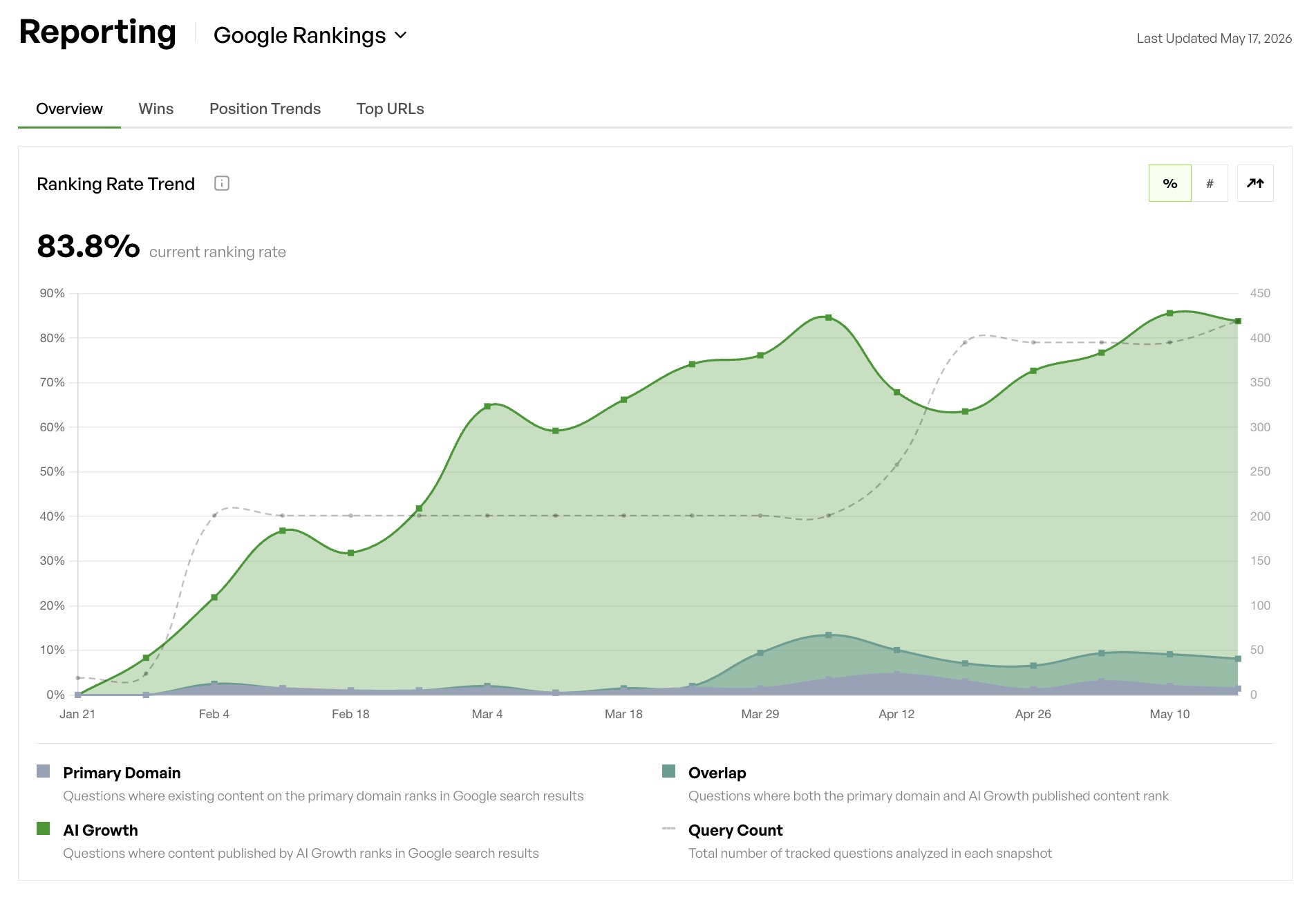
Search Intelligence provides the weekly universe snapshot, showing which queries your schema-backed content wins, which competitors displace you, and where white space remains. AI Analytics tracks brand value and consumer behavior across the full journey, from ChatGPT queries through content consumption and sentiment. Bot Tracking records every crawl, citation, and training sweep, including the specific bot ChatGPT uses to cite sources, so you can confirm that your schema is being read, not just deployed. AI Ranking replaces the old rank-position number with order of mention and citation context, tracked week over week against your content plan.
The contrast with capped-prompt monitoring tools is structural. A tool that tracks 50 or 100 prompts shows you a slice of your market that you already thought to ask about. It cannot show you the long-tail queries where AI surfaces form opinions about your brand without your input. It cannot cross-reference bot traffic, Google Search Console, and citation data in the same view. It also cannot act on what it finds. Leva Sleep became the most mentioned retailer for adjustable beds in Canada, with ChatGPT citing its content over 10,000 times per month and $40,000 to $50,000 in deals closed in under three weeks from AI-driven buyers, and this outcome required all four pillars working together rather than a monitoring dashboard that only reported the gap.
Frequently Asked Questions
How AEO Schema Differs From Traditional SEO Schema
Traditional SEO schema was designed primarily to earn rich results in Google Search, such as star ratings, sitelinks, event cards, and similar visual enhancements in the blue-link results page. AEO schema serves a different extraction model. AI surfaces like ChatGPT, Perplexity, and Google’s AI Mode do not render rich results. They parse structured data to resolve entity identity, verify factual claims, and determine citation confidence. The practical difference is that AEO schema prioritizes entity anchoring through Organization and sameAs markup, question-and-answer extraction through FAQPage, and content provenance through Article schema with complete author and publisher references. Visible-text parity remains non-negotiable in both contexts, but the downstream consumer of the signal has changed. A page tuned only for traditional rich results may carry schema that satisfies Google’s visual enhancement requirements while remaining ambiguous to an LLM deciding whether to cite the brand.
How Many sameAs Entries Support Strong AI Citation
There is no fixed minimum, but a solid brand entity typically carries at least three and ideally five or more sameAs entries covering Wikipedia, Wikidata, LinkedIn, Crunchbase, X/Twitter, YouTube, and any sector-specific directories where the brand has an authoritative profile. The goal is Multi-Source Agreement, which measures the share of external sources reporting identical core facts about the entity. A target above 85 percent consistency across those sources gives AI systems the corroborating evidence they need to cite the brand with confidence rather than hedging. Wikidata is the highest-priority entry because it supplies the structured, machine-readable facts that Google, ChatGPT, Claude, and Perplexity use to seed initial entity profiles. If a Wikidata entry does not yet exist for your brand, creating one becomes a prerequisite for full entity anchoring rather than an optional enhancement.
Why Schema Alone Cannot Replace High-Quality Content
Schema acts as the signal layer, not the substance. It tells AI surfaces what your content means and who published it. It does not replace authoritative, evidence-backed content that answers the queries your audience actually asks. The brands generating the highest AI citation rates combine comprehensive schema with content that validates every claim against primary sources, covers the full long-tail query universe rather than a handful of head terms, and refreshes automatically so the next training sweep finds the current narrative. Schema applied to thin or unvalidated content earns less citation confidence than schema applied to content that an AI system can independently verify. The two work together, because schema makes authoritative content legible to machines, and authoritative content gives schema something worth citing.
Conclusion: Own the Narrative With Headless AEO Schema
AEO schema markup functions as a living signal layer that must stay synchronized with your content, your entity profiles, and the AI surfaces reading both. Fragmented agency stacks and static plugin installs cannot maintain that synchronization at enterprise scale. The brands generating measurable AI citation wins run a single engine that provisions schema automatically, validates parity on every publish, self-heals on every refresh, and measures results across all four pillars without a capped prompt in sight.
Breadless achieved a 30x lift in Google Search Console impressions over six months and is now the most recommended healthy franchise in the US ahead of CAVA, Rush Bowls, and Sweetgreen, with ChatGPT citing its content over 45,000 times per month. Bisutti saw AI Growth Agent drive 71 percent of its brand mention visibility and became the second most recommended events brand by AI in Brazil. These outcomes come from owning the technical foundation that makes a brand the answer rather than from better monitoring alone.
The leaderboard in AI search is being written this year. Brands that establish authoritative, schema-backed content now are training the next generation of models with their own narrative, while brands that wait are training the next generation with whatever happens to be sitting on the open web.