Written by: Mariana Fonseca, Editorial Team, AI Growth Agent
Key Takeaways for CMOs Owning AI Search
- Brand narrative control means you deliberately produce and structure content so AI models cite your version of the story across ChatGPT, Perplexity, and Google AI Mode before competitors fill the gap.
- With 68% of Google searches now ending without a click, whatever the model says becomes the answer, so upstream narrative control replaces reactive reputation management.
- A seven-step audit checklist covering universe mapping, citation context analysis, schema validation, llms.txt files, and bot tracking reveals every gap between current and target AI visibility.
- Headless engines like AI Growth Agent outperform DIY chatbots, GEO monitors, SEO suites, and agencies by mapping the full query universe, publishing living content, and proving incremental visibility without per-prompt billing or agency dependency.
- Book a kickoff to see your first article live within a week and start controlling how AI surfaces describe your brand.
The 7-Step Audit Checklist to Win AI Overview Citation
Run this audit before you build anything so you see every gap between your current narrative and the visibility you need to earn consistent AI citations.
- Map your universe. List every seed term that describes your market, then expand each into the long-tail queries customers actually ask. Without this expansion, most brands track only a handful of head terms and lose the rest of the conversation by default, which is why comprehensive universe mapping underpins every other audit step.
- Validate seed terms against real-time data. Use live Google AI Overview and ChatGPT search results as the objective function. If a query is not surfacing AI-generated answers, treat it as lower priority. If it is, move it into your content plan immediately.
- Audit citation context. Search your brand name across ChatGPT, Perplexity, and Google AI Mode. Note where you appear in the answer, who you are grouped with, and what claim you are cited for. That picture is your current citation context, and it now functions as the ranking signal.
- Validate schema coverage. Ensure every published page carries JSON-LD markup for Article, Organization, and FAQ at minimum. Google recommends JSON-LD as its preferred structured data format and requires strict content parity between markup and visible page text.
- Publish llms.txt and llms-full.txt. Use these files to tell AI surfaces how to read your brand. Without them, models parse your content on their own terms, which may not match the narrative you want.
- Activate bot tracking. Track which AI crawlers read your content, when they visit, and what they cite. Per-article bot tracking is the minimum viable signal for knowing whether your narrative is being consumed.
- Establish incremental visibility baselines. Separate visibility you already had from visibility new content generates. Without that separation, you cannot prove that any effort is working.
Core Concepts for AI Narrative Control: Universe, Long Tail, Seed Terms, Citation Context, and LLMO
Five core concepts shape every decision in brand narrative control, and clarity on each one separates teams that win AI citations from teams that only monitor them.
The universe is the full set of queries and prompts that describe your market, head terms and long tail together. Most brands track a handful of head terms and lose the rest of the conversation by default. A mature content universe at AI Growth Agent reaches 1,600 or more queries, with the system running 3,000 or more searches every week to refresh the snapshot.
The long tail is where the vast majority of customer queries live. Robots search the long tail. There are hundreds of ways a customer can ask the same question in an AI search space, and that surface area exponentiates when an agent reasons on top of a user query. Brands that focus only on head terms stay blind to most of their own market.
Seed terms are the strategic anchor topics that organize the universe. Each seed term spawns dozens of long-tail queries beneath it. They function as a strategic map of where to compete, not as a simple keyword list.
Citation context replaces the old idea of a ranking number. It describes where a brand appears in an AI answer, who it is grouped with, and what claim it is cited for. AI search mentions are unstructured textual references processed by large language models to build knowledge graphs and understand relevance and authority, whereas citations are formal structured source links that provide verifiable attribution. Both signals matter, and neither appears in a traditional rank tracker.
Large language model optimization (LLMO) is the discipline of writing and structuring content so AI surfaces find it, trust it, and cite it. It works natively in natural language, which makes it fundamentally stronger than legacy SEO. It functions as the execution layer rather than a monitoring add-on.
The Current Market State: AI Mode Growth and External-Source Dominance
AI search has already reshaped user behavior at scale. Google stated at I/O 2026 that AI Mode crossed 1 billion monthly users within its first year and that queries more than doubled every quarter since launch. AI Overviews grew from 6.49% of queries in January 2025 to 13.14% by March 2025, and a Semrush analysis of over 10 million keywords found AI Overviews in 13.14% of US desktop queries by March 2025.
Click-through rates have collapsed in response. Organic CTR on queries with Google AI Overviews fell to 0.61% in September 2025, down 61% from 1.76% in June 2024. A Pew Research Center study of 68,879 real queries found users clicked results only 8% of the time when AI summaries appeared, and only 1% of users clicked sources cited within an AI Overview.
External mentions now drive much of this visibility. An Ahrefs analysis of 75,000 brands found that brands with the highest web mentions earn significantly more mentions in Google AI Overviews than those with fewer mentions, with third-party mentions in news and authoritative outlets roughly three times more correlated with AI visibility than traditional backlinks or brand-owned content alone.
Legacy monitoring tools cannot solve this problem. They track whether a brand appears for a capped set of prompts but do not produce content, own publishing, or act on the data. In a market where the leaderboard is being written this year, observation alone cannot serve as a strategy.
Comparing Solution Paths: From DIY Chatbots to Headless Engines
DIY chatbots such as Claude can draft one good article, yet the second article requires running the entire process again. Quality drifts from one piece to the next, schema remains unmaintained, and no universe map, publishing pipeline, or self-healing system exists. One company produced roughly 300 articles this way, and not one received a citation.
GEO monitors such as Profound, Athena, Peec AI, and Scrunch AI track whether a brand appears for a capped set of prompts. Monitoring does not equal action. These tools identify the gap and leave the brand to fill it, usually without a scalable system. They miss per-article bot tracking, centralized Google Search Console data, and the cross-referenced signals that drive content decisions.
SEO suites such as Semrush and Ahrefs sell keyword and rank data, which still helps with diagnosis. Data alone does not create AI search content, publish it, or self-heal what is live, so these suites do not function as an execution layer.
Agencies move slowly and cost a lot. An RFP often runs about three months, then three more months pass before the first assets appear. Nearly a year can pass before anything meaningful is in motion. When AI search changes, that structure falls behind again, and agency control of the client site often deepens the dependency.
Headless engines replace this entire stack. AI Growth Agent maps the full universe, produces validated living content, stands up a fully optimized site the client owns within the first week, tracks every bot interaction, and reports incremental visibility week over week. No capped prompt count, per-article billing, or agency dependency exists. The engine handles schema, technical SEO, bot tracking, publishing, and self-healing, while the brand states its goals in plain language and the engine pursues them.
Evaluation Factors: Capacity, Friction, Proof, and Scale
Team capacity rules out many options quickly. DIY chatbots require an editor, an SEO specialist, a designer, and an engineer working in coordination. Agencies require months of briefing and onboarding. Internal teams rarely hold all three perspectives needed: the engineer’s view of content, the marketer’s goals, and what robots need to cite it. Each approach fails for the same reason, because it assumes you can assemble and coordinate the perfect team. Headless marketing removes that requirement entirely, since the engine becomes the team.
Integration friction hides real cost. GEO monitors require separate content production workflows. SEO suites require separate publishing. Agencies often control the site, which turns every change into a dependency. AI Growth Agent connects through a reverse proxy rewrite, usually under a subdirectory, or through a subdomain, and that single step completes the client-side integration.
Incremental proof separates accountability from noise. Most tools report on visibility the brand already had. AI Growth Agent publishes into a separate environment and reports only the visibility it actually generated, cross-referenced against bot traffic, Google Search Console, and citation data. Every evaluation should apply that standard.
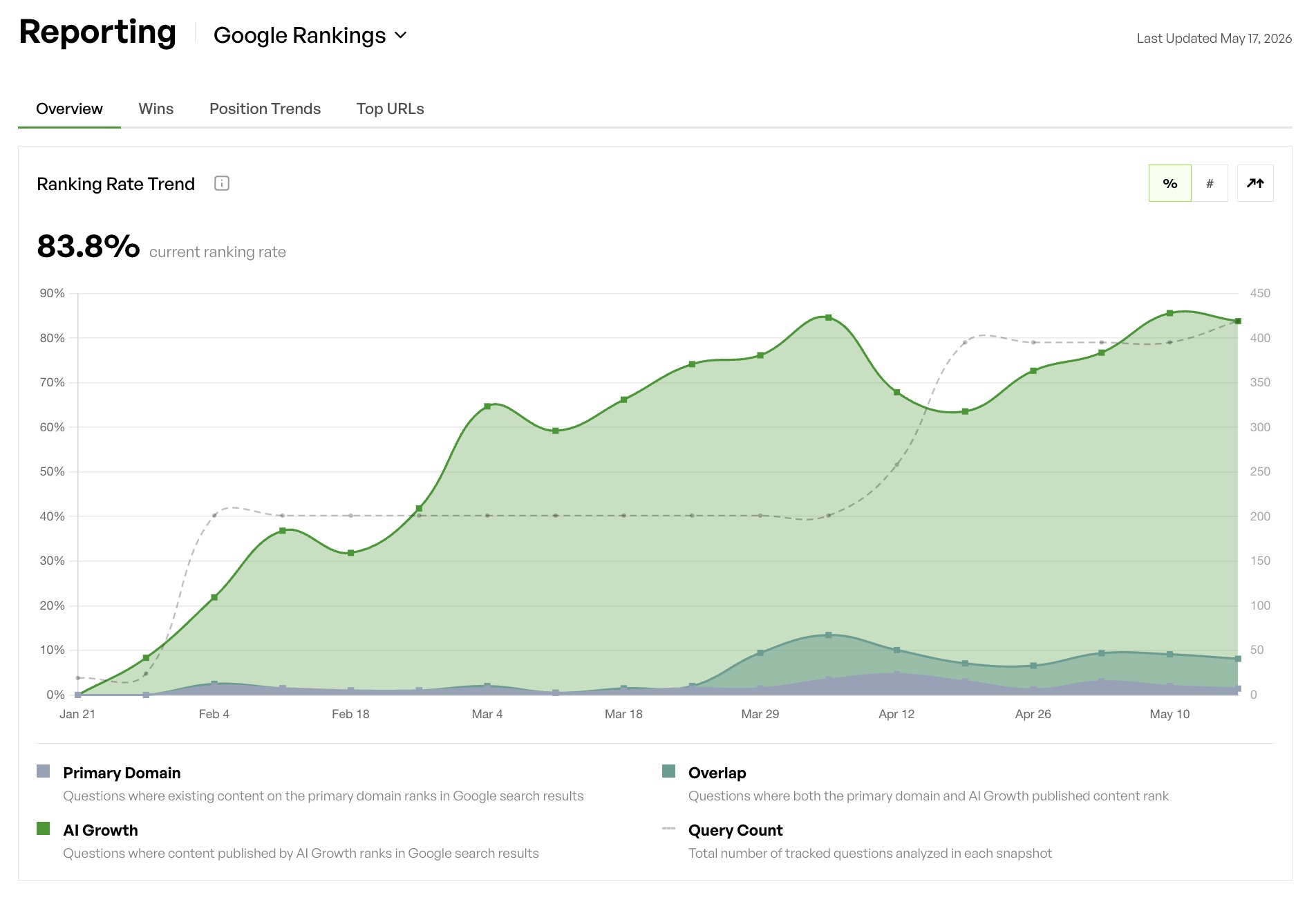
Scalability exposes the limits of prompt caps and per-article billing. A mature content universe requires 1,600 or more queries, refreshed weekly. Any tool that charges per prompt or caps tracked terms cannot cover the full universe. Flat-fee pricing with no per-prompt billing is the only model that scales with the real market size.
Ready to evaluate AI Growth Agent against your current approach? Schedule a consultation to map your universe and see how the engine handles your specific market.
Implementation Stages: From 7-Day Kickoff to Agentic Technical SEO
The first week sets the foundation. A professional journalist interviews the client to build the brand manifesto, which becomes the single source of truth for voice, factual references, deny lists, and personalization. That material feeds the keyword topology and the first articles. By the end of the week, the engine is generating content the client feels comfortable approving, and the site is live.
Topology mapping turns the manifesto into a strategic universe. AI Growth Agent ingests any unstructured material the client has, including PDFs, brand guidelines, and product pages, and its agents map the entire market. The result is a hierarchy of seed terms, each backed by real-time Google and ChatGPT data, with dozens of long-tail queries beneath each one. This real-time validation ensures the system prioritizes queries that actually trigger AI-generated answers, which defines the objective function for which long-tail queries deserve investment. A new account typically starts with three to four hundred validated queries and expands as it pursues more of the universe.
Site provisioning delivers a fully optimized, owned property in week one, without a website agency, RFP, or ongoing dependency. The site connects to the client’s domain through a reverse proxy rewrite or subdomain and does not interfere with the existing main site.
Agentic technical SEO ships automatically with every article and every site. The stack includes Blog MCP (compatible with Chrome 146 and later and other WebMCP-enabled browsers), OpenAI discovery and Agent Card guidance served via /.well-known/, natural language query parameters via /?s={query} that auto-trigger personalized and internally linked responses, Markdown served to agent crawlers, and llms.txt and llms-full.txt so AI surfaces can read the brand the way they need to. Traditional technical SEO also ships alongside this stack, including rich schema markup across Article, Organization, FAQ, author, product, and the rest of the schema suite, proper sitemaps, advanced robots.txt, automated web stories, instant indexing, autoredirects, and 404 tracking. No technical skill is required from the client.
The following JSON-LD snippet illustrates the Article schema structure AI Growth Agent provisions automatically on every published piece:
{ "@context": "https://schema.org", "@type": "Article", "headline": "Brand Narrative Control in AI Search", "author": { "@type": "Person", "name": "Author Name", "affiliation": { "@type": "Organization", "name": "Brand Name" } }, "publisher": { "@type": "Organization", "name": "Brand Name", "sameAs": ["https://linkedin.com/company/brand", "https://crunchbase.com/organization/brand"] }, "datePublished": "2026-06-15", "mainEntityOfPage": { "@type": "WebPage", "@id": "https://brand.com/article-url" } }Organization schema with sameAs links to verified external profiles resolves brand ambiguity across AI systems. Creating a consistent entity graph with accurate sameAs links to verified external profiles such as LinkedIn and Crunchbase helps resolve brand ambiguity and supports authority signals across AI systems. FAQ schema follows the same content-parity requirement, so markup must reflect visible content exactly.
An llms.txt file at the root of the domain provides AI surfaces with a structured, human-readable index of the brand’s content and capabilities. The format uses plain Markdown, listing key pages, their purpose, and any guidance for how models should interpret them. llms-full.txt extends this with the complete content of key pages, so AI surfaces can read the brand without crawling individual URLs.
Ongoing Management: Self-Healing Content, Bot Tracking, and Visibility Reporting
Content remains in motion rather than shipped and forgotten. Every article self-heals and updates over time. When the year turns, every article in a sector refreshes automatically. Stale articles are identified through Google Search Console signals and bot-traffic awareness, then updated before they decay in place. Every article’s relationships, performance, and indexing data stay centralized so authority compounds instead of eroding.
Bot tracking records every interaction from traditional crawlers and AI training agents, including each crawl, citation, and training sweep. Per-article bot tracking shows exactly when ChatGPT cites a piece of content and where that citation appears. Without this signal, you cannot tell whether the narrative is being consumed.
Incremental visibility reporting isolates the visibility AI Growth Agent generated, week over week, separate from visibility the brand already had. The reporting cross-references bot traffic, Google Search Console, and citation data that no single tool brings together. Clients who measure best capture source at the conversion moment and consistently see a lift in organic leads after starting, with the typical twelve-week results described earlier.
Risks and Common Mistakes: Stale Content, Capped Prompts, and Dependency
Stale content creates the most common and most damaging risk. Content freshness signals, including frequent updates and timestamped data, reduce visibility volatility by signaling information currency to retrieval-augmented generation systems used by AI answer engines. A brand that publishes once and moves on trains the next generation of models with an outdated narrative. The self-healing cadence in AI Growth Agent’s living content system prevents this by design.
Capped prompts create a false sense of coverage. A tool that tracks 50 or 100 prompts shows only the slice of the market the brand already thought to ask about. The long tail, where robots actually search and where most customer queries live, remains invisible. Any strategy built on a capped prompt set rests on an incomplete map.
Agency dependency amplifies every other risk. When an agency controls the site, every content update becomes a dependency. When an agency controls the schema, every technical change becomes a dependency. When an agency controls the reporting, the brand never knows whether results are real or simply attributed. AI Growth Agent stands up a site the client owns outright, provisions all technical SEO automatically, and reports incremental visibility the brand can audit independently using the same GSC integration described earlier.
The four-pillar system, Search Intelligence, AI Analytics, Bot Tracking, and AI Ranking, prevents each of these risks by giving the brand a single data backbone that turns the market into a diagnosis and the diagnosis into content decisions, instead of a set of disconnected dashboards.
Traditional search tools show you where your brand stands. AI Growth Agent makes your brand the answer. Book a kickoff and see your first article live within a week.
Frequently Asked Questions
What is the difference between brand narrative control and traditional reputation management?
Traditional reputation management is reactive and responds to negative content after it appears, attempting to suppress or outrank it. Brand narrative control in AI search is upstream and proactive, because it focuses on producing the content that AI models will use to describe a brand before any competitor, critic, or random web source fills that space. The distinction matters because AI surfaces do not present a list of results for users to evaluate; they synthesize a single answer. By the time a brand discovers it is described inaccurately in an AI answer, that description has already reached thousands of users who never clicked through to verify it. Narrative control prevents the problem instead of responding to it.
How does schema markup actually influence what AI models say about a brand?
Schema markup makes content machine-readable in a way that plain prose cannot. JSON-LD properties such as author.name, author.affiliation, datePublished, mainEntityOfPage, and sameAs give AI systems the provenance signals they need to recognize a source as authoritative and citable. Without schema, a model parsing a page must infer these relationships from context, which introduces ambiguity and reduces citation probability. With schema, the brand’s identity, the author’s credentials, the publication date, and the relationship to other verified entities all become explicit. AI systems use this structured information to distinguish between casual unstructured mentions and verified structured citations before assigning authority. Schema functions as the minimum viable signal for machine readability rather than a ranking trick.
Why do AI models prioritize the long tail over head terms when generating answers?
Head terms are high-competition, high-ambiguity queries. When a user asks a specific question in a conversational AI surface, the query almost always appears as a long-tail variant, such as a specific use case, a comparison, a how-to, or a contextual follow-up. AI models are tuned to answer the specific question in front of them, not to surface the most-searched keyword. Brands that focus only on head terms produce content that is too generic to serve as the best answer for any specific query. The long tail is where specificity lives, and specificity earns citations. A mature content universe maps hundreds of seed terms and the long-tail queries beneath each one, covering the full surface area of how customers actually ask about a market.
How long does it take to see measurable results from a headless marketing engine?
The first article typically goes live within a week of kickoff. Content has indexed in as little as ten days and often within two weeks. Measurable movement in bot traffic, impressions, and citation rates usually appears within the first month. The standard engagement runs as a three-month pilot because indexing timelines vary by industry and the compounding effect of a growing content universe takes time to build. Clients who track source at the conversion moment consistently see a lift in organic leads after starting. Across the first twelve weeks, AI Growth Agent clients average more than 12,000 additional AI citations and mentions, over 100,000 additional bot visits, and a 20% or greater lift in impressions. Standout results include Breadless achieving a 30-times lift in Google Search Console impressions over six months and Jota recording a 190% traffic increase from generated content over three months.
Conclusion: Make Your Brand the Answer
The leaderboard for AI search is being written this year, and brands that establish authoritative content now are training the next generation of models with their own narrative. Brands that wait are training the same models with whatever happens to be sitting on the open web.
Reactive monitoring functions like a rearview mirror and shows where a brand stands after the model has already decided what to say. Brand narrative control in AI search acts as the steering wheel. It maps the full universe of queries customers actually ask, produces living content robots trust, delivers incremental visibility proof isolated from existing brand equity, and runs with no headcount and no per-prompt billing.
The four pillars, Search Intelligence, AI Analytics, Bot Tracking, and AI Ranking, give every content decision a data backbone. The self-healing cadence keeps the narrative current as the world changes. The agentic technical SEO stack, including Blog MCP, llms.txt, agent discovery, and the full schema suite, makes the brand readable to every AI surface that matters. The 7-day kickoff means the first article is live before a traditional agency finishes its RFP.
The brands cited in AI search this year are training the next generation of models with their own story. The brands that are not cited are letting someone else write it.
The brands cited in AI search this year are training the next generation of models with their own story. Start training yours—schedule a demo and see your first article live within a week.