Written by: Mariana Fonseca, Editorial Team, AI Growth Agent
Key Takeaways for Agent-Ready Visibility
- An agent-enabled site visibility strategy structures owned content so AI agents discover, trust, and cite it across platforms like ChatGPT and Perplexity.
- The four-pillar framework, Search Intelligence, AI Analytics, Bot Tracking, and AI Ranking, replaces reactive monitoring with upstream narrative control.
- Technical prerequisites include semantic HTML, strict heading hierarchy, full JSON-LD schema, and server-side rendering so AI agents can parse and cite content.
- Bot tracking, self-healing content, and consistent third-party signals keep your citation position stable and build agentic trust over time.
- Stop monitoring position and start owning the answer. See how fast your first agent-ready article can go live.
Prerequisites for an Agent-Enabled Property
Two conditions must be in place before implementation begins. First, confirm outright ownership of the domain where the agent-ready property will live. Brands that let an agency control their site cannot act on the data the four pillars surface. Second, produce a brand manifesto: a single source of truth covering voice rules, factual references, primary-source URLs, and deny lists. The manifesto is what separates authoritative content from commodity output.
Once these two prerequisites are in place, the next step is to identify where the brand should compete in the AI answer landscape. Map seed terms from real-time data. AI Growth Agent runs 3,000+ searches weekly to refresh the universe snapshot, drawing from live Google and ChatGPT results rather than static keyword databases. Each seed term spawns dozens of long-tail queries, and those queries are the surface area where AI agents actually operate.
How the Four-Pillar Process Works
The four-pillar visibility framework maps directly to headless marketing execution. Search Intelligence delivers a complete portrait of the traditional search landscape, covering positioning, competition, and search volume. AI Analytics tracks brand value and consumer behavior across the full journey, from external AI-tool queries through content consumption and sentiment. Bot Tracking logs every crawl, citation, and training sweep from traditional bots and AI training agents alike. AI Ranking monitors order of mention and citation context, which replace the static rank number in AI-generated answers.
Each pillar feeds the next in a closed loop. Search Intelligence identifies where to compete. AI Analytics confirms what the audience actually consumes. Bot Tracking proves whether the content is being read. AI Ranking measures whether the brand is winning the answer. A LangChain survey of 1,340 professionals found that 57.3% of respondents already have agents running in production, which means the citation competition is live now, not approaching.
Brands that want to compete in this environment need a visibility system built for AI answers, not blue links. Traditional search tools show where your brand stands today. AI Growth Agent focuses on where your brand appears inside the answer tomorrow.
Step-by-Step Implementation: Pillar 1, Search Intelligence
Search Intelligence begins with the owned site's HTML architecture. AI agents extract content across visible text, DOM structure, semantic elements, and metadata, with Schema.org in JSON-LD identified as the single most impactful technical improvement because it serves as the translation layer between content and AI agents. The following five technical changes turn a standard website into an agent-readable property.
- Establish a strict heading hierarchy: one H1 per page, H2 for primary sections, H3 for subsections, with no levels skipped. OpenAI's ChatGPT Atlas uses ARIA tags and semantic heading structure to interpret page layout, which makes hierarchy a citation prerequisite, not a style choice.
- Replace div-soup containers with semantic HTML5 elements such as
<article>,<main>,<nav>,<aside>, and<section>. Processing the accessibility tree requires only a few thousand tokens for AI agents, compared to tens of thousands for screenshot-based approaches, so semantic structure directly reduces the cost of being cited. - Implement full schema markup in JSON-LD. Priority order: Organization, Article, FAQPage, BreadcrumbList, and Author. This structured data layer builds on the semantic HTML foundation by explicitly labeling what each page represents. Every article and site AI Growth Agent publishes ships with this suite provisioned automatically.
- Complement schema markup with Open Graph titles and descriptions, image alt text, and video metadata on every asset. While schema describes what the page is, metadata clarifies what the page contains, which helps agents identify page meaning without rendering the full DOM.
- Ensure server-side rendering for all essential content. Most AI crawlers cannot execute JavaScript, so client-side-only content is invisible to the bots doing the citing.
Step-by-Step Implementation: Pillar 2, AI Analytics
AI Analytics connects the owned property to the signals that confirm whether the content is earning trust across the full customer journey. Third-party signal consistency is the foundation. Yext Research found that 86% of AI citations come from brand-managed sources such as websites and listings, which means the owned property must be the most accurate and complete representation of the brand anywhere on the web.
The following five steps create a single analytics view that links AI citations to revenue and brand trust.
- Audit NAP consistency across all listings. Accurate entity data, including provider names, services, hours, and location-specific offers, creates the reliable source of truth AI surfaces draw from. Consistent, structured, widely distributed data connects an entity across the web in a way AI can trust.
- Connect Google Search Console as an independent audit layer. AI Growth Agent cross-references per-article bot tracking with Search Console impressions and click data to isolate incremental visibility from existing brand equity.
- Configure custom UTM parameters for attribution back into the analytics stack. In a zero-click environment, capturing source at the conversion moment is the only reliable way to connect AI citations to revenue.
- Implement Google Analytics with event tracking on content engagement. After receiving an AI recommendation, a significant portion of consumers immediately search Google to verify, and many click through to cited sources, so the analytics stack must be ready to capture that verification traffic.
- Validate structured data against primary-source URLs and the brand manifesto before any article ships. Post-draft claim re-extraction checks every assertion against product pages, manifesto, and verified external sources, and removes any claim that cannot be backed up.
Ready to see AI Analytics connect bot traffic, Search Console, and citation data in one place? Book a working session and review a live reporting view.
Step-by-Step Implementation: Pillar 3, Bot Tracking
Bot Tracking is the pillar that makes the invisible visible. Without it, a brand cannot tell whether AI training agents are reading its content, which bots are citing it, or whether a new article has been swept into a model's training data. OpenAI's GPTBot and Anthropic's ClaudeBot combined already generate request volume equal to a substantial portion of GoogleBot's volume, and that share is growing.
The seven steps below work together as a unified bot tracking capability that exposes how agents see and use your content.
- Deploy the AI Growth Agent WordPress plugin, which ships with real-time bot tracking out of the box. Every bot that touches the blog is logged, including the bot ChatGPT uses to cite sources, with no additional configuration required.
- Publish
llms.txtandllms-full.txtat the domain root. These files tell AI surfaces how to read the brand's content, which pages to prioritize, and what the brand's authoritative claims are. AI Growth Agent publishes both automatically as part of the agentic technical SEO stack. - Implement Blog MCP. AI Growth Agent was the first to bring Blog MCP to market, with clients running it in the summer of 2025, roughly a year before Google released Web MCP. Blog MCP exposes schema, manifest, discovery, and capability guidance to agents and is compatible with Chrome 146+ and other WebMCP-enabled browsers.
- Serve OpenAI discovery and Agent Card guidance via
/.well-known/. This makes the property discoverable to agents that check well-known endpoints before crawling. WebMCP is available behind flags in Chrome 146, and the W3C Web Machine Learning Community Group has published it only as a draft report (not a formal standard) as of June 2026. - Enable natural language query parameters via
/?s={query}. When an agent passes a query directly into the URL, the site returns a personalized, internally linked response, which turns the owned property into an active answer surface rather than a passive document. - Serve Markdown to agent crawlers. A typical page requires significantly more tokens when served as raw HTML but far fewer when converted to Markdown, a substantial reduction in token usage for AI agents. Lower token cost means higher citation probability.
- Authenticate bot tiers. HUMAN Security's agentic visibility framework classifies AI agents into high-, medium-, and low-trust tiers using cryptographic verification via HTTP Message Signatures (RFC 9421) and key directories. High-trust agents are cryptographically verified on each request. Low-trust agents are candidates for blocking or restriction.
Step-by-Step Implementation: Pillar 4, AI Ranking
AI Ranking replaces the static position number with order of mention and citation context. The focus shifts from what page ranks to where the brand appears in the answer and what claim it is cited for. Living, self-healing content is the mechanism that keeps that position from decaying.
The five steps below keep content fresh, compound authority, and report only incremental visibility.
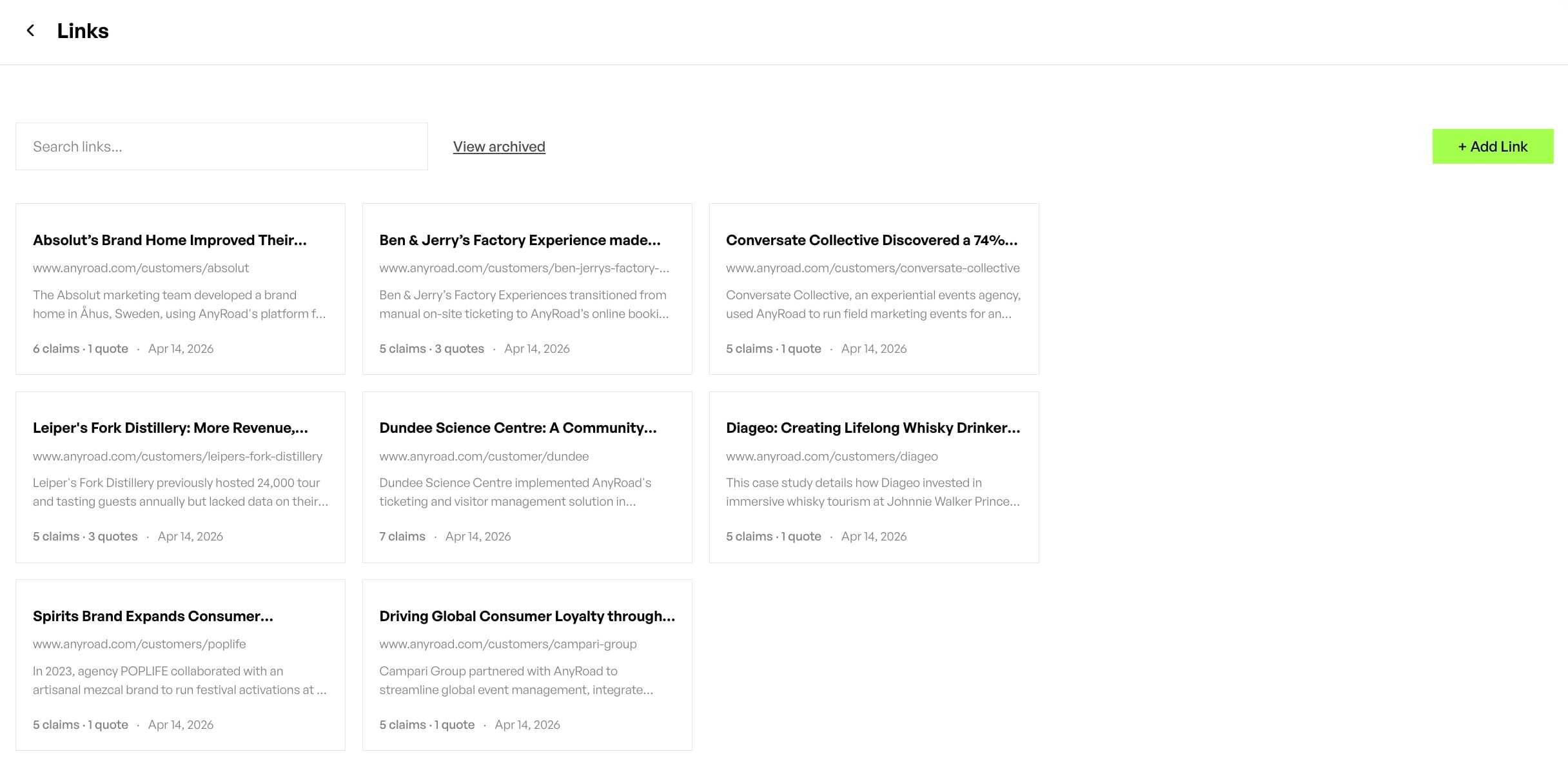
- Implement automatic content refresh triggered by Google Search Console signals and bot-traffic awareness. When an article's impressions drop or a bot sweep returns without a citation, the self-healing system flags the article for update. Stale content loses citation position. Living content compounds it.
- Run annual sector refreshes automatically. When the year turns, every article in a sector is updated to reflect current data, current competitors, and current claims. AI Growth Agent clients average more than 12,000 additional AI citations and mentions across the first twelve weeks, and that number compounds when content stays current.
- Build internal linking that compounds authority across the universe. Every new article links to related articles, and the engine uses bot-traffic and Search Console data to identify which internal links lift underperforming content.
- Generate automated web stories for every article. Each web story points back to the source article and is served through a dedicated web-stories sitemap, which creates a free internal link signal Google supports natively.
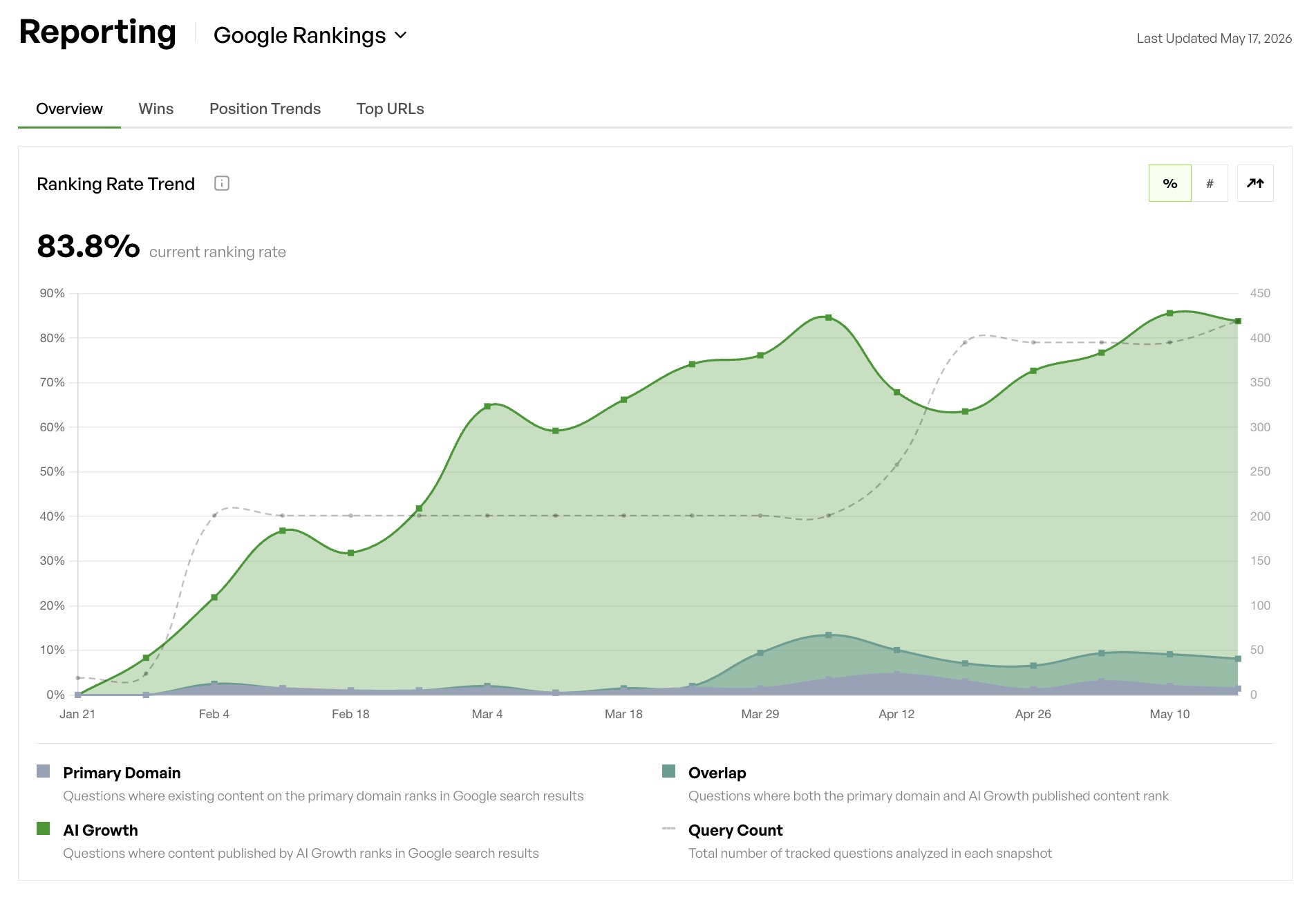
- Report incremental visibility week over week. AI Growth Agent publishes into a separate environment so it can isolate exactly what it generated, never taking credit for visibility the brand already had. The reporting view cross-references bot traffic, Search Console, and citation data that no single tool brings together independently.
Want to watch incremental visibility compound instead of guessing what moved the needle? Request a walkthrough of the AI Ranking dashboard and self-healing workflow.
Common Mistakes in Agent-Enabled Visibility
Three failure patterns account for most agent-enabled site visibility breakdowns. The first is div-soup markup. Agents commonly fail to parse sites that rely on div containers without semantic structure, use ambiguous navigation, or present conflicting metadata such as a Schema.org price that contradicts the on-page price. Pages that look polished to a human and are invisible to a bot are not assets; they are decoration.
The second mistake is stale content. The moment an article ships without a self-healing mechanism, it begins to decay, and that decay erodes AI Ranking over time. Competitors update their content, models retrain on fresher data, and the brand's citation position erodes without any visible signal. Living content is not a feature. It is the baseline requirement for sustained AI Ranking.
The third mistake is capped monitoring tools. Tools that track a fixed set of prompts show the brand only the slice of its market it already thought to ask about. Gartner predicts that 40% of enterprise applications will embed task-specific AI agents by end-2026, up from less than 5% in 2025, which means the query universe is expanding faster than any capped monitoring tool can track. Monitoring is not action. Producing and publishing authoritative content against the full universe is.
Verifying Outcomes and Proving Lift
Outcome verification runs on three parallel tracks. The first is new citation isolation: week-over-week reporting that identifies which articles generated new AI citations, which bots swept them, and which queries triggered the citation. The second is bot traffic growth: per-article bot analytics that show exactly when ChatGPT, PerplexityBot, and other AI crawlers touch the content. AI Growth Agent clients average more than 100,000 additional bot visits across the first twelve weeks. The third is impression lift: Google Search Console as an independent audit, with a target of 20%+ impressions growth in the same window.
Enterprise trust, security, and compliance controls are verified through the same stack. Legal disclaimers and claim prioritization for sensitive sectors are configured once in the manifesto and applied to every future generation. Every claim, source, and quote is validated against evidence found online rather than a model's training data, and the cascade of anti-hallucination checks runs before any article moves to publish. Bot authentication via cryptographic verification ensures that high-trust agents are confirmed on each request, which protects the property from low-trust scrapers while keeping it fully open to the AI surfaces that drive citations.
Advanced Scenarios for Enterprise and Multi-Brand Teams
Mature implementations scale to universes of 1,600+ queries, with the weekly search refresh described earlier running continuously to keep the snapshot current. At that scale, the Content Topology becomes a strategic map of where to compete across hundreds of seed terms and the long-tail queries beneath them, refreshed with real-time Google and ChatGPT data as the objective function.
Multi-brand portfolios run parallel engines, each with its own manifesto, universe map, and content topology. Bisutti runs two parallel AI Growth Agent engines, one tuned to consumer events and one to corporate events, with AI Growth Agent representing 71% of Bisutti's brand mention visibility. Each engine operates its own universe map and content topology, so the two buyer journeys never compete for the same citation context.
Large enterprises with 10,000 or more employees lead AI agent adoption, with 67% reporting agents in production, compared to 50% of organizations with fewer than 100 employees. At enterprise scale, the agent-enabled site visibility strategy must account for multi-region query universes, multi-language content production, and compliance requirements that vary by jurisdiction. AI Growth Agent's model selection by task and by language, drawing on OpenAI, Anthropic, Gemini, Grok, Perplexity, Exa, and Firecrawl, handles this without additional headcount on the client's side.
Ready to map your full query universe and see where your brand is missing from AI answers? Request a universe-mapping session and review the gaps live.
Frequently Asked Questions
What is WebMCP and why does it matter for an agent-enabled site visibility strategy?
WebMCP is a proposed W3C web standard, jointly developed by Google's Chrome team and Microsoft's Edge team, that adds a browser-native API allowing websites to register structured tools directly on pages so AI agents can discover and invoke them without scraping the DOM or simulating clicks. It supports both an imperative JavaScript API using navigator.modelContext.registerTool() and a declarative HTML API that converts existing forms into agent-ready tools by adding attributes such as toolname and tooldescription. For an agent-enabled site visibility strategy, WebMCP matters because it turns a passive content property into an active answer surface: an agent visiting the site can call structured functions, receive typed outputs, and complete tasks on behalf of a user without any ambiguity about what the page offers. AI Growth Agent's Blog MCP implementation is compatible with Chrome 146+ and other WebMCP-enabled browsers, with schema, manifest, discovery, and capability guidance exposed to agents out of the box, making it the most technically complete agentic surface available to clients from day one.
How does semantic HTML influence whether AI agents cite a brand's content?
AI agents parse websites primarily through the accessibility tree, which is generated directly from HTML. Semantic elements such as article, nav, main, aside, and section, combined with a strict heading hierarchy and properly labeled interactive elements, give agents a clean hierarchical representation of roles, labels, states, and relationships. Pages built as walls of div elements force agents to infer structure, which increases parsing errors and reduces citation probability. Structured data in JSON-LD compounds the effect: Schema.org markup serves as the translation layer between content and AI agents, letting them identify page meaning without rendering the full DOM. The practical consequence is that semantic HTML and schema markup are not accessibility niceties; they are the technical prerequisites for appearing in AI-generated answers. Every article and site AI Growth Agent publishes ships with highly structured HTML, full schema markup across the complete schema suite, and Open Graph metadata on every asset, provisioned automatically with no action required from the client.
What does agentic trust mean and how do third-party signals build it?
Agentic trust is the degree to which an AI surface treats a brand's content as a reliable source worth citing. It is built through three categories of signal. The first is structural consistency: accurate entity data, including name, address, phone, services, and hours, distributed consistently across all listings and connected through structured data markup. The second is content authority: validated primary-source claims, named authorship with author schema, and living content that stays current rather than decaying after publication. The third is verification: cryptographic bot authentication that confirms high-trust agents on each request and blocks low-trust scrapers that could dilute the property's signal quality. Yext Research found that 86% of AI citations come from brand-managed sources such as websites and listings, which means the owned property must be the most accurate and complete representation of the brand anywhere on the web. AI Growth Agent's incremental visibility reporting isolates exactly what the engine generated, giving clients a defensible proof of trust-building that no monitoring tool can replicate.
How does bot tracking differ from traditional analytics and why is it essential for AI Ranking?
Traditional analytics tracks human sessions: page views, time on page, bounce rate, and conversion events. Bot tracking logs machine interactions: which AI crawlers visited, which articles they swept, whether the visit was a training pass or a real-time citation fetch, and whether the content was returned in HTML or Markdown. Without bot tracking, a brand cannot tell whether its content is being read by the AI surfaces that drive citations, which articles are earning training sweeps, or whether a new piece has entered a model's knowledge base. AI Growth Agent's WordPress plugin ships with real-time bot tracking out of the box, logging every bot that touches the blog including the bot ChatGPT uses to cite sources. That data feeds directly into AI Ranking. The engine identifies which articles are generating bot traffic, which are being cited, and which need self-healing to recover position. It is the feedback loop that turns a static content property into a compounding visibility asset.
Conclusion: Move From Monitoring to Owning the Answer
The leaderboard for AI-generated answers is being written now. Brands that establish authoritative, agent-ready content in 2026 are training the next generation of models with their own narrative. Brands that wait are training those models with whatever happens to be sitting on the open web, which means a competitor's content, a forum thread, or an outdated press release becomes the answer a customer receives when they ask about the brand.
An agent-enabled site visibility strategy is not a monitoring exercise. It is the deliberate construction of an owned property that AI agents can discover, parse, trust, and cite, built on the four pillars of Search Intelligence, AI Analytics, Bot Tracking, and AI Ranking, and executed through headless marketing that requires no technical headcount on the client's side. Breadless achieved a 30x lift in Google Search Console impressions over six months and is now the most recommended healthy franchise in the US ahead of CAVA, Rush Bowls, and Sweetgreen, with ChatGPT citing its content over 45,000 times per month. Leva Sleep became the most mentioned retailer for adjustable beds in Canada, with $40,000 to $50,000 in deals closed in under three weeks from buyers who discovered the brand through AI Growth Agent content. Those outcomes come from building the owned property that makes the brand the answer.
Stop treating AI visibility as a reporting problem and start treating it as an owned-media build. Launch your agent-enabled site visibility strategy and get the first pillar live within a week.