Written by: Mariana Fonseca, Editorial Team, AI Growth Agent
Key Takeaways
- Enterprise marketing AI visibility keeps brands present and cited across AI answer surfaces like ChatGPT, Perplexity, and Google AI Mode through a four-pillar data system.
- Zero-click searches reached 68% in early 2026, so citation share and order of mention now act as the main ranking signals instead of clicks.
- Success comes from mapping the full query universe, publishing authoritative content, and proving incremental visibility gains instead of relying on capped prompt monitoring.
- Headless architecture, agentic technical SEO, and living content maintenance keep brand narratives current and readable by every AI surface.
- Brands ready to move from monitoring to execution can schedule a demo with AI Growth Agent to review their four-pillar data foundation and start generating measurable results within weeks.
The Discovery Shift and the Visibility Challenge
68.01% of Google searches in the US ended without a click in the first four months of 2026, up from 60.45% in 2024. That 7.5-point jump is the fastest in a decade and comes primarily from AI Overviews. AI Overviews now reduce click-through rates for the top-ranking result by 58%, and for informational keywords, average position-one CTR has fallen sharply in recent years.
The behavioral shift is clear. A Pew Research Center study of 68,879 real queries found users clicked results only 8% of the time when AI summaries appeared, versus 15% without them. Only 1% of users clicked sources cited inside an AI Overview. Customers now resolve questions inside the surface and never visit the brand that answered them.
For enterprise brands, the core challenge goes beyond lower CTR. The AI surface now decides what to say about a brand, and most brands lack a system to influence that decision. Traditional monitoring tools show where a brand stands across a capped set of prompts. They cannot map the full query universe, produce authoritative content, or prove that new work generated incremental visibility. The result is a rearview mirror where a steering wheel is needed. Brands instead need a comprehensive framework that maps the full query landscape, produces authoritative content, and proves incremental gains through a system built on four connected data pillars.
What Enterprise Marketing AI Visibility Really Means
Enterprise marketing AI visibility is not a single metric. It is a system built on four pillars of data that together describe what AI surfaces know about a brand, how they cite it, and where it appears relative to competitors.
Pillar 1: Search Intelligence provides a complete portrait of the traditional search landscape: positioning, competition, search volume, and the structure of who already wins each result. It turns a static snapshot into an action plan by identifying which seed terms anchor the brand’s universe and which long-tail queries sit beneath them.
Pillar 2: AI Analytics covers brand value and consumer behavior across the full journey, from external touchpoints including Google and AI-tool queries through content consumption, demographics, and sentiment. It shows how the brand is perceived across the surfaces where customers form opinions.
Pillar 3: Bot Tracking records every bot interaction, traditional crawlers and AI training agents alike, including every crawl, citation, and training sweep. This visibility matters because AI platforms draw from different source pools than traditional search. ChatGPT’s sources have only a 39% overlap with Google’s sources. A brand invisible to AI crawlers is therefore invisible to a distinct and growing share of the discovery landscape regardless of its Google rankings.
Pillar 4: AI Ranking replaces the static ordered list. AI answers have no fixed position one through ten. Order of mention and citation context now form the leaderboard. Where a brand appears in the answer, what claim it is cited for, and how that position changes week over week are the signals that matter.
Citation share, authority weight, and AI sentiment serve as the equivalents of impressions, rankings, and backlinks in traditional search. A brand that appears first in an AI answer with a definitive attribution earns a very different outcome than one mentioned briefly in a supporting clause. Citation context now acts as the ranking signal, and it requires a data foundation that can see all four pillars at once.
How to Measure AI Brand Visibility in Practice
AI brand visibility measurement needs a metrics framework that goes beyond prompt-level monitoring. The table below outlines the core metrics, what each measures, and the benchmark context available from current research.
| Metric | What It Measures | Benchmark Context |
|---|---|---|
| AI Citation Share | Brand citations as a percentage of total category citations across tracked AI surfaces | Calculated as (Your Citations ÷ Total Citations) × 100; example: 733 mentions vs. a competitor’s 695 yields 51.3% share |
| Bot Visits | Volume of AI crawler and training agent visits to owned content | AI Growth Agent clients average 100,000+ additional bot visits in the first 12 weeks |
| Impressions Lift | Change in Google Search Console impressions attributable to new content, isolated from existing brand visibility | AI Growth Agent clients average 20%+ impressions lift in the first 12 weeks |
| Incremental AI Citations | New brand mentions and citations in AI-generated answers, isolated from pre-existing brand visibility | AI Growth Agent clients average 12,000+ additional AI citations and mentions in the first 12 weeks |
Beyond these four headline metrics, citation context tracks whether a brand is cited as the primary authoritative source, a supporting reference, or a brief mention, because not all citations carry equal weight. Average position within AI answers, platform breakdown across ChatGPT, Perplexity, and Google AI Mode, and sentiment analysis around brand mentions complete the measurement picture.
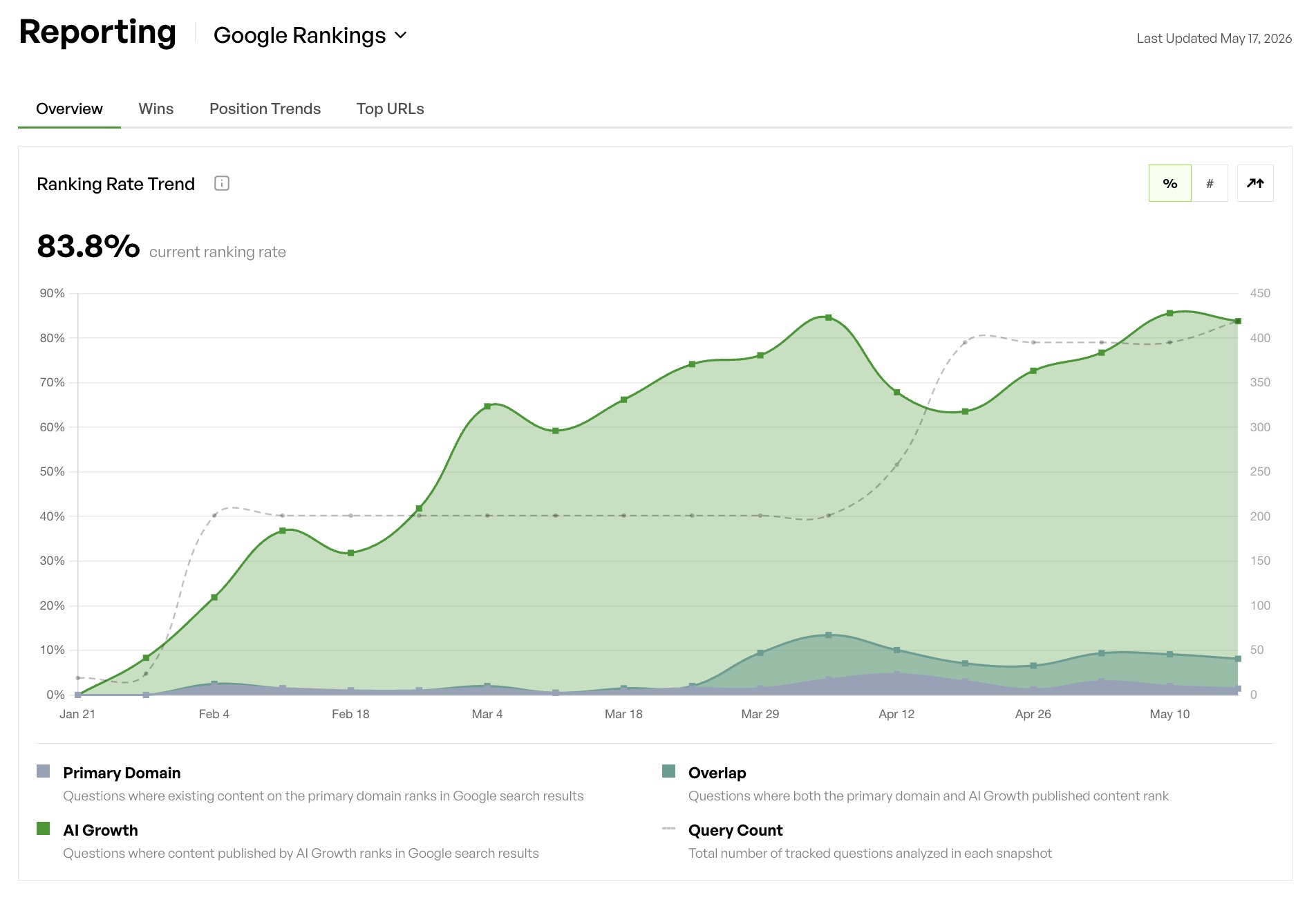
Incremental visibility reporting sits at the center of operational decision-making for enterprise CMOs. It isolates what a new content effort actually generated, separate from the visibility the brand already had. Without this view, a brand cannot separate organic growth from existing authority from new visibility earned by fresh content investment.
How AI Visibility Differs from Traditional SEO
The gap between AI visibility and traditional SEO is not mainly technical. It reflects a shift from observation to execution and from a capped market view to the full query universe.
Traditional SEO tools and AI search monitoring platforms share a structural limit: they report on a predefined set of queries. As of early 2026, dozens of specialized AI visibility platforms exist, differing in model coverage, prompt volume, and refresh frequency. A platform testing 50 prompts once per month produces a far less reliable trend than one running thousands of prompts daily across multiple models. Methodology determines whether results are rough estimates or directional indicators. More fundamentally, a capped prompt set means a brand only ever sees the slice of its market it already thought to ask about.
The long tail is where the gap grows largest. This matters because AI agents actively search the long tail, and there are hundreds of ways a customer can ask the same question in an AI search space. That surface area expands further when an agent reasons on top of a user query, which creates a discovery landscape far broader than any capped monitoring set can capture. Brands that focus only on head terms stay blind to most of their own market.
A production engine tackles this differently. It maps hundreds of seed terms and the long-tail queries beneath them using real-time Google and ChatGPT data as the objective function, refreshed weekly. It then produces authoritative content against each query, ships full traditional and agentic technical SEO, and reports the incremental visibility generated. The monitoring tool tells a brand it is not showing up. The production engine changes what shows up.
Brands cited in AI Overviews earn 35% more organic clicks and 91% more paid clicks compared to uncited brands. The value of being cited is measurable and compounding. Watching the gap without closing it does not qualify as a strategy.
Headless Marketing Architecture for Enterprise Brands
Headless marketing borrows its structure from headless commerce. The brand keeps its curated main site. AI Growth Agent stands up a separate, fully optimized blog the brand owns, connected through a reverse proxy rewrite under a subdirectory or through a subdomain. Nothing in the existing site structure changes. The engine writes, publishes, monitors, self-heals, and reports.
Content Topology and the Content Planner
Every engagement starts with a journalist-led interview that produces the brand manifesto, the single source of truth. The Content Topology then maps the brand’s full market: a hierarchy of seed terms, each backed by real-time Google and ChatGPT data, with dozens of long-tail queries beneath each one. Mature clients reach universes of 1,600+ queries, and the system runs 3,000+ searches every week to refresh the snapshot. The Content Planner turns that map into a strategic decision about where to compete, with evidence behind every move instead of instinct.
Agentic Technical SEO Stack
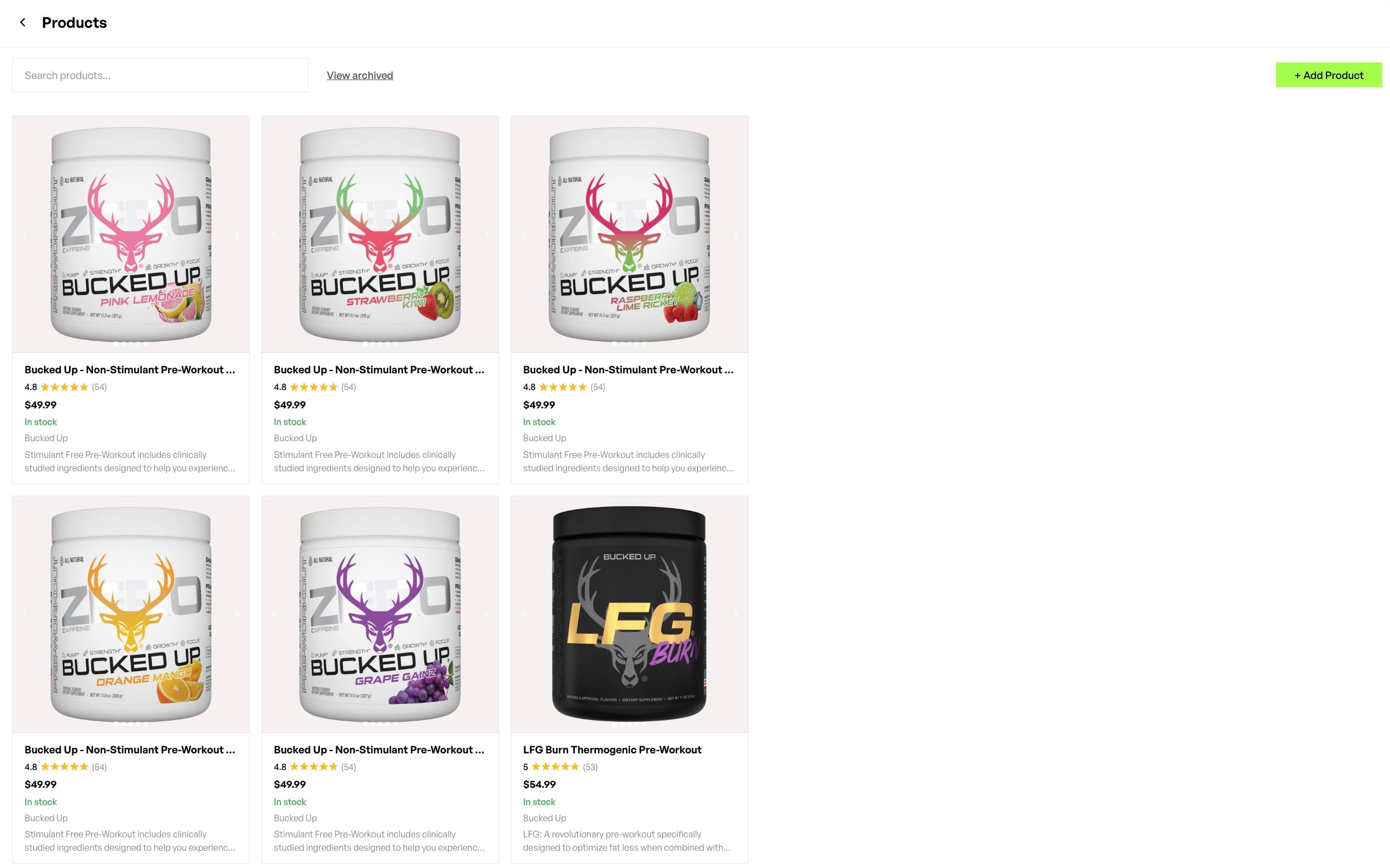
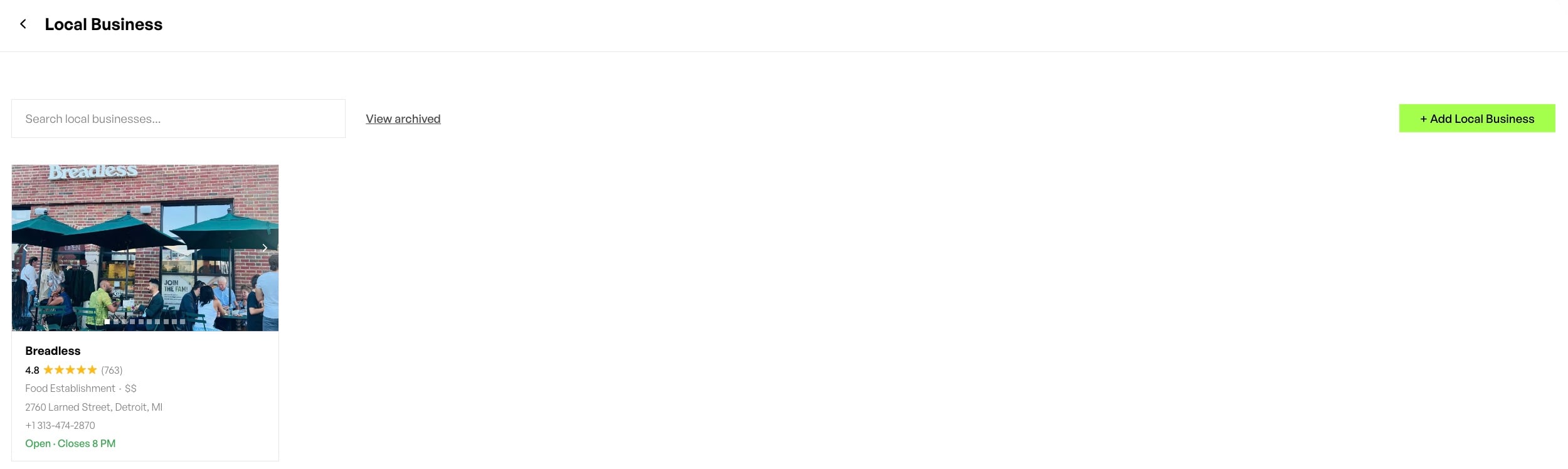
Every article and every site ships with the full traditional and agentic technical SEO stack automatically. Traditional technical SEO covers highly structured HTML, full metadata, rich schema markup across article, author, reviews, local business, product, and software application types, internal linking, sanitized external linking, proper sitemaps, a detailed robots.txt, automated web stories, real-time bot tracking, instant indexing, autoredirects, and 404 tracking.
Agentic technical SEO extends this foundation. Blog MCP, compatible with Chrome 146+ and other WebMCP-enabled browsers, exposes schema, manifest, discovery, and capability guidance to agents. OpenAI discovery and Agent Card guidance are served via /.well-known/. Natural language query parameters via /?s={query} auto-trigger personalized, internally linked responses so an agent passing a query straight into the URL receives a tailored answer. Pages are served in Markdown to agent crawlers. llms.txt and llms-full.txt are published so AI surfaces can read the brand the way they need to. Generative engine optimization requires structured metadata, indexable content sections, and full-sentence descriptions so AI agents can discover, understand, and recommend brand content. The full stack delivers this without any technical action required from the client.
Living Content Maintenance and Self-Healing
Content published once and left static decays. The world changes, competitors publish, AI models update their training data, and a brand’s narrative drifts from what the models say about it. Living content solves this structurally instead of through occasional manual audits.
When the year turns, every article in a sector refreshes automatically. The system identifies stale articles through Google Search Console signals and bot-traffic awareness and updates them before they lose authority. Every article’s relationships, performance, and indexing data sit in one place so the engine can decide what to internal-link, what to update, and where authority is compounding versus decaying.
Sustained AI performance depends on monitoring, feedback, and escalation systems that improve over time rather than one-time tool adoption. Living content is the content-layer version of that principle. The engine doubles down on what indexes well and uses internal linking to lift what does not. A brand running living content stays more current than competitors relying on a static publishing calendar and trains the next generation of AI models with its own narrative instead of whatever happens to sit on the open web.
Monitoring Platforms Versus Full Execution Engines
The operational gap between a monitoring platform and a full execution engine mirrors the gap between a diagnosis and a treatment plan. The table below compares the two categories across the dimensions that matter for enterprise decision-making.
| Capability | Monitoring Platforms (e.g., Profound, Athena, Peec AI) | Full Execution Engine (AI Growth Agent) |
|---|---|---|
| Query universe | Capped set of tracked prompts, with one example showing a brand appearing in 0.1% of relevant AI-generated answers | Hundreds of seed terms plus long-tail queries, refreshed weekly with 3,000+ searches, with prompt count never treated as a billed metric |
| Content production | None, monitoring only | 2 to 50 articles per day per client, up to about 500 per month, with anti-hallucination validation at every stage |
| Technical SEO | Not included | Full traditional and agentic technical SEO stack in every package, including schema, Blog MCP, llms.txt, instant indexing, bot tracking, and more |
| Incremental visibility proof | Reports existing visibility against tracked prompts without isolating new gains | Publishes into a separate environment and reports week-over-week incremental visibility isolated from pre-existing brand authority |
Marketers report median AI marketing ROI around 3.2× with 34% running agents. The gap between monitoring and execution is where that ROI appears. Monitoring tells a brand it is not showing up. An execution engine changes what shows up and proves the difference.
Conclusion: Taking Narrative Control
The enterprise marketing AI visibility framework described here has four components that must operate together. A four-pillar data foundation sees the full universe. A headless architecture publishes authoritative content the brand owns. Full traditional and agentic technical SEO makes the content readable by every AI surface. Living content self-heals so the brand’s narrative stays current as the world changes.
Monitoring tools deliver the first pillar partially and stop there. They show citation share and share of voice for a capped set of prompts. They cannot map the long tail, produce content, ship technical SEO, or prove that new work generated incremental visibility. Durable impact from AI comes from operational process, accountability, and governance rather than visibility or monitoring tools alone.
With zero-click searches now dominating the discovery landscape, the brands cited in AI search this year are training the next generation of models with their own narrative. AI Mode crossed 1 billion monthly users within its first year with queries more than doubling every quarter. The leaderboard is being written now. Brands that establish authoritative content across the full query universe this year build an advantage that will be structurally difficult to close later.
Traditional search tools show where your brand stands. AI Growth Agent focuses on making your brand the answer. The first article goes live within a week of kickoff, content indexes in as little as ten days, and incremental visibility reporting proves exactly what the engine generated from week one.
Frequently Asked Questions
What is the difference between enterprise marketing AI visibility and traditional SEO?
Traditional SEO focuses on ranked positions on a search results page where a user clicks through to a website. Enterprise marketing AI visibility focuses on citation and recommendation inside AI-generated answers where no click occurs. The metrics change, so citation share, order of mention, bot visits, and incremental impressions replace position rankings and click-through rates. The technical requirements also expand beyond structured HTML and schema to include Blog MCP, llms.txt, agent discovery endpoints, and Markdown served to AI crawlers. The content strategy shifts as well. Traditional SEO targets a manageable set of head terms. AI visibility requires mapping the full long-tail query universe because AI agents reason across hundreds of variations of any given question, and a brand absent from the long tail stays absent from most of the conversation.
How does AI Growth Agent prove that visibility gains are incremental rather than pre-existing?
AI Growth Agent publishes into a separate environment from the brand’s existing web presence. This separation allows the reporting system to attribute visibility gains specifically to content the engine produced instead of crediting the brand’s existing authority. Week-over-week incremental visibility reporting cross-references bot traffic data, Google Search Console impressions, and AI citation data to isolate what changed after the engine began publishing. The brand can see exactly which articles drove new bot visits, which queries moved from uncited to cited, and how impressions on AI Growth Agent content compare to impressions on the brand’s pre-existing pages. This gives CMOs a concrete answer when defending a content investment to a CEO: not “our visibility went up” but “here is exactly what this engine generated.”
Why is a capped prompt set a structural problem for enterprise AI visibility measurement?
A capped prompt set means a brand measures only the slice of its market it already thought to ask about. The long tail of queries that customers actually use in AI search is vast. There are hundreds of ways to ask the same question, and that surface area multiplies when an AI agent reasons on top of a user query. Monitoring tools that track 50 or 100 prompts stay blind to most of the conversation happening in a brand’s category. This does not represent a simple data-size issue. It is a structural issue because the queries a brand pre-selected to monitor are usually the head terms it already knows it should win, not the long-tail queries where most discovery actually happens. An enterprise AI visibility framework needs to map the full universe of seed terms and long-tail queries, refreshed weekly with real-time data, so the brand can see and compete across the entire conversation instead of a curated sample.
What technical infrastructure does a brand need to support AI visibility at scale?
The technical requirements for AI visibility fall into two categories: traditional technical SEO and agentic technical SEO. Traditional requirements include highly structured HTML, full metadata on every asset, rich schema markup across article, author, product, and organization types, proper sitemaps, a detailed robots.txt, internal linking, and fresh content with automatic updates. Agentic requirements are newer and less commonly implemented. They include Blog MCP for direct interoperability with AI search agents, OpenAI discovery and Agent Card guidance served via /.well-known/, natural language query parameters that return personalized responses to agents, Markdown served to agent crawlers, and llms.txt and llms-full.txt files so AI surfaces can read the brand’s content in the format they require. Most enterprise marketing teams are non-technical and cannot implement this stack independently. The headless marketing architecture delivers the full stack automatically as part of every engagement, with the only integration step being a reverse proxy rewrite connecting the blog to a subdirectory under the brand’s domain.
How long does it take to see measurable results from an enterprise AI visibility program?
The first article typically goes live within one week of kickoff. Content has indexed in as little as ten days and commonly within two weeks. Measurable movement in bot visits, impressions, and AI citations usually appears within the first month for most clients. The standard engagement runs as a three-month pilot because indexing timelines vary by industry and the compounding effect of living content builds over time. Across the first twelve weeks, clients typically see the citation gains described in the metrics framework above, alongside over 100,000 additional bot visits and a 20%+ lift in impressions. Standout results include Breadless reaching a 30x lift in Google Search Console impressions over six months and ChatGPT citing eatbreadless.com over 45,000 times per month, and Leva Sleep closing $40,000 to $50,000 in deals within three weeks from buyers who discovered the brand through AI Growth Agent content. The timeline from kickoff to measurable incremental visibility is measured in weeks rather than the months-long ramp of a traditional agency engagement.