Written by: Mariana Fonseca, Editorial Team, AI Growth Agent
Key Takeaways
- Monitoring platforms like Scrunch AI show where a brand appears in AI-generated answers but do not change those answers or create new citations.
- Execution engines outperform monitoring tools by producing schema-rich, agent-ready content at scale and driving measurable visibility gains within weeks.
- Technical requirements such as crawlability, schema markup, and server-side rendering are mandatory for AI citations, and monitoring tools only flag these gaps instead of fixing them.
- Living content that refreshes and self-heals automatically protects narrative control as AI models and citation patterns shift over time.
- Brands ready to move from observation to outcomes can meet with AI Growth Agent and launch their first optimized article within a week.
Where Scrunch AI Monitoring Ends and Execution Must Begin
Monitoring platforms track whether a brand appears in AI-generated answers for a defined set of prompts. They report citation frequency, share of voice, and sentiment across surfaces like ChatGPT, Perplexity, and Google AI Mode. That diagnostic layer has real value because it confirms a problem exists and identifies which competitors are winning the citations a brand is not.
The limitation is structural. Passive visibility tracking functions only as a diagnostic layer rather than an execution layer for building brand authority. A report that confirms a brand is absent from AI answers provides no mechanism to change that absence. The content still has to be produced, structured, published, and maintained by a separate team or agency operating outside the monitoring tool.
An execution engine like AI Growth Agent maps the full universe of seed terms and long-tail queries, produces authoritative schema-rich content, stands up a fully optimized site the brand owns, and reports the incremental visibility it generates week over week. Monitoring data becomes the input to a content engine rather than the end product of one. This distinction becomes concrete when you look at how quickly each approach delivers results.
See how AI Growth Agent converts monitoring gaps into owned citations in a live consultation.
Setup Speed and Time-to-First-Content
The operational gap between monitoring and execution shows up most clearly at onboarding. A monitoring platform activates within days and begins returning data almost immediately. That speed is real, yet what it delivers is a picture of a problem, not a solution to it.
Closing the gap through traditional channels takes far longer. An agency RFP often runs three months, followed by three more months to produce the first assets. AI Growth Agent goes from kickoff to the first published article in about one week, with content indexing in as little as ten days. A journalist-led interview builds the brand manifesto, the keyword topology is mapped from real-time Google and ChatGPT data, and the first articles are reviewed with the client before the week closes.
Recent data shows that AI bots often target content less than one year old. Every month spent waiting for an agency to ramp becomes a month of citation probability lost to competitors who are already publishing.
From Visibility Reports to Revenue-Ready Assets
A visibility dashboard answers one question: is the brand appearing. It cannot answer the more consequential question of what the AI says about the brand and whether that narrative is accurate and favorable. Traditional AI visibility metrics can confirm brand presence in generated answers without revealing whether the AI’s synthesized description aligns with the brand’s intended positioning.
Published assets change the input the model uses. Chunked, quotable, schema-tagged pages receive more citations in AI search engines than unstructured content. Content with proper schema markup is more likely to be cited in AI-generated answers. A monitoring report does not produce those assets. An execution engine does, at a rate of two to fifty articles per day per client.
Brands producing twelve or more new or optimized pieces of content per month achieve faster visibility gains in AI search results than brands producing just four pieces per month. Monitoring tools do not produce content. They measure the absence of it.
Review what a full content topology looks like for your market in a personalized demo.
Technical SEO and Agent Signals AI Crawlers Require
A significant portion of sites have technical barriers such as robots.txt blocks, CDN restrictions, or JavaScript rendering issues that prevent AI crawlers from accessing their content. A monitoring platform identifies that a brand is not being cited. It does not resolve the crawlability, schema, or rendering issues that explain why.
Pages must be discoverable, crawlable, and renderable by AI systems to earn citations regardless of content quality, which means ensuring AI crawlers such as GPTBot, PerplexityBot, ClaudeBot, and Googlebot are not blocked. This crawlability requirement becomes more complex because many AI crawlers cannot execute JavaScript, which requires server-side or static rendering so all content appears in the initial HTML response.
AI Growth Agent ships every article and every site with the full technical stack automatically: valid schema across the complete suite, Blog MCP for direct agent interoperability, OpenAI discovery and Agent Card guidance served via /.well-known/, llms.txt and llms-full.txt, natural language query parameters, Markdown served to agent crawlers, instant indexing, autoredirects, and 404 tracking. None of it requires action from the client. This stack powers the four intelligence pillars, Search Intelligence, AI Analytics, Bot Tracking, and AI Ranking, which are embedded into every published asset rather than reported on separately.

Content Governance and Self-Healing Over Time
Monitoring platforms produce static reports. The data they return reflects a point in time. Because LLMs are probabilistic rather than deterministic systems, point-in-time snapshots of brand mentions are unreliable; consistent presence across many prompt variations over time provides the only meaningful signal for narrative control.
A substantial share of cited sources change from month to month as AI models update and citation patterns shift. Living content that self-heals in response to those shifts maintains narrative control across the universe of seed terms and long-tail queries. Static reports cannot provide that protection.
AI Growth Agent’s content updates and self-heals over time, with stale articles refreshed automatically in response to Google Search Console signals and bot-traffic awareness. Incremental visibility reporting isolates exactly what the engine generated week over week, separate from visibility the brand already had, so the CMO has a defensible number for the CEO every week rather than a dashboard that conflates new gains with existing brand equity.
Best-Fit Use Cases for Monitoring and Execution Engines
Monitoring platforms serve teams that need a diagnostic before committing to a content strategy. When the question centers on whether AI search is a meaningful channel for a given category, a monitoring tool answers it efficiently. That use case is legitimate and bounded.
Narrative control becomes essential once the diagnostic has already returned a clear answer and the brand needs to change what AI says about it. Most marketers know AI visibility matters, yet only a small percentage have an actual strategy for it. The gap between knowing and acting is where monitoring-only platforms stop and execution engines begin.
Teams with no technical staff benefit most from a headless engine that provisions schema, MCP endpoints, llms.txt, and bot tracking automatically. Teams already running content operations benefit from AI Growth Agent’s comprehensive keyword topology, the universe map of all relevant search terms, and its automated content refresh system, the living content layer, that keeps existing assets from decaying while expanding coverage across the long tail their current stack cannot reach.
Operational Impact and Long-Term Compounding
Monitoring platforms require minimal ongoing management. That low friction also sets their ceiling. The brand remains dependent on a separate content team, agency, or internal resource to act on what the monitor surfaces, and those resources operate at a pace that cannot match the citation velocity AI surfaces reward.
AI algorithms increasingly favor recency and citation velocity over pure historical volume. An execution engine that publishes continuously and self-heals existing content compounds authority over time. A monitoring platform that reports on a static prompt set does not adapt as new AI surfaces emerge, new query patterns develop, or competitors accelerate their content production.
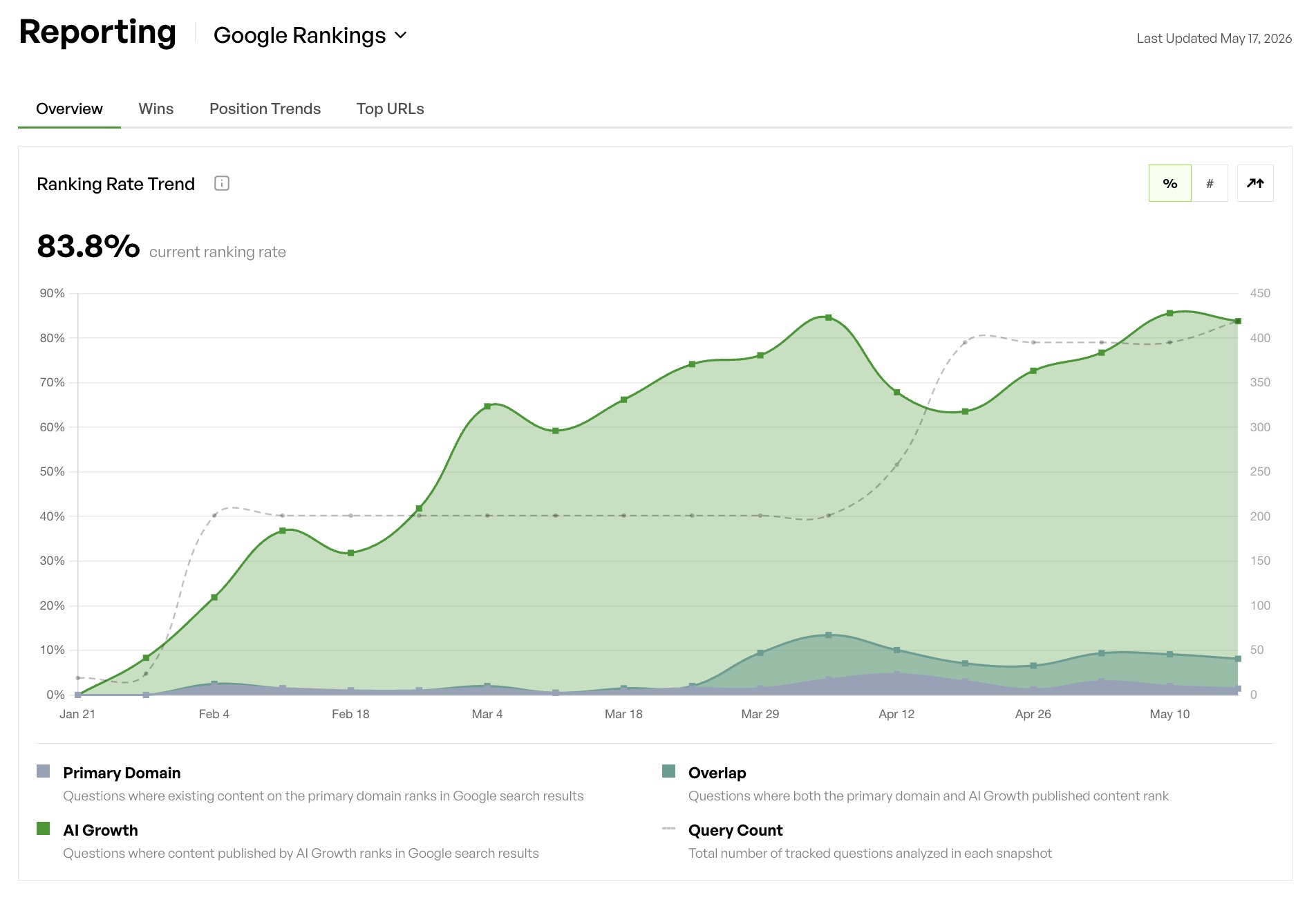
AI Growth Agent clients average more than 12,000 additional AI citations and mentions, over 100,000 additional bot visits, and a 20%+ lift in impressions across the first twelve weeks. Those numbers compound because the content is living and always current, not because a report was refreshed.
Risks and Limitations of Each Approach
Monitoring platforms carry one primary risk: the gap between diagnosis and action widens over time. Every week a brand tracks its absence from AI answers without publishing content to close that absence becomes a week competitors spend training the next generation of models with their own narrative.
Execution engines require an initial setup investment. The kickoff interview, manifesto build, and keyword topology review take approximately one week. Brands with complex legal or compliance requirements need to configure claim prioritization and disclaimer rules before the engine runs at full volume. Those requirements are configured once and applied to every future generation, so the setup cost is front-loaded rather than recurring.
The honest limitation of any content-driven approach is that indexing takes time. Content has indexed in as little as ten days and often within two weeks, but citation authority builds over a standard three-month pilot rather than overnight. Brands expecting immediate results from any organic channel, monitoring or execution, will be disappointed.
Decision Framework: Monitoring Data or Narrative Control
The following criteria map directly to the choice between a monitoring platform and an execution engine.
Choose monitoring if: the brand has not yet confirmed AI search is a meaningful channel for its category, the primary need is a competitive benchmark before committing budget, or a content team is already in place and needs only a signal layer to direct its work.
Choose an execution engine if: monitoring has already confirmed the brand is absent or misrepresented in AI answers, the internal team lacks the technical capacity to produce schema-rich, crawlable, agent-ready content at scale, the brand needs to own its site and content without agency dependency, or the goal is to change what AI says about the brand rather than only measure what it currently says.
Brands cited in AI Overviews earn higher organic CTR and higher paid CTR than uncited brands on the same queries. That delta does not close through a dashboard. It closes through published, authoritative, living content that AI surfaces can find, trust, and cite.
Get your first article live within a week by scheduling your kickoff session with AI Growth Agent.
Frequently Asked Questions
How long does implementation take?
AI Growth Agent completes a journalist-led kickoff interview, builds the brand manifesto and keyword topology, and delivers the first published articles within approximately one week. Content begins indexing in as little as ten days. The standard engagement is a three-month pilot because citation authority builds over time, yet the engine is publishing and the site is live before the first week closes. Monitoring platforms activate faster but deliver data rather than published assets, so the effective time-to-first-result for narrative control is shorter with an execution engine than with a monitoring tool paired with a separate content team.
What expertise is required to run an execution engine?
No technical expertise is required on the client side. AI Growth Agent provisions schema, the WordPress plugin, robots.txt, sitemaps, Blog MCP, agent discovery via /.well-known/, llms.txt and llms-full.txt, instant indexing, autoredirects, and 404 tracking automatically. The only integration step is a reverse proxy rewrite that connects the blog to a subdirectory under the brand’s domain. Clients give feedback in plain language through a studio interface, and the engine saves those corrections as memories so the same note is never needed twice. The internal marketing team needs no technical or engineering background.
How does scalability compare without adding headcount?
Monitoring platforms scale easily because they add prompts to a tracking set, yet that scaling does not produce content. AI Growth Agent produces between two and fifty articles per day per client, up to approximately 500 per month, through a multi-agent orchestration across every major AI provider. Mature clients reach universes of 1,600 or more queries, with the system running 3,000 or more searches every week to refresh the universe snapshot. No additional headcount is required on the client side at any volume because the engine handles research, writing, validation, publishing, schema, and self-healing automatically.
How is incremental visibility measured?
AI Growth Agent publishes into a separate environment so it can report only the visibility it actually generated, never the visibility the brand already had. Reporting tracks week-over-week indexing, bot traffic by bot type including the crawler ChatGPT uses to cite sources, Google Search Console impressions as an independent audit, and citation context showing where the brand appears in AI answers and how that position evolves against the content plan. The four intelligence pillars, Search Intelligence, AI Analytics, Bot Tracking, and AI Ranking, feed a single reporting view that cross-references signals no single monitoring tool brings together.
How do I evaluate fit between monitoring and execution approaches?
The clearest signal is whether the team has already confirmed a gap and has no mechanism to close it. When monitoring has returned data showing the brand is absent or misrepresented in AI answers, and the internal team cannot produce schema-rich, agent-ready content at the volume and velocity AI surfaces reward, a monitoring-only platform extends the diagnostic phase without advancing the result. The evaluation question is not which tool has better data. It is whether the tool produces the published assets that change what AI says about the brand. Monitoring platforms do not. Execution engines do.
Conclusion: Turning AI Visibility Insight into Action
Monitoring tools like Scrunch AI solve a real problem because they confirm whether a brand exists in AI-generated answers and identify which competitors are winning the citations it is not. That diagnostic forms the beginning of a strategy, not the strategy itself.
AI Growth Agent operates as the execution layer that closes the gap monitoring surfaces. It maps the full universe of seed terms and long-tail queries, produces authoritative living content that AI surfaces can find, trust, and cite, and reports the incremental visibility it generates in isolation from existing brand equity. The content self-heals. The technical stack ships automatically. The brand controls the narrative rather than only observing it.
The brands cited in AI search this year are training the next generation of models with their own story. The brands that wait are training the next generation with whatever happens to be sitting on the open web.