Written by: Mariana Fonseca, Editorial Team, AI Growth Agent
Key Takeaways for AI-Driven Organic Growth
- The discovery shift is moving customer discovery from traditional search to AI-generated answers, creating a zero-click reality where most users accept AI responses without verification.
- Traditional agency RFPs and DIY content tools both fail to deliver scalable, high-quality organic visibility in the new AI-driven landscape.
- A headless marketing engine solves this by mapping a brand’s full query universe, producing authoritative living content, and deploying complete technical and agentic SEO automatically.
- Clients typically see first articles published within one week, with measurable lifts in AI citations, bot visits, and impressions within the first twelve weeks.
- Schedule a consultation session to see how the headless marketing engine maps your universe with a live universe mapping walkthrough.
Prerequisites and Starting Conditions
Before the engine runs, three inputs are required, and together they create a complete foundation. First, a set of seed terms: the strategic anchor topics that organize the brand’s universe, each one spawning dozens of long-tail queries beneath it. These seed terms define what the engine will write about and where it should focus first. Second, a brand manifesto: the single source of truth covering voice rules, factual references, primary-source URLs, product pages, and deny lists that control what the engine treats as ground truth. This manifesto defines how the engine will write and keeps every article on-brand and accurate. Third, an owned domain with an existing identity, because the engine stands up a top-of-funnel blog connected through a reverse proxy rewrite under a subdirectory or subdomain, leaving the curated main site untouched. This domain defines where the content will live and how it connects to the rest of the brand.
Despite this technical architecture, no technical skill is required from the client’s team. The engine provisions schema, robots.txt, sitemaps, Blog MCP, agent discovery, llms.txt and llms-full.txt, instant indexing, autoredirects, and 404 tracking automatically. The only integration step on the client’s side is the reverse proxy rewrite.
Three-Phase Engine: From Mapping to Measured Results
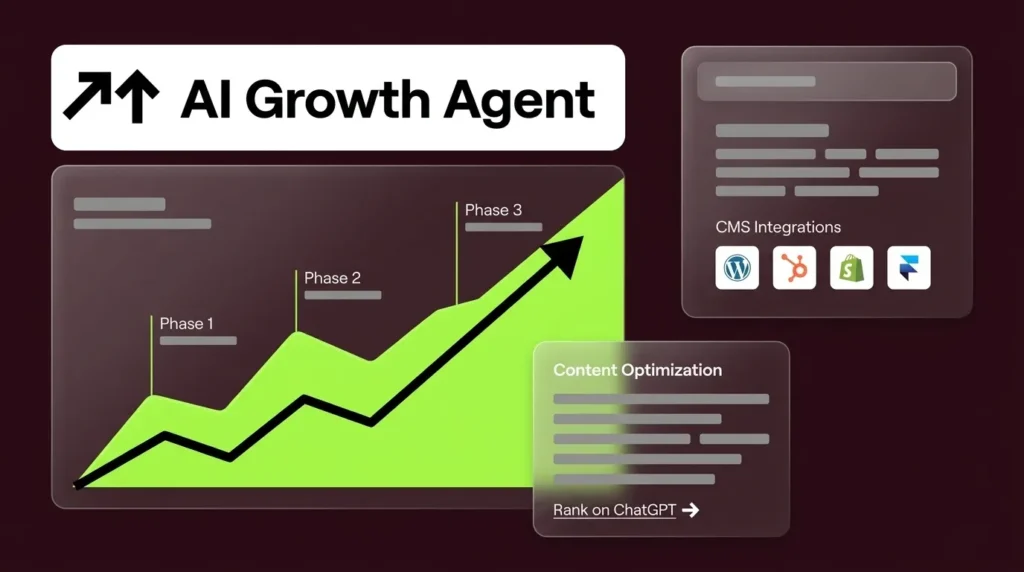
The engagement runs in three phases that move from strategy to production to proof. Phase one is universe mapping: the engine ingests the manifesto and any unstructured brand material, runs hundreds of real searches using real-time Google and ChatGPT data as the objective function, and produces a Content Topology, a hierarchy of seed terms with long-tail queries beneath each one. Phase two is single-shot production: a multi-agent orchestration across OpenAI, Anthropic, Gemini, Grok, Perplexity, Exa, and Firecrawl produces authoritative articles validated against primary sources, with anti-hallucination checks at every stage. Phase three is incremental visibility reporting: the engine tracks AI citations, bot visits, and impressions across the four pillars of Search Intelligence, AI Analytics, Bot Tracking, and AI Ranking, isolating exactly what it generated from visibility the brand already had.
One engine replaces the SEO agency, the content tool, the web agency, the GEO monitor, the schema plugin, the analytics stack, and the PR firm, at a flat fee with no per-article charges, credit limits, or per-prompt billing.
Step-by-Step Guide: 10-Step Blueprint
The following table breaks the three phases into ten concrete steps. Each step shows the goal, required inputs, actions the engine takes, and the checkpoint that confirms progress before moving on.
| # | Step | Goal | Key Inputs | Actions | Validation Checkpoint |
|---|---|---|---|---|---|
| 1 | Journalist Interview and Manifesto Build | Establish the single source of truth | Brand guidelines, product pages, PDFs | Journalist-led interview captures voice rules, factual references, deny lists, and primary sources | Manifesto reviewed and approved by client |
| 2 | Seed Term Definition | Anchor the universe | Client’s known priority topics and competitor domains | Client and engine jointly identify 10 to 20 seed terms that organize the market | Seed terms confirmed against real-time search data |
| 3 | Universe Mapping and Content Topology | Build the full query map | Seed terms, real-time Google and ChatGPT data | Engine runs hundreds of searches, maps long-tail queries beneath each seed term, identifies white space | Topology reviewed; client selects initial attack surface of 300 to 400 queries |
| 4 | Site Setup and Technical Stack Deployment | Stand up the owned, optimized property | Client domain, reverse proxy configuration | Engine deploys WordPress plugin, full schema suite, robots.txt, sitemaps, Blog MCP, llms.txt, agent discovery, web stories, instant indexing | Site live under subdirectory or subdomain; technical stack verified |
| 5 | First Article Production | Validate single-shot output quality | Manifesto, topology, primary sources | Multi-agent orchestration produces first articles with anti-hallucination cascade; client reviews and gives feedback | First articles published within one week of kickoff |
| 6 | Memory and Personalization Tuning | Lock in brand voice and compliance rules | Client feedback from step 5 | Style memories, factual memories, legal disclaimers, and anti-hallucination steering configured; engine saves corrections so they are never repeated | Second batch of articles reflects all saved memories without re-briefing |
| 7 | Indexing and Bot Tracking Activation | Confirm AI surfaces are reading the content | Published articles, sitemap, robots.txt | Instant indexing triggered; bot tracking monitors every crawl, citation, and training sweep | Content indexed in as little as ten days; first bot visits confirmed in reporting |
| 8 | Incremental Visibility Baseline | Isolate what the engine generates from existing brand visibility | Google Search Console, bot analytics, AI citation data | Reporting environment captures week-over-week impressions, bot visits, and AI citations attributed to engine-produced content only | Baseline report delivered; incremental metrics separated from pre-existing visibility |
| 9 | Ongoing Production and Self-Healing | Compound authority without decay | Google Search Console signals, bot-traffic data, updated universe snapshot | Engine produces 2 to 50 articles per day; stale articles refreshed automatically; internal linking compounds authority across the universe | Weekly universe snapshot refreshed with 3,000+ searches; no article left unupdated past its refresh cycle |
| 10 | Reporting Review and Universe Expansion | Scale to the full universe and prove results | Incremental visibility reports, Content Planner data | Client reviews four-pillar reporting; engine doubles down on what indexes well; universe expanded toward 1,600+ queries | AI citations, bot visits, and impressions lifts confirmed week over week |
See if you are a good fit and walk through the blueprint for your brand’s universe.
Common Mistakes and Troubleshooting
Tracking only head terms is the most common failure mode. Most brands monitor a handful of pre-decided keywords and lose the rest of the conversation by default. This approach fails because robots search the long tail, and the long tail is where the majority of customer queries actually live. That is why the engine maps the full universe, not just the terms a brand already thought to defend.
Quality drift occurs when the manifesto is thin or memories are not saved after feedback. The fix is to treat the manifesto as a living document and configure style memories, factual memories, and anti-hallucination steering at kickoff. Every correction saved becomes a permanent rule applied to every future generation.
Beyond content quality, the second most common issue is indexing delays. These are resolved through agentic technical SEO. The engine ships llms.txt and llms-full.txt so AI surfaces can read the brand the way they need to, Blog MCP for direct agent interoperability, OpenAI discovery and Agent Card guidance via /.well-known/, and instant indexing at the article level. If a delay persists, the autoredirect and 404 tracking systems surface the cause without requiring engineering involvement from the client.
Verifying Outcomes and Measuring Results
Once the engine is running and common issues are resolved, the next step is proving that it works. The reporting framework isolates exactly what the engine generated, separate from visibility the brand already had.
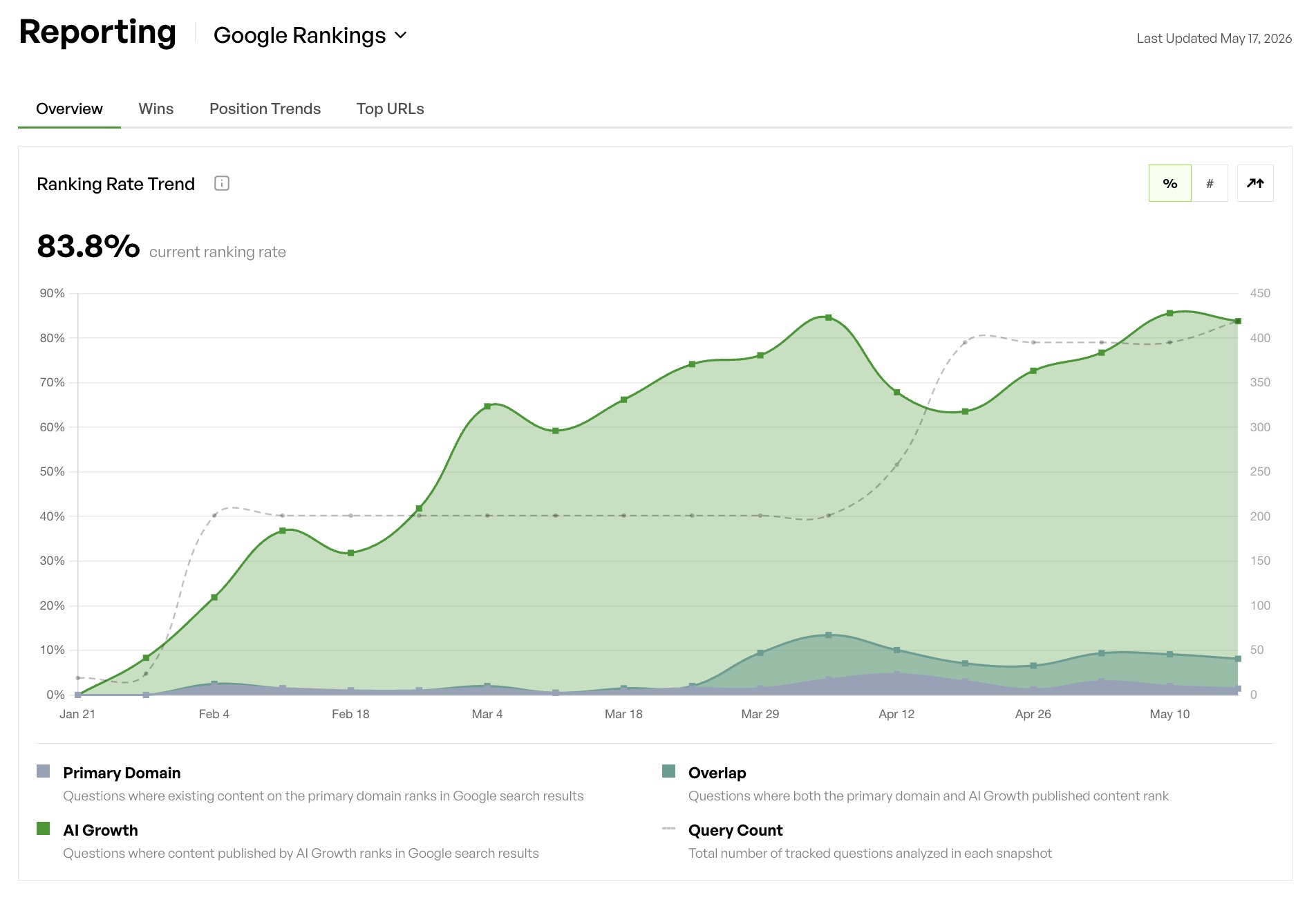
AI Growth Agent clients average more than 12,000 additional AI citations and mentions, over 100,000 additional bot visits, and a 20%+ lift in impressions across the first twelve weeks. Incremental visibility reporting isolates exactly what the engine generated, separate from visibility the brand already had, using four pillars.
Search Intelligence delivers a complete portrait of the traditional search landscape: positioning, competition, search volume, and an actionable diagnosis of who is winning each result. AI Analytics covers brand value and consumer behavior across the full journey, from external touchpoints through content consumption, demographics, and sentiment. Bot Tracking records every bot interaction, including traditional crawlers and AI training agents, capturing every crawl, citation, and training sweep. AI Ranking tracks order of mention and citation context, the new leaderboard in a world where AI answers carry no static ordered list.
Google Search Console serves as an independent audit alongside per-article bot tracking and custom UTM parameters for attribution back into the client’s analytics stack.
Advanced Scenarios and Agency Use Cases
Mature clients expand their universe to 1,600 or more queries, with the engine running 3,000 or more searches every week to refresh the snapshot. At that scale, the Content Topology becomes a strategic map of the entire market, updated faster than any traditional SEO tool can match.
Self-healing content updates run automatically: when the year turns, every article in a sector is refreshed to maintain relevance, and Google Search Console signals trigger targeted updates to articles that show indexing or traffic movement. This continuous refresh cycle means authority compounds instead of decaying, because each update strengthens the content’s position instead of letting it go stale.
Beyond direct brand implementation, the engine also serves specialized use cases. The PR Agency Owner scenario illustrates how agencies can layer AI search on top of existing press and influencer work as a new service line. The agency uses Search Intelligence to view any client’s universe from any competitor’s point of view, identifies which domains and URLs are winning each result, and walks into client meetings with a data-backed point of view rather than instinct. The engine then produces and self-heals authoritative content for each client without the agency hiring an engineer, an SEO specialist, or a content team.
Frequently Asked Questions
What is the discovery shift and why does it matter for organic traffic?
The discovery shift describes the migration of customer discovery from traditional blue-link search results to AI-generated answers on surfaces like ChatGPT, Perplexity, and Google’s AI Mode. Google’s AI Mode crossed 1 billion monthly users within its first year, and queries more than doubled every quarter since launch. The practical consequence is zero-click search: users receive answers inside the AI surface and never visit the source. For brands, this means that what AI surfaces can find, trust, and cite is now the deciding factor in whether a brand exists in the conversation at all. Organic traffic strategies built entirely around traditional keyword rankings miss the majority of where discovery is now happening.
What is a headless marketing engine and how is it different from an SEO agency or a content tool?
Headless marketing borrows its architecture from headless commerce. The brand keeps its curated main site, the storefront humans read. The engine runs behind it, producing and publishing content engineered for the AI surfaces that read, cite, and act on it, with no headcount required from the brand’s team. An SEO agency takes close to a year from RFP to first assets and leaves the brand dependent on an external vendor that often controls the site. A content tool generates text on demand but provides no universe map, no publishing, no technical SEO, and no self-healing. Unlike traditional engagements that require separate vendors for each function, the headless marketing engine consolidates the entire stack into one system, at a flat fee, with the client owning the site and all content outright.
How is AI Growth Agent different from monitoring tools like Profound?
Monitoring tools track whether a brand appears for a capped set of prompts and stop there. They tell a brand it is not showing up and leave the team to solve it with no system behind the answer. AI Growth Agent is not a monitoring company. It produces the content, owns the publishing, deploys the full technical and agentic SEO stack, and proves the incremental result. The differentiator is not data volume but action: the engine turns data into published, self-healing content and isolates exactly what it generated week over week through incremental visibility reporting that cross-references bot traffic, Google Search Console, and AI citation data.
How quickly can a brand expect to see results?
The first article is typically live within one week of kickoff. Content has indexed in as little as ten days and often within two weeks. The standard engagement is a three-month pilot, because indexing timelines vary by industry and domain authority, but clients see movement early. Across the first twelve weeks, clients see the results described earlier, with standout cases including Breadless reaching a 30x lift in Google Search Console impressions over six months and Leva Sleep closing $40,000 to $50,000 in deals within three weeks from buyers who discovered the brand through AI Growth Agent content.
Does the engine interfere with an existing website or require a technical team to operate?
No on both counts. AI Growth Agent stands up a top-of-funnel blog styled to match the brand’s existing site and connected through a reverse proxy rewrite under a subdirectory or a subdomain. Nothing in the existing site structure changes. The engine provisions the full technical and agentic SEO stack automatically, the same infrastructure described in the prerequisites section. The only integration step on the client’s side is the reverse proxy rewrite. The internal team gives feedback in plain language, the engine saves it as a memory, and the same correction is never needed twice.
Conclusion
The discovery shift has made zero-click AI answers the default for customer discovery. Traditional agencies cannot move fast enough, and DIY chatbots cannot hold quality at scale. The headless marketing engine maps the full universe, produces living content validated against primary sources, deploys the complete technical and agentic SEO stack, and delivers incremental visibility reporting across Search Intelligence, AI Analytics, Bot Tracking, and AI Ranking, all within a one-week kickoff and a flat fee that replaces the fragmented agency model described earlier.
Get your first article live within a week, book your consultation now.