Written by: Mariana Fonseca, Editorial Team, AI Growth Agent
Key Takeaways For AI Overview Visibility
- Direct answer formatting and passage-level relevance are the primary drivers of AI Overview citations because models extract self-contained passages, not full pages.
- E-E-A-T signals, off-site trust, and structured data/schema form the credibility layer AI surfaces require before citing any brand.
- Fresh, living content, strong intent matching for informational queries, and targeted brand mentions increase visibility once foundational signals are in place.
- Agentic technical SEO infrastructure, including llms.txt, Blog MCP, and agent discovery endpoints, now functions as baseline requirements in AI-driven search.
- Schedule a demo with AI Growth Agent to see how the complete optimization stack runs automatically and get your first article live within a week.
1. Direct Answer Formatting And Passage-Level Relevance
AI Overviews extract content at the passage level, not the page level. A page that hides its answer inside long paragraphs becomes structurally invisible to the extraction layer, even if it ranks well in traditional search. Content that opens each section with a self-contained, declarative sentence, uses numbered or bulleted structure for multi-part answers, and mirrors the exact phrasing of the query gives the model a clean passage to lift and cite.
Google’s guidance on AI Overviews confirms that the system favors content that directly addresses the user’s question without forcing the model to infer or reconstruct the answer from surrounding context. Passage-level relevance acts as the mechanism here, because the model scores individual passages, not whole documents, when deciding what to surface. To structure content for passage-level extraction, apply the following rules consistently.
- Open every H2 section with a one-to-two sentence direct answer to the implied question so the model has a clear extraction target.
- Use numbered lists for sequential processes and bulleted lists for non-sequential attributes so the model can parse each step or attribute independently.
- Keep paragraphs under 80 words so the extraction layer can isolate the claim cleanly without parsing excess context.
- Mirror the exact language of high-volume queries in the first sentence of each passage so retrieval systems recognize direct relevance.
- Avoid burying the answer after long context-setting preamble, because models prioritize concise, upfront responses.
- Test each passage by asking whether it stands alone as a complete answer if stripped from the page and shown in isolation.
See how AI Growth Agent structures every article for passage-level extraction from day one and review the formatting approach in a live demo.
2. E-E-A-T And Off-Site Trust Signals For Safe Citation
Passage-level extraction makes content findable, but AI surfaces still need to trust a source before they cite it. Experience, Expertise, Authoritativeness, and Trustworthiness remain the evaluative framework AI surfaces use to decide whether a source feels safe to reference. In 2026, the off-site dimension of E-E-A-T carries particular weight, because a brand mentioned, linked to, and cited across authoritative third-party domains trains the model to treat it as credible before any individual page is evaluated.
Google’s helpful content guidance frames E-E-A-T as a quality signal applied at the site level, not just the article level. A single well-written page on a domain with weak off-site authority rarely earns a citation, while a moderately written page on a domain with strong third-party validation often does. The following actions strengthen that off-site trust layer.
- Publish named author profiles with verifiable credentials and author schema on every article so models can connect expertise to real people.
- Earn mentions and links from industry publications, trade associations, and news outlets in your sector to build third-party validation.
- Validate every factual claim with a primary source link so the model can trace the evidence chain behind your statements.
- Maintain consistent brand information, including name, address, and category, across all third-party directories and data aggregators.
- Commission or cite original research that other domains will reference, creating a citation loop that points back to your content.
See how AI Growth Agent maps your off-site trust profile and identifies the fastest paths to citation authority so you can prioritize the highest-impact opportunities.
3. Structured Data And Schema For Machine Understanding
Schema markup acts as the translation layer between human-readable content and machine-readable signals. AI surfaces use structured data to confirm what a page covers, who authored it, which entity it describes, and whether the claims appear in a format the model can parse with confidence. Pages without schema force the model to infer all of that context, which introduces ambiguity and lowers citation probability.
Google’s structured data documentation highlights Article, Organization, Person, Product, Review, and FAQ schema as the types most directly connected to rich result eligibility and AI surface extraction. In 2026, a complete schema suite, including author schema for E-E-A-T reinforcement and FAQ schema for passage-level extraction, functions as a baseline requirement for brands competing for AI citations. Use these implementation practices to make schema work in your favor.
- Deploy Article schema on every published piece with datePublished, dateModified, author, and publisher fields populated accurately.
- Add Organization schema to the root domain with sameAs properties pointing to all authoritative third-party profiles.
- Use FAQ schema on any page that answers a discrete set of questions so models can extract those answers directly.
- Implement author schema with a verifiable URL for each named contributor to reinforce individual expertise.
- Validate schema on every publish using Google’s Rich Results Test and resolve all errors before indexing.
- Keep schema current by updating dateModified on every content refresh so freshness signals propagate correctly.
Review the full schema suite AI Growth Agent provisions automatically on every article and site, without adding work to your internal engineering roadmap.
4. Freshness And Living Content Signals That Compete
Freshness signals help AI surfaces compensate for training data cutoffs by favoring recently updated, frequently crawled content. A page published in 2023 and never updated competes against pages refreshed last week, and the retrieval layer notices that difference. Freshness focuses less on publishing more content and more on ensuring existing content reflects the current state of the world.
Content that self-heals, updating statistics, replacing outdated references, and refreshing publication dates when underlying facts change, signals to both crawlers and AI surfaces that the domain remains an active, reliable source. This freshness signal compounds over time. AI Growth Agent clients average a lift in impressions across the first twelve weeks, in part because living content keeps the brand’s signal current across every bot visit and training sweep.
To operationalize freshness, treat these actions as a recurring maintenance plan.
- Set a scheduled review cycle for every published article, at minimum annually, and more frequently in fast-moving sectors.
- Update dateModified in schema and in the visible byline whenever you make substantive changes.
- Replace outdated statistics with current figures and update the source citation at the same time.
- Monitor Google Search Console for pages losing impressions and prioritize those for refresh.
- Use bot tracking data to identify which articles AI training agents crawl most often and keep those pages especially current.
5. Intent Matching Across Informational Queries
AI Overviews appear primarily on informational queries where the user wants an explanation, a comparison, or a recommendation rather than a transaction. Content written for a transactional audience, heavy on pricing and conversion language, misaligns structurally with the query types that trigger AI Overview extraction. Intent matching means producing content that answers the question the user actually asked, in the tone and depth they expect for that query type.
Google’s documentation on how Search works describes query interpretation as the first step in result ranking, and AI Overviews inherit that logic. A page optimized for “buy adjustable beds” will not surface in an AI Overview for “what should I look for in an adjustable bed” because the content does not match the informational intent of the query, even if the brand carries strong authority. Use the following practices to align content with informational intent.
- Audit your content inventory by query type and separate informational, navigational, and transactional pages.
- Produce dedicated informational articles for every high-volume “what,” “how,” and “why” query in your universe.
- Avoid mixing conversion copy into informational articles and keep the informational register consistent throughout.
- Map the long tail of informational queries beneath each seed term and produce content for each cluster.
- Use real-time AI Overview and ChatGPT results to decide which informational queries deserve priority.
6. Brand Mentions And Citation Context In AI Answers
In AI search, static ranked lists disappear and citation context replaces position as the key metric. Citation context describes where the brand appears in the answer, what claim it supports, and which other brands appear alongside it. A brand mentioned first in a positive context, cited as the authoritative source for a specific claim, accumulates a stronger signal than a brand mentioned incidentally at the end of a list. Off-site brand mentions on forums, review platforms, and editorial publications shape the model’s prior belief about whether a brand deserves citation at all.
Breadless achieved a high citation rate against competitors and a high recommendation rate versus Sweetgreen within 90 days by systematically producing content that positioned the brand as the authoritative answer to franchise-related queries, not just another participant in the category conversation.
- Identify the specific claims and categories where you want citations and produce dedicated content for each one.
- Pursue earned mentions on publications, forums, and communities that AI surfaces treat as authoritative in your sector.
- Monitor citation context weekly and track where your brand appears in AI answers and which claims it supports.
- Correct citation context that misrepresents the brand by publishing more authoritative content on the accurate claim.
- Use bot tracking to confirm which AI training agents read your content and how frequently they return.
7. Agentic Technical SEO With MCP, Llms.Txt, And Blog MCP
Agentic technical SEO in 2026 extends traditional technical SEO by addressing the infrastructure AI agents need to read, trust, and act on a brand’s content. Model Context Protocol endpoints, llms.txt and llms-full.txt files, agent discovery via /.well-known/, and Blog MCP tell AI surfaces how to interact with a domain programmatically. Brands that lack this infrastructure remain readable to humans but effectively invisible to agents.
AI Growth Agent was the first to bring Blog MCP to market, with clients running it in the summer of 2025, roughly a year before Google released Web MCP. The full agentic stack, including Blog MCP compatible with Chrome 146+ and other WebMCP-enabled browsers, OpenAI discovery, Agent Card guidance, natural language query parameters, Markdown served to agent crawlers, and llms.txt and llms-full.txt, ships automatically with every AI Growth Agent engagement and is provisioned by the platform.
To make your domain agent-ready, treat these items as core technical requirements.
- Publish llms.txt and llms-full.txt at the root domain so AI surfaces can read your brand’s content in the format they require.
- Implement Blog MCP with schema, manifest, discovery, and capability guidance exposed to agents.
- Serve OpenAI discovery and Agent Card guidance via /.well-known/ so agentic crawlers can identify and interact with your domain.
- Configure natural language query parameters at /?s={query} to return personalized, internally linked responses to agents passing queries directly into the URL.
- Serve pages in Markdown to agent crawlers alongside the standard HTML version for human visitors.
- Audit robots.txt to confirm AI training agents and agentic crawlers are not inadvertently blocked.
Explore the full agentic technical SEO stack AI Growth Agent ships on day one and see how it integrates with your existing infrastructure.
How To Optimize For AI Overviews In Sequence
Optimizing for AI Overviews works best when you execute the seven factors in sequence, starting with the highest-impact signals. First, structure content for passage-level extraction so models can find and lift your answers. Next, build the E-E-A-T and off-site trust profile that makes the domain safe to cite, then deploy the complete schema suite. After that, layer freshness and intent matching across the content inventory, pursue citation context through targeted brand mentions, and complete the stack with agentic technical SEO infrastructure. No single factor suffices, because the model evaluates all of them together when deciding whether to cite a source.
The practical sequence looks like this. Audit existing content for direct-answer formatting and restructure pages that bury the answer. Deploy schema across the full site. Establish a living content refresh cycle. Map the full universe of informational queries and produce dedicated articles for each cluster. Pursue off-site mentions on authoritative domains. Implement the agentic technical SEO stack, including llms.txt, Blog MCP, and agent discovery endpoints.
Book a kickoff to see how AI Growth Agent executes this sequence as a single headless engine, with the first article live within a week and content indexing in as little as ten days.
How To Appear In AI Overviews Consistently
Appearing in AI Overviews consistently requires control of the full stack of signals the model evaluates, not isolated work on a single factor. The prioritized checklist below draws directly from the seven ranked factors and represents the minimum viable implementation for a brand entering AI Overview competition in 2026.
- Restructure every key page so the first paragraph of each section is a self-contained direct answer to the implied query.
- Deploy Article, Organization, Author, and FAQ schema across the full content inventory.
- Establish a living content cycle, refresh statistics, update dateModified, and replace outdated references on a scheduled basis.
- Produce dedicated informational articles for every high-volume “what,” “how,” and “why” query in your universe, separated from transactional pages.
- Pursue earned mentions on authoritative third-party publications and forums in your sector to build the off-site trust profile the model uses to evaluate citation safety.
- Publish llms.txt, llms-full.txt, Blog MCP, and agent discovery endpoints so AI surfaces can read and interact with your domain programmatically.
- Track citation context weekly and produce corrective content wherever the brand is misrepresented or absent from high-value AI answers.
Frequently Asked Questions
What Is Large Language Model Optimization?
Large language model optimization, or LLMO, is the discipline of writing and structuring content so that AI surfaces find it, trust it, and cite it. LLMO works natively in natural language, which makes it fundamentally stronger than legacy SEO for AI environments. Traditional SEO optimizes for a ranked list of blue links, while LLMO optimizes for citation context in AI-generated answers, including where the brand appears in the answer, what claim it supports, and how that position evolves over time. LLMO covers direct-answer formatting, E-E-A-T and off-site trust building, schema deployment, freshness management, intent matching, brand mention strategy, and the full agentic technical SEO stack. It functions as a content and infrastructure discipline that changes what the AI says about a brand, rather than a monitoring discipline that only observes current output.
How Long Does It Take To See AI Overview Citations?
The timeline varies by industry, domain authority, and the competitiveness of target queries. Brands that implement the full stack of factors described in this guide typically see first citations within two to six weeks of publishing optimized content. AI Growth Agent clients have seen first citations in as little as two weeks, consistent with the indexing timeline mentioned earlier. The standard engagement runs as a three-month pilot because indexing takes time and the compounding effect of living content, off-site mentions, and agentic technical SEO infrastructure builds over weeks, not days. Brands that only implement one or two factors, such as schema alone or direct-answer formatting without off-site trust signals, tend to see slower and less consistent citation rates than brands that execute the full stack simultaneously.
How Do You Measure Incremental Visibility From LLMO Efforts?
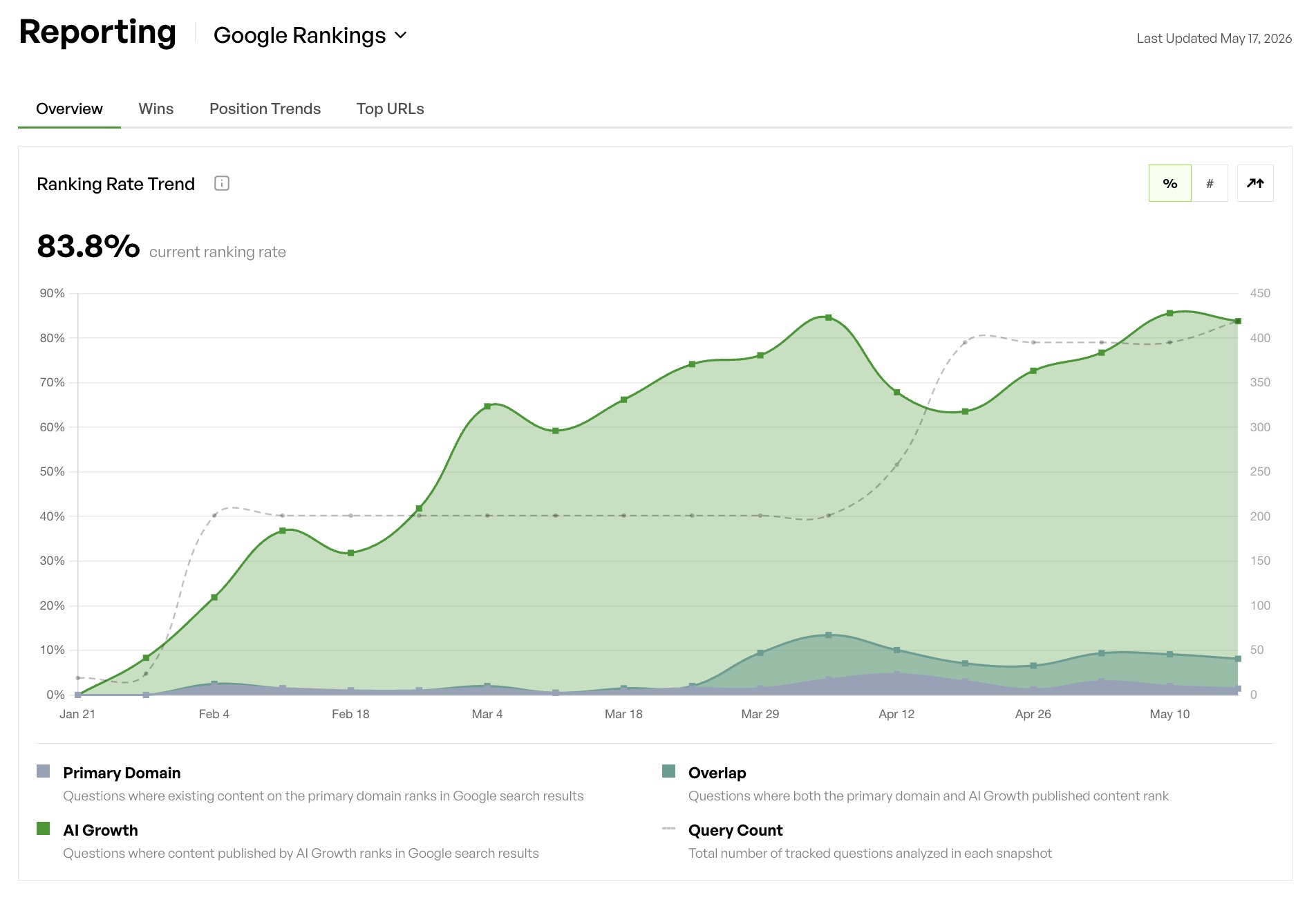
Incremental visibility measurement requires isolating the visibility generated by new LLMO efforts from the visibility the brand already had before those efforts began. The most reliable approach publishes new content into a separate, trackable environment and reports week-over-week changes in bot traffic, Google Search Console impressions, and citation frequency, cross-referenced against the content that was live before the engagement started. Bot tracking that identifies which AI training agents read which articles, combined with Google Search Console as an independent audit, provides the evidence chain needed to attribute citation gains to specific content decisions. In a zero-click environment where the user never visits the source, brands that measure best capture the traffic source at the conversion moment and consistently observe a lift in organic leads after LLMO efforts begin compounding.
What Enterprise Concerns Arise When Adopting A Headless Engine?
Enterprise teams typically raise four concerns when evaluating a headless marketing engine. The first concern involves site ownership and control. A headless engine stands up a separate, fully optimized blog connected to the brand’s domain through a reverse proxy rewrite or subdomain, so the existing main site and its structure remain untouched and the brand owns the new property outright. The second concern involves brand voice and compliance. The engine is configured from a brand manifesto and a set of style and legal memories that apply to every future generation, including legal disclaimers, claim prioritization for regulated sectors, and anti-hallucination controls that validate every claim against primary sources before anything ships. The third concern involves technical dependency. The full agentic technical SEO stack, including schema, Blog MCP, llms.txt, robots.txt, sitemaps, and agent discovery endpoints, ships automatically with every engagement and is handled entirely by the engine. The fourth concern involves proof of results. Incremental visibility reporting isolates exactly what the engine generated, week over week, so the CMO has a defensible answer for the CEO that is not inflated by pre-existing brand visibility.
Conclusion: Building A Compounding AI Signal Stack
The seven factors ranked in this guide, direct answer formatting, E-E-A-T and off-site trust, structured data and schema, freshness and living content, intent matching, brand mention and citation context, and agentic technical SEO, operate as a compounding stack rather than independent levers. A brand that executes all seven simultaneously trains the current generation of AI models with its own narrative and builds the infrastructure the next generation will read. A brand that waits effectively trains the next generation with whatever currently sits on the open web.
AI Growth Agent is a headless engine that delivers this complete stack, including living content that self-heals over time, a full schema suite provisioned automatically, bot tracking across every AI training agent, Blog MCP and agentic technical SEO infrastructure from day one, and incremental visibility reporting that isolates exactly what the engine generated. One engine replaces the SEO agency, the content tool, the web agency, the GEO monitor, the schema plugin, and the analytics stack, at a flat fee with no per-article charges or per-prompt billing.
Schedule a consultation session to control your brand narrative across AI surfaces and begin publishing immediately.