Written by: Mariana Fonseca, Editorial Team, AI Growth Agent
Key Takeaways
- Click-based metrics no longer reflect brand influence in AI search. Citations, branded search lift, and assisted conversions now define organic marketing ROI.
- Four data pillars form the measurement foundation: search intelligence, AI analytics, bot tracking, and AI ranking, all working together to show incremental visibility.
- Citation frequency, order of mention, and context now act as the primary KPI for brand influence in zero-click environments.
- Branded search lift and assisted conversions prove that AI citations drive awareness and revenue even when users never click a source.
- AI Growth Agent delivers these outcomes with living, self-healing content and flat-fee pricing. Map your citation universe before competitors lock in the advantage.
The Zero-Click Reality and the New Organic ROI Formula
Click-based measurement is structurally broken. Google’s AI Mode crossed 1 billion monthly users within its first year, and most users resolve their questions without clicking a result. The model answers, the session ends, and the source never receives a visit.
This shift directly changes organic marketing ROI in AI search. The organic click, which justified agency retainers and content budgets for a decade, no longer serves as a reliable proxy for brand influence. Roughly 83% of people say they are skeptical of AI answers, yet only about 8% ever click through to verify them. For most people, whatever the AI says becomes the answer.
This asymmetry now defines the operating environment. A brand cited authoritatively in an AI answer reaches the buyer at the moment of decision. A brand absent from that answer does not exist in the conversation, regardless of how many clicks its blog accumulated last quarter.
The measurement framework must match this channel. Citations, branded search lift, and assisted conversions replace session counts and click-through rates as the primary signals of organic performance.
Get a citation-universe mapping session and see where your brand appears in AI answers today.
Build the Four-Pillar Data Foundation for AI ROI
Before you can measure citation frequency or branded search lift, you need infrastructure that captures those signals. Measuring organic marketing ROI in AI search requires four distinct data streams. Any team operating with fewer works from a partial picture.
- Search Intelligence. This pillar provides the baseline, a complete portrait of the traditional search landscape. It covers positioning, competition, search volume, and who already wins each result. Teams use this layer to measure incremental gains against where they stand today.
- AI Analytics. This layer connects that baseline to real audience behavior. It tracks brand value and consumer behavior across the full journey, from external touchpoints like Google and AI-tool queries through content consumption, demographics, and sentiment. It shows how citations translate into engagement.
- Bot Tracking. This pillar makes both layers visible. It records every bot interaction, from traditional crawlers to AI training agents, including each crawl, citation, and training sweep. When you can see which agents read your content, you can tell which signals actually reach the models.
- AI Ranking. This pillar replaces traditional rank tracking. AI answers do not use a static ordered list, so order of mention and citation context become the new leaderboard. It measures where the brand appears in AI answers and how that position evolves over time, revealing whether the other three pillars are working.
These four pillars form a single system. Search Intelligence shows where you stand, AI Analytics shows how audiences respond, Bot Tracking shows which models see you, and AI Ranking shows how often those models name you. Teams winning this channel see all four pillars and act on them in the same week.
Monitoring tools that cap prompt counts and report on a handful of head terms leave most of the conversation invisible. See how all four data pillars work together for your brand in a live walkthrough.
Use Citation Frequency and Context as Your Core KPI
Citation frequency measures how often an AI surface names the brand in a relevant answer. It functions as the direct replacement for organic rank in a zero-click environment.
Two dimensions shape the impact of that frequency. First comes order of mention. A brand named first in an AI answer carries far more influence than one listed fourth. Second comes citation context. The claim the brand is cited for, and the competitors it appears beside, determine whether the citation builds authority or dilutes it.
Together, these dimensions create citation context, the new ranking signal. A brand cited first as the recommended solution for a high-intent query holds a fundamentally different position than a brand mentioned as an optional alternative in a comparison list. Tracking citation frequency without tracking context produces a misleading number.
AI Growth Agent clients average more than 12,000 additional AI citations and mentions across the first twelve weeks, with per-article bot tracking that shows exactly when ChatGPT cites the content and where. That level of detail turns citation frequency from a vanity metric into a reliable KPI.
Map your current citation context across target queries in a 30-minute diagnostic session.
Measure Branded Search Lift After AI Exposure
Branded search lift tracks the increase in direct queries for the brand name that follows AI citation activity. It provides a clear signal that AI exposure is generating awareness that converts into intent.
The mechanism is straightforward. A buyer encounters the brand name in an AI answer and chooses not to click the source. They open a new tab and search the brand directly. That branded query appears in Google Search Console as organic branded traffic. When the timing aligns with citation spikes, the lift can be attributed to AI exposure.
Breadless achieved a 30x lift in Google Search Console impressions over six months, growing from 387,000 to 12.3 million impressions, with a 7x increase in clicks and average organic rank improving from position 25 to front-page 7.6. That trajectory reflects branded search lift compounding on top of citation frequency gains.
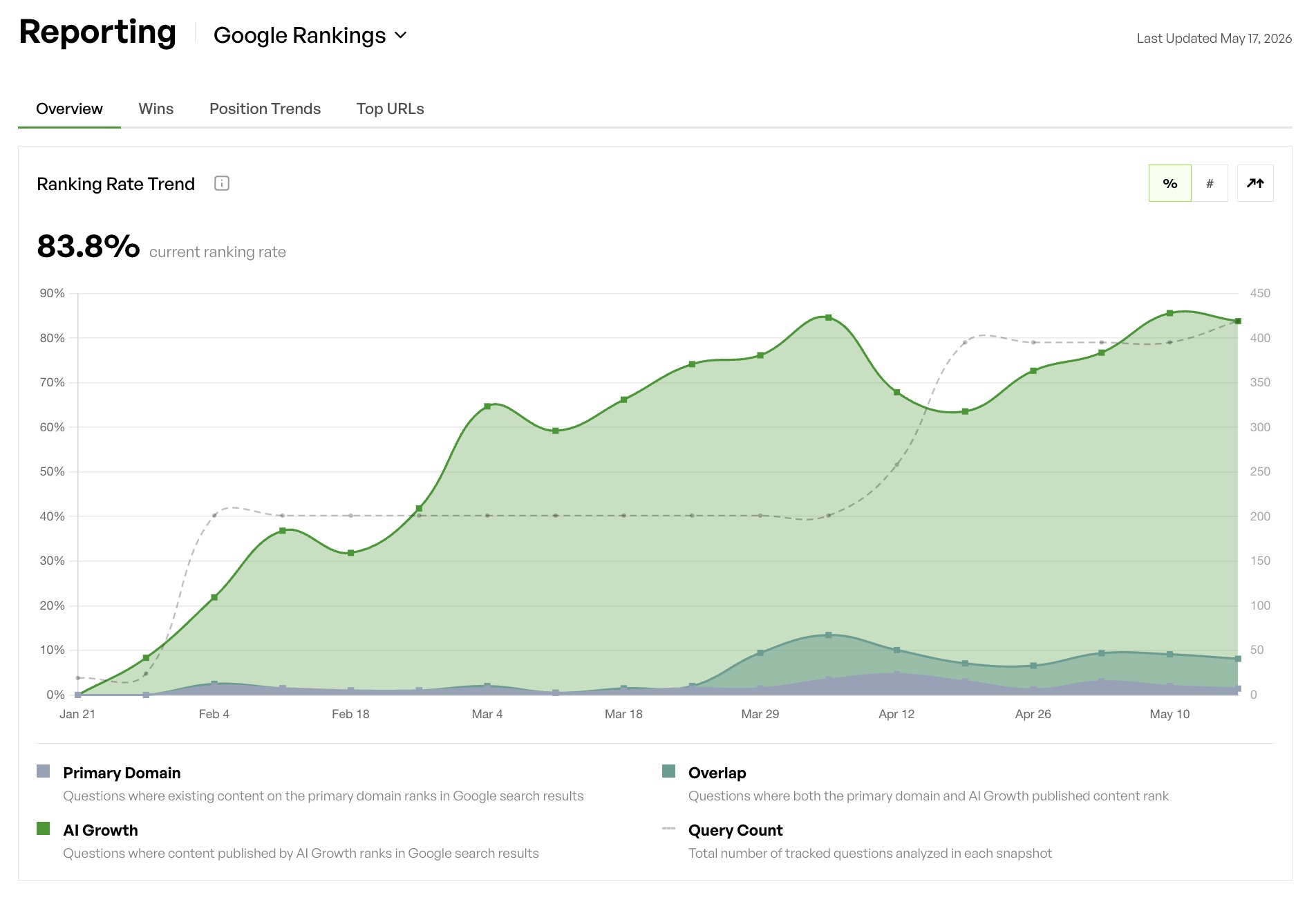
Accurate branded search lift measurement starts with a clean baseline. You must separate pre-existing branded search volume from the incremental volume generated after deployment. Frameworks that credit existing brand equity to a new program inflate ROI and undermine trust.
Connect AI Citations to Assisted Conversions
Assisted conversions capture pipeline and revenue events that AI citation activity influenced but did not directly produce. In a zero-click environment, the AI answer often acts as the first touch. The conversion happens later, through a branded search, a direct visit, or a sales conversation with a buyer who already knows the brand from an AI surface.
The measurement approach combines correlation with disciplined source capture. When AI citation volume spikes for a specific query cluster, the same period should show a lift in demo requests, pipeline entries, or closed revenue from buyers who name that query cluster as their discovery path. Capturing source at the conversion moment through intake forms, sales call notes, or CRM fields becomes the operational requirement.
Leva Sleep closed $40,000 to $50,000 in deals in under three weeks from buyers who walked into the store carrying the blog and asking about specific features they had discovered through AI Growth Agent content. That scenario makes assisted conversion visible. The AI answer created the buyer, the buyer converted in a channel that looked like direct or in-store, and source capture at the moment of sale connected the two.
Run the Investment-Versus-Return Math on AI Search
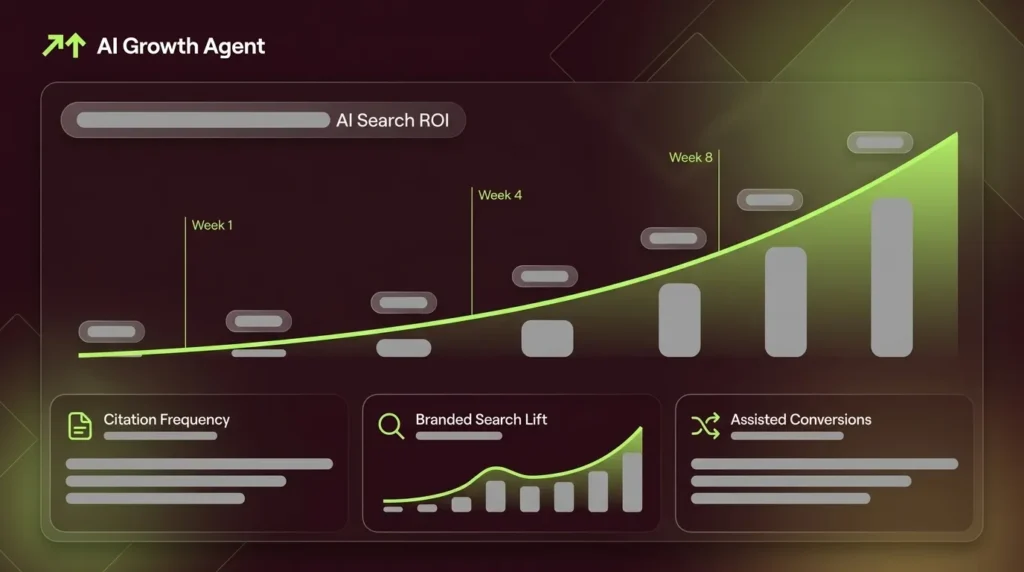
The ROI formula is simple: (Value of AI Citations + Branded Search Lift + Assisted Conversions) minus (Flat-Fee Cost). Each variable needs a defined measurement method before the calculation carries weight.
Value of AI Citations is estimated by assigning a cost-per-impression equivalent to the citation volume, using paid media benchmarks for the same audience as the floor. Branded Search Lift is measured as incremental branded query volume multiplied by the conversion rate and average deal value of branded organic traffic. Assisted Conversions represent pipeline and revenue events captured at source that name AI discovery as the entry point.
The table below contrasts click-based and citation-based measurement across four dimensions.
| Dimension | Click-Based Measurement | Citation-Based Measurement | Why It Matters |
|---|---|---|---|
| Primary signal | Organic clicks and sessions | Citation frequency and order of mention | Clicks collapse in zero-click AI search, while citations persist as a visibility signal. |
| Brand influence proxy | Click-through rate | Branded search lift after AI exposure | Buyers often search the brand after AI answers without clicking the original source. |
| Revenue attribution | Last-click or assisted session | Source capture at conversion correlated with citation spikes | AI often acts as a first touch that converts later in a different channel. |
| Baseline isolation | Rarely separated from existing traffic | Incremental visibility only, with pre-existing presence excluded | Without isolation, existing brand equity inflates reported ROI. |
Calculate your citation-based ROI against current program costs in a personalized demo.
Deploy Living Content for Compounding AI Visibility
A single content deployment rarely produces compounding ROI. AI surfaces retrain and update continuously, and content that felt authoritative six months ago may no longer match the market. Static content decays. Living content compounds.
Living content stays updated and self-heals over time. When the year turns, every article in a sector refreshes automatically. When Google Search Console signals that a page is losing impressions, the engine identifies the gap and updates the content before the decay becomes a citation loss. When a competitor publishes a claim that contradicts the brand’s position, the self-healing cadence detects it and responds.
AI Growth Agent clients average a 20%+ lift in impressions across the first twelve weeks, with authority compounding as the content universe expands and self-heals. The brands cited in AI search this year are training the next generation of models with their own narrative. Brands that wait train the next generation with whatever happens to be sitting on the open web.
See how the self-healing cadence works in practice and how it protects your AI visibility.
Implement a Citation-Based Program With No Extra Headcount
The following phases outline a full deployment sequence for a citation-based organic marketing program that runs without adding internal headcount.
- Universe mapping. A journalist-led interview produces the brand manifesto. The engine ingests it alongside product pages, brand guidelines, and existing content. It then maps the full universe of seed terms and long-tail queries using real-time Google and ChatGPT data as the objective function. A mature client universe covers 1,600+ queries, with the system running 3,000+ searches weekly to keep the snapshot current.
- Content topology creation. Seed terms are organized into a hierarchy with dozens of long-tail queries beneath each one. The topology highlights white space the brand is not yet winning and prioritizes queries where citation opportunity is highest.
- Technical SEO deployment. AI Growth Agent stands up a fully optimized site the client owns within the first week. The setup includes full schema, Blog MCP, llms.txt and llms-full.txt, agent discovery via /.well-known/, advanced robots.txt, a proper sitemap.xml, and automated web stories. Each element helps AI agents discover, interpret, and reuse the content, which directly supports citation-based measurement.
- Bot and Search Console tracking. Per-article bot tracking goes live immediately, capturing every crawl, citation, and training sweep. Google Search Console connects as an independent audit layer that validates visibility gains.
- Weekly incremental reporting. The engine reports week over week where content indexes, where new visibility appears, and where the two overlap. Only incremental visibility receives credit, while pre-existing brand presence remains excluded.
- Self-healing cadence. Content refreshes in response to Search Console signals, bot-traffic data, and market changes. The engine doubles down on pages that index well and uses internal linking to lift those that lag.
Get a deployment timeline and see how quickly your first article can go live.
Answering the Forums: Traffic Declines and Branded Search Spikes
Two objections surface consistently in marketing forums and leadership conversations. Both receive clear, data-backed answers.
“AI is killing our organic traffic.” This statement holds true for click-based traffic and misses the point for citation-based visibility. The channel has not shrunk, it has changed shape. A brand that once earned clicks from informational queries now earns citations from the same queries, and those citations reach buyers at a higher-intent moment than a blog visit ever did. The measurement framework needs to change, not the investment in organic.
“We saw a big jump in branded search but cannot explain it.” Unexplained branded search lifts almost always reflect downstream AI citation activity. Bisutti saw AI Growth Agent drive 71% of its brand mention visibility and became the second most recommended events brand by AI in Brazil. That shift produced measurable branded search lift without a matching increase in paid media. When citation volume and branded query volume are tracked together, the correlation becomes the attribution signal.
Both objections point to the same gap, which is the absence of a citation-based measurement framework. Teams that adopt one stop asking why traffic is down and start asking which queries to win next.
Get a diagnostic on where your brand stands in AI answers and what to do next.
Conclusion: Turn AI Observation Into Measurable Execution
Click-based organic marketing ROI functions like a rearview mirror in a zero-click world. The replacement framework, Value of AI Citations plus Branded Search Lift plus Assisted Conversions minus Flat-Fee Cost, already operates in production. It is the formula that Leva Sleep used to close five-figure deals from AI-driven buyers, that Breadless used to become the most recommended healthy franchise in the United States, and that Bisutti used to own 71% of its brand mention visibility in Brazil.
The shift from observation to execution defines the real change. Monitoring tools report where your brand stands. AI Growth Agent changes what the answer is. The four-pillar data foundation, living content, self-healing cadence, and incremental visibility reporting work together as the architecture of autonomous narrative control, not as a feature list for a content tool.
The training window is now. Every citation your brand earns today shapes how the next generation of models will answer tomorrow’s queries. Brands that act now write their own story into those models. Brands that wait let the open web write it for them.
Move from observation to execution and see your first article live within a week.
Frequently Asked Questions
What is the difference between citation frequency and a traditional organic ranking, and why does it matter for ROI measurement?
A traditional organic ranking is a static position on a search results page. It is a number assigned to a URL for a specific keyword at a specific moment. Citation frequency measures how often an AI surface names a brand in a relevant answer across a universe of queries.
These two signals measure different realities. A brand can rank first for a keyword and never appear in the AI answer for the same query, because the model draws on a different set of sources than the traditional index. For ROI measurement, citation frequency matters more in a zero-click environment because it reaches the buyer directly.
The buyer who gets an AI answer and never clicks a result still absorbs which brand the model named and in what context. Citation frequency, combined with order of mention and citation context, captures that influence. Traditional rank data remains useful as a baseline and as an independent audit layer, but it no longer serves as the primary signal for organic marketing ROI in AI search.
How do you isolate incremental visibility from pre-existing brand presence when calculating organic marketing ROI?
Isolation starts with publishing into a separate environment and establishing a clean baseline before deployment begins. AI Growth Agent stands up a distinct, fully optimized property for each client and reports week over week on the visibility that property generates, separate from the visibility the brand’s existing site already held.
The incremental reporting cross-references bot tracking, Google Search Console data, and citation signals to identify what changed after deployment and attribute it to the new content. Pre-existing branded search volume, existing citation mentions, and organic impressions from the brand’s main site stay excluded from the calculation.
Only visibility generated by the new content, in the period after it was published, receives credit. This isolation makes the ROI formula defensible to a CEO or CFO who wants to know whether the investment works or whether the program is taking credit for brand equity that already existed.
Why is a flat-fee pricing model relevant to organic marketing ROI in AI search?
Per-prompt and per-article pricing models create a structural incentive to cap the universe a brand tracks. When every additional query costs more, teams naturally track fewer queries and focus on head terms they already know.
That approach leaves most of the long-tail conversation invisible, which is where many AI citations actually occur. A flat-fee model removes this constraint. The full universe of seed terms and long-tail queries can be mapped and refreshed weekly without costs rising as the universe expands.
For ROI measurement, this matters because a capped universe produces a systematically underestimated citation count. A brand that tracks 50 prompts and sees 200 citations per month may actually generate 2,000 citations per month across the full long tail. The ROI formula is only as accurate as the citation count it starts with, and the citation count is only as accurate as the universe it covers.
How do assisted conversions get captured in practice when AI search is a zero-click channel?
Assisted conversions in a zero-click channel rely on source capture at the moment of conversion rather than at the moment of discovery. Because the buyer does not click through from the AI answer, no referral URL exists to track.
Practical methods include intake form fields that ask how the buyer first heard about the brand, sales call notes that record the buyer’s stated discovery path, and CRM fields that capture the query or topic the buyer mentions when describing their research. When teams collect these source signals consistently, they can correlate them with citation volume spikes for specific query clusters.
A spike in citations for a cluster of queries about a specific product feature, followed by a lift in demo requests from buyers who name that feature as their entry point, creates the assisted conversion signal. The correlation provides the attribution. It does not match last-click attribution, but in a zero-click environment, last-click attribution never captured the full picture.
What makes living, self-healing content structurally different from a standard content refresh program?
A standard content refresh program relies on a scheduled human review cycle. Someone on the team, or at an agency, periodically revisits published articles and updates them based on what they notice. The cadence moves slowly, coverage remains partial, and the trigger is a calendar date rather than a performance signal.
Living, self-healing content responds to data signals instead of schedules. When Google Search Console shows that a page is losing impressions, the engine identifies the gap and updates the content automatically. When the year turns, every article in a sector refreshes for the new year without a human initiating the process.
When a competitor publishes a claim that shifts the citation context for a query, the self-healing cadence detects it and responds. Living content stays current relative to the market, not relative to the last time someone had bandwidth to review it. In AI search, where models retrain continuously and the content landscape shifts weekly, the difference between a content program that self-heals and one that goes stale becomes the difference between compounding authority and decaying visibility.