


AI-powered tools like ChatGPT, Gemini, and Perplexity are reshaping how users find information, especially on mobile devices. For marketing leaders, this shift creates a pressing need to keep your brand visible and cited as an authority in AI search results. Old-school keyword strategies no longer cut it. To stay ahead, you must focus on mobile-first AI SEO, combining technical accuracy, semantic depth, and high-volume content creation.
This guide offers a clear roadmap for marketing managers, VPs, directors, and CMOs to excel in AI search citations. You’ll learn why standard mobile SEO isn’t enough, uncover key strategies for AI visibility, and see how AI Growth Agent’s platform can help your brand gain an edge in the mobile-first AI landscape.
Why Mobile-First AI SEO Is Essential for Your Brand
The way customers discover brands has changed dramatically. Before, search success meant focusing on keywords and links. Now, it’s about earning authority and citations in the Large Language Models (LLMs) that drive mobile search experiences.
AI generates massive amounts of content daily, shrinking your brand’s digital footprint unless you adapt. Without a targeted AI search strategy, your content risks being ignored by the systems deciding what gets recommended, especially on mobile where direct answers often replace link lists.
Speed matters more than ever. Just as social media redefined content marketing, AI search demands regular, high-quality updates to stay relevant. LLMs value fresh, detailed, and consistent content, making occasional blog posts insufficient for standing out.
If you don’t shape your brand’s narrative with strong content, competitors will fill the gap. When AI lacks enough material from you to answer user queries, it turns to others, positioning them as trusted sources and costing your brand visibility and credibility.
What Makes Traditional Mobile SEO Ineffective for AI Search?
Standard mobile SEO, focused on keywords and responsive design, falls short in the AI search environment. While it prioritized rankings, AI search values user intent, semantic context, and entity recognition.
AI systems don’t just count keywords; they interpret meaning, relevance, and the ability to answer complex questions directly. Your content needs to be a primary source for AI responses, not just mobile-friendly.
Manual content creation also can’t keep pace with AI’s speed. With AI tools updating their data constantly, irregular posts, even if optimized, won’t maintain the authority needed for consistent citations.
Marketing leaders relying on outdated methods struggle with slow agencies or overworked teams. These options can’t deliver the volume or quality of mobile-optimized content required to compete in AI search at scale.
Key Strategies for Mobile-Friendly AI Search Content
How to Optimize for Conversational AI Understanding
AI search requires content built for conversational tone and user intent, not just keyword stuffing. This shift means creating material that answers questions naturally and thoroughly.
AI tools grasp context and query intent, so your content should link concepts, provide depth, and cover related topics. This approach addresses not only the main question but also follow-ups users might have.
For mobile users, who often use spoken, question-based searches, natural language is vital. Clear, logical writing increases the chance of AI citing your content in mobile responses.
Effective content teaches concepts simply, explains terms, and builds understanding step by step. This benefits both AI systems and mobile readers with limited time to digest information.
Why E-E-A-T Matters More for AI Summaries
Experience, Expertise, Authoritativeness, and Trustworthiness (E-E-A-T) are crucial for appearing in AI-generated summaries, especially on mobile where trust must be clear instantly.
AI evaluates content quality and source reliability, focusing on who created it and whether it shows true knowledge. Shallow or generic content won’t earn citations from LLMs.
For mobile AI SEO, E-E-A-T means showcasing author expertise early, citing reliable sources, and offering practical examples. On smaller screens, these trust signals need to stand out quickly.
Marketing leaders face the challenge of meeting E-E-A-T standards across high volumes of content. Traditional methods often can’t embed authority at the scale needed for AI recognition.
Schedule a consultation to see how AI Growth Agent builds E-E-A-T into your content strategy for stronger AI citations.
Technical Must-Haves for Mobile AI Indexing
Technical optimization underpins mobile-first AI SEO success. Key factors include fast load times, responsive design, Core Web Vitals, structured data, and accessibility for better user experience and AI indexing.
Mobile-first design is now the default, not an option. Content that underperforms on mobile will struggle across all search platforms, including AI-driven ones.
AI search demands advanced technical setup, like detailed schema markup, AI-optimized robots.txt files, and emerging LLM.txt standards for content categorization. These elements, along with site speed and usability, are critical in a mobile-focused, AI-heavy landscape.
Most marketing teams and agencies lack the expertise to handle this complexity. Success requires advanced technical implementation while maintaining daily content output for AI visibility.
Emerging Trends in Mobile-First AI SEO for Marketing Leaders
Adapting to Generative Engine Optimization (GEO)
Generative Engine Optimization marks a major change in content creation for AI search. Platforms like SGE value usefulness and trust over old-school factors like keyword counts or backlinks.
For marketing leaders, traditional rankings matter less than visibility in AI responses. Content must be easy for AI to interpret, summarize, and cite, requiring a rethink of structure and strategy.
On mobile, where AI often delivers full answers instead of links, GEO becomes even more important. Being cited as a key source in these answers redefines search success.
Content needs to serve both human readers and AI systems, offering value while being easy to parse and summarize in mobile formats for accurate representation.
Staying Agile with Personalized Mobile Search
AI search excels at personalization on mobile, using location, history, and behavior data. Static content strategies can’t keep up with this dynamic environment.
Marketing leaders must create adaptable content plans that respond to algorithm updates and personalized results. Unlike traditional SEO, AI SEO supports rapid adjustments to stay relevant.
Mobile users often need immediate, current information, so AI prioritizes fresh content. Brands that publish timely, authoritative material gain an advantage in this space.
Traditional methods can’t match the speed needed for real-time adaptation. Leaders require tools to spot trends, produce quality content fast, and maintain technical standards without losing brand voice.
Tracking AI Citation Visibility as a Core Metric
As AI reshapes content discovery, old SEO metrics lose relevance. New indicators like AI citation visibility and summary inclusion rates are vital for mobile-first AI search success.
Citation visibility shows how often AI references your content across platforms, reflecting your brand’s authority in these systems and likelihood of user recommendations.
Summary inclusion rates measure how often your content appears in AI overviews, especially important for mobile users seeking quick answers without browsing multiple sources.
Tracking these metrics manually across AI platforms is challenging. Specialized systems are needed to monitor citations and provide insights for refining content strategies.
Schedule a demo to explore AI Growth Agent’s monitoring tools for tracking citation visibility and performance analytics.
Practical Tips for Mobile-Optimized AI Citation Content
Structuring Content for AI Summaries and Clarity
AI-friendly content demands a shift in writing style. It must be easy to extract, well-organized, and designed to answer both common and detailed queries, especially for mobile users needing fast information.
Focus on answer-focused formatting. Each section should stand alone as a complete response, not relying on earlier context. This modular style suits mobile readers scanning for quick insights.
Balance clarity with depth to establish authority. Use headers, bullet points, and structured layouts to make content scannable for humans and AI systems looking for key information.
Address the full scope of a topic, anticipating related questions. This depth ensures AI views your content as a reliable source, particularly for mobile voice searches with nuanced queries.
Boosting Visibility with Multimodal Content on Mobile
AI search on mobile increasingly values diverse content types, making multimodal optimization critical. Voice, text, images, and video all play a role in enhancing visibility.
For images, go beyond basic alt text. AI analyzes image content and context, so ensure fast loading and relevance to surrounding text, improving mobile user experience.
Video offers unique opportunities, as AI evaluates audio, visuals, and engagement. Optimize for mobile with quick load times, thumbnails, and transcripts for accessibility and AI parsing.
Creating varied content at scale while maintaining quality is tough. Systems that automate optimization across formats are essential for seamless mobile integration and AI compatibility.
Enhancing Voice Search and Conversational Experience
Voice search is central to mobile-first AI SEO, as users turn to natural language queries. Content must match speech patterns and answer questions directly for better discoverability.
Use question-based headers and conversational tone throughout content. This aligns with how mobile users ask questions, often via voice assistants while multitasking.
Mobile context heightens the need for conversational content. Users want quick answers during brief interactions, so structure content for immediate value without complex navigation.
Understand the settings where mobile voice searches happen, like driving or walking. Content should prioritize clarity and brevity to meet these on-the-go needs.
Scaling Your Mobile-First AI Content Strategy
Evaluating Your Content Readiness for AI Search
Before adopting a mobile-first AI SEO plan, assess your current content across quality, technical setup, and production capacity to meet AI search demands.
Start with E-E-A-T. Check if your content shows expertise, authority, and trust through deep insights and reliable sources. Weak content won’t gain AI citations, no matter the optimization.
Review technical aspects like load speed, responsive design, Core Web Vitals, and structured data. Ensure content is formatted for AI with clear headers and metadata.
Finally, evaluate your team’s ability to produce daily, high-quality content. If current resources fall short, consider technology to close the gap for consistent output.
| Assessment Area | Traditional SEO Focus | Mobile-First AI SEO Needs | Priority Level |
|---|---|---|---|
| Content Quality | Keyword focus | E-E-A-T and semantic depth | High |
| Technical Setup | Basic mobile design | Advanced schema, LLM.txt, AI metadata | Critical |
| Publication Frequency | Weekly or monthly | Daily authoritative posts | Essential |
| Content Structure | Keyword headers | Answer-focused for AI extraction | High |
Scaling Content with AI Growth Agent’s Autonomous Tools
Traditional content creation can’t match AI search demands, creating a need for advanced solutions. AI Growth Agent uses autonomous technology to bridge this gap, replacing manual scaling.
Our ‘White-Glove’ onboarding builds a Company Manifesto, capturing your brand’s voice and story to maintain consistency across all content, even at high volumes.
The Keyword Deep Research Agent analyzes thousands of queries in your field, crafting targeted strategies to build topical authority and seize key opportunities.
The Core Content Agent handles the entire content process, from strategy to technical optimization, in minutes, not months, ensuring readiness for AI indexing.
Our AI Search Monitor tracks your citation visibility across platforms, offering analytics to refine strategies and prove the value of mobile-first AI SEO.
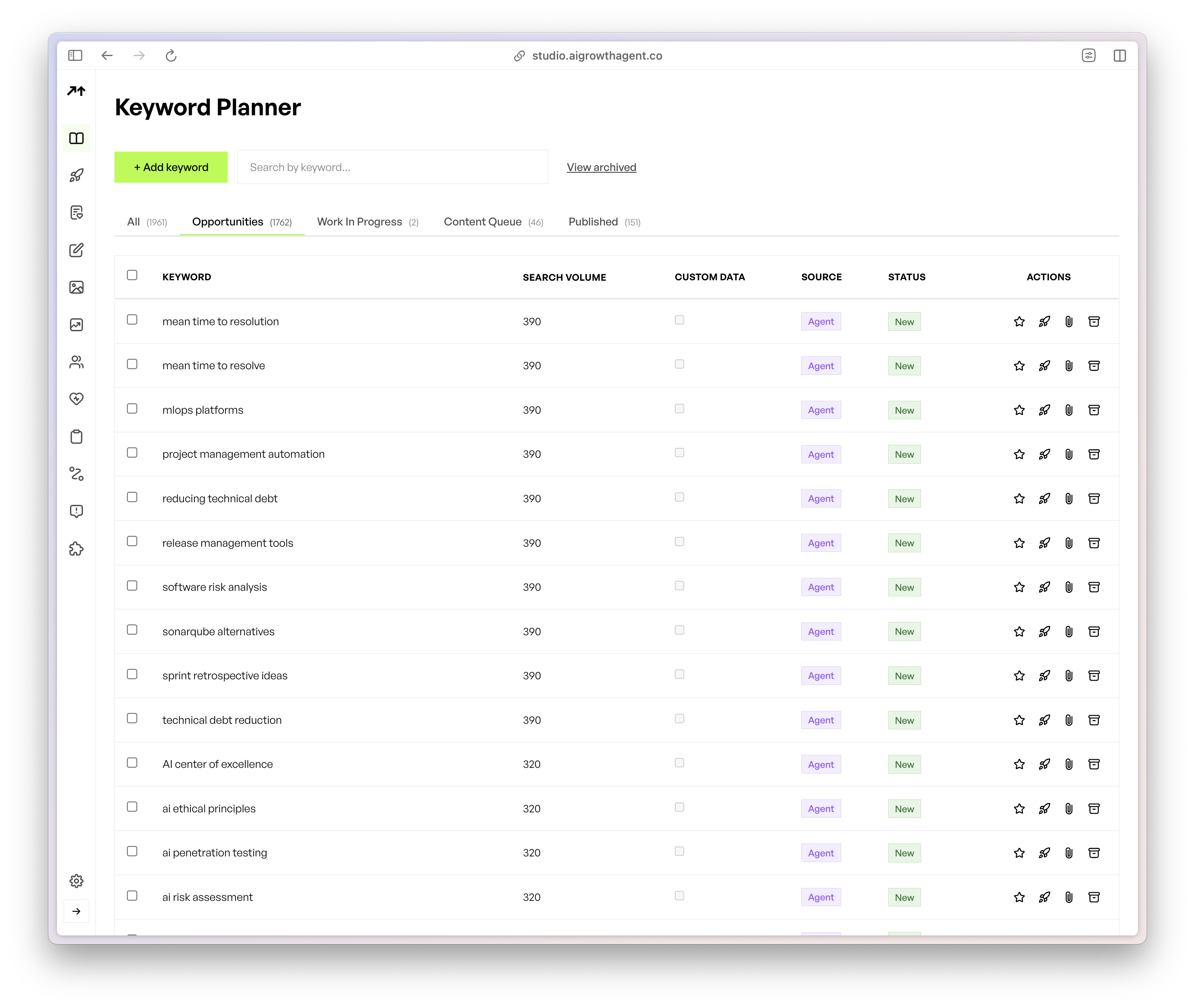
Schedule a consultation to learn how AI Growth Agent scales your mobile-first AI content with precision and authority.
Common Pitfalls in Mobile-First AI SEO to Avoid
Avoiding Low-Quality, Generic AI Content
Using basic AI tools to churn out content is a risky shortcut. Such content often lacks the unique insights and expertise needed for AI citations.
Generic output fails to show E-E-A-T, which AI prioritizes. Without distinct value or authority, it won’t gain traction and may even damage your brand’s reputation.
On mobile, where attention is fleeting, generic content gets ignored. AI favors sources with clear expertise and immediate value for users.
Effective mobile-first AI SEO blends AI efficiency with brand-specific knowledge, requiring advanced systems to embed authority at scale while optimizing technically.
Ensuring Proper Technical Setup for AI and Mobile
Many brands overlook the technical demands of AI search on mobile. Traditional teams often lack skills for advanced schema markup, LLM.txt files, and AI-ready metadata.
Success goes beyond basic mobile design. It involves structured data for content context, Core Web Vitals for user experience, and flawless display across devices.
Emerging AI standards, like LLM.txt and optimized robots.txt, are often missed. These help AI understand and cite content, and neglecting them limits visibility.
Manual technical updates can’t keep up with evolving AI needs. Automated systems are essential to maintain optimization and adapt to new requirements.
Shifting Focus from Traditional SEO Metrics
Many leaders cling to old metrics like rankings and traffic, ignoring AI-specific indicators like citation visibility and summary inclusion rates, leading to flawed strategies.
Rankings mean less when AI delivers direct answers. Content cited often by AI may not rank traditionally but still builds significant brand authority.
For mobile, where AI responses dominate, traffic metrics don’t tell the full story. Users may never click through, yet citations still drive value.
New metrics focusing on AI citations and brand mentions in responses offer better insight into performance in today’s mobile discovery landscape.
Key Questions About Mobile-First AI SEO Answered
How Mobile Optimization Impacts AI Search Results
AI search tools view mobile optimization as a key quality signal when selecting content for citations. Poor performance on mobile, like slow loading or bad design, suggests lower reliability to AI systems.
Specifically, AI assesses Core Web Vitals, load speed, and usability as quality markers. Content excelling in these areas gains priority for citation due to perceived value.
Well-structured mobile content, with clear headers and logical flow, is easier for AI to summarize accurately, boosting citation chances across devices.
Why E-E-A-T Remains Vital for Mobile AI Content
E-E-A-T is more relevant than ever in AI search for mobile content. AI systems heavily weigh credibility and quality when deciding what to cite, especially as mobile users judge trust quickly.
Demonstrate E-E-A-T with clear credentials, authoritative sources, and detailed coverage. Use industry terms and address complex queries to show expertise.
For mobile, place trust signals early in content. Use formatting to highlight authority, ensuring visibility on small screens for both users and AI.
Top Technical SEO Priorities for Mobile AI Search
Focus first on Core Web Vitals, optimizing Largest Contentful Paint, First Input Delay, and Cumulative Layout Shift for fast, smooth mobile experiences that AI values.
Next, use structured data markup like Article or FAQ schema to help AI interpret content, improving accurate extraction and citation.
Prioritize AI-specific standards, like LLM.txt files and optimized robots.txt, alongside metadata tailored for AI parsing, as these gain importance.
Lastly, ensure full mobile responsiveness with quick loads, readable text, and accessible design across screen sizes, meeting AI’s baseline for citation-worthiness.
How Marketing Leaders Can Boost AI Citations
Consistent AI citations demand a structured approach with quality content and monitoring. Automated systems can produce authoritative content daily while tracking performance.
Create content with deep expertise, answering questions fully to position your brand as a top resource. Offer clear, actionable insights for AI recognition.
Use specialized tools to monitor citation visibility across AI platforms. Traditional analytics won’t capture this, so dedicated systems provide essential optimization data.
Manual efforts can’t scale to meet AI demands. Technology that automates production and tracking while maintaining quality is key for busy leaders.
Biggest Mobile Content Mistake for AI Search
Many brands see mobile-first AI SEO as a minor tweak to existing plans instead of a complete shift. This misstep leads to ineffective strategies.
Common errors include irregular posting instead of daily content, focusing on keywords over expertise, and using outdated metrics rather than AI citation indicators.
Underestimating technical needs is also widespread. Basic mobile setup without advanced schema or AI metadata limits indexing and citation potential.
The core issue is relying on human-driven processes over tech solutions built for AI search, lacking the volume and precision needed for success.
Conclusion: Lead in Mobile-First AI Search with AI Growth Agent
Search is now mobile and AI-driven. Marketing leaders who adapt will gain a lasting edge, while others risk fading from view. Moving from keyword focus to semantic authority reshapes how brands connect with customers.
Winning requires high-quality content with expertise, frequent updates to match AI’s pace, and technical accuracy for indexing. Traditional methods can’t deliver at this scale.
AI Growth Agent offers a unique platform using autonomous tech to scale content creation, producing daily, mobile-optimized material that AI consistently cites.
For premium brands, the path is clear: update your strategy for AI search or lose ground to competitors. Early movers in content authority will lead their markets long-term.
AI has countless questions. With AI Growth Agent, your brand delivers the best answers on mobile. Schedule a demo to see how you can lead in the mobile-first AI search era.
