


Key Takeaways
- AI search engines such as ChatGPT, Google AI Overviews, and Perplexity now favor brands that show clear topical authority, technical quality, and consistent publication across entire subject areas.
- Traditional SEO models that rely on manual keyword selection and a few monthly articles do not produce the volume, structure, or freshness required for reliable AI citations.
- A practical AI search content framework starts with an AI readiness audit, a clear company manifesto, programmatic keyword and topic cluster research, and technical infrastructure built for LLM consumption.
- Programmatic systems that handle research, writing, optimization, and publishing at scale help brands win citations across AI platforms while keeping messaging aligned with brand standards.
- AI Growth Agent provides an autonomous programmatic content system for premium brands, and you can see how it works in a live session by booking a strategy demo.
The AI Search Imperative: Why Traditional SEO Falls Short
AI search has raised the bar for content volume and quality. As AI multiplies published content, individual brands occupy a smaller share of the overall information field unless they scale output in a structured way.
AI search engines like Perplexity now weigh site authority, backlink quality, online reputation, and strong organic rankings, while Google AI Overviews depend on core ranking systems and structured data. Brands that want visibility must pair publishing velocity with clean technical implementation.
Manual agency models that deliver one or two articles each month cannot create the depth and coverage AI platforms expect. Basic AI writing tools generate text, but they do not handle schema, internal linking, LLM-oriented files, or publishing workflows, so internal teams still face significant technical work.
Schedule a strategic AI Search review to understand how exposed your brand is today.
Understanding AI Search Engines: Ranking Factors and Citation Mechanisms
AI search platforms evaluate many of the same quality signals as traditional search, but they apply them across whole topic areas instead of isolated pages. Google AI Overviews use multiple LLMs and still rely on systems such as Helpful Content, PageRank, and Freshness.
ChatGPT considers relevance, brand mentions, online reputation, and Bing rankings through its Browse capability. Perplexity places strong emphasis on backlinks, comprehensive coverage, and organic performance.
Topic authority now outweighs single-page optimization. AI systems look for consistent coverage and expertise across related queries, so content strategies must define and fill entire knowledge clusters, not just isolated keywords.
Structured data, entity linking, internal clustering, fast performance, and scannable layouts like tables and bullet lists significantly improve AI visibility. LLM.txt files and Model Context Protocol give LLMs direct guidance and access to content, which increases citation accuracy and frequency.
See how AI Growth Agent designs content architectures that AI systems can easily cite.
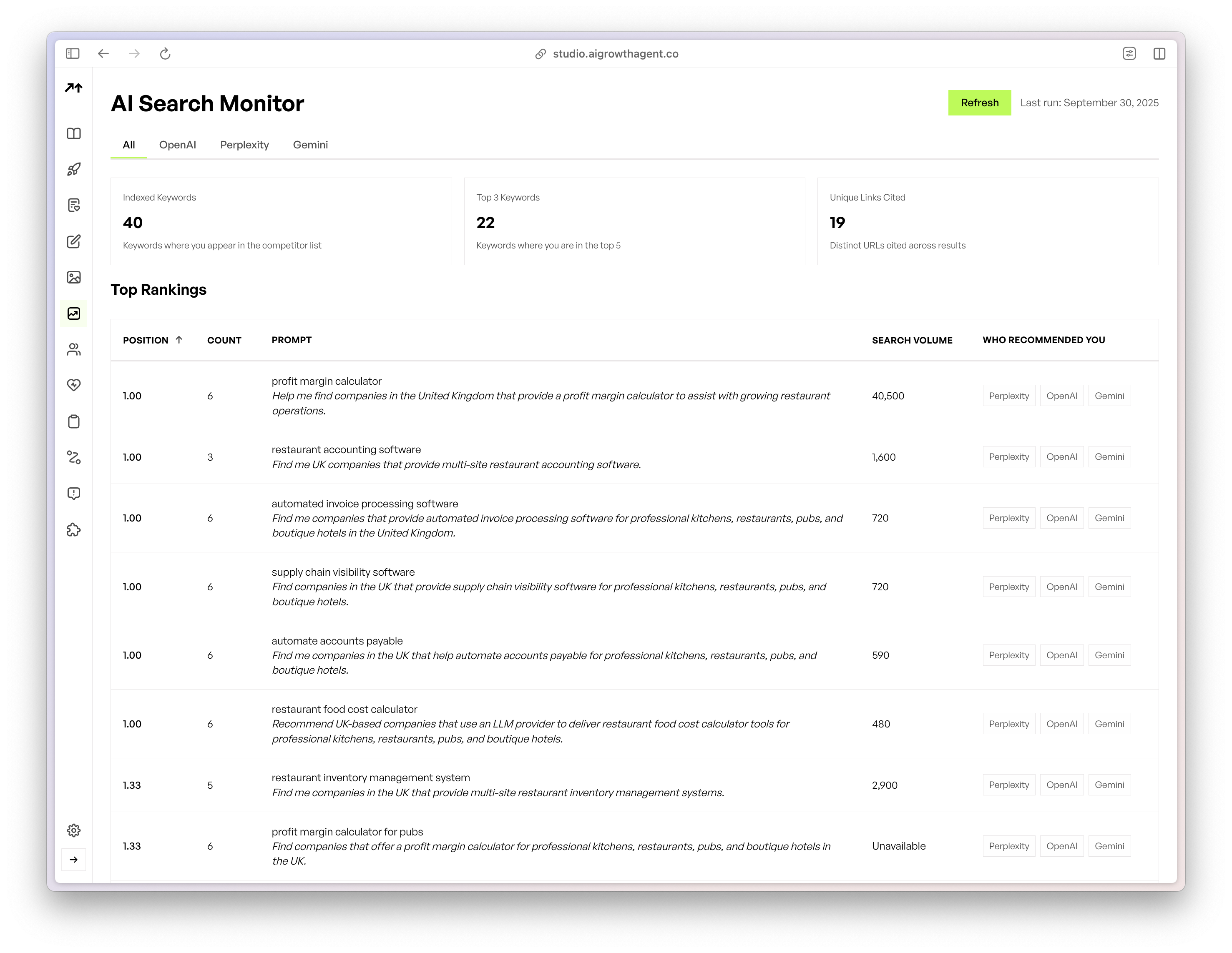
Build Your Programmatic AI Search Content Strategy: A Framework for Leaders
Effective AI search strategies treat content as a system. That system must define topics, encode brand voice, and deliver technically optimized pages at a pace that matches AI-driven discovery.
Step 1: Audit For AI Readiness
Start by reviewing your current domain strength, content inventory, and technical health. Existing rankings and backlink quality still influence which sites AI systems trust, so gaps here deserve early attention.
Map content that already aligns with AI-friendly formatting, and flag missing schemas, weak internal linking, or thin coverage within important topics.
Step 2: Define Your Company Manifesto
A company manifesto documents positioning, audience, tone, product details, and non-negotiable guidelines. This reference turns autonomous content creation into a controlled process that reflects brand expertise and avoids generic output.
Step 3: Expand Keyword And Topic Clusters Programmatically
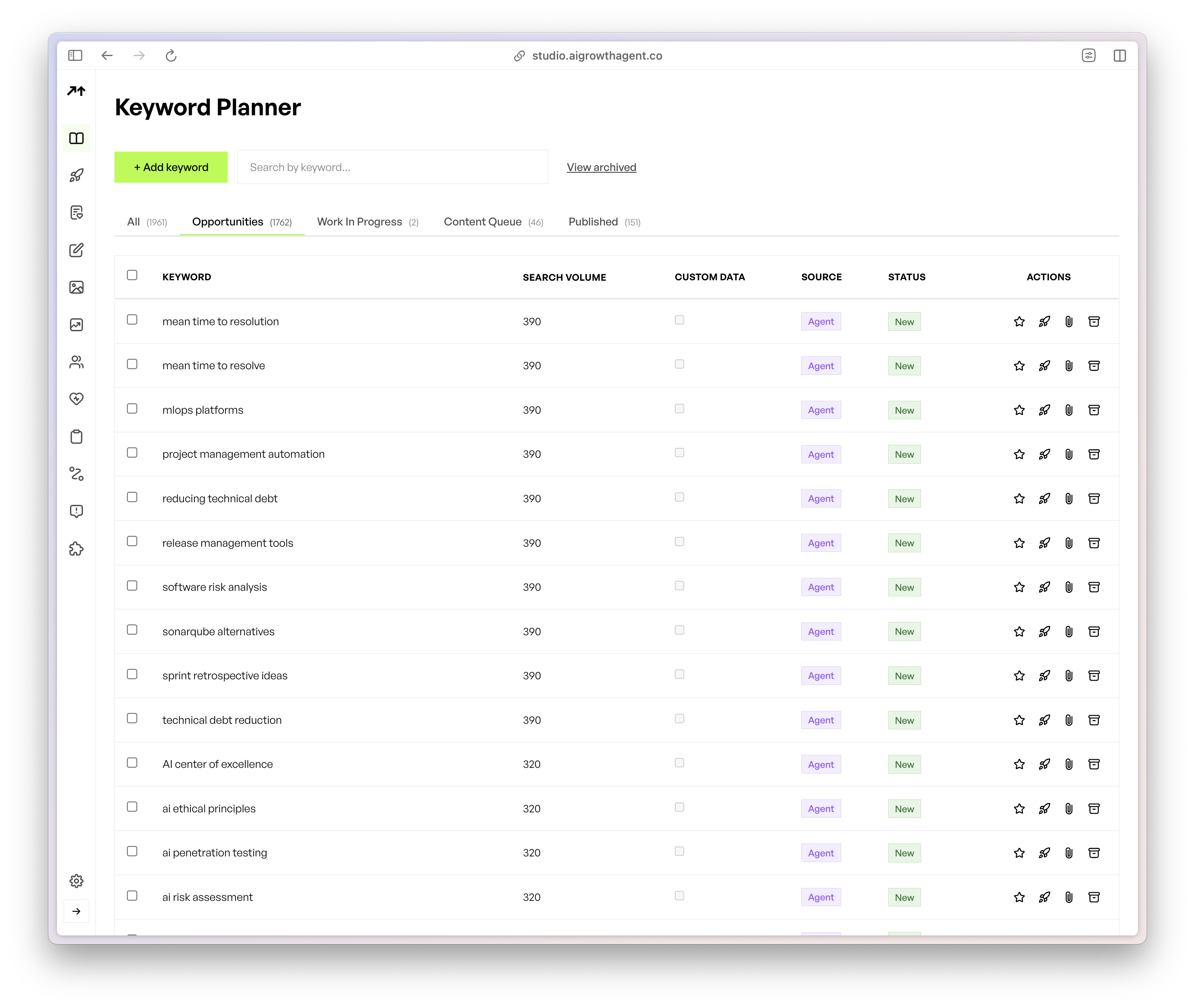
AI search dominance requires broad and deep coverage. Move from a short list of head terms to structured topic clusters that span questions, comparison queries, implementation guides, and use cases across the full customer journey.
Programmatic planning tools help convert those clusters into hundreds of briefs that still map back to a coherent strategy.
Step 4: Build Technical Infrastructure For AI Indexing
Support your content plan with infrastructure designed for LLMs. This includes automated schema, LLM.txt, Model Context Protocol where relevant, clean sitemaps, and publishing flows that send new content live and indexable within minutes.
Overcome Programmatic Execution Challenges
Many internal teams lack the engineering capacity to automate schema, manage subdomains, and maintain publishing pipelines. Agencies typically focus on strategy and copywriting, which leaves a gap between plans and consistent execution.
Review how AI Growth Agent closes these gaps with an autonomous content engine.
AI Growth Agent: An Autonomous System For Programmatic AI Search Authority
AI Growth Agent is built to run the full programmatic SEO lifecycle for AI search, from strategy to technical deployment and publishing. The system focuses on quality, consistency, and AI-friendly structure at scale.
Guided Onboarding And Company Manifesto
Onboarding sessions with experienced content and strategy specialists capture brand story, audience, and product knowledge. The outcome is a living Company Manifesto that trains the agent to write with your perspective and voice.
Autonomous Technical Infrastructure
AI Growth Agent can deploy a fully optimized blog on a subdomain that matches your visual identity, or integrate with platforms such as WordPress, Webflow, or HubSpot. The hosted option removes developer bottlenecks and supports autonomous publishing.
Programmatic SEO Content Agent
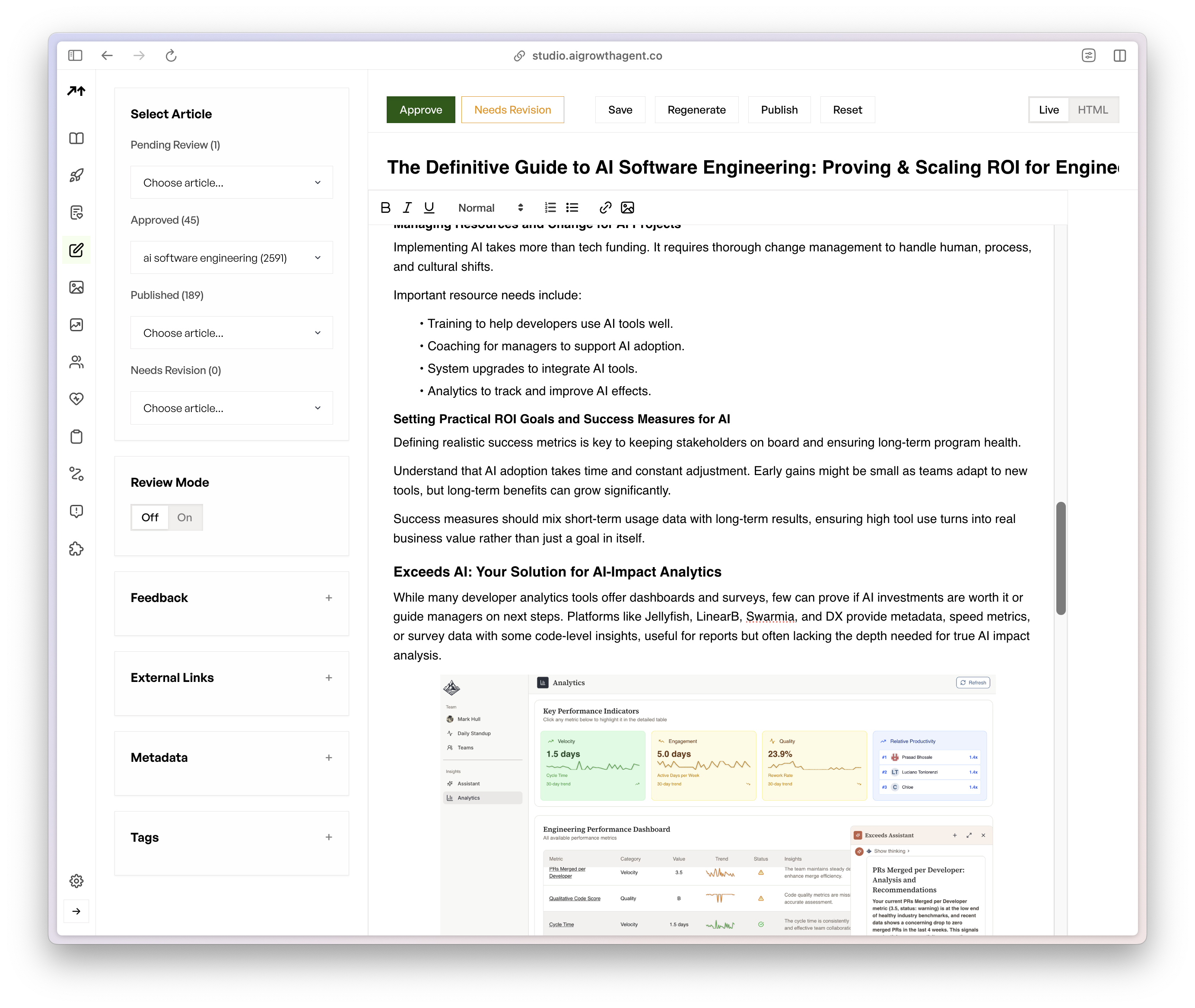
The Content Agent handles research, outlining, drafting, fact checks, and on-page optimization. Each article includes structured data, metadata, and image SEO, plus LLM.txt guidance and Model Context Protocol support for direct AI access where implemented.
Programmatic Deployment Across Multiple Brands
Enterprises and portfolio companies can manage separate agents for each brand from a single interface. Each agent maintains its own voice, topics, and cadence while sharing governance and reporting.
Real-Time And Data-Driven Content Automation
AI Growth Agent reacts to trends and internal data. The system can publish timely pieces on emerging topics and convert product catalogs or proprietary datasets into structured, search-focused content.
AI Growth Agent Compared To Common Alternatives
|
Feature |
AI Growth Agent (Programmatic) |
Traditional SEO Agencies (Manual) |
Self-Service AI Tools (Basic) |
|
Content Volume And Cadence |
High volume, daily or near-daily publication |
Limited by team capacity |
Depends on manual prompts and oversight |
|
Technical Optimization |
Automated schema, LLM.txt, MCP, direct publishing |
Partial, often needs developer time |
Minimal, mostly raw text output |
|
AI Citation Focus |
Designed for LLM ingestion and AI search |
Indirect, through classic SEO work |
Requires separate engineering and strategy |
|
Strategy And Execution |
Unified, autonomous workflow |
Fragmented across teams and vendors |
Tool-only, strategy remains manual |
Success In The LLM Era: Case Studies From AI Growth Agent
Programmatic content, paired with strong technical execution, produces measurable AI search results across categories.
- Exceeds AI built authority around performance management tools and earned Perplexity recommendations within two weeks, then appeared in Google AI Overview and Gemini snapshots for key engineering performance queries.
- BeConfident gained rapid visibility in English learning searches in Brazil and became a top Google AI Overview and Gemini recommendation within weeks, despite competition from large incumbents.
- Bucked Up increased category presence for protein soda, with ChatGPT citing the brand within three weeks for high-intent terms such as “best protein soda.”
- Gitar.ai moved from low awareness to frequent citations for AI-powered CI/CD automation across Google AI Overview, Gemini, ChatGPT, and Perplexity in under two months.
Frequently Asked Questions About AI Search Content Strategy
How do AI search engines assess content authority?
AI search engines measure authority through E-E-A-T signals, backlink strength, brand mentions, and content depth across related topics. Google AI Overviews still use systems such as Helpful Content and PageRank, while ChatGPT adds Bing rankings and reputation data. Perplexity leans heavily on backlink quality and traditional organic performance. Brands that publish comprehensive, technically sound content across full topic clusters tend to earn more citations.
What is the shrinking digital footprint, and how does programmatic content address it?
The shrinking digital footprint describes how rapid growth in AI-generated content reduces the relative visibility of any single brand. When content volume grows faster than your own publishing program, your share of attention declines. Programmatic content strategies counter this by raising output to a sustainable, high cadence while preserving quality and structure, which helps maintain or grow topical share in both search and AI responses.
Do traditional SEO ranking factors still matter for AI Overviews and LLMs?
Traditional ranking factors remain important. Relevance, content quality, internal linking, page speed, mobile experience, and backlink patterns still influence AI search systems that draw on web indexes. The main change is scale. Brands now need these fundamentals across many more pages, supported by consistent schemas and AI-friendly formatting, instead of occasional one-off optimizations.
What is LLM.txt, and why is it important for AI search visibility?
LLM.txt is a machine-readable file that guides Large Language Models through your content structure, similar to how robots.txt guides crawlers. It describes hierarchy, key sections, and access rules in a clear format. When combined with standards such as Model Context Protocol, this file makes it easier for AI systems to understand, navigate, and correctly cite your content.
How quickly can a brand see results with an AI Search Content Strategy?
Brands with solid domains and clean technical setups often see early AI citations within two to three weeks of programmatic deployment. Results depend on authority, publishing cadence, and the precision of topic targeting. Ongoing success comes from continuous, structured publication rather than a one-time campaign.
Conclusion: Define Your Brand’s Authority In The Age Of AI Search
AI-driven search in 2026 rewards brands that treat content as an engineered system. Manual keyword efforts and occasional articles do not match the pace or structure that LLMs now expect.
Creating unique, high-value content that serves both human visitors and AI systems is now the competitive baseline. AI Growth Agent focuses on this standard at programmatic scale by combining topic strategy, technical infrastructure, and autonomous publishing.
