Written by: Mariana Fonseca, Editorial Team, AI Growth Agent | Last updated: January 10, 2026
Key Takeaways
- AI search has shifted focus from basic keyword rankings to semantic coverage, entity relationships, and trusted citations across entire topics.
- The volume of AI-generated content makes manual keyword optimization too slow and narrow to keep brands visible in AI answers.
- Programmatic SEO builds structured content clusters at scale, so AI systems can recognize, reuse, and cite your expertise across many queries.
- Traditional agencies, in-house teams, and basic AI writing tools struggle to combine strategy, content, and technical SEO at the speed AI search now requires.
- AI Growth Agent delivers programmatic, AI-first keyword optimization and content engineering, and you can see it in action by scheduling a demo.
The Problem: Your Digital Footprint Is Shrinking in the AI Search Era
Marketing leaders are seeing once-strong organic visibility erode. AI-generated content floods search results and answer engines, while traditional keyword tactics struggle to keep up.
The Proliferation of AI-Generated Content
Millions of AI-generated articles now go live every day. This volume dilutes individual brand voices and makes narrow keyword targeting less effective. Even well-crafted content can lose visibility when it competes with an endless stream of generic material.
Brands that cannot match this velocity with authoritative coverage across their topics see their share of impressions and citations decline.
AI Search Engines Have New Requirements
AI systems prioritize semantic understanding, topical completeness, and authoritative citations over simple keyword matches. They assess how concepts connect, not just how often a phrase appears.
Instead of presenting long result lists, AI search tools synthesize direct answers. These systems favor a small set of accurate, fresh, and contextually deep sources. Thin or isolated pages rarely appear in that shortlist.
Traditional Keyword Optimization Falls Short
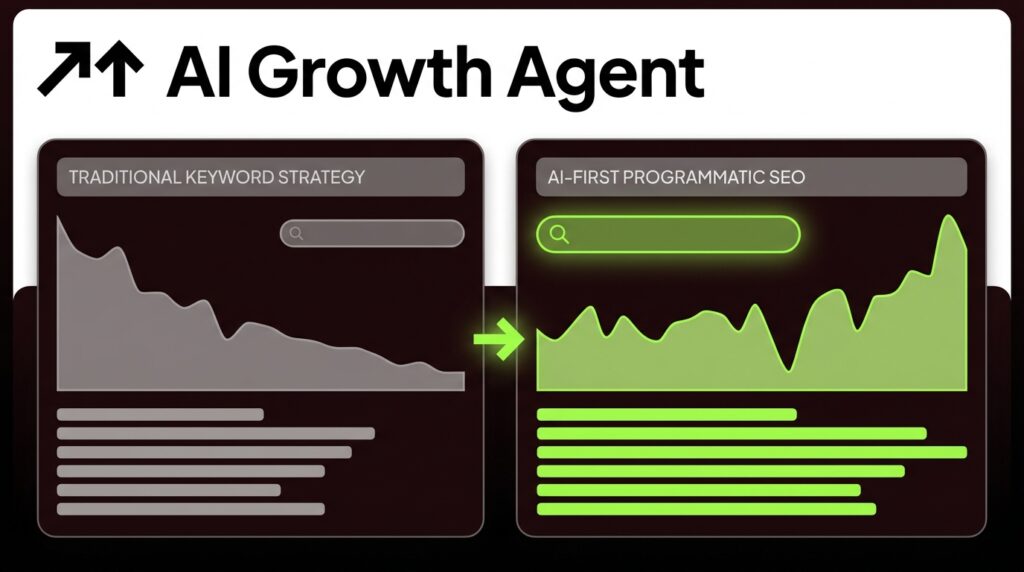
The objective has shifted from ranking position to citation and selection inside AI outputs. Classic workflows that focus on a handful of target phrases per page miss how AI tools interpret full topics and entities.
Older tactics emphasize exact-match phrases and single-query intent. AI-era optimization requires coverage of related questions, use cases, and subtopics so models see your content as a reliable, reusable source.
The Long Long Tail and Conversational Search
AI systems now surface and recombine very granular, intent-rich queries. Users ask follow-up questions, refine scenarios, and expect coherent answers across a conversation.
Around a third of consumers now begin their searches with AI assistants instead of Google. This behavior fragments discovery across AI chats and traditional SERPs and demands much broader, conversational keyword coverage.
The Solution: Programmatic SEO for AI Citation and Authority
Programmatic SEO applies systems thinking to keyword optimization. It uses structured templates, automation, and technical engineering to generate comprehensive, interconnected content that AI tools can easily interpret and cite.
AI and Entity SEO focus on entities, relationships, and structured context, not only on keyword strings. This approach builds authority inside AI knowledge graphs so your brand shows up when models assemble answers.
Topical Depth and Breadth With Content Clusters
Authority in 2026 is defined by depth and breadth across content clusters. A cluster connects high-level explainers, tactical guides, FAQs, and use cases into a visible coverage map.
Brands that cover each key topic in this structured way give AI models many consistent touchpoints. That repeated exposure increases the chance of ongoing citation across related queries.
Semantic Clarity and Entity Relationships
AI models evaluate how clearly content explains concepts and how consistently it refers to entities such as products, audiences, and industries. Structured context and content clustering show how pages reinforce each other, which signals expertise.
Clean internal linking, consistent terminology, and schema markup help models place each page within a broader knowledge structure. That foundation supports more reliable AI citations.
Answer Engine Optimization and Generative Engine Optimization
Answer Engine Optimization and Generative Engine Optimization have emerged as dedicated workstreams. They focus on becoming a preferred source for AI-generated responses rather than only improving blue-link rankings.
GEO prepares content to be easily extracted and synthesized by large language models through clear Q&A structures. This format lets AI tools reuse your explanations with minimal friction.
Why Current Keyword Optimization Solutions Struggle in the AI Era
Most existing approaches were built for classic SERPs, not AI answer engines. They either move too slowly or lack the technical depth needed for AI-first optimization.
Traditional SEO Agencies
Many agencies rely on manual production models. They create strong individual pieces, but limited throughput makes it hard to build full topical coverage.
Teams often lack the engineering capacity to deploy advanced schema, AI-specific metadata, and structured content templates at scale. This gap slows response to new AI search opportunities and raises costs per article.
Internal Marketing Teams
In-house marketers know the brand best but rarely have bandwidth or specialized SEO engineering skills for programmatic systems. Complex tasks such as large-scale schema, LLM-specific directives, and crawl optimization usually compete with other priorities.
Without automation and purpose-built infrastructure, teams struggle to maintain both quality and volume across dozens or hundreds of topic clusters.
Basic AI Content Tools and Prompt Templates
Tools such as ChatGPT or Jasper help draft content, but do not manage the full lifecycle of programmatic SEO. Strategy design, interlinking, schema, metadata, and publishing workflows still sit with the user.
Output quality and optimization also depend heavily on prompts, which creates inconsistency. These tools improve writing speed but do not replace a structured, AI-aware SEO system.
AI Growth Agent: Programmatic SEO for AI-First Keyword Strategies
AI Growth Agent provides an autonomous system for research, content, and technical SEO built specifically for AI search environments. It focuses on coverage, structure, and measurement rather than isolated keywords.
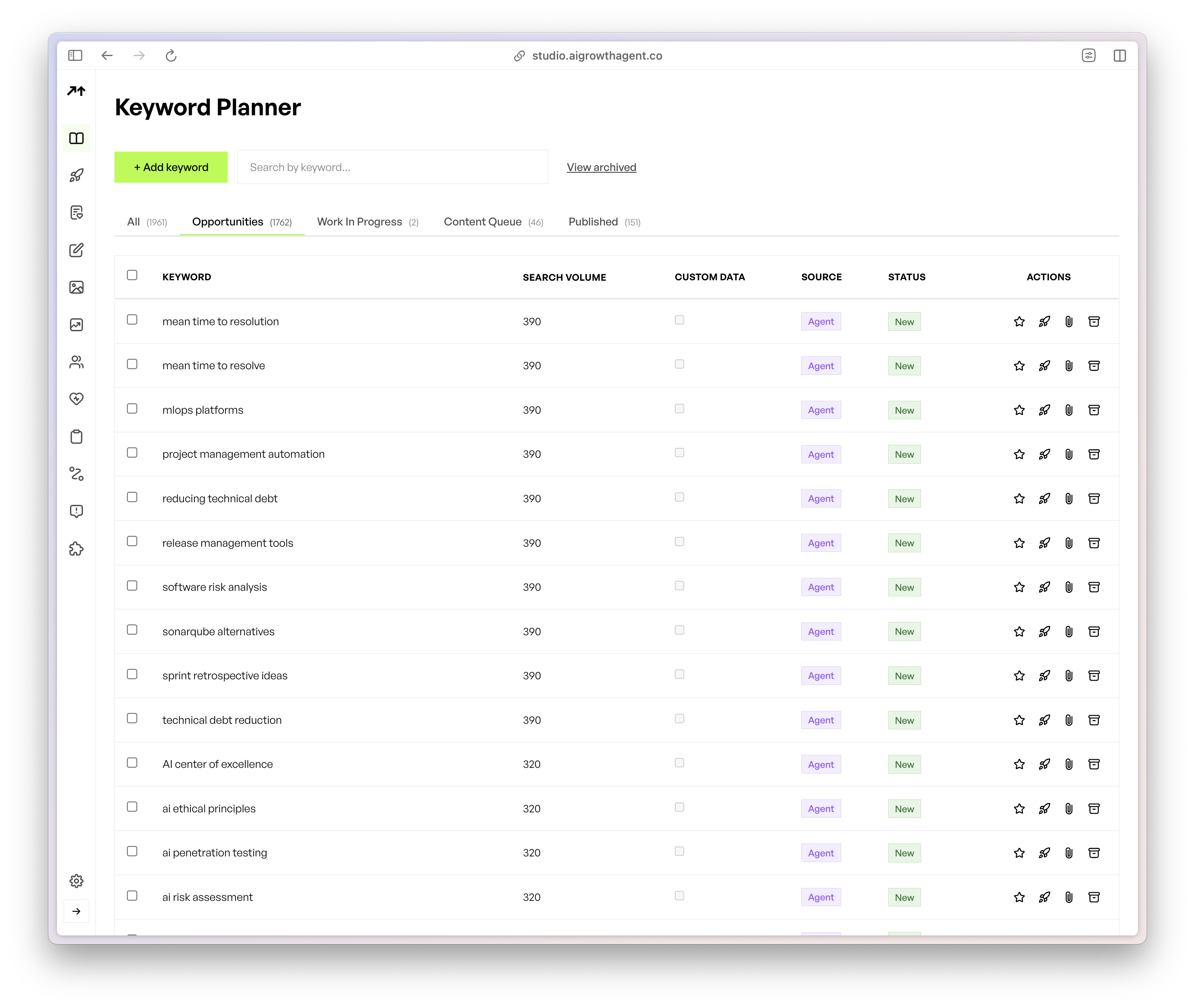
Programmatic Keyword and Content Research
The agent evaluates tens of thousands of relevant queries, organizes them into pillars and clusters, and maps them to content opportunities aligned with AI search behavior. This method targets citation potential while building consistent topical authority.
Autonomous Technical Engineering
AI Growth Agent automatically implements schema markup, LLM.txt files, and a blog Model Context Protocol that lets AI systems understand and query your content with high precision.
The platform deploys optimized blog structures that align with your brand while providing a clean technical base for programmatic SEO.
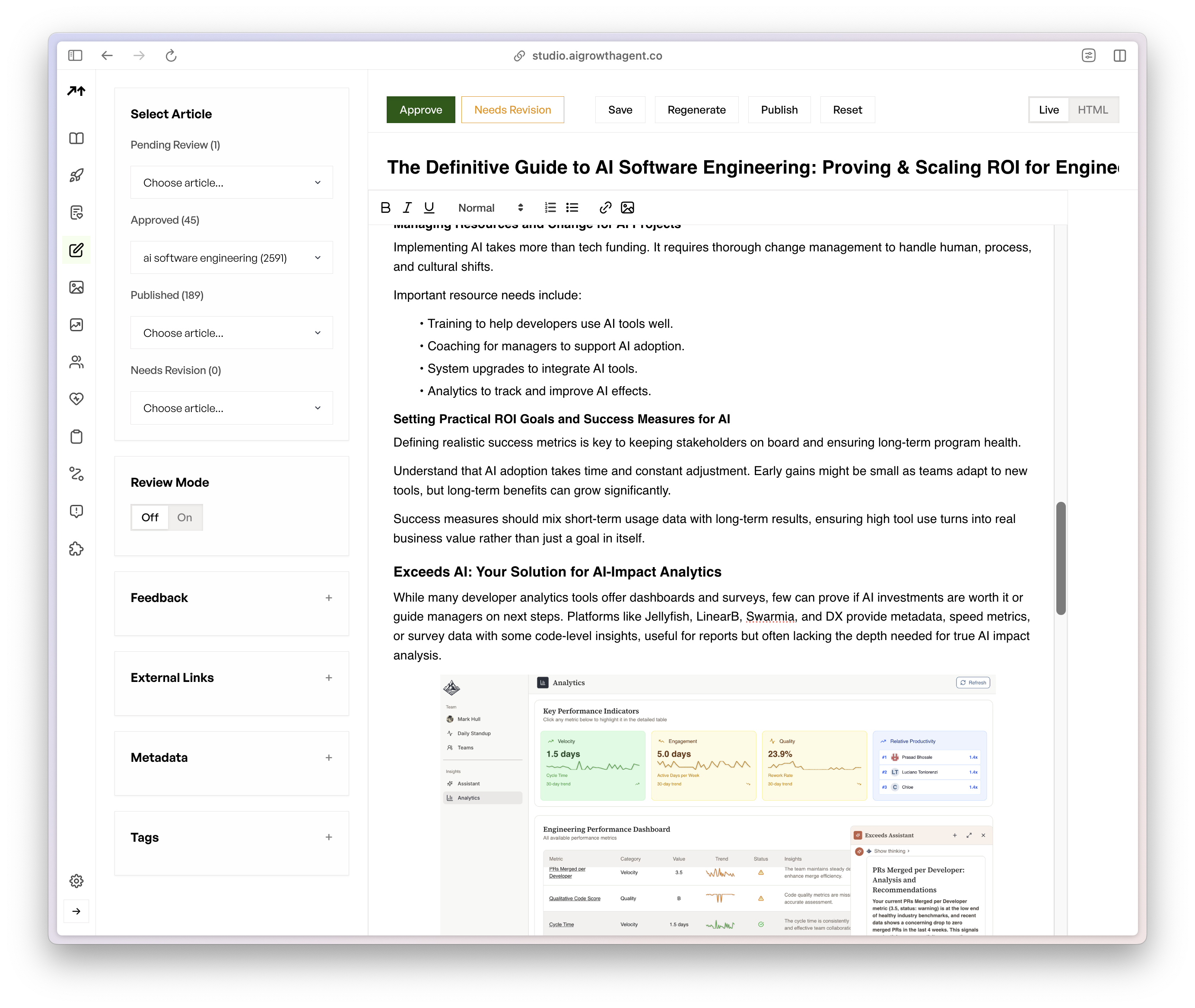
Autonomous Content Engineering
The content agent manages research, outlining, drafting, fact-checking, and technical optimization. It produces both tactical articles and longer pillar pieces that share a consistent voice and structure.
Each article connects to your broader authority architecture so that every new piece reinforces existing clusters.
AI Search Monitor and Feedback Loop
The AI Search Monitor tracks how your content appears across ChatGPT, Google AI Overviews, and Perplexity. It surfaces which URLs are cited, how often they appear, and where opportunities exist for stronger coverage.
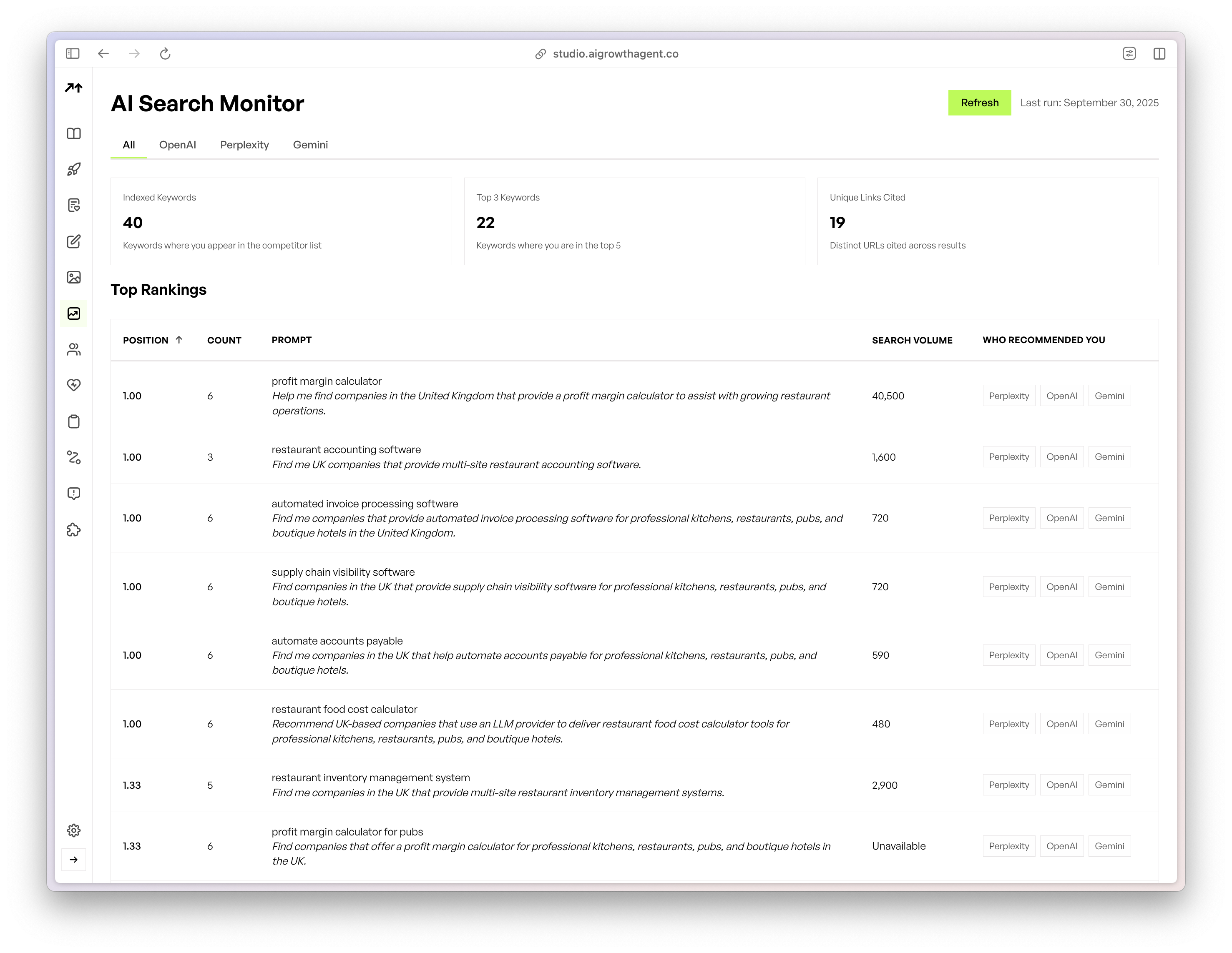
This feedback loop informs ongoing research and content updates so your programmatic SEO adapts to real AI search behavior.
Experience autonomous, AI-first keyword optimization in a live demo of AI Growth Agent.
Comparison Table: Programmatic SEO vs. Traditional Approaches
|
Feature or Capability |
Traditional SEO Agency |
Basic AI Content Tool |
AI Growth Agent |
|
Keyword research approach |
Manual, limited scale |
Prompt-driven, fragmented |
Autonomous, programmatic, clustered |
|
Content volume and velocity |
Low, slow |
Variable, user-dependent |
Consistent, high, structured |
|
AI citation optimization |
Limited focus |
Indirect, prompt-dependent |
Core focus, integrated |
|
Technical SEO automation |
Manual, project-based |
Minimal |
End-to-end implementation |
Benefits: Building Authority and Visibility in AI Search
Earn Recognition as a Topic Authority
Comprehensive content clusters and strong technical signals help AI systems treat your site as a reliable source. That recognition increases the likelihood of consistent citations across many related prompts.
Compete Effectively at Scale
Programmatic SEO lets your team cover more topics and queries without sacrificing structure or quality. AI Growth Agent aligns research, content, and engineering so coverage grows faster than with manual methods alone.
Prepare for Search Everywhere
Search Everywhere Optimization highlights how discovery now happens across AI chat, classic search, social, and in-app experiences. Programmatic SEO with AI Growth Agent supports this shift by producing structured, reusable content that travels across channels.
Improve ROI With Autonomous Content Engineering
Automation reduces dependence on hourly services and one-off projects. A single system can research, create, and optimize content continuously, lowering cost per page while staying aligned with AI search standards.
Frequently Asked Questions (FAQ)
How does programmatic SEO with AI Growth Agent change keyword research?
AI Growth Agent groups related queries into topic clusters based on conversational intent and semantic similarity. It then plans content that addresses each cluster in depth, which increases the chances that AI systems will reuse and cite your material.
Can AI Growth Agent help my brand appear in Google AI Overviews and ChatGPT responses?
AI Growth Agent is designed for AI search environments such as Google AI Overviews, ChatGPT, and Perplexity. It uses LLM.txt files and a blog Model Context Protocol to clarify how your content is structured and accessible. The AI Search Monitor then reports where your pages appear inside AI-generated answers.
What is a shrinking digital footprint, and how does AI Growth Agent address it?
A shrinking digital footprint occurs when your share of organic impressions and citations declines as AI-generated content volume rises. AI Growth Agent responds by scaling high-quality, structured content so AI models see your brand across more queries instead of defaulting to competitors.
Conclusion: Update Keyword Strategy for AI-First Search
AI search has moved optimization away from isolated keywords and toward structured, topic-level authority. Brands that rely only on manual, page-by-page tactics will see visibility decrease as AI systems concentrate on a smaller set of comprehensive sources.
Programmatic SEO offers a practical path forward. It combines scale, structure, and technical precision so AI models can recognize and reuse your expertise.
AI Growth Agent provides this capability in a single platform, from research and content engineering to AI citation monitoring. Schedule a demo to see how AI Growth Agent can support your AI-era keyword strategy.