


Written by: Mariana Fonseca, Editorial Team, AI Growth Agent | Last updated: January 10, 2026
Key Takeaways
- AI search engines now act as primary gatekeepers of authority in 2026, so brands need clear strategies for AI citation, not just traditional rankings.
- Programmatic content velocity helps counter AI-driven content saturation and gives large language models enough high-quality data points to recognize your expertise.
- Technical elements such as schema markup, structured data, and LLM-focused protocols improve how AI systems interpret and surface your content.
- Programmatic SEO that focuses on entities, topical depth, and answer-ready content increases the chances of being referenced in AI-generated responses.
- Teams that want to operationalize this approach can use AI Growth Agent and schedule a demo to see how the platform supports AI citation at scale.
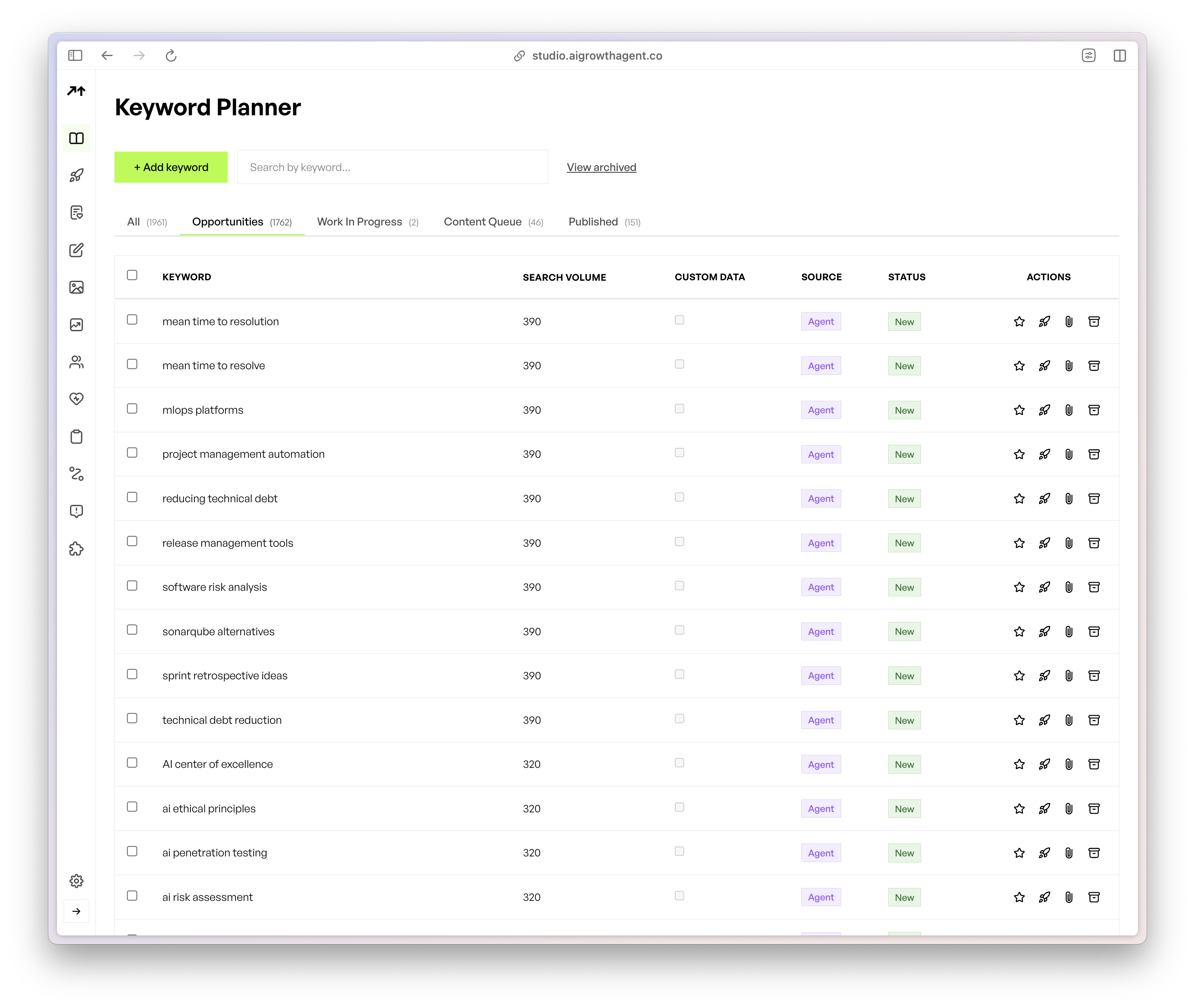
The Problem: Your Brand Is Losing Visibility in the AI Search Era
AI Content Saturation Shrinks Your Digital Footprint
AI-generated content now floods search results and feeds, which compresses the space your brand once occupied. Your company’s digital presence, the pixel you own on the internet, keeps shrinking as content volume accelerates. Without a structured response, your brand voice fades while automated content that lacks real expertise fills the gaps.
AI Citation Has Replaced Traditional Ranking as the Goal
Modern AI systems emphasize trust, confidence, and validation. Large models evaluate entity clarity, factual consistency, and reputation signals when deciding which sources to cite. Visibility now depends on being selected as an authoritative entity that AI tools reference in answers, not just on ranking a single page for a keyword.
Programmatic Velocity Is Required for AI Visibility
AI models respond well to content ecosystems that show depth, recency, and structural consistency at scale. Most teams that publish one or two manually crafted posts each month cannot keep pace with how fast AI search surfaces and recombines information. A programmatic approach to content creation becomes necessary to stay present in the data these systems use.
AI Invisibility Lets Competitors Define Your Narrative
Insufficient content and weak entity signals create a vacuum that competitors can fill. Their content becomes the material AI systems draw from, their claims shape how the market is described, and their brand appears as the cited authority. This shift affects more than traffic metrics, it determines who defines the story for your category.
Marketing leaders who want to regain authority in AI search can schedule a consultation session with AI Growth Agent to review their current footprint.
The Solution: Use Advanced AI Algorithms to Build Defensible Authority
Programmatic Content Architectures Built for AI Citation
Advanced AI algorithms help design content architectures that match how AI search engines understand topics and entities. Interconnected content clusters around your core expertise create consistent signals about what your brand knows and does. This structure makes your site more useful to AI systems that look for reliable, well-organized information to synthesize into answers.
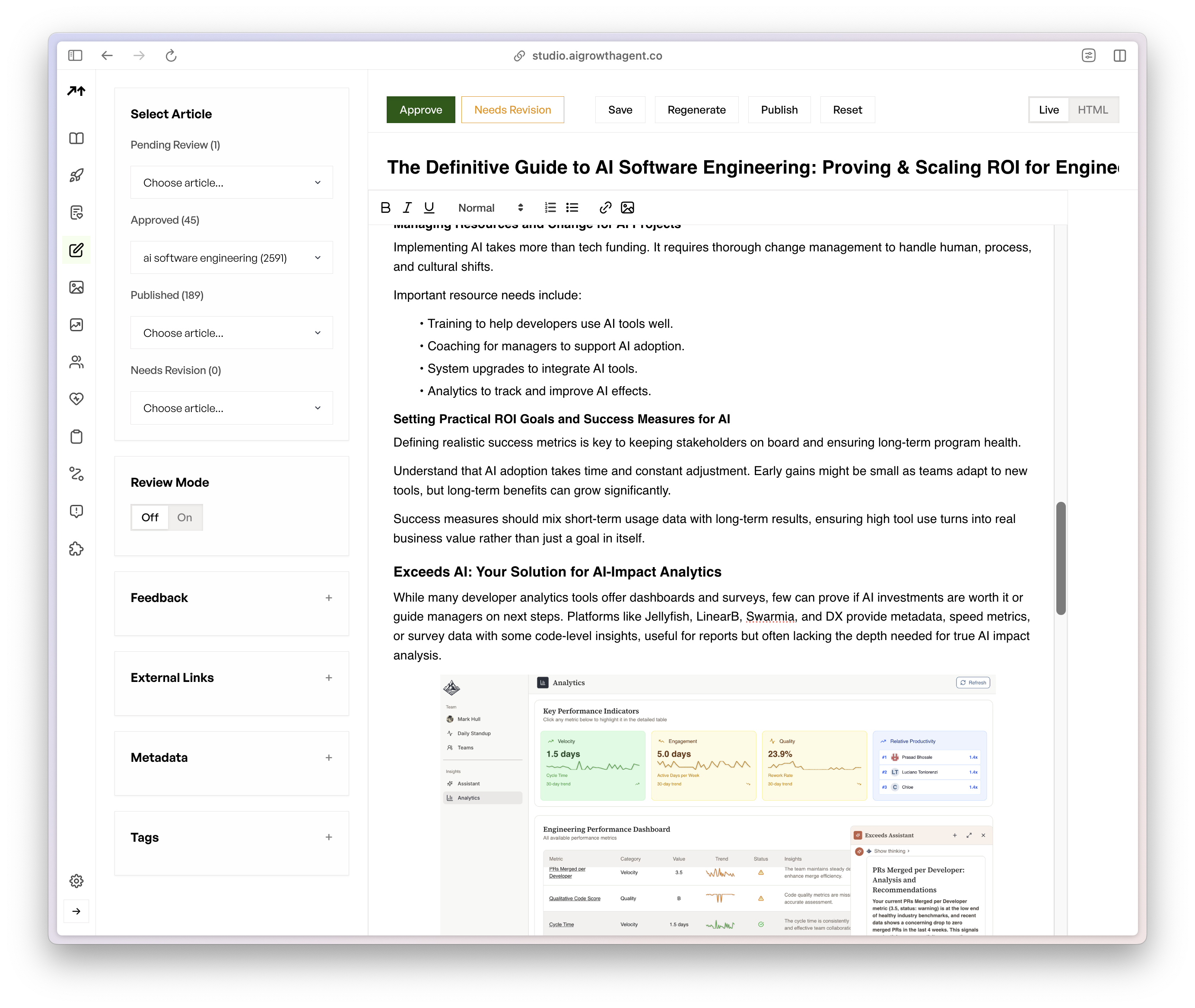
Technical Optimization Signals Credibility to AI Systems
Technical SEO in 2026 now extends beyond page speed and meta tags. Elements such as schema markup, structured data, and precise metadata give AI models clearer context about entities, relationships, and claims. AI Growth Agent focuses on embedding this structure across large content sets so AI search engines can evaluate and surface your expertise more reliably.
Answer Engine Optimization Aligns Content With AI Outputs
Search behavior is shifting from ten blue links to direct answers. Answer Engine Optimization focuses on building content that AI tools can cite verbatim or synthesize confidently. Clear headings, concise definitions, step-by-step explanations, and explicit coverage of related questions all contribute to stronger citation potential when models generate responses.
Teams that want to operationalize this level of technical and editorial rigor can schedule a demo to see how AI Growth Agent supports programmatic content for AI citation.
AI Growth Agent: A Programmatic SEO Agent for AI Citation
How the Programmatic SEO Agent Works for Marketing Teams
AI Growth Agent provides an autonomous system for building high-authority content architectures at programmatic scale. The Programmatic SEO Agent reduces manual effort across research, planning, drafting, optimization, and publishing, so teams can focus on positioning and strategy instead of production logistics.
Solving the Scale Versus Quality Tradeoff
The platform manages the full content lifecycle while enforcing quality standards and technical completeness. Key capabilities include:
- Automated schema markup, LLM.txt, and Model Context Protocol (MCP) to help AI search engines connect directly with your content database and interpret your expertise with precision.
- Multi-tenant programmatic deployment that supports complex, multi-brand strategies with separate manifests and distinct brand voices.
- Real-time programmatic content injection that generates branded, SEO-optimized articles on emerging topics fast enough to capture search interest from breaking news or new queries.
Comparison: AI Growth Agent Versus Traditional and Basic AI Approaches
|
Capability |
Traditional SEO Agencies |
Basic AI Content Tools |
AI Growth Agent |
|
Programmatic Velocity |
Low (Manual Process) |
Medium (Unstructured) |
High (Autonomous) |
|
Technical SEO at Scale |
Limited |
Poor |
Robust (Schema, LLM.txt, MCP) |
|
Entity-First Strategy |
Manual or Limited |
No |
Yes (Automated) |
|
End-to-End Automation |
No |
No |
Yes (Full Lifecycle) |
Marketing leaders who want to see these capabilities in practice can book a demo with AI Growth Agent and review example architectures for their industry.
Case Studies: How Brands Achieve AI Citation With AI Growth Agent
Clients across different industries use AI Growth Agent to increase their presence in AI-generated answers. Examples include:
- Exceeds AI: Within three weeks, became a frequently cited source for “AI performance review tools for engineers” across ChatGPT, Google AI Overview or Gemini, and Perplexity.
- BeConfident: Gained measurable visibility for English learning app searches in Brazil, with Google AI Overview or Gemini referencing the brand shortly after programmatic content deployment.
- Bucked Up: Within three weeks, appeared in ChatGPT answers as a leading protein soda brand for “best protein soda,” which improved authority in a crowded sports nutrition category.
- Gitar: In less than two months, emerged as a reference brand for AI-powered CI or CD automation, consistently appearing in AI answers for queries such as “fix broken CI builds automatically.”
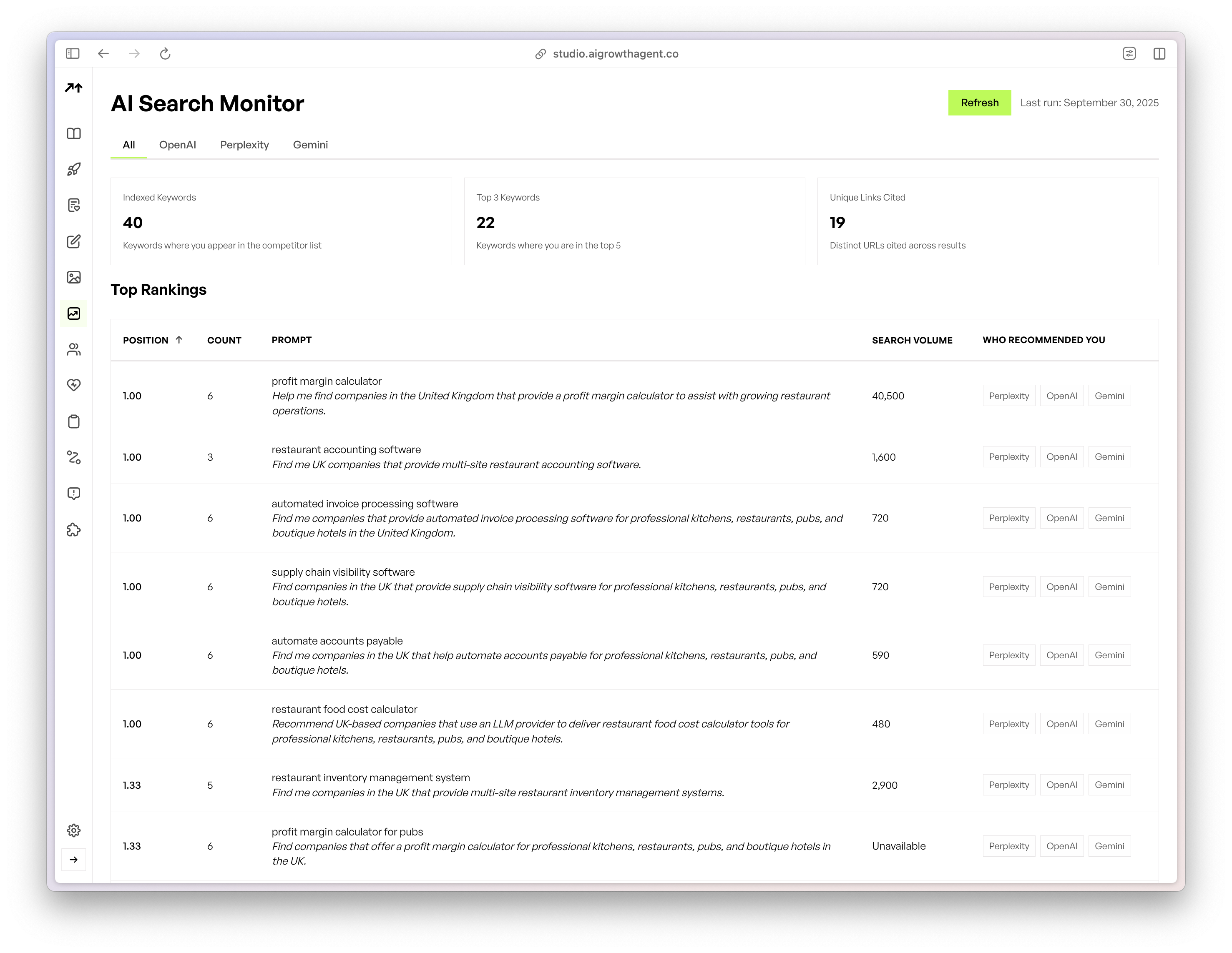
Frequently Asked Questions (FAQ) About AI Citation and Advanced Algorithms
What is AI citation, and why is it important?
AI citation happens when AI search engines reference or synthesize information from your content in their responses. This behavior signals that the system views your site as one of the most credible and useful sources on a topic based on consistency, relevance, and reputation.
How do advanced AI algorithms help my brand get cited by AI search engines?
Advanced AI algorithms map your expertise into structured content architectures with deep topical coverage. They also apply technical optimizations such as schema markup and LLM-focused files so AI models can locate, interpret, and reuse your answers more accurately.
Can my internal marketing team or traditional SEO agency match the required programmatic velocity?
Most manual content programs struggle to match the velocity and coverage that AI search engines now reward. Human teams can define strategy, voice, and positioning, while automated systems handle large-scale production, optimization, and monitoring.
What technical optimizations matter most for AI citation?
Effective AI citation strategies typically include:
- Schema markup that clarifies entities such as products, people, and organizations.
- Logical content hierarchies that help AI interpret relationships between topics.
- LLM.txt and Model Context Protocol (MCP) files that guide AI systems to authoritative content and clarify how to use it.
How quickly can brands see results from advanced AI-driven content strategies?
Timelines vary by competition and existing authority, but many brands begin seeing AI citations within weeks of deployment when they combine a strong technical foundation with focused programmatic content around their core expertise.
Conclusion: Build Sustainable Authority in an AI-First 2026
AI search engines now influence how buyers, partners, and analysts understand your category. Brands that want to stay visible in 2026 need programmatic content velocity, clear entity strategies, and technical structures that make it easy for AI systems to cite their work.
AI Growth Agent offers an autonomous Programmatic SEO Agent that helps marketing leaders build durable authority in the AI search ecosystem. Teams that want their company to provide definitive answers in AI search can schedule a consultation session with AI Growth Agent and evaluate whether this approach aligns with their growth strategy.
