Written by: Mariana Fonseca, Editorial Team, AI Growth Agent | Last updated: January 10, 2026
Key Takeaways
- AI search in 2026 rewards brands that publish technically sound, structured content at a pace manual workflows cannot match.
- Metrics such as AI Presence Rate, Citation Authority, and Share of AI Conversation give a clearer view of AI search authority than traditional rankings alone.
- Manual agencies, generic AI tools, and under-resourced internal teams often miss the technical depth and scale required for AI-driven discovery and citation.
- Programmatic SEO with strong infrastructure, monitoring, and multi-brand controls gives enterprise marketers a practical path to consistent AI search performance.
- AI Growth Agent delivers this programmatic foundation and can show its autonomous workflows and analytics in a brief, customized demo for your team.
The Critical Need for Speed and Performance in Enterprise AI Search
Enterprise SEO now operates in an AI-first environment where models influence how buyers discover and compare brands. SEO operations are now too complex to be managed manually at enterprise scale, with manual practices becoming a performance bottleneck. Manual workflows struggle to keep pace with AI-driven indexing and content consumption.
AI-powered interfaces like ChatGPT, Google Search with AI Overviews, and Perplexity concentrate attention into synthesized answers. The volume of AI-generated content continues to grow, which means static or slow-moving sites lose relative visibility over time. Automation is becoming baseline for technical fixes, site structuring, and content production, not a differentiator.
Enterprise teams that prioritize speed and technical precision can build authority that AI systems repeatedly cite. That shift requires engineered, scalable content architectures and structured data, not isolated pieces of manually created content.
Key Performance Metrics for AI Search Authority
AI Presence Rate
Answer Engine Optimization (AEO) emphasizes brand presence and frequency in AI-generated answers as core metrics. AI Presence Rate tracks how often your brand appears in AI responses, summaries, and comparison tables, highlighting whether AI systems view your content as a reliable source.
Citation Authority
Citation Authority measures how frequently AI systems link to or reference your content as evidence. Well-formatted schema markup significantly boosts the odds of brands being referenced or linked by AI systems in their answers, so structured data has direct influence on this metric.
Share of AI Conversation
Share of AI Conversation expresses how much of the AI discussion in your category mentions your brand compared to competitors. Platforms like Peec AI track presence, rank, and sentiment across ChatGPT, Perplexity, Claude, and Gemini, giving a cross-model view of your footprint in AI-generated content.
Response-to-Conversion Velocity
Response-to-Conversion Velocity connects AI visibility to business outcomes. This metric tracks how quickly users who encounter AI-generated recommendations engage with your site or convert, helping teams prioritize content and queries that drive revenue.
Core Web Vitals and Technical Health
Core Web Vitals impact both rankings and how AI prioritizes pages, with technical issues like slow loading and crawl errors reducing AI and search visibility. Fast, structured, and crawlable pages let AI agents access and reuse your content efficiently, which supports both rankings and citation frequency.
These metrics favor a programmatic approach, where content, structure, and metadata are engineered at scale rather than optimized one page at a time. A live demo of AI Growth Agent shows how these AI search metrics translate into day-to-day workflows.
Traditional Approaches: Where Speed and Scale Break Down
Manual SEO Agencies
Most agencies follow a craftsman model that produces thoughtful work at low volume. Manual practices have become performance bottlenecks as enterprises need automation for technical fixes and content production. Limited throughput makes it difficult to cover the breadth of topics and entities that AI systems expect.
Budgets and headcount restrict how many pages can be researched, written, and structured each month. That pace may support classic SEO retainers but does not match the volume and consistency needed to influence AI training data and live AI search behaviors.
Internal Marketing Teams Without Programmatic SEO Tools
In-house teams often know their products deeply but lack specialized engineering support. Implementing advanced schema, LLM.txt files, and Model Context Protocol (MCP) at scale becomes difficult without dedicated tools. The result is content that may be accurate yet remains hard for AI systems to parse and reuse.
Teams without programmatic SEO infrastructure usually cannot standardize metadata, templates, and internal links across hundreds or thousands of pages. That gap slows down AI indexing and weakens citation authority.
Generic AI Content Tools and Prompt Templates
Generic AI writers generate text quickly but rarely include the full stack of elements needed for AI-first discovery and citation. Without automated schema injection, link structure, metadata, and publishing workflows, raw drafts still require heavy manual work.
Responsibility for strategy, formatting, and technical implementation shifts back to your team, which recreates the same bottlenecks programmatic SEO is meant to remove.
AI Growth Agent: Programmatic SEO for Speed and Performance
AI Growth Agent is a Programmatic SEO Agent built to help enterprise marketers meet AI search demands for scale, structure, and speed. The platform focuses on autonomous workflows that connect research, content creation, technical SEO, and publishing.
Autonomous Engineering for Velocity
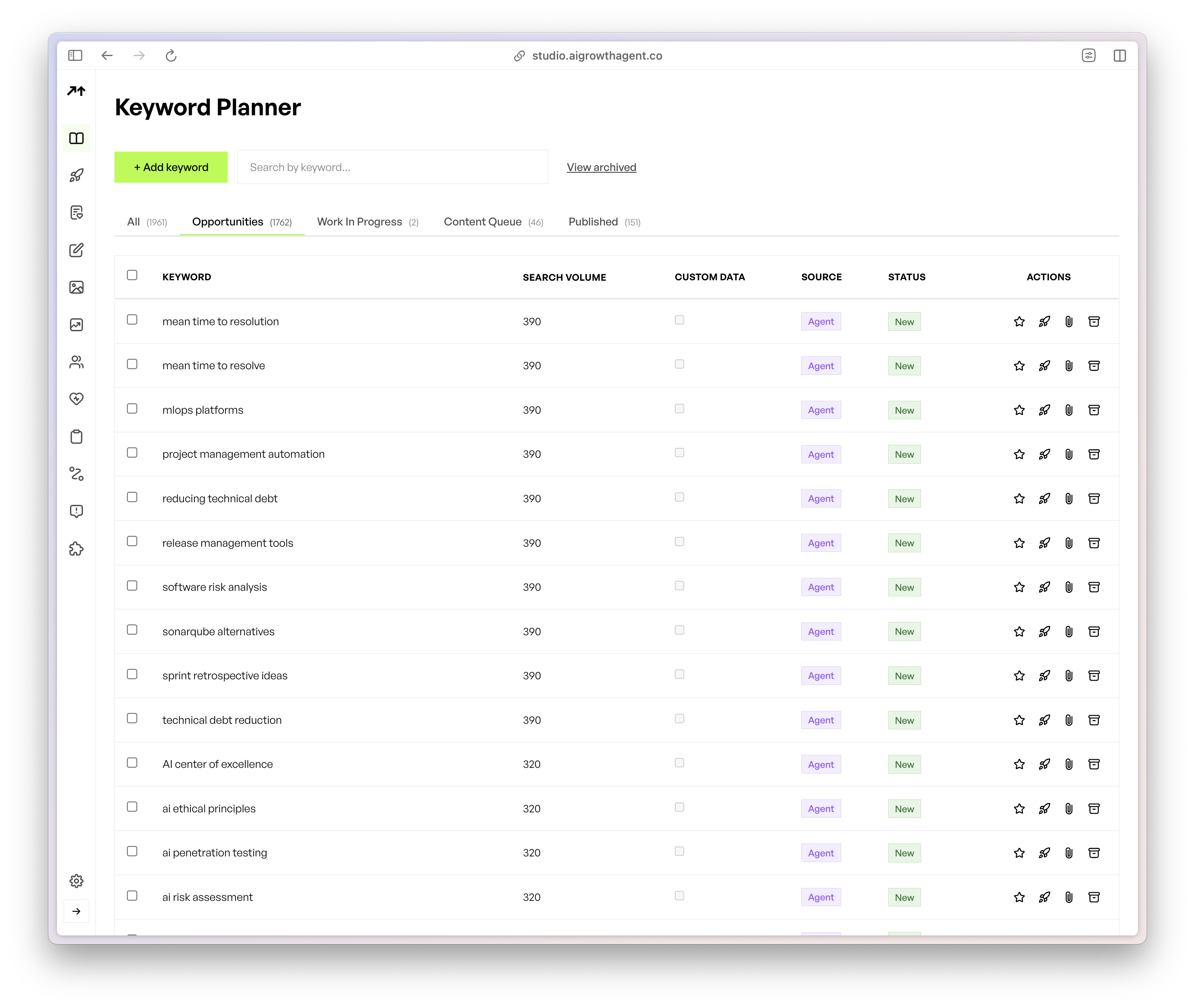
AI Growth Agent automates the SEO lifecycle, from large-scale keyword discovery to content briefs, drafting, optimization, and publication. Teams can move from kickoff to the first programmatically engineered article in about a week, with onboarding that sets guardrails for voice, priorities, and brand rules.
The agent processes large keyword sets, groups them into programmatic strategies, and executes content workflows without requiring line-by-line human intervention. That approach supports consistent publishing cadences that match how quickly AI search evolves.
Technical Infrastructure for AI Indexing
The platform includes blog architecture tuned for crawling, advanced LLM.txt implementation, and an MCP integration that clarifies content for AI engines. Schema markup and metadata come standard, which supports precise entity recognition and improves the odds of AI citation.
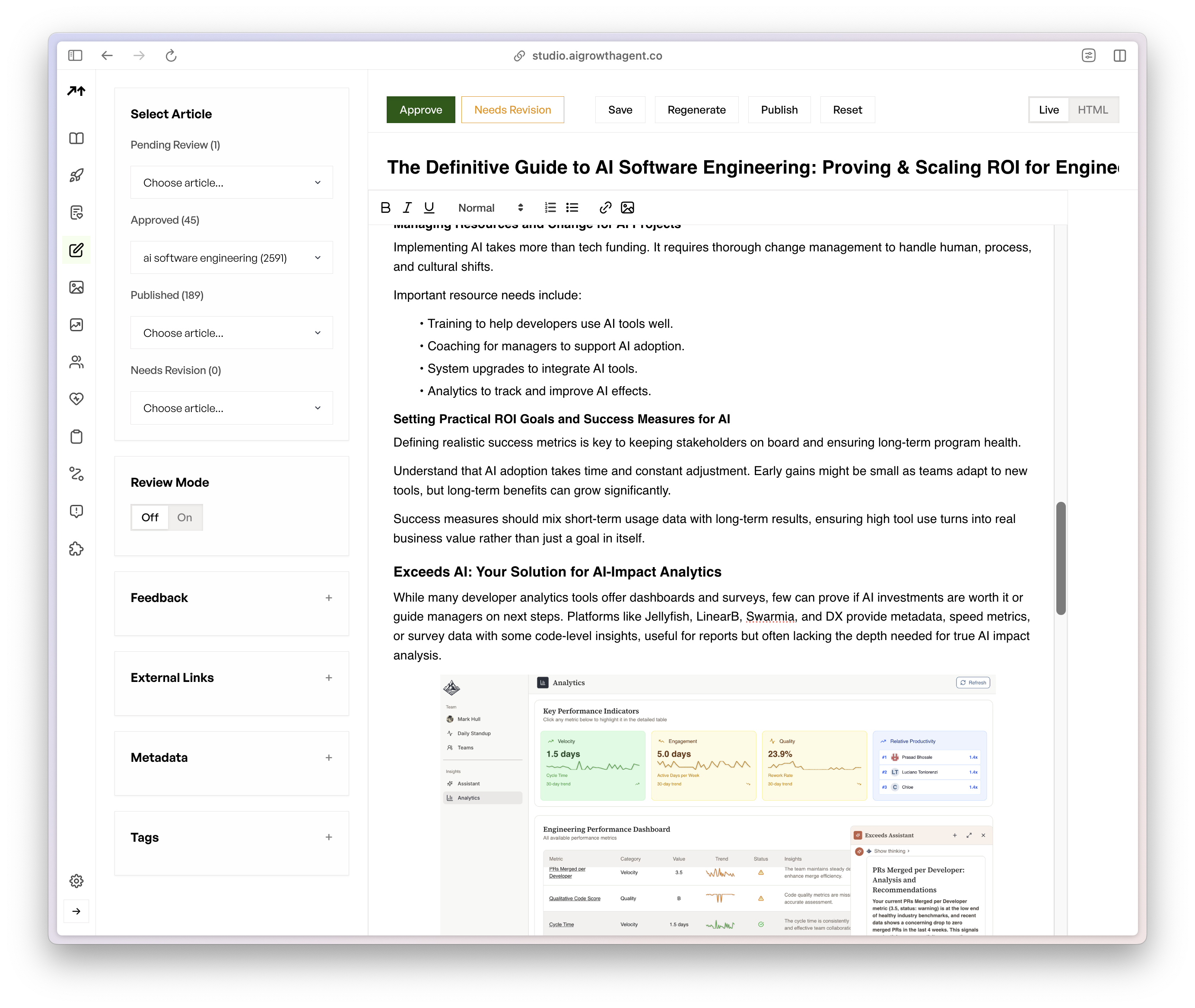
Each article receives structured data, image tags, and metadata automatically. That consistency gives AI systems clearer signals about topics, relationships, and intent across your entire content library.
Real-Time Monitoring and Feedback
The AI Search Monitor and feedback loop track how content performs across ChatGPT, Gemini, and Perplexity. Exceeds AI, for example, reached Perplexity recommendations within two weeks of programmatic deployment, illustrating how fast well-structured content can gain traction.
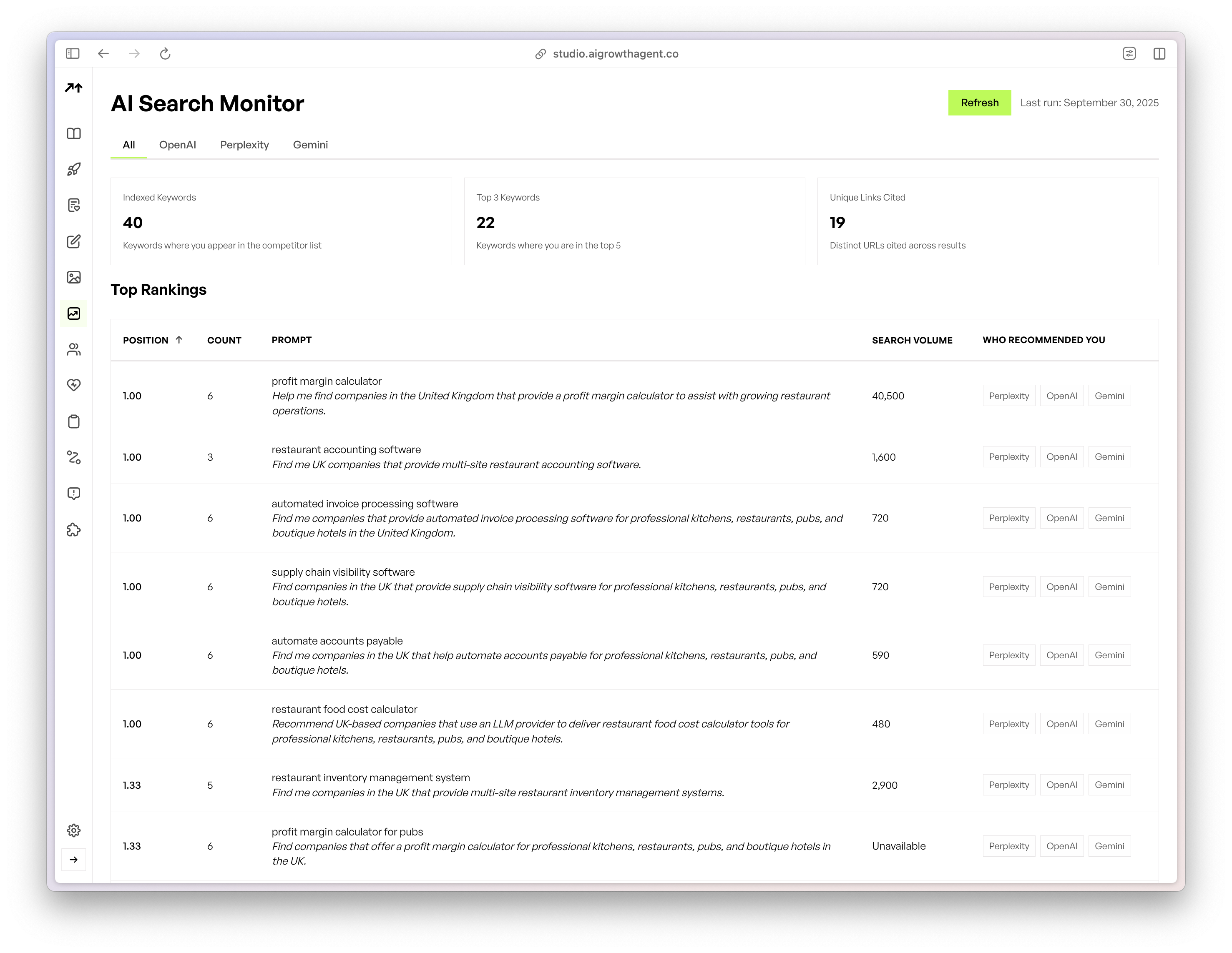
The platform surfaces which pages AI agents reference, which queries they answer with your content, and where gaps remain. Teams can then adjust topics and templates without rebuilding tracking from scratch.
Multi-Tenant Deployment for Enterprise Scale
AI Growth Agent runs multiple Programmatic SEO Content Agents from a single interface. Enterprise teams can manage distinct brands or product lines with separate keyword strategies and tones while sharing the same technical infrastructure.
This multi-tenant approach helps maintain brand consistency, reduce duplicated work, and scale AI search coverage across complex portfolios.
You can see these workflows and controls in action in a personalized AI Growth Agent demo.
Comparative Analysis: Speed and Performance Across Approaches
|
Performance Factor |
Traditional SEO Agency |
Internal Marketing Team |
AI Growth Agent |
|
Content Production Speed |
1–2 articles per month |
Variable, limited by staff time |
Programmatic, daily publishing potential |
|
Technical SEO Implementation |
Manual and incremental |
Often constrained by engineering |
Autonomous and standardized |
|
AI Search Optimization |
Focus on classic rankings |
Minimal AI-specific tactics |
MCP, LLM.txt, and schema by design |
|
Scalability Potential |
Tied to billable hours |
Constrained by internal bandwidth |
Built for high-volume execution |
|
Real-Time Adaptation |
Quarterly or monthly updates |
Manual monitoring and reactions |
Continuous monitoring and adjustment |
|
Multi-Brand Management |
Separate scopes and contracts |
Complex and hard to coordinate |
Unified multi-tenant platform |
|
AI Performance Monitoring |
Limited tools and reporting |
Little or no AI-specific tracking |
Dedicated AI search analytics |
|
Content Authority Building |
Slow, low-volume growth |
Inconsistent pipeline |
Systematic, high-volume coverage |
Conclusion: Build AI Search Authority with Programmatic SEO
Speed and performance in AI search now function as core requirements for enterprise marketers, not optional optimizations. Automation has become the baseline for technical fixes and content production, which makes programmatic SEO central to staying competitive in 2026.
AI Growth Agent focuses on velocity, structure, and measurement so your content is easier for AI systems to find, understand, and cite. Exceeds AI, for example, saw Perplexity recommendations within two weeks and Google AI Overview visibility within three weeks of programmatic rollout, while BeConfident gained a leading position for English learning apps in Brazil through Google AI Overview within weeks of publication.
Enterprise brands with a strong foundation and clear category focus can use AI Growth Agent to extend that position into AI-driven search. If your team wants to evaluate whether programmatic SEO is a fit, book a strategy session to review your current AI search footprint and see how the agent could improve speed and performance.
Frequently Asked Questions: AI Search Performance
How do AI performance metrics differ from traditional SEO metrics?
AI performance metrics measure how AI systems interpret and reuse your content, not just where pages rank. AI Presence Rate tracks how often you appear in AI answers, Citation Authority tracks how often AI links to you, and Share of AI Conversation shows your share of AI discussions against competitors.
Why are Core Web Vitals and structured data so important for AI search speed?
Technical fundamentals determine how quickly AI agents can crawl and interpret your site. Strong Core Web Vitals and clear schema markup let AI systems process more pages in less time and understand entities and relationships more accurately, which improves both visibility and citation quality.
Can generic AI writing tools match programmatic SEO platforms for AI search performance?
Generic AI tools generate text but usually lack integrated schema, LLM.txt management, MCP support, and automated publishing. That gap leaves teams handling strategy and technical tasks manually, which limits scale compared with a programmatic SEO platform that automates those layers.
How quickly can enterprises see AI search visibility gains with a programmatic approach?
Programmatic SEO can produce visible AI search wins within weeks when foundations are in place. Exceeds AI reached Perplexity recommendations in about two weeks and Google AI Overview rankings in about three weeks, and BeConfident gained prominent Google AI Overview placement within a similar window.
What makes programmatic velocity a competitive advantage in AI search?
AI systems favor fresh, consistent, and well-structured content. Programmatic velocity keeps new, technically optimized pages entering the index, which builds a dense footprint of data points that AI models can reference. Brands that cannot sustain this pace risk fading from AI-generated answers over time.