


Written by: Mariana Fonseca, Editorial Team, AI Growth Agent | Last updated: January 10, 2026
Key Takeaways
- AI search engines now act as primary discovery channels, so brands need content that is easy for models like ChatGPT, Google AI Overviews, and Perplexity to cite and recommend.
- Programmatic SEO provides the scale and structure required to publish consistent, authoritative coverage across entire topic clusters, which strengthens AI citation patterns over time.
- Citation-worthy content depends on clear E-E-A-T signals, strong semantic structure, and machine-readable data, not only on traditional metrics such as keyword density and backlinks.
- Brands that rely only on manual content production, traditional agencies, or basic AI tools risk losing control of their narrative as AI engines default to citing better-structured competitor content.
- AI Growth Agent helps brands operationalize programmatic SEO for AI search, and you can see the approach in practice by scheduling a live demo.
The Problem: Why Your Digital Footprint is Shrinking in the AI Search Era
The New AI Search Reality: From Rankings to Citation
AI search engines prioritize citation and recommendation instead of simple rankings. Content credibility, author expertise, and consistent cross-references now play a central role in which pages appear in AI-generated answers.
AI systems favor authoritative sources, clear structure, and direct responses. Content must pass a practical citation test, where models can confidently quote and attribute specific passages as reliable information.
The Programmatic Velocity Dilemma: Drowning in AI-Generated Content
Content volume has increased rapidly as AI tools accelerate publishing. Millions of new pages appear every day, which creates a strong signal-to-noise challenge for both search crawlers and LLMs.
Programmatic velocity now acts as a baseline requirement. Brands that publish only a few manual articles each month struggle to compete with those that ship structured, authoritative content at scale across every relevant topic.
The Consequence: If You Do Not Define Your Brand, Competitors Will
Gaps in your content footprint give competitors room to define the category. When AI systems cannot find enough authoritative material from your domain, they turn to alternative sources and begin citing those brands instead.
Over time, AI engines develop trust patterns around consistent, high-quality sources. Once competitors occupy that space, breaking into preferred citation sets becomes significantly harder.
Why Current Solutions Fall Short in the AI Search Context
Traditional SEO teams and agencies can struggle to match the speed, coverage, and technical precision that AI search now demands. Manual workflows rarely scale to the thousands of pages required for full topic coverage and structured experimentation.
Internal marketing teams often lack engineering resources for tasks such as automated schema, internal-link mapping, and LLM-facing documentation. Basic AI writing tools output text but usually require heavy manual effort for formatting, optimization, and publishing.
The Solution: Programmatic SEO for Reliable AI Authority and Citation
What Programmatic SEO (pSEO) Means for AI Search
Programmatic SEO applies automated content engineering to generate structured, optimized pages at scale. The goal is to create a consistent, machine-readable content layer that AI engines can easily parse, quote, and map to user intent.
Technical elements such as semantic HTML, schema markup, and organized topic taxonomies give LLMs a clear picture of your expertise. This approach solves the tension between volume and quality by systematizing the patterns that make content citation-worthy.
Key Pillars of a Citation-Ready pSEO Strategy
- E-E-A-T and domain authority: Content should show clear expertise, real-world experience, and trustworthy sourcing. Comprehensive pages that fully address user intent tend to earn more AI citations than thin or fragmented content.
- Semantic structure and machine readability: Clean headings, logical sections, and structured data help AI crawlers and models understand entities, relationships, and context on each page. Frameworks such as LLM.txt files and Model Context Protocol can expose your content more directly to AI systems.
- Topical clustering and internal links: Dense clusters of related pages signal depth of knowledge. Smart internal linking demonstrates coverage across a topic area and positions your domain as a broad reference point rather than a single isolated article.
- Answer-first and conversational alignment: An inverted pyramid structure, where the main answer appears near the top, makes it easier for AI models to extract quotable passages. Content that mirrors how people phrase questions to AI systems improves relevance.
Request a walkthrough to see how pSEO can position your brand as a default AI citation source.
How AI Growth Agent Supports Programmatic AI Search Optimization
AI Growth Agent operates as a programmatic SEO agent that designs, builds, and maintains large-scale content architectures for AI search. The system focuses on technical clarity, topical depth, and ongoing monitoring of how AI engines reference your domain.
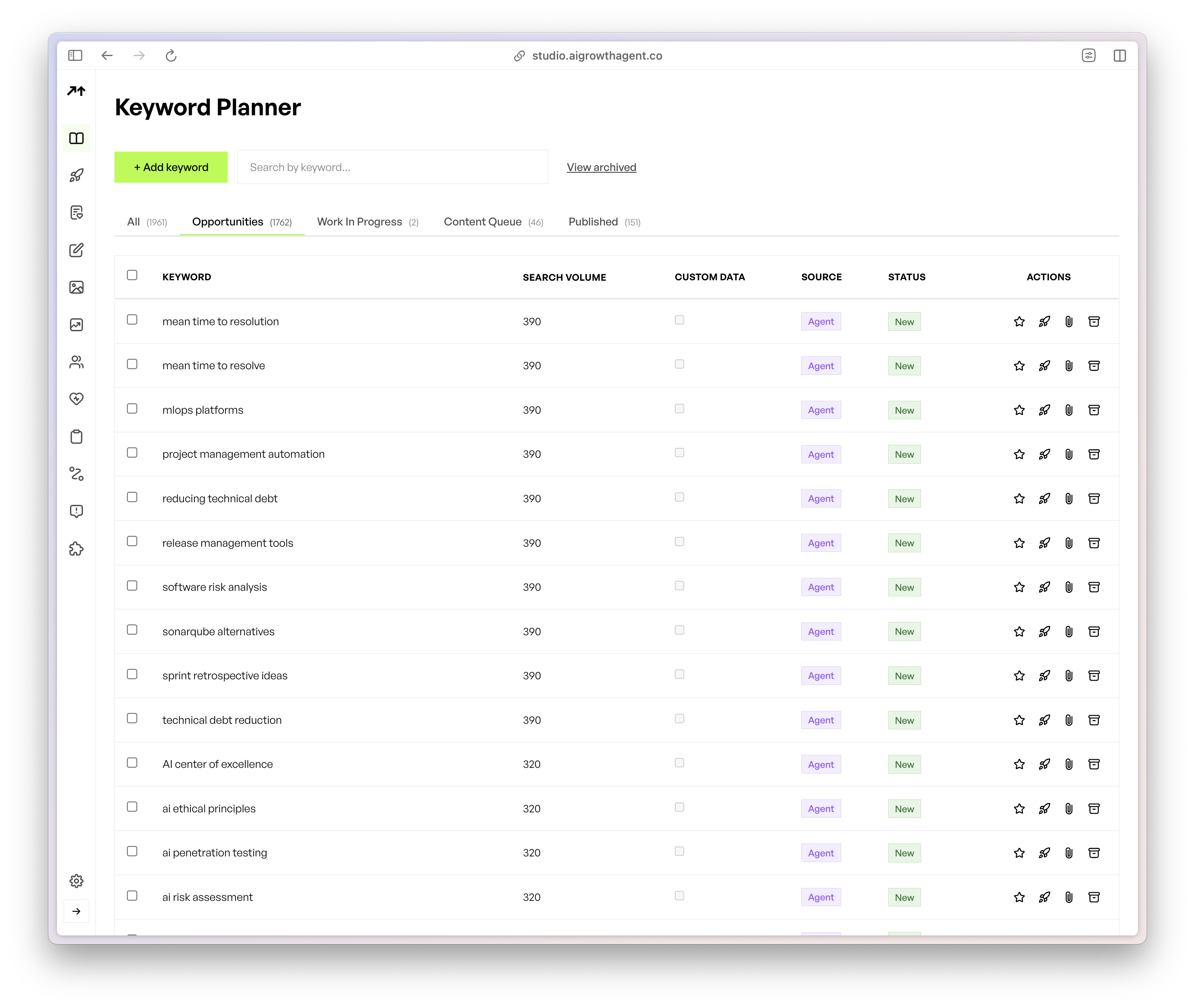
How AI Growth Agent Engineers AI Citation and Recommendation
- Automated content architecture: The platform deploys optimized content hubs as branded subdomains with clean technical foundations, including schema markup, LLM.txt files, and Model Context Protocol to guide AI understanding.
- Programmatic keyword and content research: The agent evaluates large sets of relevant queries and organizes them into pillars and clusters. Each article targets a clear AI search opportunity within that structure.
- Autonomous technical implementation: Metadata, structured data, internal links, and image optimization are handled programmatically so every page ships with consistent technical quality.
- Rapid content generation from signals: Teams can submit inputs such as trending news or proprietary datasets, and the agent produces optimized articles that reflect the brand perspective while aligning with AI search patterns.
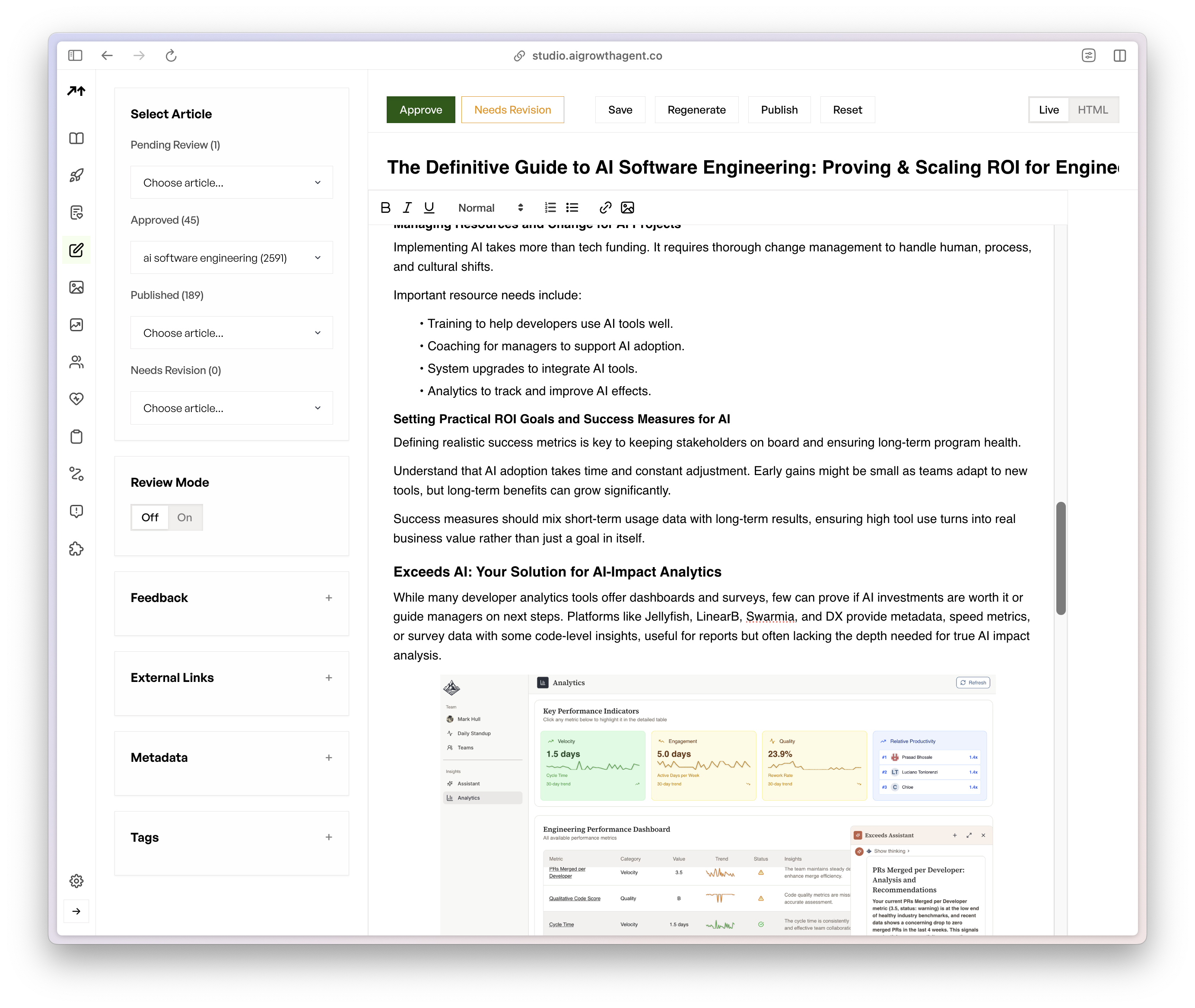
Capabilities That Help Build Authority in AI Search
- Multi-tenant programmatic deployment: Enterprises can manage separate pSEO strategies for multiple brands, regions, or product lines from one interface, each with tailored voice and keyword focus.
- AI search monitoring and feedback: The platform tracks citations across ChatGPT, Google AI Overviews, and Perplexity, then ties those signals to specific URLs and topics. Integration with Google Search Console helps teams connect AI visibility with organic traffic performance.
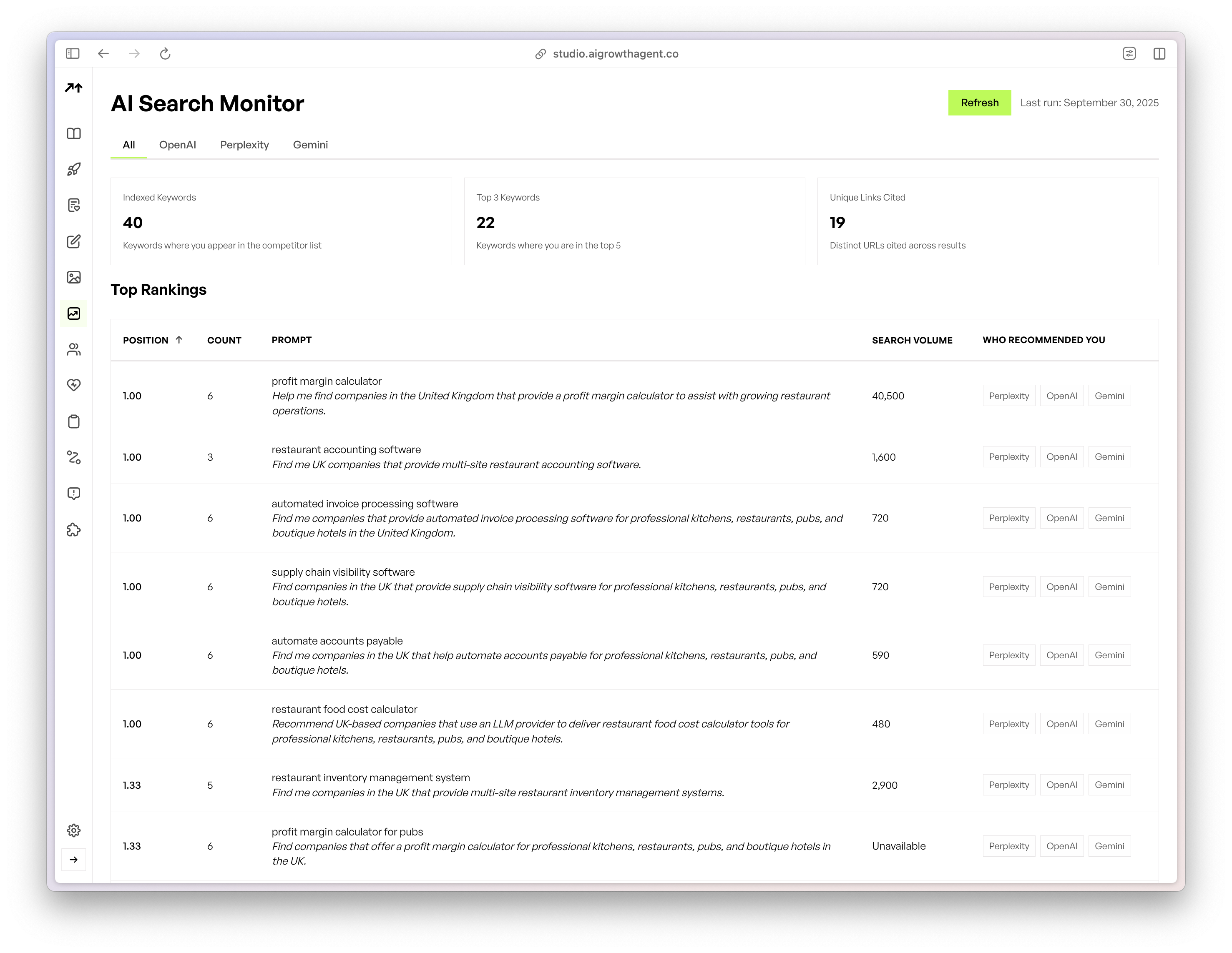
AI Growth Agent Compared with Manual SEO Approaches
|
Feature or Benefit |
AI Growth Agent |
Traditional SEO Agencies |
Basic AI Content Tools |
|
Content output scale |
Programmatic, high-volume production with consistent structure |
Manual production limited by team size |
Ad hoc text generation with manual prompts |
|
Technical SEO implementation |
Automated schema, LLM.txt, MCP, metadata, and internal links |
Partially manual and variable across clients |
Minimal technical support, handled by users |
|
AI citation focus |
Explicit optimization for LLM parsing and quotation |
Primary focus on traditional search rankings |
Generic text without AI search targeting |
Schedule a demo to see how AI Growth Agent structures content for AI search performance.
Success Stories: Brands Advancing in AI Search with AI Growth Agent
Exceeds AI saw Perplexity recommend the product as a leading alternative within two weeks, and Google AI Overview snapshots began surfacing the brand for core keywords shortly after.
BeConfident entered a competitive language-learning market and gained rapid indexing through programmatic publishing, then earned top recommendations in Brazil from Google AI Overview and Gemini.
Bucked Up implemented programmatic SEO and, within weeks, appeared as a primary citation in ChatGPT responses for protein soda searches, alongside larger incumbents.
Gitar.ai became a frequent citation for AI-powered CI or CD automation queries in under two months, with consistent mentions across Google AI Overview, ChatGPT, and Perplexity.
Frequently Asked Questions About AI Search and Citation
How do AI search engines determine content authority for citations?
AI models look for strong E-E-A-T signals, clear attribution, supporting evidence, and structural consistency. Content that covers topics in depth and offers direct, organized answers is more likely to be cited.
Is optimizing for AI search the same as traditional SEO rankings?
Foundational SEO still matters, but AI search optimization places more weight on machine readability, conversational relevance, and answer quality than on keyword density or raw backlink counts. The focus shifts from ranking positions to being reliably quotable.
What role does structured data play in AI search citation?
Structured data and schema markup help AI systems interpret entities and relationships on a page, which improves summarization and citation accuracy. Implementations such as LLM.txt and Model Context Protocol provide additional clarity for models.
How can I measure my content performance in AI search citations?
Measurement involves tracking how often AI platforms reference your brand, which topics trigger those citations, and which URLs receive the most visibility. Pairing these insights with traffic and engagement metrics shows where programmatic SEO is working and where gaps remain.
Why is programmatic velocity essential for AI search success?
AI systems reward fresh, comprehensive, and consistently updated content. Programmatic velocity allows brands to publish enough high-quality pages to establish and maintain topical authority, even as new competitors and queries emerge.
Conclusion: Secure Your Authority in the AI-Powered 2026 Landscape
AI-driven search now shapes how audiences discover brands, evaluate solutions, and compare competitors. Manual publishing and legacy SEO processes rarely provide the scale or structure needed to stand out in AI-generated answers.
AI Growth Agent offers a programmatic approach that aligns content creation, technical SEO, and AI search monitoring. The result is a durable content architecture that supports ongoing citation and recommendation from major AI engines.
Brands that act now can define their category narrative for 2026 and beyond. Schedule a strategy session with AI Growth Agent to assess fit, review your current AI search footprint, and plan a programmatic SEO roadmap.
