Written by: Mariana Fonseca, Editorial Team, AI Growth Agent | Last updated: January 10, 2026
Key Takeaways
- AI search in 2026 rewards brands that target topics, entities, and user intent rather than chasing single high-volume keywords.
- Programmatic SEO depends on keyword tools that can cluster thousands of terms, expose content gaps, and support scalable content architectures.
- Multimodal and AI-generated results require keyword research that anticipates conversational queries, AI Overviews, and AI-specific SERP behavior.
- Real-time insight into AI visibility, trends, and citations now matters as much as traditional metrics like search volume and difficulty.
- Marketing leaders gain the most leverage by pairing an AI keyword finder with a programmatic platform like AI Growth Agent; schedule a demo to see how this works in practice.
1. Prioritize Topics, Entities, and Intent Over Single Keywords
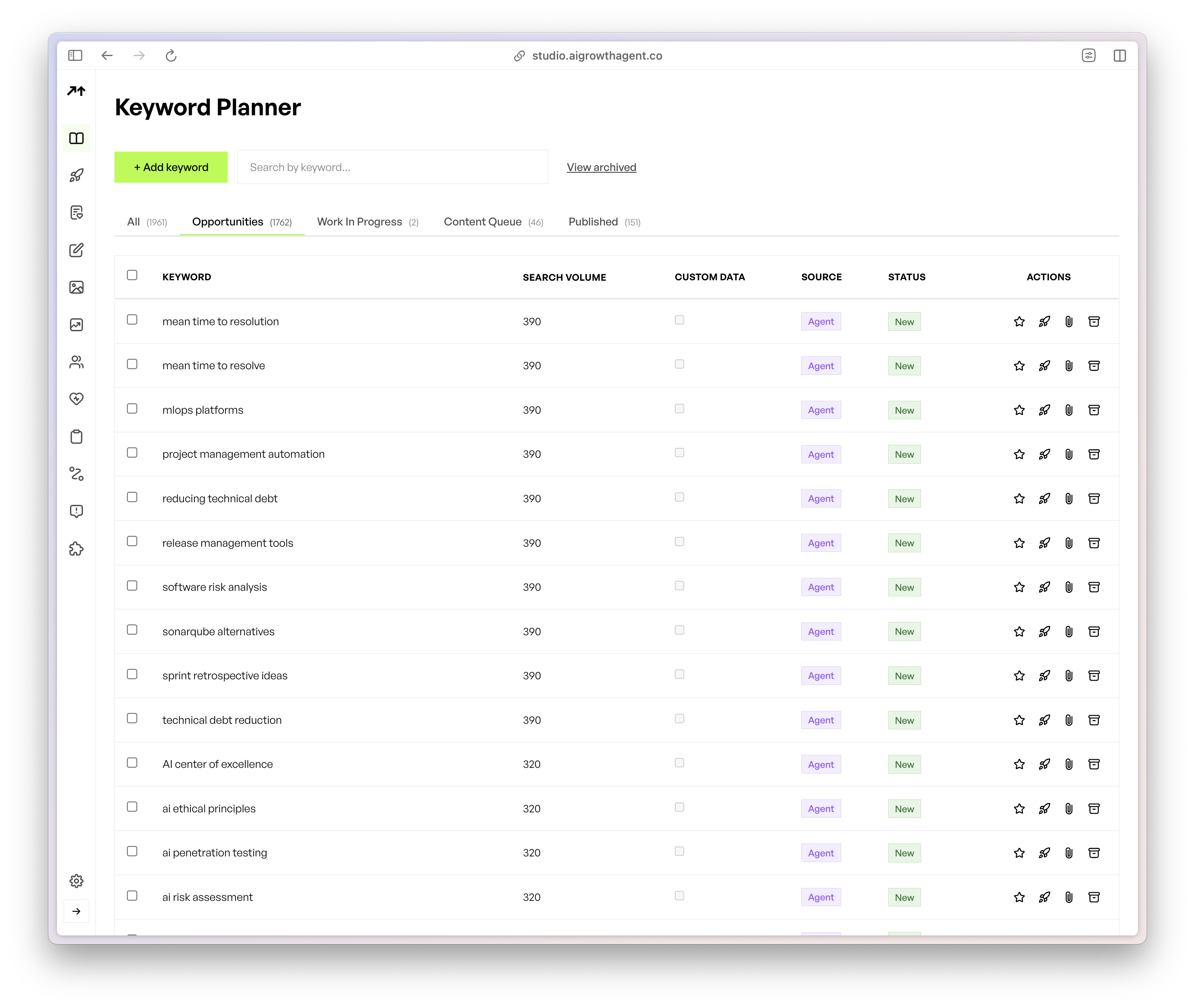
Effective AI keyword finders organize search behavior around topics, entities, and intent, not isolated terms. This approach aligns with how AI systems evaluate context and topical authority across the web.
Marketing leaders benefit from tools that parse full questions and conversational searches, then group them into semantic clusters. This supports content architectures that answer related queries across a topic, which makes content more likely to appear in AI-generated answers and summaries.
AI-first keyword research emphasizes topics, entities, intent, and omnichannel authority across Google, ChatGPT, and Perplexity. Modern AI tools also enable deeper intent analysis and topic modeling, rather than stopping at search volume.
|
Feature/Metric |
Traditional Keyword Research |
AI-First Keyword Research |
|
Focus |
Individual exact-match keywords |
Topics, entities, intent, and clusters |
|
Search Queries |
Short, head terms |
Conversational, question-based, long-tail |
|
Key Metrics |
Search volume, difficulty |
Intent, topical authority, AI citation potential |
|
Content Goal |
Rank for keywords |
Be cited and recommended by AI |
2. Support Programmatic Content Architectures and Scale
Programmatic SEO depends on keyword data that scales. A suitable AI keyword finder clusters thousands of related terms, surfaces patterns, and highlights gaps that can feed automated content workflows.
Teams gain leverage when keyword outputs map directly into content pillars, subtopics, and page templates. This structure gives systems like AI Growth Agent the raw material to generate and optimize large volumes of consistent, interlinked content.
AI keyword generators already apply machine learning to automate large-scale keyword research. These tools can cluster extensive keyword sets into actionable topic groups that align with programmatic content architectures.
3. Address Multimodal Search and AI-Specific SERP Features
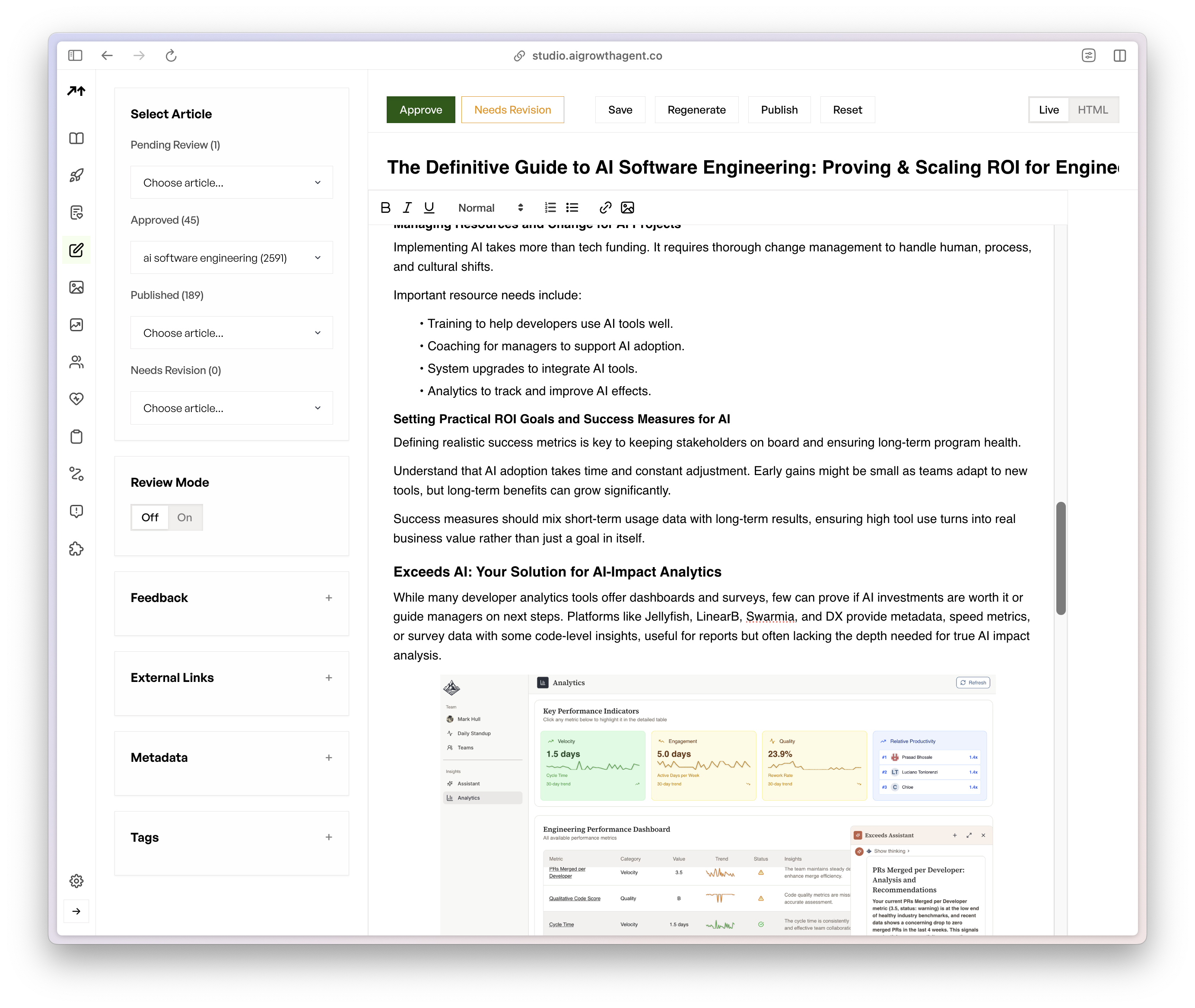
AI-driven results now blend text, tools, and visual assets. Keyword finders need to reflect this by revealing opportunities for assets like calculators, templates, and imagery that reinforce topical authority.
Strong tools highlight conversational, question-based queries that mirror how people prompt AI assistants. This helps teams create content that AI can summarize, cite, or adapt across surfaces such as AI Overviews, answer boxes, and chat-style responses.
AI Overviews and similar features reduce some traditional click-through, so marketing leaders now plan for citation potential and presence in summaries, not just blue-link rankings. AI search is already shifting behavior toward longer, more complex, conversational queries. Multimodal exploration also pushes keyword research beyond simple text strings toward richer entity- and intent-based mapping.
4. Provide Real-Time Insights into AI Visibility and Trend Signals
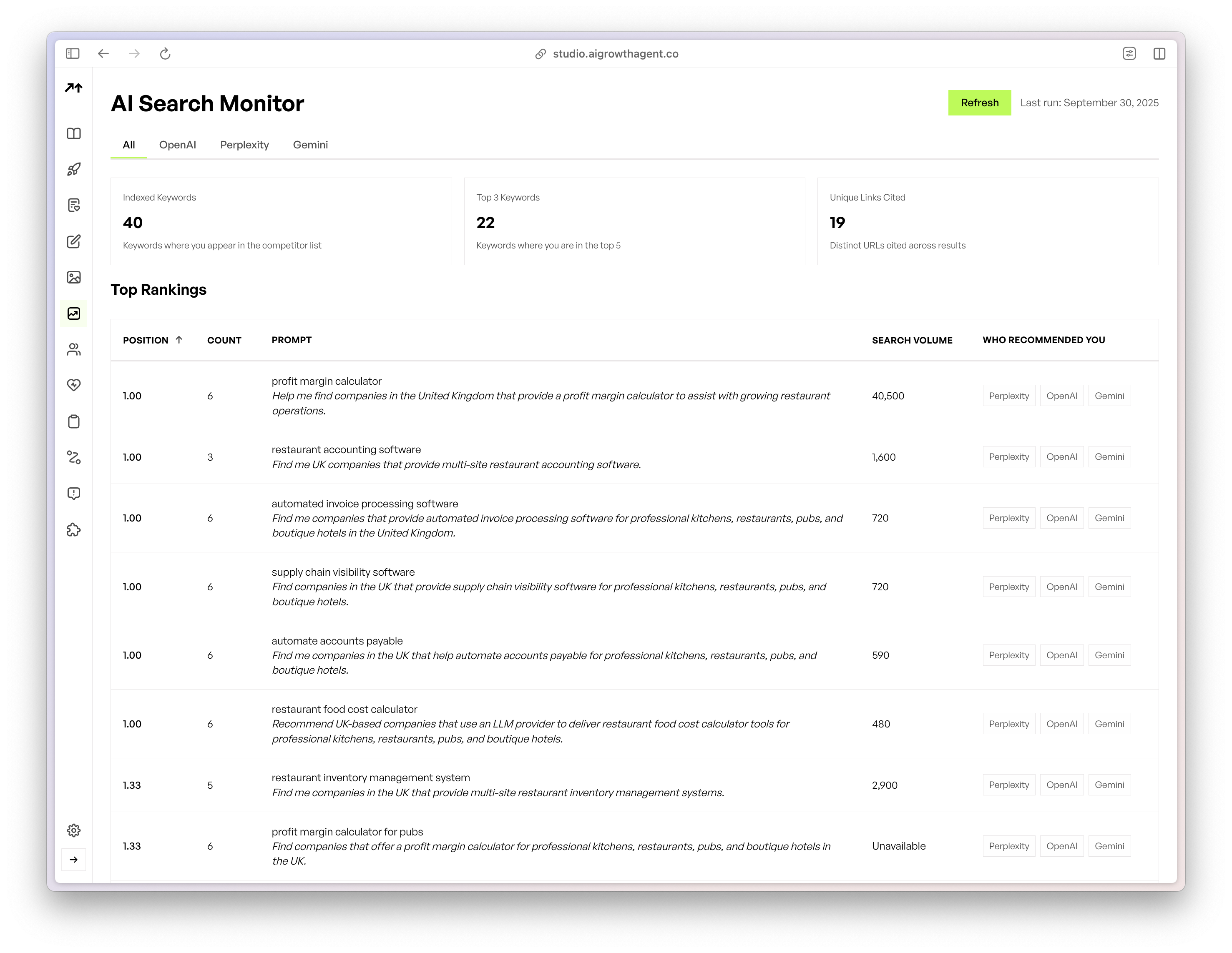
Static metrics alone do not support AI-era SEO decisions. Effective keyword finders combine volume and difficulty with trend data, SERP volatility, topical authority, and AI visibility indicators.
Teams that monitor how often a brand appears or is cited in AI-generated answers can react faster and allocate effort to topics where authority is emerging. Real-time data on rising themes and news-driven spikes also enables rapid content deployment while demand is still developing.
Modern AI-first keyword workflows layer intent, topical authority, volatility, and trend signals on top of legacy metrics. Marketers also benefit from tracking visibility across AI search surfaces, including citations within AI-generated responses.
5. Integrate with a Full-Stack Programmatic SEO Solution like AI Growth Agent
Keyword research delivers the most value when it connects directly to execution. An AI keyword finder that integrates with full-stack programmatic SEO lets teams move from insight to live content with minimal manual work.
This type of integration routes clusters and entities into content generation, on-page optimization, internal linking, and publishing workflows. Marketing leaders then rely less on separate technical SEO resources and more on a coordinated system that handles schema, site structure, and ongoing updates.
AI now supports the entire SEO workflow, from keyword clustering to content optimization. Generative Experience Optimization encourages a shift toward integrated content strategies tuned for AI-generated experiences, which is where platforms like AI Growth Agent provide an advantage.
Conclusion: The Foundation for AI Authority
The choice of AI keyword finder has become a strategic decision for brand visibility in AI-driven discovery. Tools that emphasize topics and entities, scale with programmatic architectures, reflect multimodal and AI-specific SERP behavior, and expose real-time AI visibility signals position marketing teams for durable authority.
Pairing those capabilities with AI Growth Agent turns keyword data into an operational content engine that can publish, monitor, and refine at scale. Schedule a demo with AI Growth Agent to evaluate whether this approach fits your growth goals.
Frequently Asked Questions (FAQ)
What is the biggest difference between traditional keyword research and AI-first keyword research?
Traditional keyword research focuses on individual terms, exact matches, and search volume within a single search engine. AI-first keyword research emphasizes topics, entities, and user intent across multiple AI surfaces, including chat interfaces and AI Overviews. It groups related conversational queries into clusters to help content appear in AI-generated answers, not only in classic organic listings.
How does AI Growth Agent leverage keyword finder insights for programmatic SEO?
AI Growth Agent ingests structured keyword and topic outputs from compatible tools and uses them to configure its pSEO Content Agent. This agent builds content plans around clusters and entities, then writes, optimizes, and publishes pages that match those structures. The result is a programmatic content system aligned with AI search behavior and citation patterns.
Why are citation potential and AI visibility more important than traditional ranking in AI search?
AI-generated summaries often sit between users and traditional search results. When those summaries cite or mention a brand, users may form an opinion before visiting any site. Citation potential and AI visibility describe how likely a brand is to appear in those responses and how prominently it is referenced, which makes them critical indicators for influence in AI-first discovery.
Can a basic AI content tool substitute a sophisticated keyword finder for AI search optimization?
Generic AI writing tools produce text but usually lack structured keyword research, clustering, and technical SEO guidance. They do not provide systematic topic coverage, schema recommendations, or monitoring of AI visibility. A dedicated keyword finder, paired with a platform like AI Growth Agent, supports an end-to-end strategy that basic tools alone do not offer.
What new metrics should marketing leaders track when evaluating keyword finder performance in 2026?
Marketing leaders can expand their dashboards to include AI presence rate, citation authority, share of AI conversation, and response-to-conversion velocity. These metrics describe how often a brand appears in AI-generated answers, how authoritative it seems within those responses, and how efficiently that exposure converts into measurable outcomes across channels.