


Marketing leaders at premium brands face a pressing issue. AI search engines are changing how authority is defined and content is found, shrinking your digital presence every day. Traditional SEO tactics, like focusing on keywords and backlinks, no longer work as AI platforms such as ChatGPT, Gemini, and Perplexity create answers from various sources. If your brand doesn’t have enough high-quality content, AI will point to competitors, positioning them as the trusted voice for your potential customers. To regain control and ensure AI recommends your company, you need a tech-driven strategy to produce the volume and quality of content necessary to stand out.
Why Your Digital Presence Is Shrinking in the AI Search Era
AI Search Redefines Authority
AI search engines like ChatGPT, Gemini, and Perplexity pull from multiple sources to answer queries, moving away from traditional keyword and backlink rankings. This change makes old SEO methods less effective. Instead, brands must prioritize Generative Engine Optimization (GEO), which values mentions, contextual relevance, and presence in credible sources over top-page rankings.
When a customer asks an AI tool for solutions in your field, it doesn’t list websites. It combines data into a single response. If your content isn’t seen as authoritative, you’re left out, making you invisible in a high-stakes, winner-takes-all environment where only the strongest voices are cited.
Authority now means more than domain scores or backlinks. AI evaluates content based on expertise depth, citation by trusted sources, real-world reputation, and unique insights. Brands adapting to these signals will lead their markets, while those stuck on old tactics risk fading away.
Why Traditional Content Tactics Don’t Work Anymore
Older content strategies aren’t just falling short. They can hurt your visibility. AI search engines downrank keyword stuffing, weak links, and manipulative content, favoring genuine authority and value. Many marketing teams see their SEO efforts losing impact as a result.
SEO agencies, limited by hourly billing and staff capacity, often produce only a few strong pieces monthly. They can’t keep up with the daily output needed for AI relevance. Internal teams also struggle, stretched thin by limited resources and lacking the technical skills for AI-specific adjustments.
Basic AI writing tools create content fast, but the results often feel generic and miss your unique brand tone or deep industry knowledge. This leaves marketing teams to handle strategy, editing, and publishing, leading to low-value content that AI engines reject rather than promote.
The core problem lies in scale and quality. What used to require occasional updates now demands daily, authoritative content that shows real expertise and offers fresh value to users.
What Happens If You Don’t Act
Not adapting to AI search has serious consequences. When AI lacks strong content from your brand, it doesn’t just skip you. It recommends competitors instead. This snowballs as rivals gain visibility and take market share from those who don’t adjust.
Think about the impact on customers. If an AI tool answers a query with detailed responses citing competitors while ignoring your brand, it’s more than a missed chance. It harms your market standing. AI recommendations carry a sense of objectivity, making them more influential than ads or personal referrals.
Daily high-quality publishing is now the standard for AI models, which prioritize fresh, in-depth, and consistent content. Brands posting sporadically fall far behind competitors who publish regularly to show ongoing thought leadership.
Time is running out. As more companies focus on AI search, the content needed to stand out will grow. Acting early builds a strong advantage, while waiting makes it harder to catch up in a crowded, costly space.
How to Build Strong Content Authority for AI Search
What High-Quality Content Means for AI
High-quality content has a new definition in the AI age. AI values depth, clarity, usefulness, and current information, requiring regular updates to stay credible. Shallow posts aimed at keyword ranking don’t cut it anymore. AI rewards detailed content with unique insights and clear expertise.
Following E-E-A-T guidelines, which stand for Experience, Expertise, Authoritativeness, and Trustworthiness, is essential for user value and AI trust. Originally a Google concept, this framework matters more with AI, which quickly judges source reliability for responses.
Experience shows in firsthand knowledge. AI can tell if content reflects real practice or just rehashes others’ ideas. Expertise means specialized insight beyond basics. Authoritativeness comes from external validation, like citations from respected sources. Trustworthiness ties to accuracy and clear messaging.
Content must also fit conversational queries and semantic search. Users ask AI complex questions, and content answering these fully gains an edge in citation. To build authority, your content needs to meet these standards. Schedule a demo to explore how autonomous platforms can help.
Key Factors for AI Search Authority
Focusing on Context and Citation Value
Content must prioritize authority, relevance, frequent citations by others, and alignment with trusted sources. Moving from keywords to contextual value is one of the biggest shifts in digital marketing.
Relevance isn’t just mentioning terms. It’s about covering topics users care about with depth and insight. AI looks at analysis quality, evidence, and originality to gauge expertise.
Citation value matters most. AI prioritizes sources often referenced by other credible sites. This creates a cycle: authoritative content gets cited more, boosting recognition by AI. To achieve this, offer unique research or perspectives others want to reference.
Technical SEO for AI Discovery
Technical SEO, like schema markup and structured content, boosts chances of AI citation. Yet, AI-focused optimization goes beyond standard practices with tools built for discovery.
Success now requires structured data, conversational formatting, and human oversight alongside tech. Schema markup clarifies content context for AI, increasing citation likelihood.
Semantic headings organize content for easy parsing. Descriptive headings signal key topics. Structured lists, tables, and FAQs help AI extract answers directly. Advanced tools like LLM.txt files guide AI crawlers, while Model Context Protocols enable direct system communication for better indexing.
Authenticity and Industry Standing
Authority comes from third-party mentions, speaking roles, and social proof, valuing real-world reputation over digital metrics. This moves away from old SEO scores to true industry impact.
Reputation includes awards, conference talks, media features, and research citations. AI detects these signals and weighs them heavily. Mentions from credible sources boost how AI views your standing. Social proof now means quality engagement on professional platforms and recognition in industry discussions.
Why You Need a Scalable Content System
AI search demands a new way to create content. Traditional methods, whether through agencies or internal teams, can’t match the needed volume and quality. Basic AI tools fall short too, lacking depth and strategy.
An autonomous content platform meets these challenges. It uses AI agents to work nonstop, producing high-quality content at a rapid pace. Unlike human-dependent models, it handles research, planning, writing, optimization, and publishing in minutes.
This scalability allows strategies impossible before. Brands can manage multiple topics, respond to trends instantly, and cover their industry broadly, outpacing rivals stuck with slower methods.
Using Autonomous Platforms to Strengthen AI Search Authority
Breaking Free from Old Content Limits
Traditional content creation struggles in the AI era. SEO agencies, bound by human hours, can’t publish daily at the quality needed. Costs for such output would be too high, even for large firms.
Internal teams know their brand but lack staff and AI-specific skills for optimizations like schema markup or LLM.txt files. Basic AI tools scale output but produce generic content, leaving strategy and edits to busy teams.
Autonomous platforms overcome this by using AI agents that work without limits. They blend strategic insight with relentless execution, scaling infinitely while keeping content aligned with your brand.
Essential Features of Modern Content Platforms
Advanced autonomous platforms offer specific tools for AI search success. Key capabilities include:
- Deep analysis of search queries to build targeted content strategies.
- Full content creation, from research to publishing, optimized for AI citation.
- Automatic technical SEO, including schema markup and AI communication protocols.
- Tracking of AI citations and content performance across platforms.
- Handling multiple content streams and reacting to trends in real time.
- Using proprietary data to create unique, traffic-driving content.
Comparing Autonomous Platforms to Traditional Methods
| Feature/Aspect | Traditional SEO Agencies | Basic AI Content Tools | Autonomous Content Platforms |
|---|---|---|---|
| Content Volume & Speed | Low to Moderate, Slow | Moderate, Repetitive | High Scale, Fast |
| Content Quality & Authority | Variable, Human-Dependent | Often Low, Generic | High, Brand-Specific |
| Technical SEO for AI | Manual, Limited | Minimal Focus | Advanced, Automated |
| AI Citation Focus | Low, Indirect | Low, Unfocused | High, Direct Priority |
This table shows why autonomous platforms are a major leap forward. Traditional methods can’t match the scale or technical depth needed for AI search leadership.
Meet AI Growth Agent: Your Solution for AI Search Authority
AI Growth Agent is built to help premium brands gain strong content authority in AI search. Unlike agencies or basic tools, it uses a network of AI agents to replicate a full content team at an unmatched pace.
The platform starts by capturing your brand’s story through a detailed onboarding process. This ensures all content matches your voice and goals while showing industry expertise AI values.
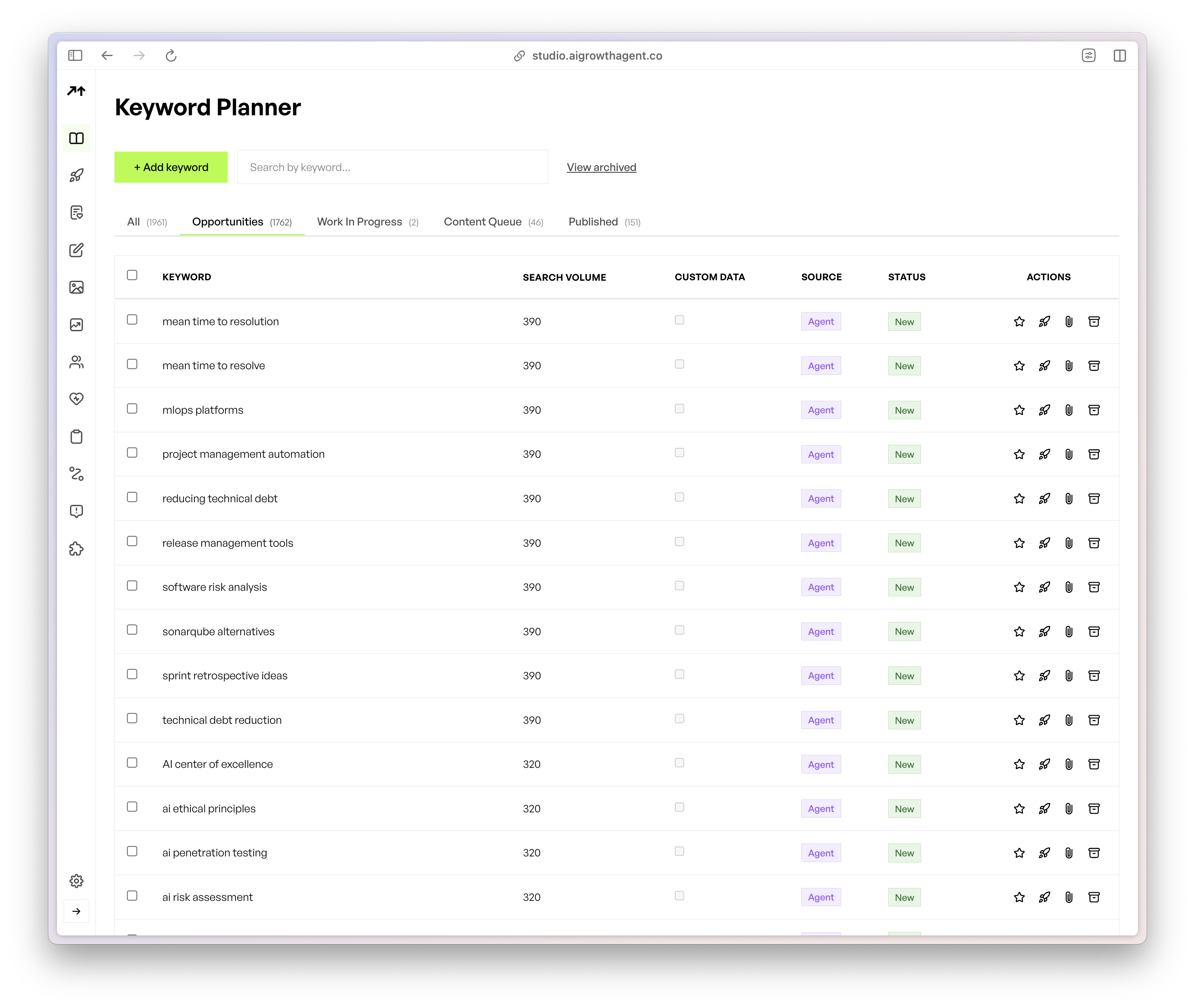
Its Keyword Research Agent analyzes thousands of queries, creating a strategy in 24 hours. The Core Content Agent manages everything from planning to publishing, ensuring quality and optimization.
AI Growth Agent excels with technical SEO for AI, automating schema markup, LLM.txt files, and the unique Model Context Protocol for clear AI communication. Features like parallel content management, real-time trend response, and custom data use set it apart. The Studio dashboard offers full control and transparency over performance and schedules.
Ready to build content authority for AI search? Schedule a consultation to see how AI Growth Agent can elevate your strategy.
Common Questions About AI Content Authority
How Often Should Content Be Updated for AI Search?
Regular updates keep content credible and relevant for AI, which values freshness and depth. Daily publishing of quality content sets the standard. While not every piece needs daily edits, consistent new content signals an active, current brand.
Review existing content every few months to ensure accuracy and add fresh insights. AI flags outdated data, so updates help maintain trust. They also allow you to strengthen authority with new citations or stats.
Consistency matters more than occasional spikes. AI favors brands showing steady expertise through regular posts and updates, building authority over time.
Which Technical SEO Matters Most for AI Visibility?
Technical SEO, like schema markup and structured content, is vital for AI citation. It clarifies content context, raising citation chances. Semantic headings organize topics for easy AI parsing.
Structured formats, such as lists and FAQs, allow quick extraction for answers. Tools like LLM.txt guide AI crawlers, while Model Context Protocols enable direct system links, ensuring maximum discoverability across platforms.
How Do AI Engines Define Authority Differently?
AI measures authority via third-party mentions, relevance, citations from trusted sources, and real-world reputation, unlike traditional keyword focus. External validation, like media features or industry recognition, weighs heavily.
Contextual depth and original insights show expertise. Frequent citations by credible sources boost authority further. Offline signals, such as awards or partnerships, also factor into AI’s trust assessment.
What Sets AI Search Optimization Apart from Traditional SEO?
Traditional SEO aimed for keyword rankings and backlinks. AI optimization focuses on authority and citation in generated answers. Success shifts from traffic to being the cited source for industry queries.
Content must show expertise and value for AI citation, not just rank. Technical needs include AI-specific tools like LLM.txt and advanced markup for better discovery and understanding.
When Can You Expect Results from AI Optimization?
Initial results from AI search optimization often appear in 3 to 6 months with steady, quality content. Significant authority takes 6 to 12 months, based on starting point and competition.
Early signs include AI indexing and citations for brand queries. Long-term success means regular inclusion in competitive answers. Consistency and quality speed up results, making early action valuable. Schedule a demo to see faster progress with autonomous tools.
Lead Your Market in the AI Search Age
AI is reshaping search in a way not seen since the internet began. Old strategies focused on keywords and links don’t work and can even harm visibility. AI prioritizes genuine expertise and citation value above all.
For premium brand leaders, delay costs dearly. Competitors gain ground daily, and AI recommends them over you, widening the gap. Traditional methods can’t match the content volume or quality AI demands.
Autonomous platforms offer the solution, scaling output with precision. Premium brands can seize this chance to lead, but the opportunity narrows as others act. AI Growth Agent ensures your answers are the ones AI trusts. Schedule a consultation today to claim your authority in AI search.
