


Written by: Mariana Fonseca, Editorial Team, AI Growth Agent
Marketing leaders are already reorganizing their strategies around generative AI’s impact on discovery and customer journeys, recognizing that visibility in these AI assistants will increasingly rival traditional SEO in business impact.
The old playbook of sporadic blogging and link chasing is giving way to a race to become the definitive, well-documented expert on your category in the eyes of AI systems. What we’ll see in this article:
- AI assistants like ChatGPT, Gemini, Perplexity, and Google’s AI Overviews now sit between your audience and your website, favoring a small set of trusted sources.
- Domain authority has become a core signal for whether these systems cite and recommend your brand, not just an SEO metric.
- Traditional agencies, internal teams, and basic AI tools struggle to sustain the volume, quality, and technical SEO needed for AI-driven discovery.
- Advanced AI writing platforms automate research, content creation, and AI-focused technical SEO so you can publish authoritative articles every day.
- AI Growth Agent provides an autonomous, AI-native content system designed to build domain authority and increase AI citations for qualified brands.
The Problem: Why Your Digital Footprint Is Shrinking in the AI Search Era
The New Reality of AI Search and LLM Citation
Search is no longer just a list of links. It is an answer box powered by large language models (LLMs). AI assistants synthesize multiple sources into a single response and selectively expose the underlying sources they view as most authoritative.
AI layers are already part of mainstream search experiences. Google Search now surfaces AI-generated summaries at the top of many results, pulling from a small subset of sources that meet quality and relevance thresholds. Tools like Perplexity place sources at the center of their interface. Perplexity explicitly highlights citations alongside each AI-generated answer, which increases the value of being among the URLs it trusts.
Conversational agents such as ChatGPT and Gemini have become default discovery interfaces for many users. In this environment, the mechanics of ranking are changing:
- LLMs focus less on exact-match keywords and more on topical authority, coherence, and depth.
- Recency and consistent publishing matter. Fresher, regularly updated content is more likely to be crawled, indexed, and incorporated into models.
- Citation is the new click. Being surfaced as a named or linked source inside AI answers has become a key signal of visibility and trust.
The Deluge of AI-Generated Content and Its Impact
Generative AI has driven down the cost of producing low-quality content. Every marketer and founder now has access to powerful text-generation tools. The global data sphere continues to expand quickly. Projections for this decade show zettabytes of new data added annually as organizations increase their digital output.
Most of this new content is:
- Lightly edited AI output with generic structures and repetitive phrasing.
- Disconnected from a differentiated brand narrative.
- Published without the technical SEO and structured data AI indexers depend on.
The result is a paradox. Content volume increases, while true authority becomes rarer and more valuable. AI systems trained on this noisy ocean of text must choose a small set of trusted sources for each topic. If your content is thin, sporadic, or indistinguishable from everyone else’s, your brand is likely to be ignored.
Why Traditional Content Strategies Fall Short
Marketing leaders feel this tension clearly. You need to publish more, at higher quality, with stronger technical foundations. The operating models you have were not built for this environment.
Traditional SEO agencies are built on billable hours and headcount. They may produce a few excellent pieces each month, but they typically cannot:
- Deliver daily, on-brand, authoritative articles without straining your budget.
- Continuously update technical SEO elements like schema, robots directives, and experimental files like LLM.txt across hundreds of posts.
- React in real time to trending topics with same-day, fully optimized content.
Internal marketing teams face a different constraint. You have deep brand knowledge and strategic insight, but limited time and headcount. The same people responsible for brand, campaigns, events, and sales enablement cannot also run a full-scale newsroom and technical SEO engineering function. Even if you increase output for a quarter, it is difficult to sustain over time.
Basic AI content tools such as prompt templates and SaaS copy generators promised a shortcut, then pushed the real work back onto your team:
- You still need to conduct keyword research, map topics to strategy, and plan an editorial calendar.
- You still need to manually edit and polish repetitive drafts that sound obviously AI-generated.
- You still need to engineer schema, optimize metadata, and publish inside your CMS.
Low-quality, highly generic AI content also creates risk. Search engines continue to refine their ability to demote thin, derivative pages. LLMs are unlikely to treat your content as an authoritative source if it merely restates what already exists.
The Cost of Inaction: Losing Authority to Competitors
In the AI search era, inaction is not neutral. It is compounding loss.
- Every day you do not publish, your competitors’ content helps train the models that answer your buyers’ questions.
- Every query where you are absent is an opportunity for a competitor to define the category, the problem, and the success criteria in their favor.
- Every missed citation in ChatGPT, Gemini, or Perplexity makes it harder to shift the narrative later.
As AI surfaces the same small set of sources repeatedly, authority becomes path dependent. Once a competitor is entrenched as the primary cited source for your key topics, dislodging them requires an even greater volume of credible, technically sound content.
Left unaddressed, your brand’s footprint on the internet shrinks. Organic traffic flattens or declines, branded search gives way to aggregator sites, and the AI assistants your prospects trust may never mention your company.
The Solution: Building Durable Domain Authority with Advanced AI Writing Platforms
Reversing this trend requires more than another tool that writes paragraphs. You need a system that behaves like a dedicated, AI-native content organization. It must understand your narrative, your ideal customer profile, your product, and the mechanics of AI indexing, then execute against that understanding every day.
Advanced AI writing platforms for domain authority are built for this purpose. They combine:
- Deep research and strategy: Comprehensive keyword and topic mapping to your category, not just a list of phrases.
- Autonomous content production: Daily creation of long-form, high-quality articles aligned with that strategy.
- Technical SEO for AI search: Automatic implementation of schema, metadata, and AI-specific artifacts that make your content legible to LLMs.
- Continuous feedback loops: Measurement of AI citations, rankings, and traffic that shape what to publish next.
Instead of hiring more writers or juggling more SaaS tools, you deploy an engine that makes “publish daily” the default. Over time, this steady accumulation of authoritative, technically clean content builds a meaningful advantage in your category.
If you are ready to explore how AI-native content operations can work in your organization, now is the time to schedule a demo with AI Growth Agent to see how autonomous AI writing platforms for domain authority can strengthen your AI search strategy.
AI Growth Agent: Autonomous Content to Strengthen Domain Authority
AI Growth Agent is not an agency and not a simple writing tool. It is an autonomous content platform that uses orchestrated AI agents to help make your brand the definitive authority in your category.
From a single kickoff session, it learns your business, designs a keyword strategy, sets up a fully optimized blog, and begins publishing authoritative content daily. Each article includes advanced technical SEO designed for AI search engines.
Key Capabilities for AI Search Advantage
1. Autonomous, daily content publication
After onboarding, AI Growth Agent’s Core Content Agent runs the entire content lifecycle with minimal human intervention:
- Transforms your category and product narrative into a detailed Company Manifesto.
- Uses that Manifesto to maintain voice, positioning, and differentiation across every article.
- Generates high-quality drafts that can range from tactical articles to 2,000-word pillar pieces mapped to your keyword strategy.
- Continuously improves based on your feedback inside the Studio until you are comfortable enabling full autopilot.
The outcome is a sustainable, daily publishing cadence delivered programmatically.
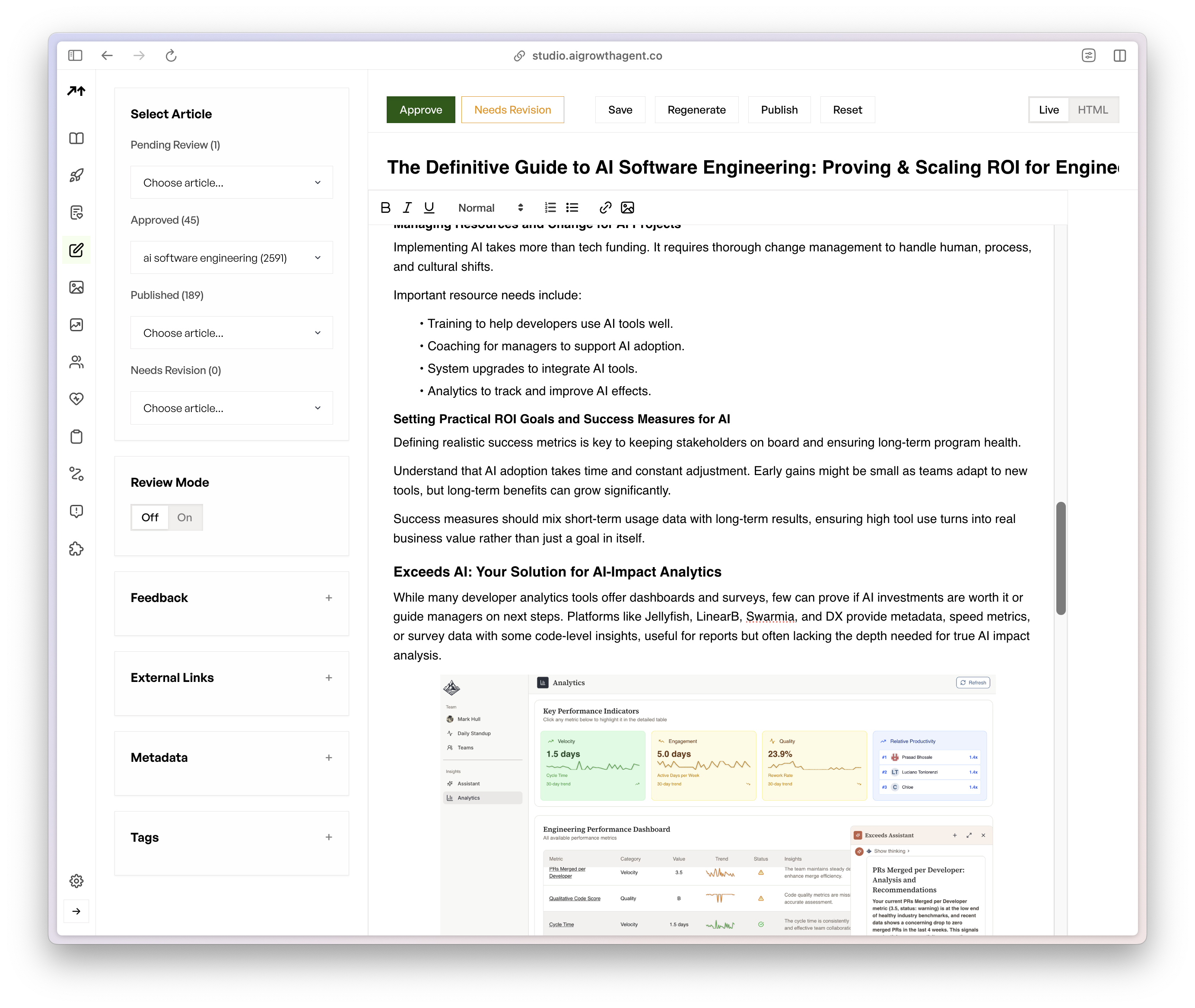
2. Advanced technical SEO for AI indexing
AI Growth Agent treats technical SEO as a core function, not an afterthought. Every published piece is automatically structured with:
- Structured data and rich schema that help search engines and AI systems interpret context.
- Optimized metadata, headings, and internal links aligned with your keyword strategy.
- An advanced LLM.txt file and an early blog-level Model Context Protocol (MCP) implementation, which allow AI search engines to query your content directly and understand your corpus with greater clarity.
This engineering focus helps ensure your content is both readable for humans and legible to the AI systems that decide which sources to cite.
3. Parallel agent deployment for multi-brand portfolios
For portfolio owners such as private equity firms, venture studios, and multi-brand enterprises, AI Growth Agent enables parallel deployment of multiple Content Agents from a single interface:
- Each brand or product line gets its own Manifesto, keyword strategy, and content plan.
- Agents can publish to one shared blog or multiple subdomains, depending on your architecture.
- A small central team can oversee a complex, multi-brand content ecosystem without multiplying headcount.
This creates a new type of capability: multi-agent, multi-brand, AI-native content operations at portfolio scale.
4. Real-time content generation on trending topics
Timely response is essential when news breaks in your category. AI Growth Agent helps you react at the speed of the market:
- You drop a link to a trending article into the Studio.
- The agent generates a high-quality response that reflects your brand’s point of view.
- Content is optimized, illustrated using your image library with intelligent placement, and ready to publish within minutes.
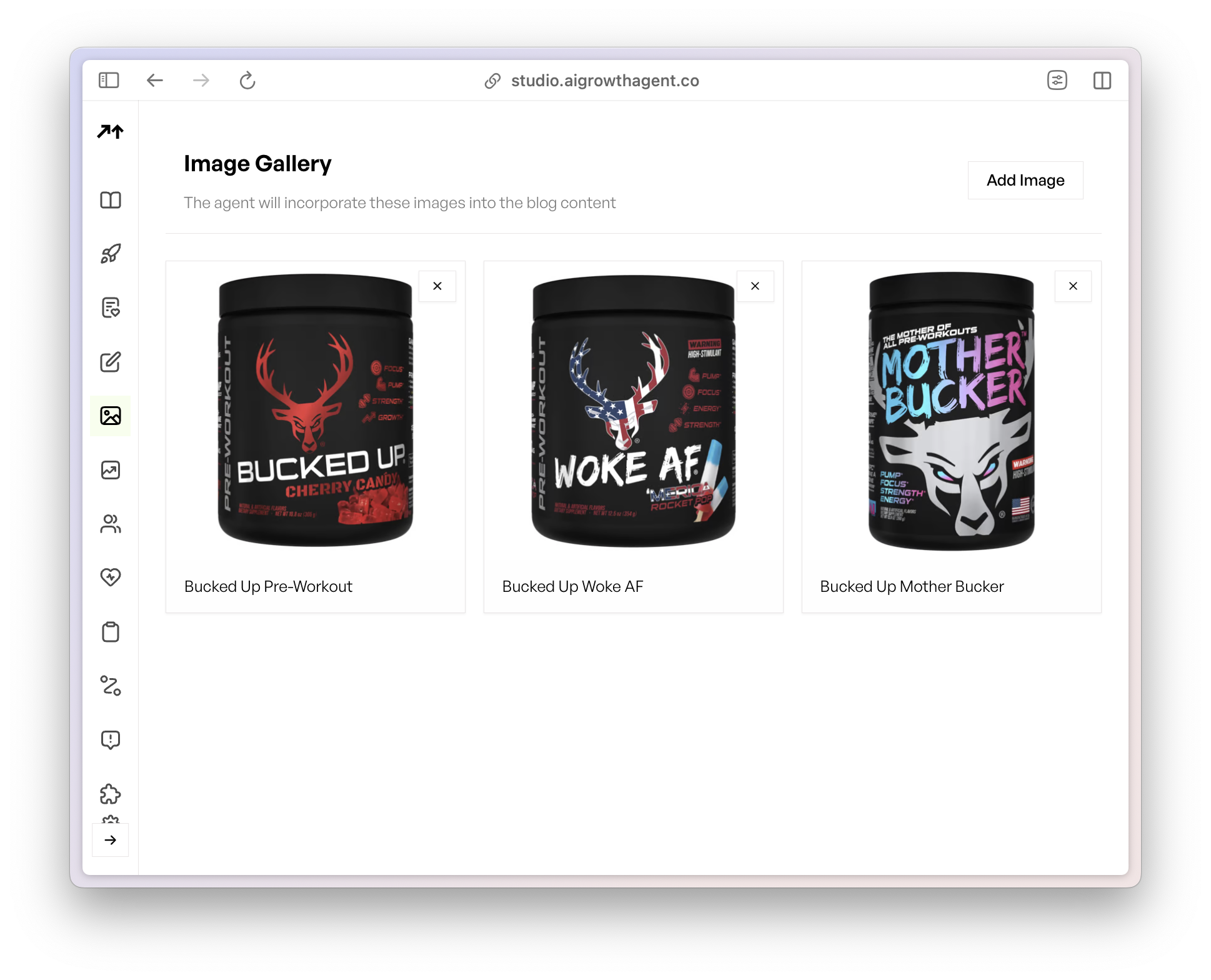
This keeps you visible in real time and inserts your narrative into the same conversations that models are learning from.
5. Integrated analytics for AI citations and organic growth
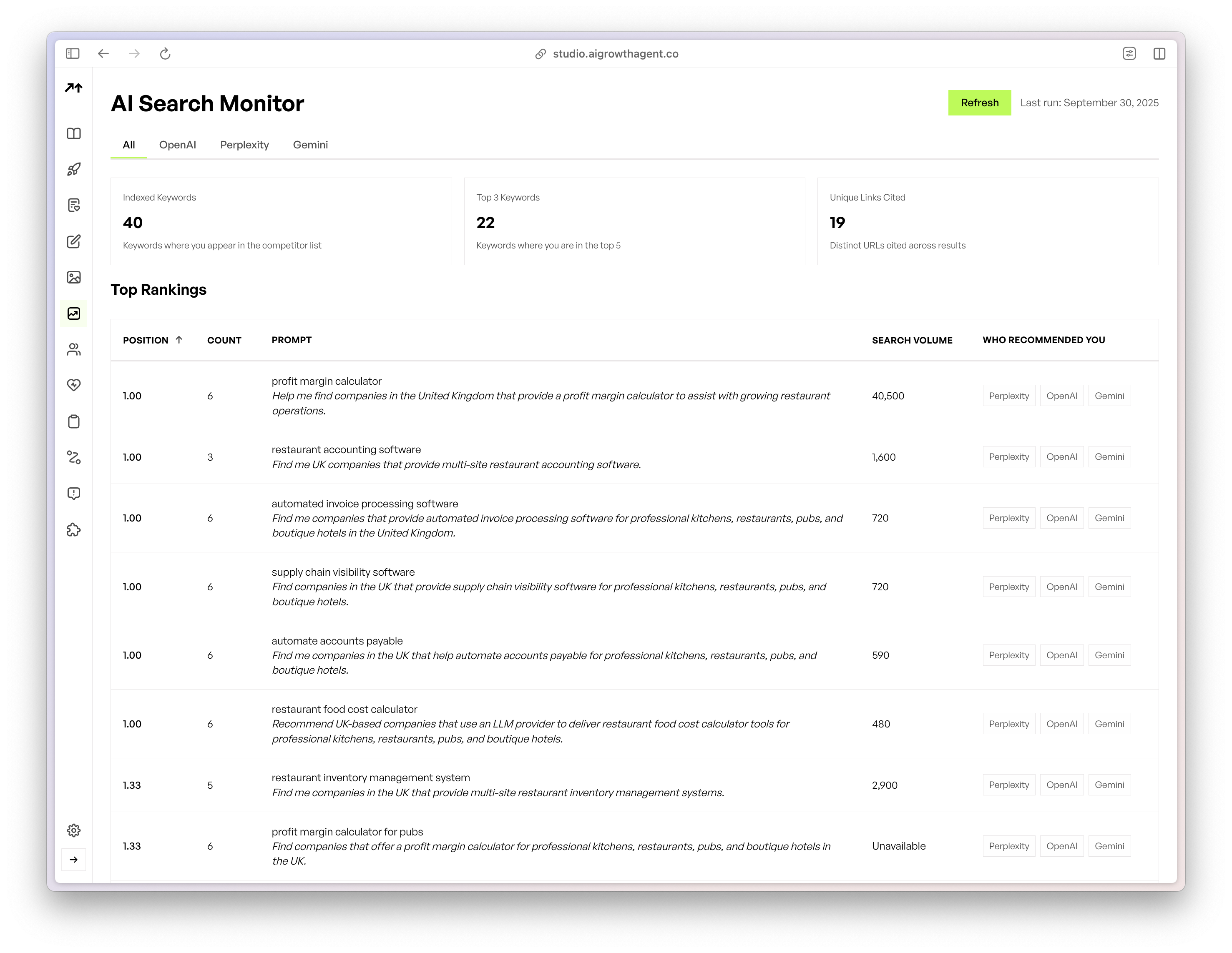
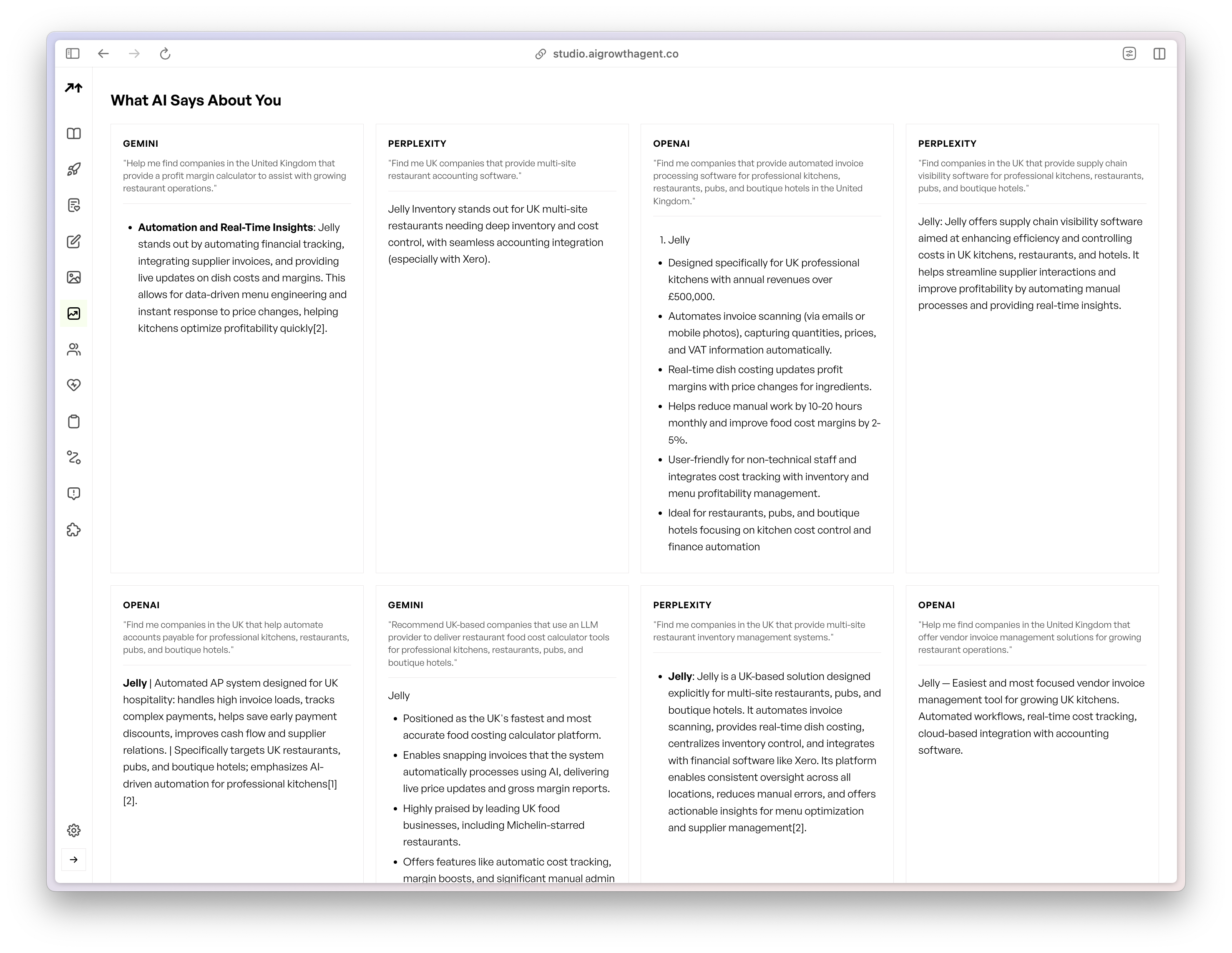
AI Growth Agent includes an AI Search Monitor and Performance Agent that closes the loop between publishing and impact. Inside the Studio, you can see:
- A heatmap of your visibility across ChatGPT, Gemini, and Perplexity for target topics.
- Which articles and URLs AI assistants cite, and in what context.
- Competitive comparisons for critical queries and topics that matter most to your pipeline.
- Integrated Google Search Console data that ties content output directly to growth in organic clicks and impressions.
AI writing platforms should be judged on outcomes, not just output volume. AI Growth Agent is engineered around that principle.
To see this in action for your own category, you can schedule a consultation session with AI Growth Agent to evaluate whether autonomous AI writing for domain authority is the right fit for your brand.
Beyond Generic AI: Why AI Growth Agent Outperforms Standard Tools
The Limitations of Generic AI Content Tools
Self-service AI tools typically solve a narrow problem: they help individuals write faster. They often do not address the broader requirements of becoming an AI-cited authority.
Common limitations include:
- No end-to-end strategy: You must provide the keyword plan, editorial calendar, and competitive positioning.
- Shallow brand understanding: Profiles capture tone and a brief persona, but not the nuanced, evolving narrative of your company and market.
- Low-quality, generic output: Drafts often read like recycled templates, with clear AI patterns and limited unique insight.
- No technical SEO execution: You still need someone to handle schema, metadata, internal linking, and AI-specific artifacts like LLM.txt or MCP integrations.
- Operational overhead: Your team must orchestrate topics, prompt the tool, review content, and engineer publishing workflows on a recurring basis.
In practice, many organizations end up hiring or overloading a senior content strategist plus at least one writer or editor to make these tools effective at scale. The AI component becomes just another step in a human-heavy process.
The Engineering Difference: AI-First Content Creation
AI Growth Agent starts from a different premise. Content operations should be engineered as an AI-native system, not as a human workflow with AI added on top. That engineering mindset shows up in several core components:
- Company Manifesto: During a one-hour onboarding session led by a professional journalist, your strategy, voice, ICP, and product positioning are captured and distilled into a Manifesto. This artifact becomes the single source of truth guiding every agent’s behavior.
- Keyword Deep Research Agent: Immediately after onboarding, a specialized agent ingests your Manifesto and scans tens of thousands of queries. It generates a structured keyword strategy across clusters and categories within about 24 hours.
- Core Content Agent: This agent accepts the strategy and continuously converts it into briefs, drafts, fact-checked articles, and fully optimized posts, compressing much of a content agency’s workflow into minutes.
- Model Context Protocol and LLM.txt: AI Growth Agent’s technical layer implements an LLM.txt file and a Model Context Protocol endpoint for your blog, making it easier for AI search engines to discover and index your content corpus with precision.
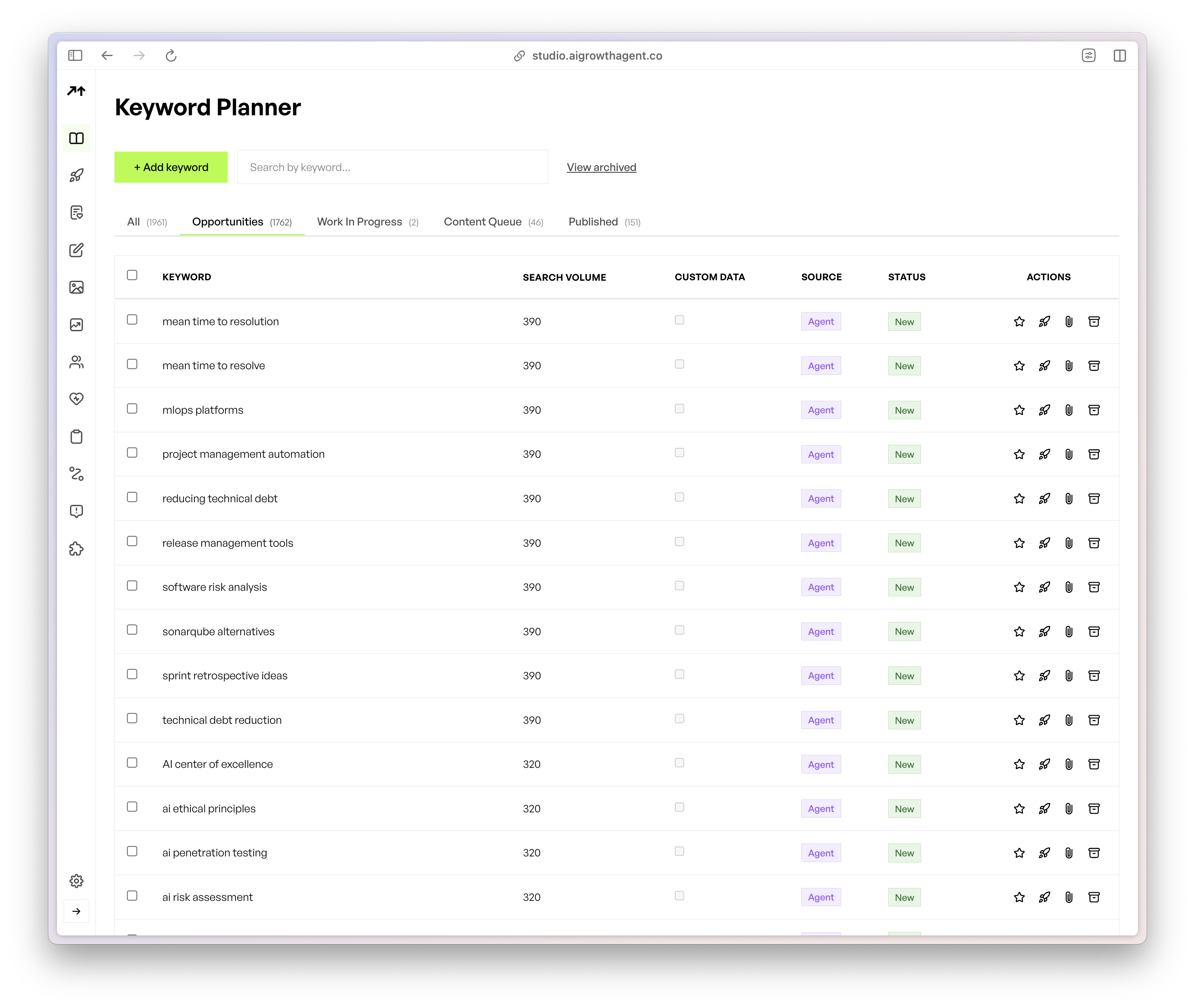
Rather than bolting AI onto older workflows, AI Growth Agent re-architects the content stack around the requirements of AI search.
Efficiency and Scale for Competitive Advantage
Because AI Growth Agent is autonomous, scale becomes a configuration choice rather than a hiring plan.
- If you need to increase your publishing cadence ahead of a major category launch, you adjust your content targets and the agents handle execution.
- If you need separate content tracks for different verticals, personas, or product lines, you spin up additional agents with tailored Manifestos and keyword maps.
- If you need to respond to a competitor’s announcement in the same news cycle, you generate and publish a high-quality point of view within minutes.
This level of velocity gives you an edge when domain authority depends on who can cover a topic landscape in depth and with consistency.
If you suspect your current stack is limiting your impact, it is worth exploring what a true AI-native platform can deliver. Schedule a demo with AI Growth Agent to compare autonomous AI writing platforms against your existing content operations.
Achieving Measurable ROI: Quantifying AI Domain Authority with AI Growth Agent
Quantifying AI Citations and Recommendations
In the AI search era, traditional SEO metrics such as rankings and backlinks only tell part of the story. You also need visibility into:
- When AI assistants are referencing your content.
- Which questions or intents surface your brand.
- How frequently you appear compared with direct competitors.
AI Growth Agent’s AI Search Monitor and Performance Agent tracks these signals. For your key topics, you can see:
- Which pages AI systems cite or recommend.
- The share of AI answers where your brand appears for specific queries.
- Trends over time as your content footprint expands.
This level of insight turns AI citations from a black box into a measurable, optimizable metric.
Tracking Organic Traffic and Qualified Lead Growth
AI visibility must connect to business outcomes. AI Growth Agent integrates with Google Search Console so you can connect:
- Content output, such as articles per week and topical coverage, to changes in impressions and clicks.
- Specific clusters or themes to queries that influence pipeline.
- Long-tail informational queries to top-of-funnel lead capture.
Combined with your CRM and analytics stack, this gives you a clearer path from daily publishing to measurable impact through organic and AI-driven discovery.
Establishing a Competitive Edge in the New AI Landscape
The strategic ROI of an advanced AI writing platform is competitive advantage:
- Your content works to become a core explanation of problems and solutions in your category.
- AI assistants are more likely to cite you as they answer buyer questions over time.
- Competitors may be pushed into a reactive position as they try to differentiate against a narrative you are shaping.
In a world where generative AI compresses the buyer journey and reduces the number of visible sources, becoming a frequently cited source is a key goal. AI Growth Agent is designed to help qualified brands move toward that position.
AI Growth Agent vs. The Status Quo: A Comparison
The table below compares AI Growth Agent to the main alternatives: traditional agencies and internal teams, and generic AI content tools. To align with on-page constraints, agencies and internal teams are grouped together as the human-led status quo.
|
Capability |
Agency / Internal Team |
Generic AI Tool |
AI Growth Agent |
|
Daily high-quality content production |
Constrained by headcount and budget; typically weekly or monthly cadence. |
Fast drafts, but requires manual oversight and editing; quality inconsistent. |
Autonomous daily publishing of long-form, on-brand, authoritative articles. |
|
AI citation optimization and technical SEO (LLM.txt, MCP) |
Limited AI-specific expertise; manual and error-prone technical work. |
Minimal technical SEO; no AI-specific indexing features. |
Built-in schema, metadata, LLM.txt, and Model Context Protocol for AI indexing. |
|
Autonomous execution and scalability for portfolios |
Scaling multi-brand content requires hiring more people or more agencies. |
Each brand requires manual setup and ongoing orchestration by your team. |
Parallel agents per brand or product line, all managed from a single interface. |
|
Strategic research and content planning |
Strong strategy, but slow and expensive; updates can lag market shifts. |
No integrated strategy; you must bring the keyword plan and calendar. |
Keyword Deep Research Agent creates and updates a comprehensive strategy in about 24 hours. |
|
Cost-efficiency and time-to-value |
High retainers; months to ramp; limited leverage from each dollar. |
Low subscription cost, but hidden costs in headcount and rework. |
Technology-driven leverage that compresses much of a content agency into a software subscription. |
|
Real-time content responsiveness |
Often cannot react same-day to news or trends. |
Can draft quickly, but still needs humans for strategy and publishing. |
Generates and publishes optimized, on-brand responses to trends within minutes. |
Frequently Asked Questions (FAQ)
How does AI Growth Agent ensure content quality and accuracy for AI writing platforms?
AI Growth Agent embeds quality assurance into every stage of its autonomous workflow. The process starts with a guided onboarding session led by an experienced journalist who captures your brand narrative, positioning, and subject-matter expertise. This insight is distilled into a Company Manifesto that the content agents use as a reference for tone, depth, and perspective.
When generating each article, the Core Content Agent conducts structured research across your Manifesto, your existing assets, and trusted external sources. It then assembles a detailed outline and full draft. A built-in review layer checks for factual consistency, clarity, and alignment with your strategic messaging. Over time, your feedback in the Studio refines the system so the content improves while sustaining a high publishing cadence.
Can AI Growth Agent integrate with my existing CMS for domain authority?
Yes. While AI Growth Agent can deploy a fully hosted, pixel-consistent blog on a subdomain that matches your existing brand, it also supports integration with popular CMS platforms. For organizations that prefer or need to keep content within an existing stack, AI Growth Agent can integrate with systems like WordPress, Webflow, Framer, Sanity, Hashnode, or HubSpot.
In practice, many clients choose the hosted blog because it removes engineering friction and provides full technical SEO benefits out of the box. When you integrate with your own CMS, AI Growth Agent’s team works with you to ensure that schema, metadata, LLM.txt, and related configurations are implemented correctly so the content contributes directly to your domain authority in search and AI models.
What kind of results can I expect from using an AI writing platform like AI Growth Agent?
Results vary based on your starting point, competitive landscape, and how aggressively you deploy the platform. Most organizations see impact across three areas:
- Visibility in AI search: Over time, your brand may appear more frequently as a cited or recommended source in AI assistants for key topics in your category.
- Organic traffic growth: With a sustained increase in high-quality, technically optimized content mapped to your keyword strategy, you may see upward trends in impressions, clicks, and time on site from organic channels.
- Pipeline and revenue impact: As your digital footprint expands and your content educates buyers earlier in their journey, you may see warmer inbound prospects and better-informed leads.
AI Growth Agent is built to make these outcomes measurable, so you can monitor performance gains with appropriate context.
How is AI Growth Agent different from a traditional SEO agency in the AI era?
Traditional agencies are human-service organizations. They rely on analysts, writers, editors, and account managers to deliver strategy and content. While they can produce strong work, they are constrained by headcount, billable hours, and manual processes. This makes it difficult to maintain the daily, AI-optimized publishing cadence now required to compete in AI-driven search.
AI Growth Agent is a technology platform. Its system of specialized agents handles strategy, research, drafting, optimization, and publishing autonomously. This allows you to reach a level of scale and responsiveness that is hard to match with a purely human team. Instead of paying for incremental hours, you invest in a platform that focuses on building domain authority and optimizing for AI citation.
Is AI Growth Agent right for every company?
No. AI Growth Agent is intentionally designed for brands that already have a solid technical foundation and a clear value proposition. The platform is not intended to operate as an SEO repair service or a shortcut for unproven products. If your website has significant technical issues, poor architecture, or lacks a coherent offering, those fundamentals should be addressed first.
AI Growth Agent is a strong fit for organizations that are ready to lead their category. If you have a strong product, a clear ICP, and a functioning website but lack the content engine to match your ambitions in AI search and organic acquisition, the platform can provide a substantial advantage in visibility and authority.
Conclusion: Lead Your Category with AI-Powered Content Authority
The shift to AI-centric search is one of the most significant changes in digital marketing since the early days of Google. AI assistants are compressing attention into single answers, and those answers often reference a small set of authoritative sources. At the same time, generative AI has flooded the internet with low-quality content, which makes it harder for thoughtful brands to stand out.
In this environment, relying on slow agencies, overextended internal teams, or generic AI tools is unlikely to be sufficient. To protect and grow your digital footprint, you need an AI writing platform engineered specifically for domain authority and AI citation, with the ability to publish daily, optimize technically, and measure impact across both search engines and AI assistants.
AI Growth Agent is built to be that type of platform. By combining a structured onboarding process, autonomous multi-agent architecture, advanced technical SEO (including LLM.txt and Model Context Protocol), and integrated analytics, it provides a technology-driven upgrade over manual content operations.
AI will continue to generate more questions. AI Growth Agent helps your company provide clear, authoritative answers. If you are ready to lead your category in the age of AI search, schedule a consultation session with AI Growth Agent today to see if you are a good fit and to explore AI writing platforms for domain authority.
