Written by: Mariana Fonseca, Editorial Team, AI Growth Agent | Last updated: January 10, 2026
Key Takeaways
- AI search systems like ChatGPT, Gemini, and Perplexity now shape discovery, so content programs need technical precision and semantic structure, not just more articles.
- Autonomous AI agents can run end-to-end content workflows, increasing volume while preserving quality, narrative clarity, and brand alignment.
- Structured topical architectures, real-time trend response, and continuous feedback loops improve the likelihood that AI systems cite and recommend your content.
- Multi-tenant deployments let lean teams manage programmatic SEO across several brands, products, or portfolios with consistent standards.
- Marketing leaders can use AI Growth Agent to operationalize these capabilities and book a live walkthrough by scheduling a demo with AI Growth Agent.
AI search is changing how people find and trust information. Brands that want AI search authority in 2026 need content systems that are accurate, structured, and responsive at scale, not just more manual production.
1. Enabling Autonomous Orchestration for Scaled Content Velocity
Autonomous AI agents change content operations by acting as persistent systems instead of one-off generators. These agents maintain long-term context, pursue defined goals, and execute multi-step workflows without constant human prompts, which allows them to coordinate entire content programs.
Well-designed agents manage the full content lifecycle, from ideation and research through briefing, drafting, review, publishing, personalization, and optimization. This level of orchestration supports the depth and volume that large language models reward while keeping storylines and positioning consistent across channels.
Agent-led orchestration also helps align many individual assets into a coherent content ecosystem. AI Growth Agent’s Programmatic SEO Agent runs these workflows autonomously, reducing manual handoffs and technical friction so teams can focus on strategy, not task management.
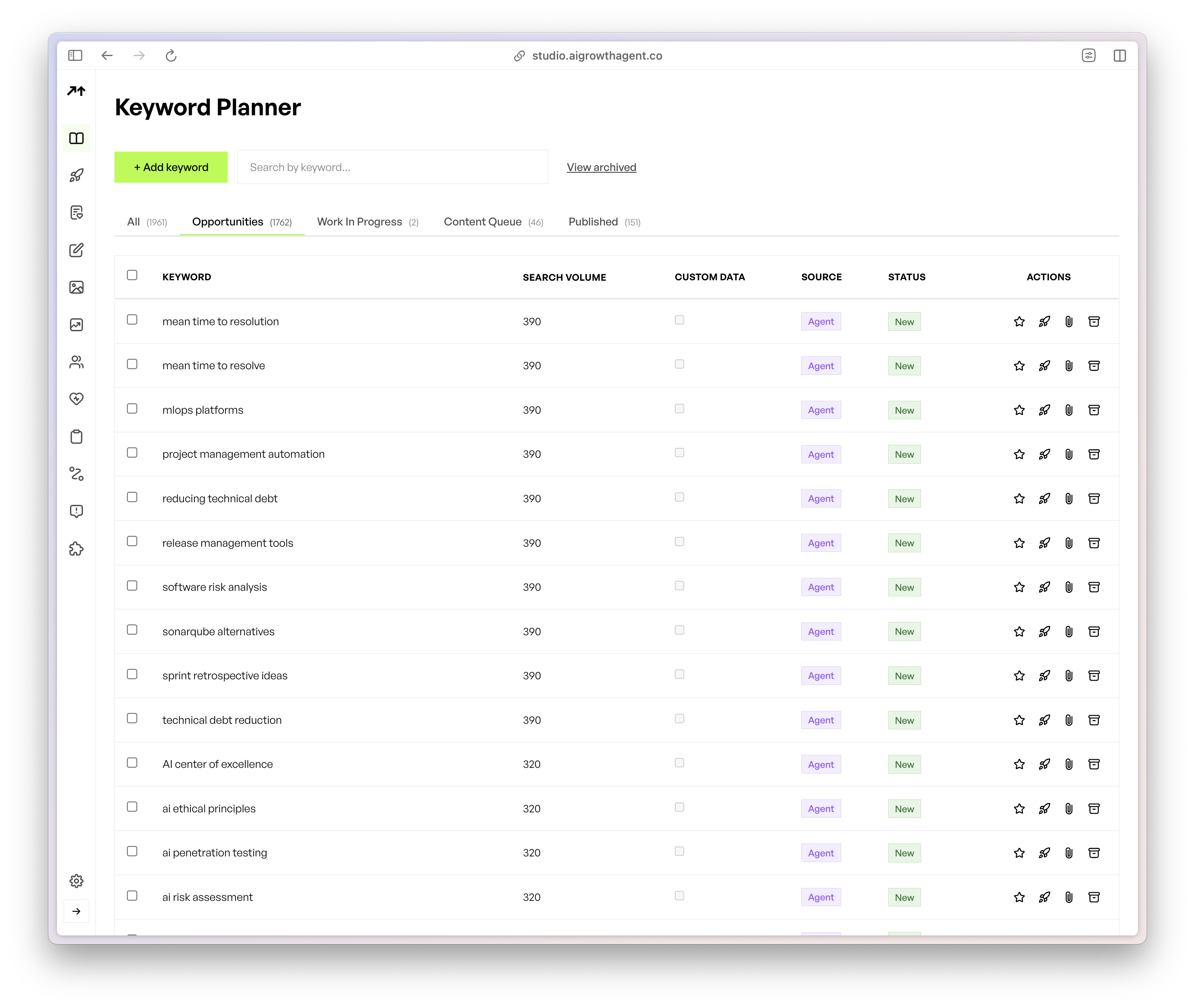
Actionable takeaway: Review your content workflow for steps that can be delegated to autonomous agents, especially coordination across research, briefs, drafts, optimization, and publishing.
2. Building Semantic Authority and Technical SEO for AI Citation
AI search authority depends on clear semantic structure as much as on content volume. Specialized agents map entities and relationships across your topics, products, and audiences and then organize content around those relationships, which strengthens topical depth and clarity for AI systems.
Gap analysis plays a central role in this process. Autonomous agents scan existing libraries to find missing subtopics, weak internal links, and shallow clusters, then propose or generate content that closes those gaps so the overall knowledge graph is more complete.
Technical SEO must match this semantic structure. Dedicated agents can handle metadata, schema, and other content operations programmatically so every asset ships with machine-readable context. AI Growth Agent automatically applies schema markup, metadata, and a blog Model Context Protocol (MCP) and LLM.txt structure, which makes it easier for AI search engines to parse, index, and cite your content.
Actionable takeaway: Design content plans around entities, topics, and relationships, and use programmatic technical SEO so AI systems can reliably understand and cite your material.
3. Responding to Trends in Real Time With AI Agents
Recency now plays a visible role in AI search recommendations, especially for fast-moving topics. AI agents can continuously monitor news, forums, and social channels to flag emerging themes before they reach peak attention, giving brands more time to publish helpful coverage.
Once a signal appears, agents can draft and optimize response content quickly while preserving guardrails for brand, legal, and factual quality. AI Growth Agent’s Real-Time Programmatic SEO Content Injection lets teams feed in a trending link, then receive search-optimized articles that reflect the brand perspective and are ready for review and publication.
Actionable takeaway: Combine monitoring agents with rapid content workflows so your brand can publish accurate, optimized responses while a topic is still gaining momentum in AI search.
4. Scaling Multi-Brand Programs With Multi-Tenant AI Agents
Enterprise teams and portfolio owners often run several brands or product lines in parallel. Multi-agent systems make this manageable by splitting responsibilities across research, drafting, optimization, and distribution, while still following shared rules.
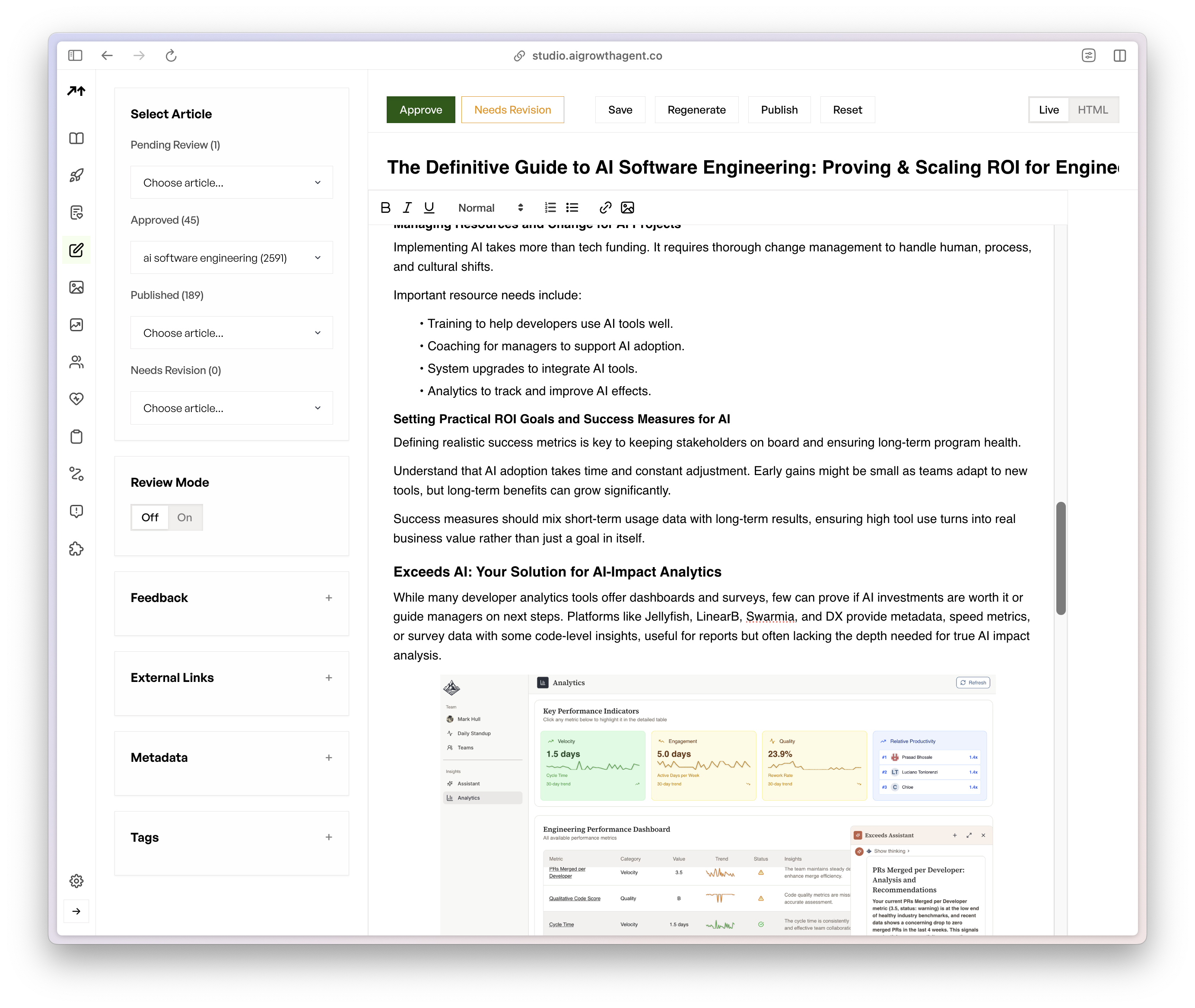
Within a single platform, agents can be configured for distinct use cases, customer journeys, or brands, which lets a central team coordinate strategy without writing every asset. AI Growth Agent’s Multi-Tenant Programmatic Deployment supports separate Company Manifestos, keyword strategies, and brand voices for each domain or subdomain, so a lean team can oversee programmatic SEO across many brands.
Actionable takeaway: If you manage multiple brands or product lines, explore multi-tenant agent setups that keep messaging and SEO structures consistent without scaling headcount at the same rate.
5. Using Continuous Feedback Loops for AI Search Optimization
AI search behavior changes frequently, so static content strategies age quickly. Optimization agents can monitor performance data, trigger content refreshes, and shift effort across topics within defined guardrails, creating a continuous improvement loop.
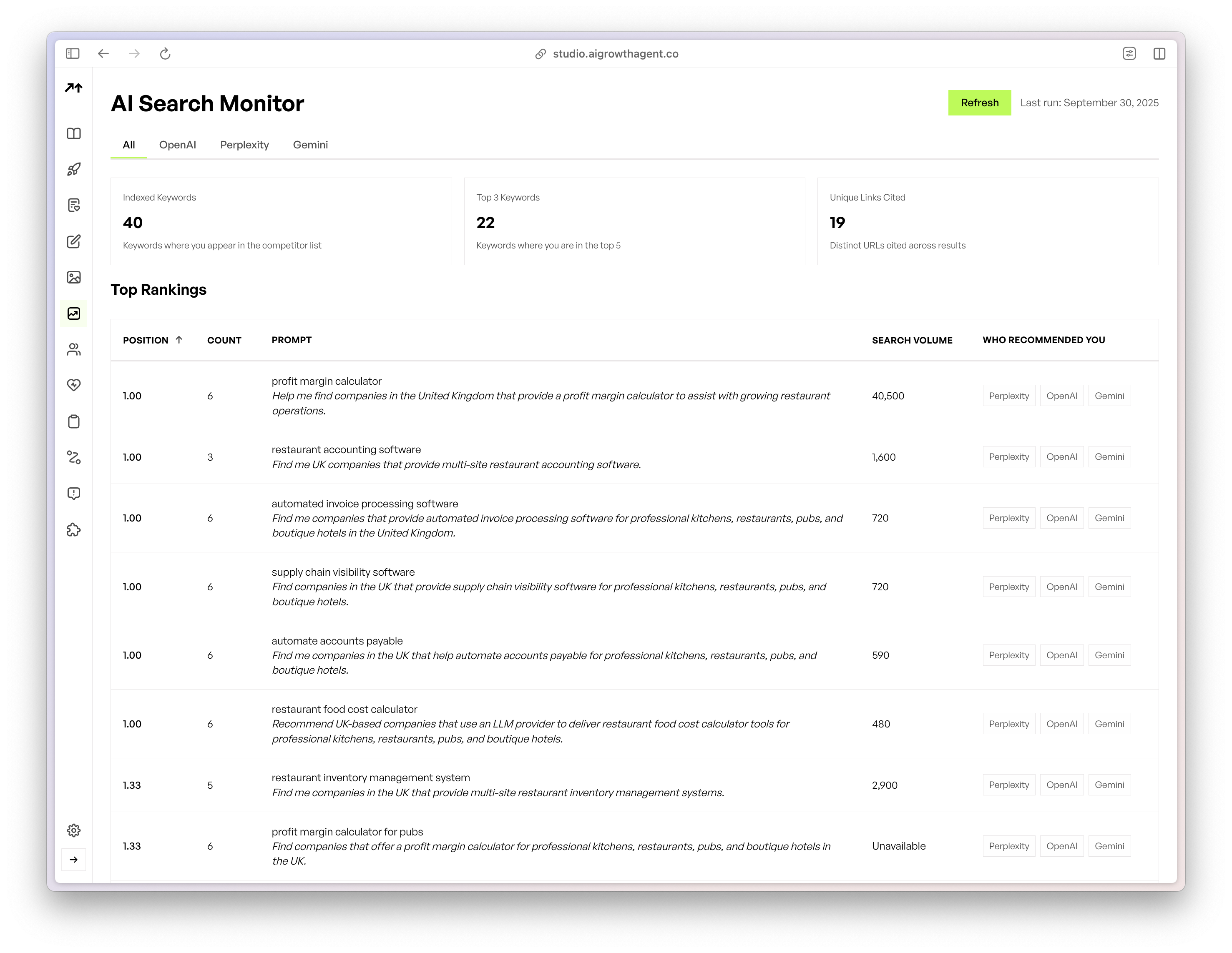
Real-time feedback on how AI systems respond to content helps refine agent behavior and strategy in a way that traditional dashboards cannot match. AI Growth Agent’s AI Search Monitor tracks presence across ChatGPT, Gemini, and Perplexity, including which URLs appear, where citations occur, and how often content is surfaced in AI responses.
These AI-specific metrics support practical decisions, such as which topics to expand, which pages need technical updates, and where to invest additional programmatic content. Teams can move away from guessing based only on classic rankings and instead optimize for how AI search actually behaves.
Actionable takeaway: Add AI search monitoring and automated refresh triggers to your content stack so strategies stay aligned with current citation and visibility patterns.
Traditional AI Tools vs. AI Growth Agent: A Comparison
Not all AI-driven content tools operate at the same level. Traditional tools focus on assistance at the document level, while agentic platforms like AI Growth Agent focus on orchestrating entire content systems.
|
Feature |
Traditional Content Creation |
Basic AI Content Tools |
AI Growth Agent (Programmatic SEO Agent) |
|
Content Velocity |
Manual and slow |
Faster drafts |
High volume and autonomous |
|
Technical SEO Depth |
Basic and manual |
Limited |
Advanced and automated with LLM.txt and MCP |
|
Brand Voice Consistency |
Inconsistent at scale |
Requires close oversight |
Consistent via Company Manifesto |
|
AI Search Visibility |
Low and unpredictable |
Requires manual architecture |
Structured for citation and authority |
Frequently Asked Questions About AI Agents in Content Marketing
What is the difference between traditional AI content tools and autonomous AI agents?
Traditional tools generate content when prompted and depend on humans to manage each step of the process. Autonomous AI agents maintain goals and context over time, make decisions about what to produce next, and coordinate workflows across research, drafting, optimization, and publishing. The result is a system that manages a content program rather than a tool that produces one asset at a time.
How do AI agents impact content velocity and scale for brands?
AI agents increase content velocity by automating many steps that usually slow teams down, including research, outlining, drafting, optimization, and basic QA. These agents can run continuously, respond to new opportunities outside normal working hours, and keep quality within agreed guardrails, which allows brands to cover more topics in greater depth without linear increases in headcount.
How do AI agents help with technical SEO for AI search engines?
Agents can apply technical SEO rules consistently at publish time, including schema markup, metadata, internal links, and AI-specific files such as LLM.txt and MCP. This programmatic approach reduces manual errors and ensures each new URL is machine-readable, which supports better indexing and clearer context for AI search engines deciding what to cite.
Can AI agents maintain brand voice and guidelines across large volumes of content?
Advanced agents use a structured Company Manifesto that encodes brand voice, positioning, tone, and key messages. Every asset references this shared source of truth, which helps keep messaging consistent across large volumes of content while still allowing for updates as the brand evolves.
What kind of ROI can marketing leaders expect from implementing AI agents for content marketing?
Leaders typically see value through lower cost per article, faster time to publish, deeper topical coverage, and improved visibility in both traditional and AI search. Over time, consistent programmatic output and better technical implementation support higher organic traffic and more frequent citations in AI systems, which compounds authority in a measurable way.
Conclusion: Moving to Agentic Content Marketing in 2026
Content programs that rely only on manual workflows struggle to keep pace with AI search in 2026. Autonomous agents that support orchestration, semantic structure, real-time response, multi-tenant management, and continuous optimization give marketing teams a practical way to build and maintain AI search authority.
AI Growth Agent focuses on these capabilities so brands can run scalable, technically sound, and data-informed content operations. AI has many questions, and your content can supply clear answers. If you are a premium brand with a strong foundation and want to strengthen your position through Programmatic SEO, schedule a demo with AI Growth Agent to see how an agentic approach can support your goals.