Written by: Mariana Fonseca, Editorial Team, AI Growth Agent | Last updated: January 10, 2026
Key Takeaways
- AI-first search across ChatGPT, Google AI Overviews, and Perplexity now rewards structured authority, technical quality, and scale more than isolated keyword tactics.
- Enterprise programmatic SEO platforms need headless, API-first architecture, multi-model AI, and strict performance engineering to support millions of pages and fast global delivery.
- Autonomous keyword strategy, database-to-content automation, and real-time content injection help enterprises capture emerging demand and convert internal data into durable search assets.
- Security, governance, multi-tenant management, and AI-focused analytics are now baseline requirements for any enterprise adopting programmatic SEO at scale.
- AI Growth Agent provides an autonomous programmatic SEO agent that combines strategy, content, technical SEO, and AI search monitoring at enterprise scale, and you can see it in action by booking a demo.
The AI-Driven Shift: Why Enterprise Programmatic SEO Platform Features Matter
AI search has shifted discovery from static result pages to dynamic, synthesized answers. Programmatic SEO now needs to serve both traditional crawlers and AI indexers that rely on structured, credible information at scale. Headless, API-first CMS setups that support sub-100 ms API responses and millions of page requests now define competitive baselines for enterprises.
Manual SEO and basic AI copy tools cannot keep pace with AI-generated content volumes. Traditional agency workflows rely on individual writers and fragmented tools, while generic AI tools output unstructured text that lacks the schema, metadata, and reliability AI search systems prefer. Marketing leaders now need autonomous systems that combine content velocity, technical rigor, and brand control.
Foundational Architecture: Building Enterprise-Grade Programmatic SEO Capabilities
Scalable Infrastructure With Headless CMS and Global Delivery
Enterprise platforms now favor multi-region infrastructure, multi-tier CDNs, and geographic load balancing to maintain sub-2 second page loads and sub-200 ms TTFB worldwide. Headless CMS architectures decouple content management from presentation, so teams can generate and update millions of pages without impacting performance.
Multi-Model AI and Retrieval-Augmented Generation
Leading platforms use multiple specialized AI models for drafting, entity enrichment, localization, and optimization, all tied to real-time data sources. Retrieval-augmented generation with vector databases such as Pinecone and Weaviate, orchestrated with frameworks like LangChain, supports fact-checked, citation-rich output that meets enterprise quality and compliance standards.
Performance Engineering as a Core Requirement
Enterprise platforms target 95 percent or higher cache hit ratios for static assets, around 70 percent for dynamic content, and multi-tier caching to balance speed and cost. Edge execution environments such as Cloudflare Workers support global execution of SEO logic and AI workloads with no cold starts and rapid deployments, which improves p95 latency compared with traditional serverless stacks.
Advanced Features for Autonomous Content Engineering at Scale
Autonomous Keyword and Content Strategy Development
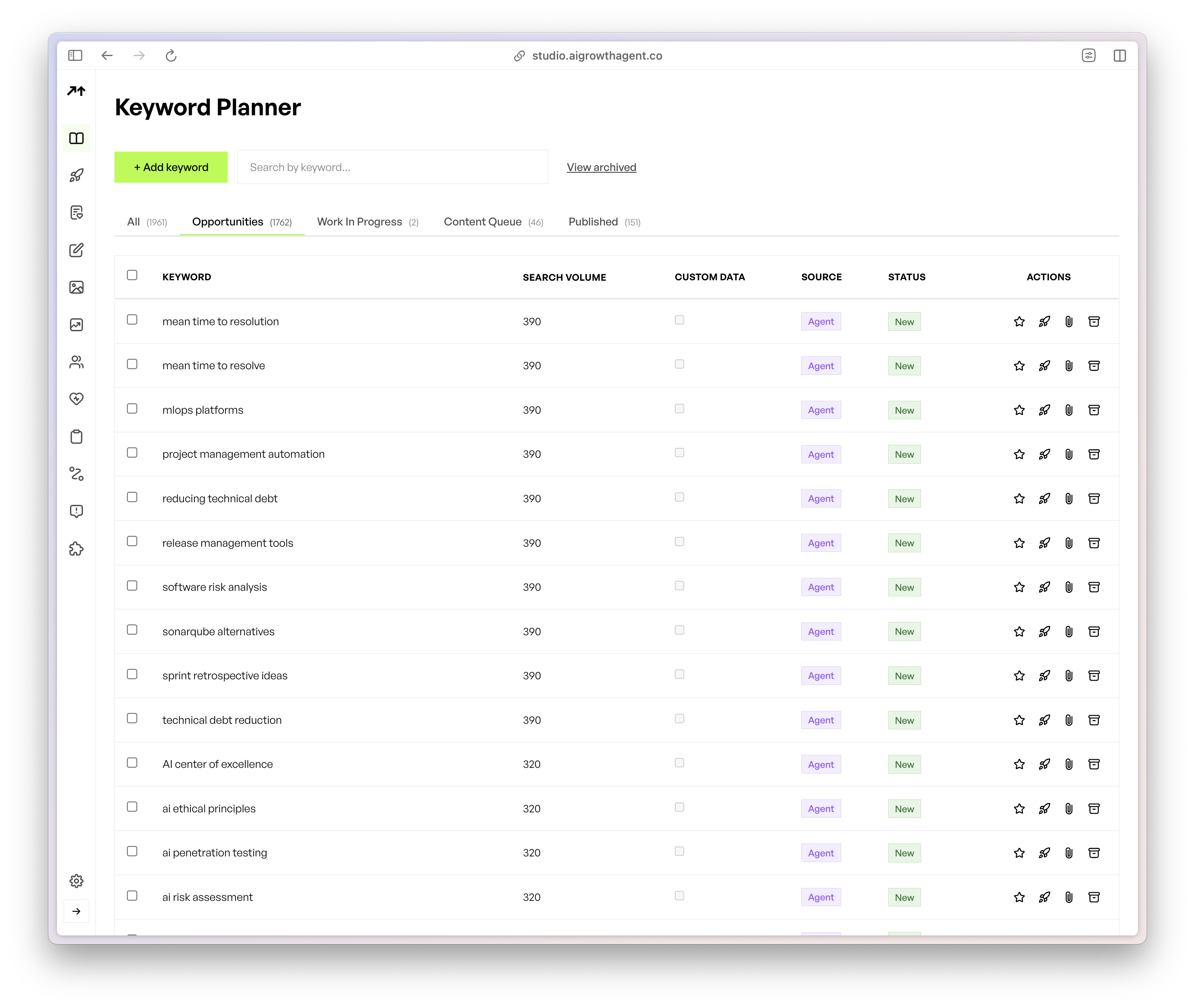
Enterprise-grade platforms analyze thousands of queries, cluster them into topics, and group them into pillar and cluster structures aligned with search intent. This approach produces clear roadmaps that prioritize themes, map templates to opportunities, and avoid duplicate content at scale. AI Growth Agent evaluates full search landscapes and business context to generate these strategies automatically, which reduces manual research overhead for in-house teams.
Automated Content Generation and Technical SEO
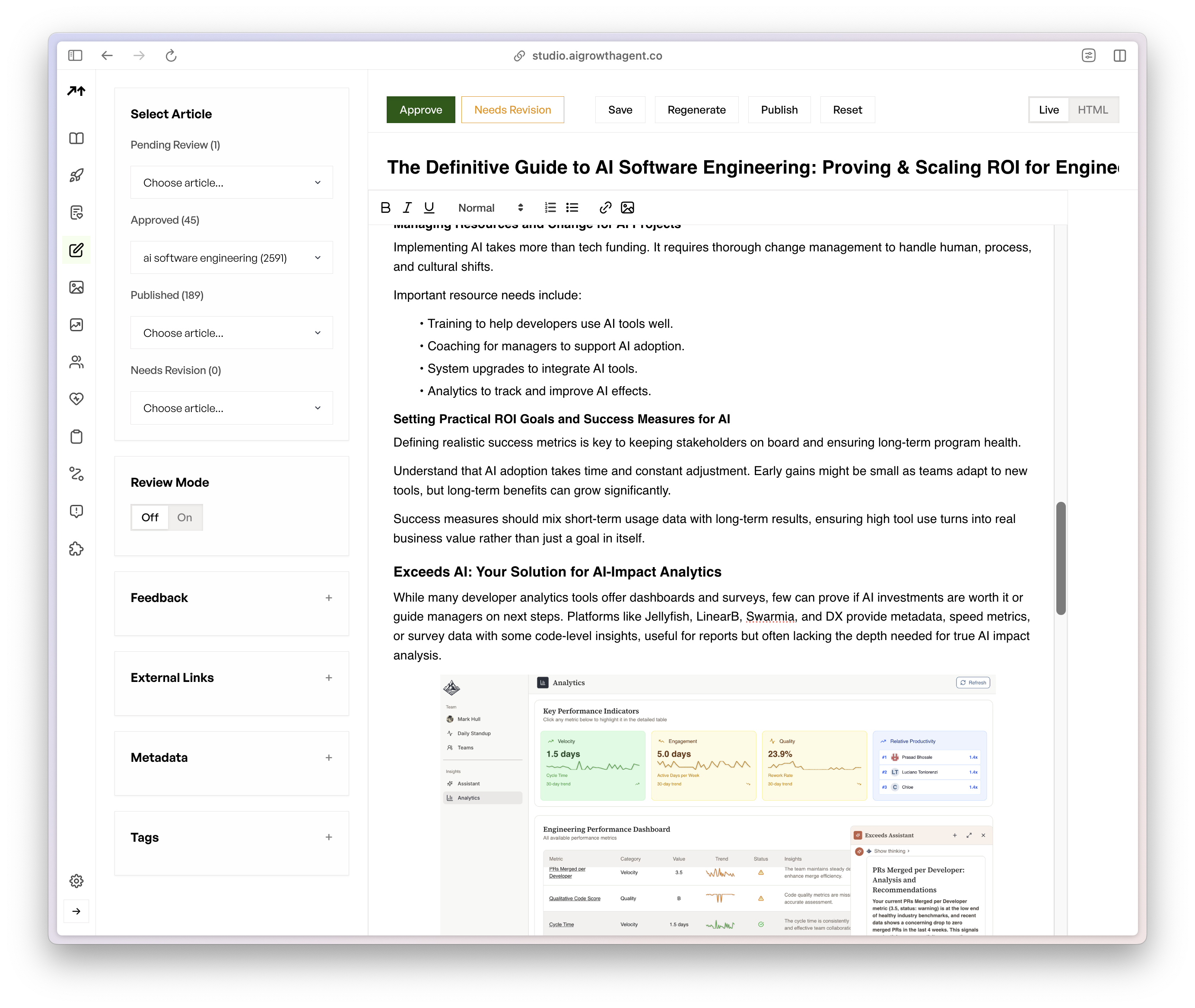
Template and parameter systems let enterprises define reusable page blueprints that adapt to large keyword sets while preserving depth and uniqueness. AI Growth Agent extends this with automatic schema markup, metadata optimization, LLM.txt files, and a blog Model Context Protocol that helps AI systems connect directly to content collections for richer citations.
Database-to-Content Automation
Enterprise platforms connect to live data sources such as pricing, availability, and location data, then convert that information into structured, indexable content. AI Growth Agent has turned offline app databases and other internal systems into full article libraries, allowing companies to convert underused data into search traffic and AI citations.
Real-Time Programmatic Content Injection
The 2026 news and trend cycle moves quickly, so platforms that can ingest a fresh article or event and generate optimized coverage within minutes create a measurable advantage. AI Growth Agent supports real-time topic feeds and outputs brand-safe articles that capture emerging search demand while aligning with existing content structures. Teams can then route this content directly to CMS publishing flows.
Teams that want to see autonomous content engineering in production can request a live AI Growth Agent walkthrough.
Operational Essentials: Integration, Workflow, and Governance
Unified Platforms Instead of Patchwork Tooling
Programmatic SEO stacks often combine Surfer, Airtable, Make, Zapier, Hexomatic, Notion, Semrush, and Byword in custom pipelines. Enterprise SEO platforms consolidate crawling, keyword research, workflows, and dashboards into single environments. AI Growth Agent follows this unified model while still integrating with existing analytics, CMS, and data platforms.
Centralized Data and Automated Workflows
Systems such as Airtable often act as central databases for templates, variables, and page configurations. Automation tools then orchestrate database-to-CMS and CMS-to-publish flows. Enterprise platforms now embed this orchestration directly, so teams can schedule bulk page creation, update large inventories safely, and apply conditional logic without writing custom glue code.
Security, Compliance, and Multi-Tenant Management
Enterprise deployments require SOC 2, ISO, and HIPAA-aligned controls, GDPR readiness, SSO, granular roles, audit logs, and strong admin capabilities. Architectures also need tenant isolation and compliance-ready data flows. AI Growth Agent supports multi-tenant setups so holding companies, portfolios, or multi-brand enterprises can run separate agents with distinct strategies, voices, and domains from one control panel.
Performance Analytics: AI Search Monitoring and Optimization Loops
AI Visibility and Citation Tracking
Platforms such as Semrush now measure brand presence across AI search surfaces similar to ChatGPT, which reflects a broader shift toward AI visibility metrics. AI Growth Agent Studio tracks indexing and citations across ChatGPT, Gemini, and Perplexity, including which URLs appear most often and the exact wording AI systems pull into responses.
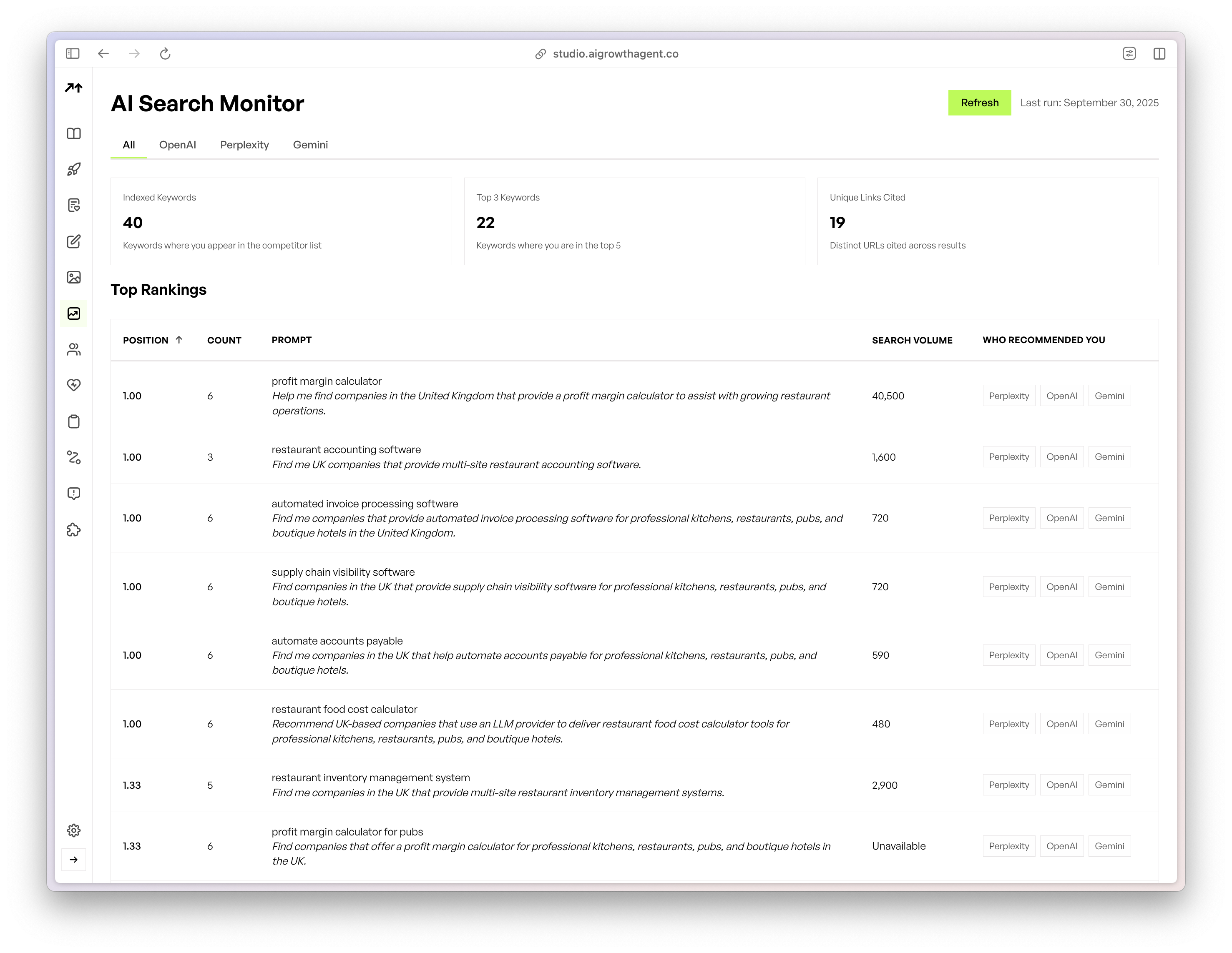
Marketing and SEO leaders who want this level of AI visibility can schedule a demo of AI Growth Agent Studio.
Iterative, Data-Driven Optimization
Enterprise SEO tools increasingly support A/B and multivariate testing, template iteration, and ML-driven optimization. Tight feedback loops that connect rankings, traffic, and conversions back to each template or page type help teams refine content programs over time. AI Growth Agent uses similar feedback to adapt strategies, templates, and internal linking patterns.
Competitive Analysis: Differentiating Autonomous Enterprise Platforms
Comparison Table: Key Enterprise Programmatic SEO Platform Features
|
Feature Category |
Traditional Agencies |
Self-Service AI Tools |
AI Growth Agent |
|
Content Scale and Velocity |
Manual, tied to headcount |
Requires setup and prompts |
Autonomous, high-volume output |
|
Technical SEO Integration |
Project-dependent |
Basic, manual configuration |
Built-in schema, LLM.txt, MCP |
|
Strategic Research |
Manual, campaign-based |
Relies on user keyword lists |
Automated clustering and mapping |
|
End-to-End Integration |
Fragmented tools |
Limited workflow coverage |
Hosted, end-to-end agent |
Why AI Growth Agent Redefines Enterprise Programmatic SEO
Earlier 2025 analyses of SEO automation tools highlighted a trend toward connecting research, content, optimization, and publishing in one flow. AI Growth Agent advances this pattern by acting as a true autonomous agent that covers strategy, content production, technical implementation, and AI search monitoring from a single system.
Frequently Asked Questions About Enterprise Programmatic SEO Platform Features
What defines an enterprise-level programmatic SEO platform?
An enterprise platform supports millions of URLs, complex taxonomies, and multiple integrations while maintaining performance, security, and brand consistency. It includes governance, role-based access, technical SEO automation, and analytics that connect content work directly to traffic and revenue outcomes in AI and traditional search.
How does an autonomous programmatic SEO agent differ from standard AI writing tools?
An autonomous agent such as AI Growth Agent manages the full lifecycle, from keyword discovery and strategy through drafting, fact-checking, schema, and direct publishing. Standard AI writing tools create text blocks that still require human planning, formatting, optimization, and implementation.
What role do vector databases play in enterprise programmatic SEO?
Vector databases like Pinecone and Weaviate store embeddings of documents and facts so AI models can retrieve precise context for each page. This retrieval step enables consistent, citation-backed content that stays aligned with verified data rather than relying only on pattern prediction.
How do platforms handle multi-site and multi-brand management?
Advanced platforms use multi-tenant architectures that let teams manage separate brands, domains, or portfolios from a shared backbone. Each tenant has its own strategies, styles, and publishing rules, while central teams maintain oversight, security, and shared infrastructure.
Teams that want to explore these capabilities in more detail can connect with an AI Growth Agent specialist.
Conclusion: Mastering AI Search With Modern Programmatic SEO Platforms
Successful enterprise deployments now follow phased rollouts, starting with infrastructure and data, then layering templates, automation, and measurement. This approach recognizes that AI-focused organic growth relies on both technical foundations and continuous optimization.
Manual SEO and simple AI copy tools no longer match the scale and precision that AI search ecosystems reward. Organizations that adopt autonomous, enterprise-ready programmatic SEO platforms such as AI Growth Agent can build defensible authority, earn more AI citations, and extend their reach across both traditional and AI-native search surfaces.
Marketing and growth leaders who are ready to modernize their approach can schedule a demo with AI Growth Agent and evaluate whether an autonomous programmatic SEO agent fits their 2026 search strategy.