Written by: Mariana Fonseca, Editorial Team, AI Growth Agent | Last updated: January 10, 2026
Key Takeaways
- AI-powered search in 2026 favors structured, high-quality content that AI systems can easily parse, reuse, and cite as credible answers.
- Programmatic SEO now depends on strict technical compliance, including clean HTML, schema markup, and emerging AI-specific protocols such as LLM.txt and MCP.
- E-E-A-T signals, user intent alignment, and engagement metrics shape which brands’ AI assistants surface and recommend across critical queries.
- Traditional SEO workflows and basic AI content tools struggle to deliver the technical precision and quality needed at programmatic scale.
- AI Growth Agent provides an autonomous programmatic SEO system that plans, creates, and monitors AI-ready content at scale, with demos available for teams that want to assess fit.
The AI Search Transformation: A New Paradigm for Digital Authority
AI-driven assistants and answer engines now shape discovery more than traditional ten-blue-link results. Google AI Overviews via Gemini, ChatGPT, Perplexity, and similar systems act as primary discovery layers that summarize information inside their own interfaces.
AI search experiences that synthesize content directly in the interface are eroding open-web traffic flows, while the volume of AI-generated material makes brand voices harder to distinguish.
AI Overviews and LLM-based engines favor structured, semantic content. Effective AI search optimization focuses on entities, relationships, and machine-readable structure rather than only keyword density. Brands that do not adapt their content to this model risk disappearing from AI-generated answers.
Engineering Programmatic SEO Compliance for AI Indexing
Structured Data and Semantic Markup: The Foundational Layer
Metadata and schema markup now function as core AI SEO components. JSON-LD Schema.org markup gives AI models a precise map of entities, relationships, and content sections.
Each programmatic page needs clearly defined structured data that states whether it describes a product, service, article, or FAQ. This structure increases the odds that AI systems extract the right snippet and cite it in responses.
Technical HTML and Site Architecture for AI Agents
Clean, semantic HTML with logical heading hierarchies helps AI agents interpret and reuse content as concise answers. Well-organized sections and headings guide AI systems as they chunk content into reusable units.
Standard technical SEO elements also contribute to AI visibility. XML sitemaps, clear internal linking, and performance optimization provide reliable crawl paths, and Core Web Vitals and fast, stable experiences serve as quality signals for AI-driven search.
Emerging AI-Specific Protocols: LLM.txt and Model Context Protocol
New AI-focused standards help direct model behavior. Protocols such as MCP servers and llms.txt files provide instructions for how AI crawlers and LLMs should access and use site content.
LLM.txt files can prioritize important sections, while Model Context Protocol servers allow AI systems to tap into structured datasets in real time. These approaches give brands more control over how programmatic content appears in AI-generated answers.
Marketing and product teams can align their programmatic SEO with these technical standards. AI Growth Agent supports AI-readability at scale through automated implementation of these elements.
Elevating Programmatic SEO Quality for AI Citation
Content Authority and Depth: Beyond Keywords
Modern SEO now blends with Answer Engine Optimization, where content must support how AI systems extract and present answers. Depth, semantic coverage, and topical completeness carry more weight than raw keyword counts.
Programmatic templates that solve complete tasks or questions outperform shallow pages that only repeat target phrases. High-value programmatic content combines structured data with useful explanations, examples, and clear next steps.
E-E-A-T and Trust Signals in the AI Era
E-E-A-T has become a stronger filter for AI systems choosing sources, especially in sensitive categories. Signals of experience, expertise, authoritativeness, and trust increasingly influence which domains AI assistants rely on.
Visible author credentials, clear sourcing, and transparent references function as trust signals that models can detect and weigh. Programmatic pages that include expert input and original perspectives stand out from generic, aggregated data.
User Intent Alignment and Engagement Metrics
Detailed user intent mapping helps AI systems match pages to specific needs and stages in the journey. Programmatic structures that label and design content around clear intents give AI a cleaner signal.
User engagement interacts with these signals. Metrics such as dwell time, bounce rate, and on-page interaction provide evidence that content satisfies real users, which in turn supports AI visibility.
Brands that want a durable AI presence need a large base of high-quality, intent-matched programmatic content. AI Growth Agent focuses on this combination of coverage, depth, and structure.
The Programmatic SEO Challenges and AI Growth Agent’s Solution
Why Traditional Solutions Struggle in the AI Era
|
Attribute |
Traditional SEO Agencies |
Basic AI Content Tools |
AI Growth Agent |
|
Content Velocity |
Slow, manual, limited by headcount |
Unstructured, requires manual deployment |
High volume, automated, continuous publishing |
|
Technical Compliance |
Limited AI indexing expertise |
No schema or metadata implementation |
Automated schema, MCP, and LLM.txt setup |
|
Quality at Scale |
Hard to maintain, expensive |
Often generic or low-quality output |
Consistent, brand-aligned, optimized for AI search |
|
End-to-End Automation |
Manual workflows, high overhead |
Requires ongoing human coordination |
Autonomous publishing and monitoring |
AI Growth Agent: A Specialized Programmatic SEO Agent
AI Growth Agent operates as a dedicated Programmatic SEO Agent that designs and maintains AI-ready content architectures for companies that want to be cited across AI assistants. The system closes the gap between manual editorial quality and the volume required for programmatic coverage.
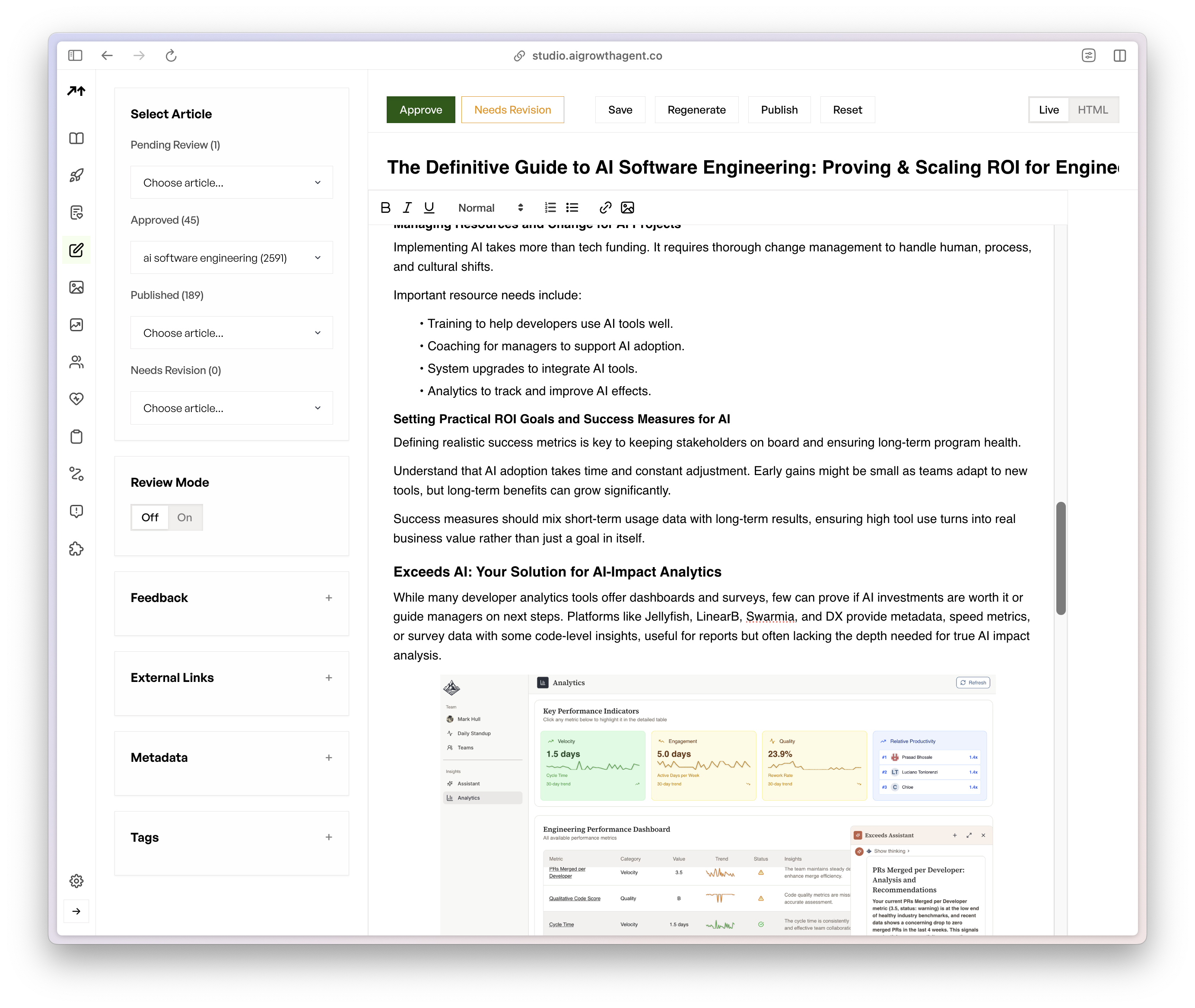
Key capabilities include a focused onboarding process that captures a brand narrative in a Company Manifesto, then feeds it to the agent. Programmatic keyword and content research identifies scalable topic clusters, and an autonomous technical layer deploys AI-ready blog structures and clean foundations that match the brand.
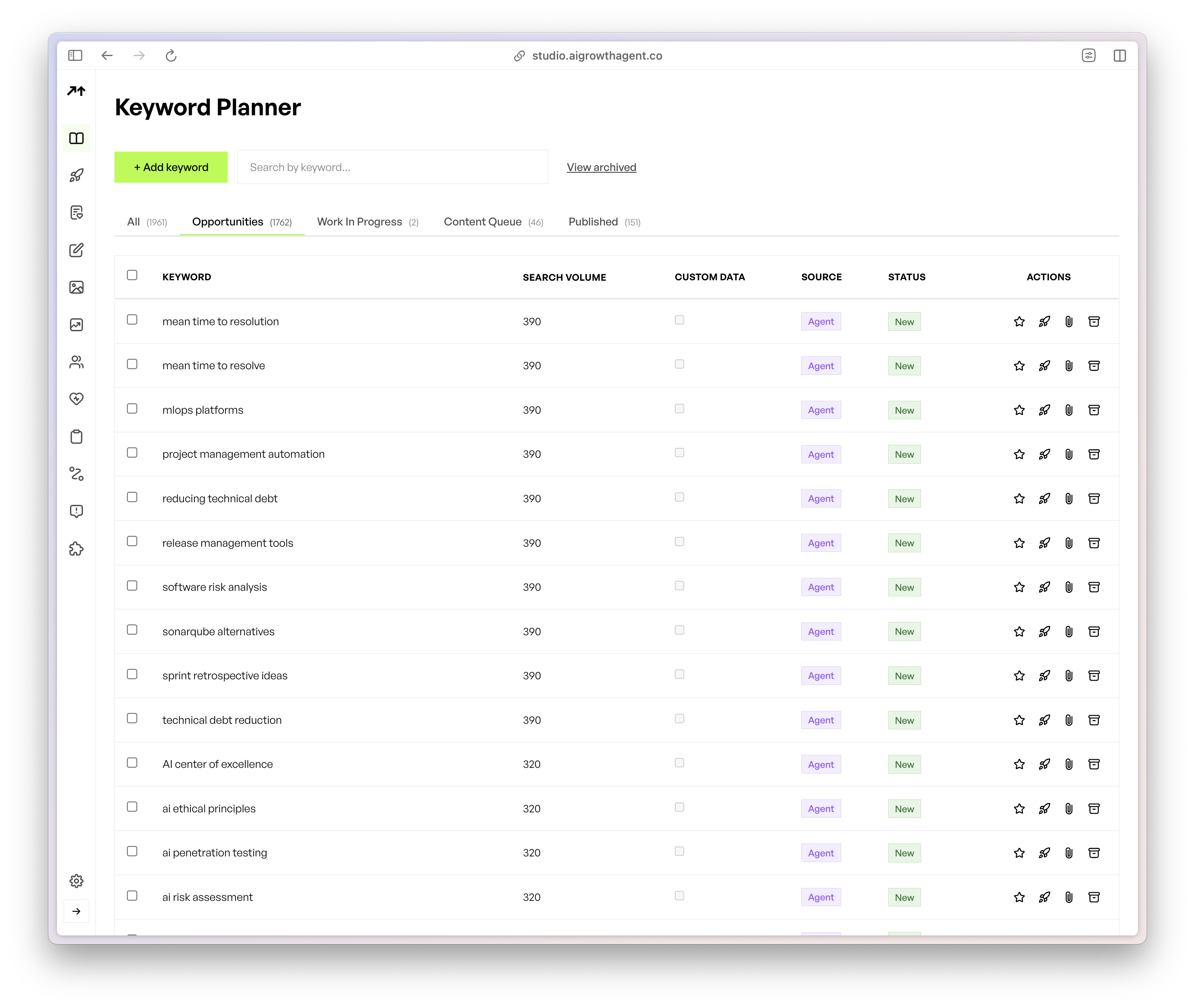
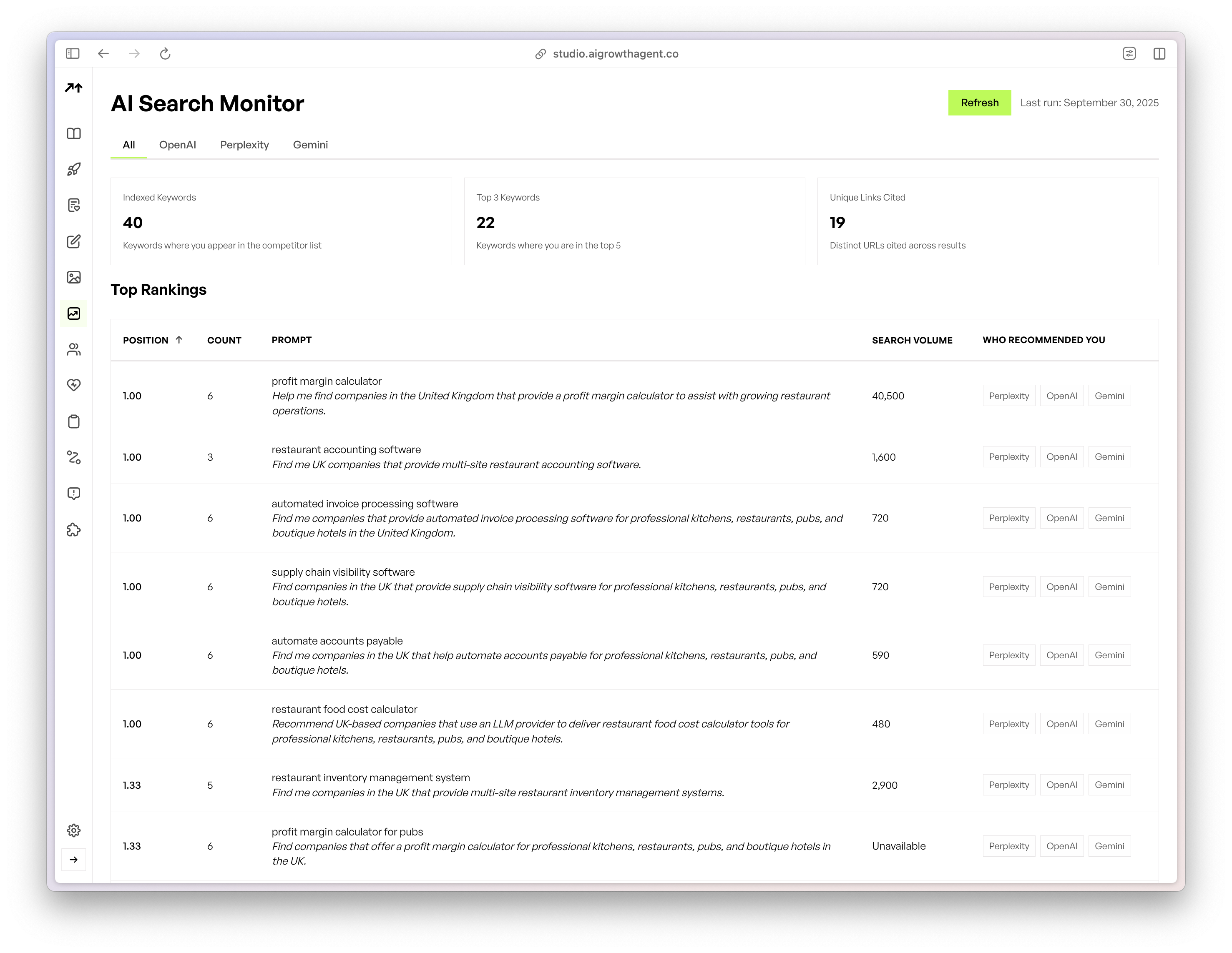
The Programmatic SEO Content Agent manages strategy, briefs, drafting, fact-checking, and technical SEO implementation, including structured data and metadata. An AI Search Monitor tracks visibility and citations across ChatGPT, Gemini, and Perplexity so teams can see how AI surfaces their content.
Capabilities That Support Category Authority
AI Growth Agent supports multi-tenant deployments, so teams can run parallel agents for different brands or product lines from a single interface, each with its own Manifesto and strategy. Real-time topic detection enables rapid publishing around emerging themes, and database-to-content automation converts proprietary data into structured, search-ready content.
Intelligent asset placement selects and embeds relevant visuals with appropriate metadata to strengthen both usability and AI readability. Teams can see this end-to-end system in action through a live demo.
AI Growth Agent Programmatic SEO Success Stories
Exceeds AI – Performance Reviews for Engineers
Exceeds AI reached Perplexity recommendations as a leading alternative to competitors in two weeks and began appearing in Google AI Overview and Gemini snapshots for core queries soon after. They now feature across major AI assistants for searches related to AI performance review tools for engineers.
BeConfident – English Learning on WhatsApp
BeConfident faced established language-learning brands but gained rapid indexing through programmatic publishing. Their content then earned visibility in Google AI Overview and Gemini, showing how structured programmatic SEO can open space in competitive categories.
Bucked Up – Sports Nutrition Brand
Bucked Up gained ChatGPT citations for protein soda within three weeks of publishing and now appears for high-intent searches such as “best protein soda.” Programmatic coverage and technical precision helped them compete against larger incumbents.
Gitar – Supercharge CI with AI
Gitar became a reference brand for AI-powered CI/CD automation in under two months. They frequently appear as a cited tool across Google AI Overview, Gemini, ChatGPT, and Perplexity for queries about fixing CI builds and AI reviewers for CI failures.
Conclusion: Mastering AI Search with Programmatic SEO
Programmatic SEO compliance and content quality now define which brands AI search engines recognize and cite. Traditional methods that rely on manual workflows and basic keyword optimization no longer match the technical and semantic standards of AI assistants.
AI Growth Agent gives marketing leaders an autonomous system for building and maintaining AI-ready content architectures at scale. Teams that want to strengthen their position in AI search can book a strategy session with AI Growth Agent.
Frequently Asked Questions (FAQ)
How do AI search engines define quality for programmatic content, and how can brands ensure compliance?
AI systems favor content that answers a query completely, uses clear structure, and displays E-E-A-T. Compliance involves JSON-LD Schema.org markup, clean semantic HTML, and support for AI-specific standards such as LLM.txt. Brands also need expert insights and unique perspectives so that pages add more value than raw data.
What is the role of structured data in achieving programmatic SEO compliance in the AI era?
Structured data gives AI models explicit signals about what each page represents and how different elements relate to each other. Schema markup across Article, FAQ, HowTo, Product, and Review content helps AI identify the best snippet for an answer. This clarity increases the chance that programmatic pages are surfaced and cited in AI-generated responses.
How can programmatic content avoid being categorized as low-quality or spam by AI search algorithms?
Programmatic content needs clear intent, sufficient depth, and visible expert input rather than thin lists of data. Templates that include commentary, guidance, and context tend to pass quality thresholds more reliably. Internal linking, related resources, and a logical hierarchy reinforce that each page is a complete resource for a focused query.
What are the key performance indicators for monitoring programmatic SEO compliance and quality in AI search?
Important KPIs include AI visibility and citations across ChatGPT, Gemini, and Perplexity, plus the specific URLs that drive those mentions. Crawl data from AI-related bots and trends in organic clicks show how programmatic content performs over time. These metrics help teams prioritize updates and new content that can improve AI coverage.
How does AI Growth Agent ensure continuous improvement in programmatic SEO performance?
AI Growth Agent runs a feedback loop that monitors how content appears across major AI assistants and feeds that data back into planning. The Studio interface shows keyword indexing, URL-level visibility, and live citations so teams can see which topics and formats work best. These insights guide the next wave of programmatic content and technical refinements.