Written by: Mariana Fonseca, Editorial Team, AI Growth Agent | Last updated: January 10, 2026
Key Takeaways
- AI search in 2026 favors brands that appear as cited sources inside AI-generated answers, not just as blue links in traditional search results.
- Structured, topic-based content architectures and clear entity definitions help AI systems understand when your brand is a relevant authority.
- Programmatic content velocity and precise technical markup now set the baseline for staying visible across AI search engines at scale.
- Human oversight, expert review, and clear brand guidelines remain essential for building trust and credibility with both AI systems and real buyers.
- Marketing leaders can use AI Growth Agent to operationalize GEO, technical SEO, and AI search monitoring in one workflow; schedule a demo to see if you’re a good fit.
The old rules of SEO are changing. Traditional search optimization focused on ranking URLs, while the future favors brands that earn citations inside AI-generated answers across ChatGPT, Google AI Overviews, and Perplexity. Schedule a demo to see if you’re a good fit and explore how AI Growth Agent can align your content strategy with this new reality.
1. Prioritize Generative Engine Optimization (GEO) Over Traditional SEO
Generative Engine Optimization shifts focus from positions on a results page to presence inside AI-generated responses. The goal is clear: increase how often AI systems cite your content when answering user questions.
Effective GEO treats each piece of content as a source of concise, quotable information. AI models need clear facts, definitions, and step-by-step explanations that are easy to extract and recombine into answers.
- Structure pages around specific questions and subtopics.
- Use clear headings and short sections that each address a single idea.
- Highlight definitions, data points, and processes in compact paragraphs or lists.
Measurement also changes. Instead of tracking only keyword rankings and organic traffic, marketing leaders should monitor AI citation frequency and share of voice across AI platforms.
The technical foundation includes structured content formats and schema markup that clarify entities, relationships, and context for AI. AI Growth Agent applies this programmatically, so GEO principles shape content architecture across large libraries instead of on a page-by-page basis.
2. Engineer Content Architecture for AI Authority and Entity Recognition
AI systems deconstruct queries into sub-intents, then pull from many related topics to build answers. Brands that organize content around coherent topic clusters have a better chance of being treated as reliable sources.
A strong AI-oriented content architecture starts with clear entity and topic models. Your brand, products, solutions, and core concepts need explicit definitions and consistent relationships across your site.
- Map core entities, such as brand, product lines, and key customer problems.
- Build topic clusters that cover each problem area from strategy to execution.
- Use schema markup to connect entities, topics, authors, and formats.
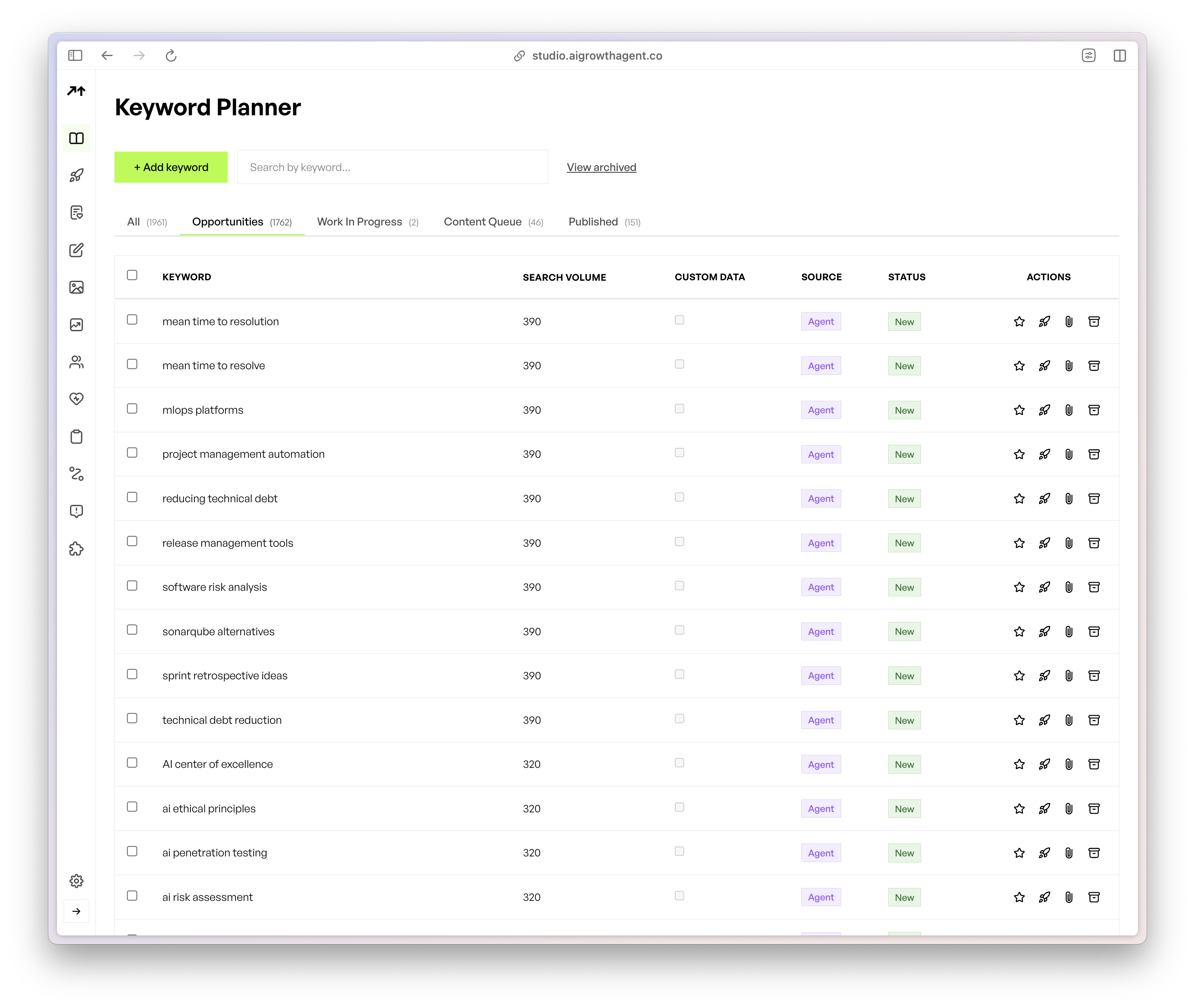
Moving from keyword-only planning to comprehensive topic modeling helps AI understand where your brand fits in the broader landscape. AI Growth Agent’s Programmatic SEO Agent identifies topic relationships and builds systematic coverage built for AI authority, not just single-page rankings.
3. Embrace Programmatic Content Velocity and Technical Precision
AI-generated content volume is increasing rapidly, which raises the bar for discoverability. Brands that rely on manually publishing a few articles per month fall behind those that use programmatic systems to achieve consistent, high-frequency output.
AI search engines favor recent, deep, and structurally consistent content libraries. Brands that publish only one or two manually crafted articles each month give competitors room to dominate AI answers with more comprehensive coverage.
Technical precision matters as much as volume. Schema markup, LLM.txt, and protocols that help AI systems interface with your content all increase the likelihood of citations.
|
Feature/Benefit |
AI Growth Agent (Programmatic SEO Agent) |
Traditional SEO Agencies |
Basic AI Content Tools |
|
Content Velocity |
Autonomous, high-frequency publishing (daily or near-daily) |
Limited by billable hours |
Manual output, unstructured text |
|
Technical Precision |
Advanced schema, LLM.txt, Model Context Protocol |
Basic SEO, limited engineering |
Minimal or no AI-focused technical work |
|
Authority Engineering |
Builds comprehensive content for AI citation |
Focus on individual page ranking |
Generates text, lacks strategic architecture |
|
Cost Model |
Platform-based, scalable |
High, per-hour or project |
Low-cost, but high manual effort |
Brands that want to compete in AI search need systems that automate content engineering, technical optimization, and publishing. AI Growth Agent combines programmatic velocity with AI-aware technical implementation, so marketing teams can scale GEO without adding headcount. Schedule a demo to see if you’re a good fit if you want to assess this approach for your team.
4. Cultivate Human-Centric Trust Signals
AI can generate and structure content at scale, but trust still depends on human expertise and accountability. AI systems factor in signals such as author expertise, editorial standards, and consistency with trusted sources.
Marketing leaders benefit from pairing automation with clear human oversight. Expert review, documented style and ethics guidelines, and visible authorship all contribute to stronger trust signals.
- Define a brand narrative that explains who you serve and why you are credible.
- Document voice, tone, and boundaries for what the brand will and will not claim.
- Route high-impact content through expert or stakeholder review before publishing.
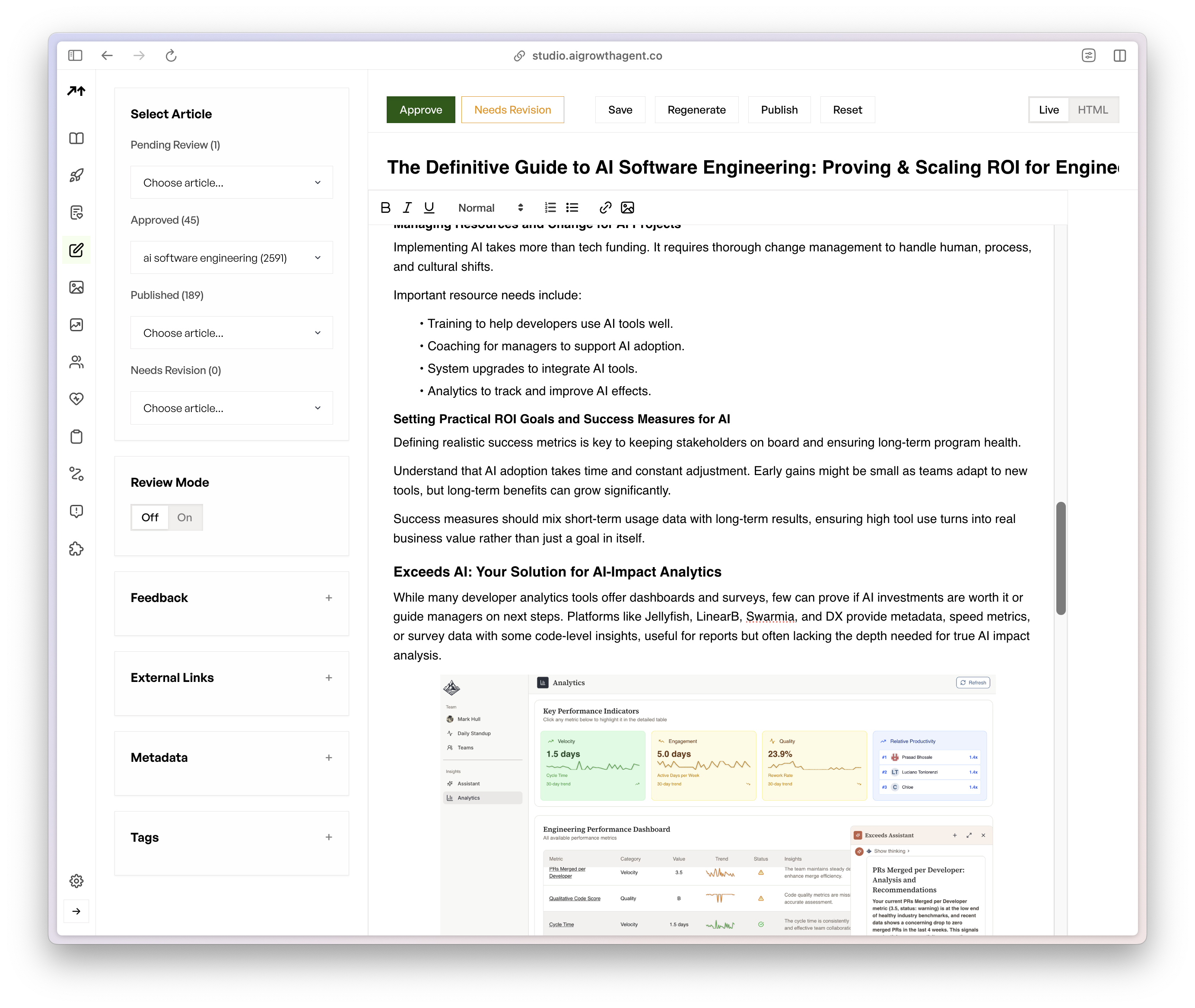
AI Growth Agent supports this model with an onboarding process that captures your brand narrative in a Company Manifesto and with workflows in the AI Growth Agent Studio that keep humans in the loop. The system uses that context to guide programmatic content while preserving voice and standards at scale.
5. Implement a Closed-Loop AI Search Monitoring and Feedback System
AI-powered content strategy only works when you can see how content performs across AI search engines. Traditional analytics that focus on rankings and organic traffic miss how often AI answers reference your brand.
Modern monitoring needs to track:
- Citation frequency across ChatGPT, Google AI Overviews via Gemini, Perplexity, and other AI platforms.
- Share of voice for priority topics inside AI-generated answers.
- Which URLs, topics, and formats most often appear in AI responses.
- Activity from AI-specific crawlers and bots across your site.
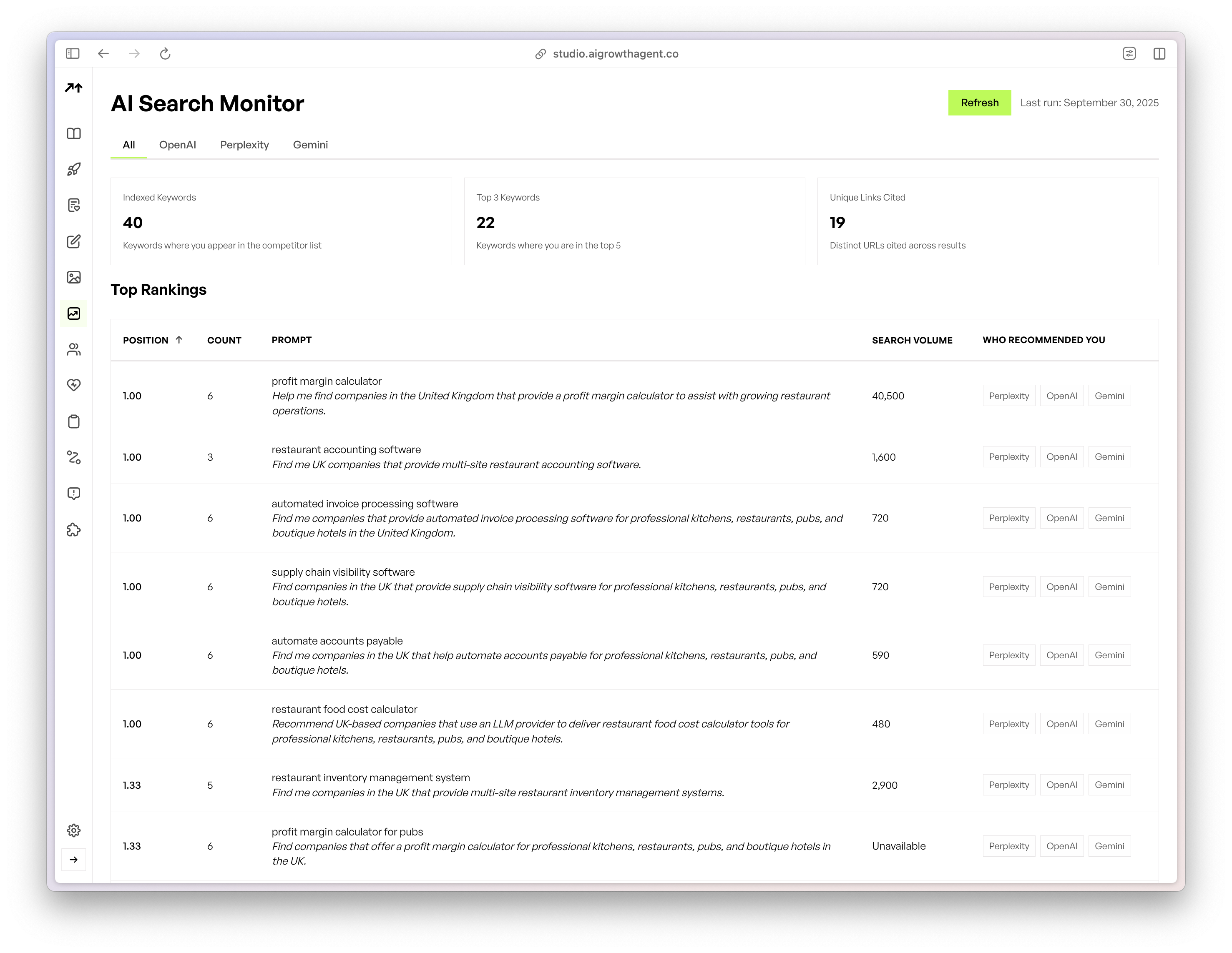
Visibility alone is not enough. Content and technical teams need a feedback loop that connects AI performance data to content planning, optimization, and internal linking decisions.
AI Growth Agent’s AI Search Monitor provides this type of closed loop. The platform surfaces heatmaps of keyword indexing across AI platforms, direct citations, and performance trends alongside traditional analytics, so marketing leaders can refine content strategy with current AI search data.
Frequently Asked Questions
How is AI-powered content strategy different from traditional SEO?
Traditional SEO focuses on ranking web pages in organic search results through keyword and on-page optimization. AI-powered content strategy focuses on being cited and synthesized directly into AI-generated answers across tools such as ChatGPT, Google AI Overviews, and Perplexity. This approach emphasizes topic authority, structured information, and entity clarity so AI systems can understand and reuse your content.
Does an AI-powered content strategy replace the need for human content creators or strategists?
AI-powered content strategy changes how human teams work but does not remove the need for them. AI automates repetitive tasks such as drafting, structuring, and technical optimization, while human strategists define positioning, messaging, and priorities. Platforms like AI Growth Agent reduce manual production and technical overhead so marketers can focus on narrative, differentiation, and campaign strategy.
What are the benefits of programmatic content velocity in AI search?
Programmatic content velocity helps brands keep pace with AI search engines that reward recency, depth, and coverage. A programmatic approach supports frequent publishing with consistent structure and markup, which improves the odds that AI models will discover, understand, and cite your content across a wide range of related queries.
Conclusion: Build Durable Authority in an AI-Driven Search Landscape
AI-driven search is reshaping how people discover solutions and evaluate vendors. Marketing leaders who adapt their strategies to GEO, entity-focused architecture, programmatic velocity, human trust signals, and closed-loop monitoring will be better positioned to earn consistent citations in AI-generated answers.
The window for gaining an advantage in AI search is narrowing as more brands adopt AI-powered content systems. Teams that move now can establish the authority, topic coverage, and technical foundation needed to compete over the long term.
AI Growth Agent provides a focused way to apply these practices through programmatic SEO, AI search monitoring, and brand-aware content automation. Schedule a demo to see if you’re a good fit and explore how your team can build durable authority in AI-powered search.