Written by: Mariana Fonseca, Editorial Team, AI Growth Agent | Last updated: January 10, 2026
Key Takeaways
- Long-form content tools in 2026 must focus on programmatic authority, not only text generation, so AI search engines can confidently cite your brand.
- Built-in technical SEO, including schema, metadata, and AI-specific files, is now a baseline requirement for content to appear in AI search results.
- End-to-end autonomous workflows and continuous learning allow small teams to run large-scale, authoritative content programs for AI search.
- Real-time adaptability, multi-tenant support, and verifiable AI search monitoring provide a measurable competitive edge across multiple brands or portfolios.
- AI Growth Agent delivers these capabilities through an autonomous programmatic SEO agent; schedule a demo to see it in action.
1. Programmatic Authority Engineering, Not Just Content Generation
Effective long-form AI in 2026 must engineer authority into every piece of content, not just assemble paragraphs. The system needs to handle deep keyword clustering, cover topics comprehensively, apply structured schema, and follow a clear Company Manifesto that encodes your brand’s narrative and positioning.
This programmatic approach positions content as a definitive source that Large Language Models can cite reliably. Many tools generate articles but still require manual work to add structure, strategy, and technical SEO. Marketing leaders benefit from solutions that build authority at scale. AI Growth Agent focuses on this by automating Programmatic SEO architectures and turning topic clusters into structured content assets, as seen in client examples like Bucked Up and Gitar.ai that gained rapid AI search citations.
2. Autonomous Technical SEO Integration at Scale
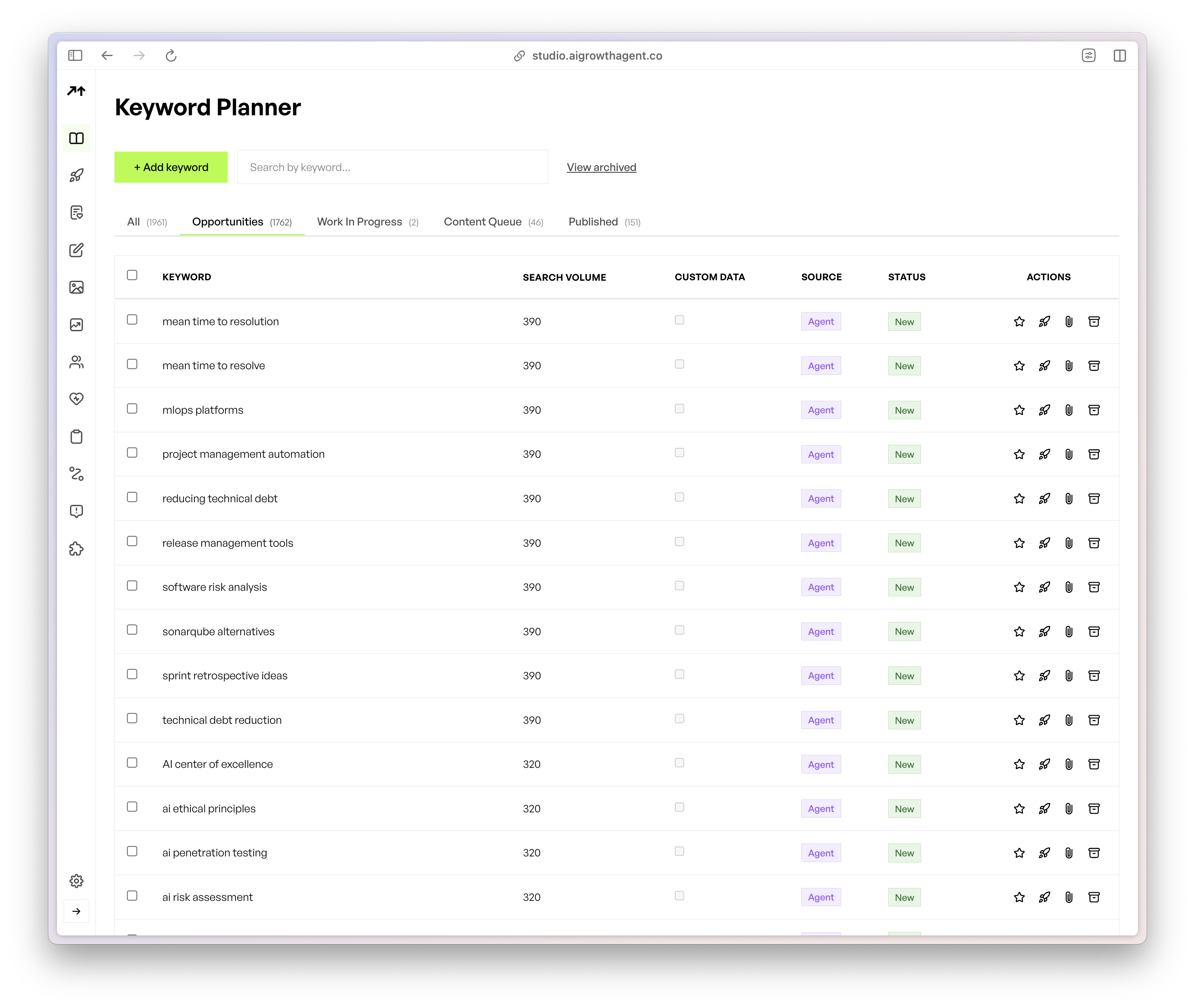
Success in AI search depends on technical SEO built into the content creation process. An effective long-form AI tool should apply rich schema types such as Article, FAQ, and Product, set metadata, optimize image alt text, and generate AI-focused files like LLM.txt and Model Context Protocol configurations.
Content that lacks this technical layer often struggles to surface in AI search, even when the writing quality is strong. Some tools suggest on-page improvements but still rely on manual implementation or extra integrations, which slows execution.
Organizations that want consistent visibility in AI search need AI tools that embed technical SEO from the start. Manual checklists cannot keep pace with the speed and volume required. AI Growth Agent automates this technical infrastructure so every long-form piece is engineered for AI indexing, without requiring your team to become technical SEO specialists.
See how AI Growth Agent automates advanced technical SEO for your content in a live demo.
3. End-to-End Autonomous Workflow and Continuous Learning
Modern long-form AI should operate as a full content engineering system. The ideal workflow covers keyword and topic research, brief creation, drafting, fact-checking, technical optimization, and direct publishing into platforms like WordPress or Webflow.
Many general-purpose AI tools assist with writing but leave gaps around research, formatting, and publishing. Those gaps create friction, limit scale, and increase dependence on manual work for every article.
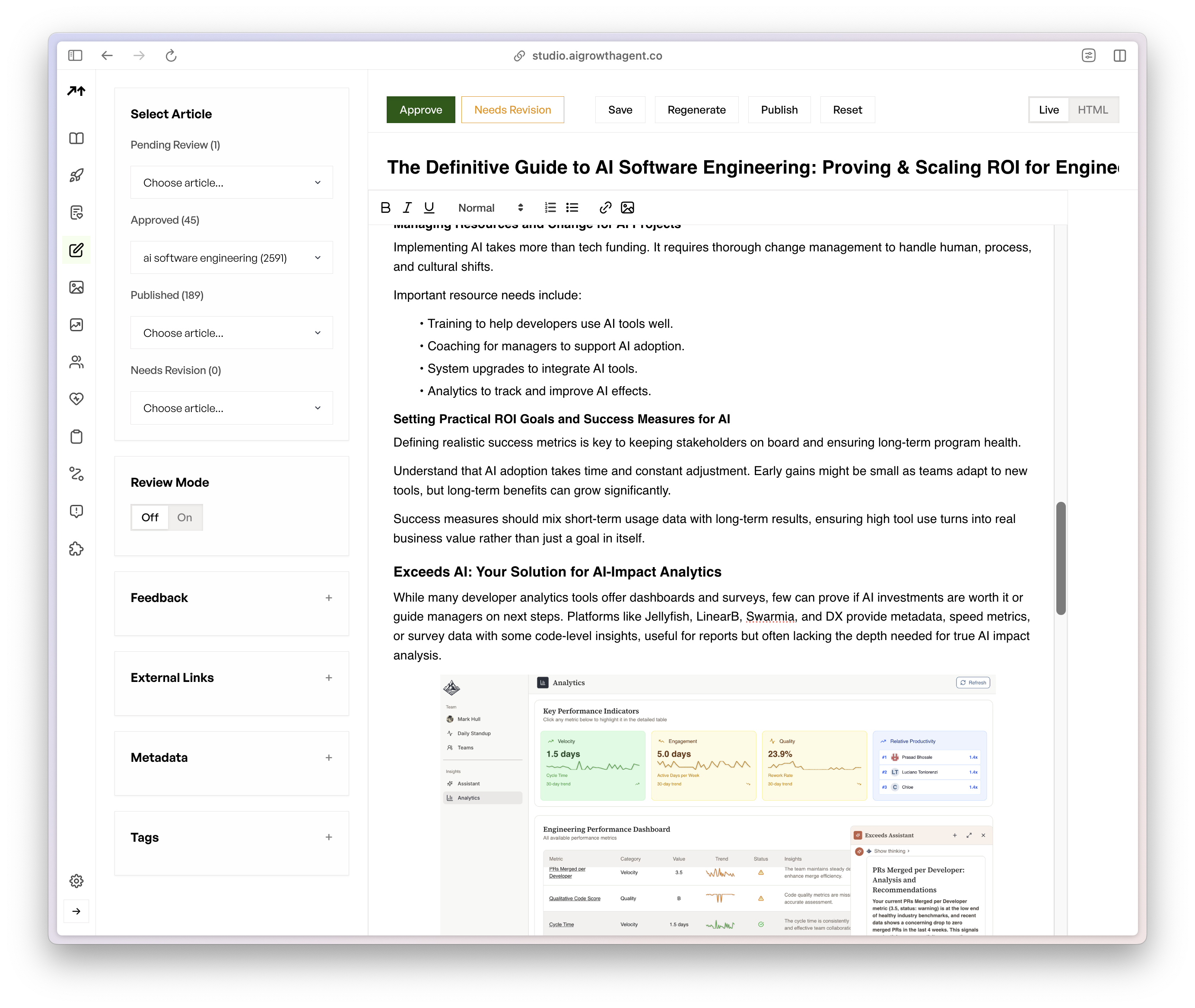
Autonomous systems that learn from your edits and guidelines improve over time. AI Growth Agent uses a Studio environment where teams can edit drafts, give feedback, and refine the Company Manifesto. The agent then incorporates those patterns and can eventually operate in an Auto-Pilot mode, which has helped brands like BeConfident get content indexed and recommended quickly in AI search results.
4. Real-Time Adaptability and Multi-Tenant Deployment for Competitive Edge
Brands that react quickly to trends and new search patterns gain more AI visibility. An effective long-form AI platform should support real-time content injection, so teams can publish authoritative, optimized pieces as soon as new topics or data emerge.
Organizations that manage multiple brands, portfolios, or product lines also benefit from multi-tenant deployment. A strong solution lets several autonomous agents run in parallel from one interface, each aligned to its own Company Manifesto, voice, and strategy.
Traditional single-instance writing tools rarely support this level of operational flexibility. Limited integrations and manual workflows hold back content velocity and make it hard to coordinate at scale.
AI Growth Agent addresses this by offering multi-tenant programmatic deployment and the ability to convert proprietary or third-party data feeds into pSEO assets. This setup helps teams respond to market changes faster and turn short-lived opportunities into durable search authority.
Schedule a demo to see how AI Growth Agent supports real-time content and multi-brand deployment.
5. Verifiable AI Search Citation and Performance Monitoring
Publishing content is only part of the job. In 2026, marketers also need clear visibility into how AI search engines use that content. Long-form AI tools add more value when they connect to your CMS, streamline publishing, and show where and how AI systems such as ChatGPT, Gemini, and Perplexity reference your pages.
Some AI tools provide source links for their own responses, but very few track how AI systems cite a specific brand. That gap makes it difficult to measure authority, refine strategy, or show stakeholders concrete AI search outcomes.
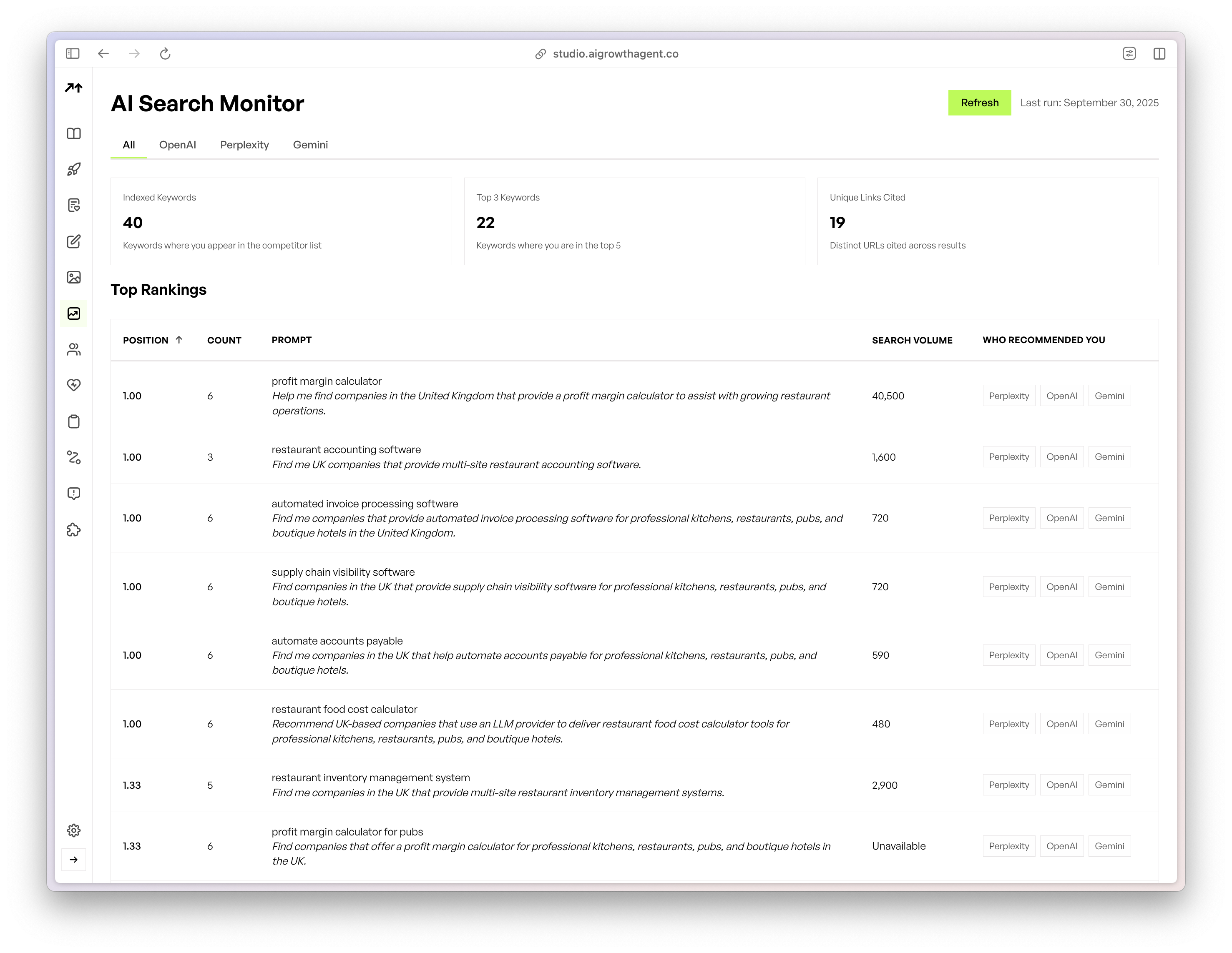
Reliable monitoring across AI platforms supports better decisions on topics, formats, and internal linking. AI Growth Agent’s AI Search Monitor tracks citations, crawl activity from AI bots, and the presence of your content in AI answers, which has helped clients like Exceeds AI identify where they appear across multiple AI search environments.
Frequently Asked Questions About AI for Long-Form Content
Can generic AI content tools achieve programmatic SEO?
Generic AI tools can assist with drafting and ideation, but many do not handle strategy, schema, internal linking, and publishing in a coordinated way. Programmatic SEO usually requires an integrated system that automates these steps at scale, so teams are not rebuilding workflows for every article.
How does AI search citation differ from traditional SEO ranking?
Traditional SEO aimed to place a webpage on search engine results pages. AI search citation centers on whether an AI model uses your content as a referenced source inside its answer, such as in a ChatGPT response or a Google AI Overview from Gemini. This type of citation signals higher trust and demands deeper, more context-rich long-form content.
Is it possible for a small team to produce authoritative long-form content at scale for AI search?
A small team can operate a large program when it relies on an autonomous programmatic SEO agent rather than manual production. Tools like AI Growth Agent are built to manage keyword research, technical SEO, and publishing, which lets a lean group oversee a broad content footprint while keeping quality standards high.
What are common limitations of current AI long-form content tools?
Many tools deliver uneven quality on complex topics, require extensive editing, and do not integrate tightly with CMS platforms. Most are centered on content generation instead of authority engineering, so they may not provide the structured, technically optimized content that AI search engines prefer to cite.
How can teams assess whether an AI content strategy works in the AI search era?
Teams gain the clearest picture when they track AI search citations alongside traditional metrics such as organic traffic and rankings. Visibility into where ChatGPT, Perplexity, and Google AI Overview reference your content helps confirm whether long-form pieces function as trusted sources rather than just indexed pages.
Conclusion: The Future of Long-Form Content Is Programmatic Authority
AI search in 2026 favors brands that treat long-form content as a structured, engineered asset. The most effective tools now combine programmatic authority, technical SEO, autonomous workflows, and verifiable AI search monitoring into a single system.
Marketing leaders who adopt this approach position their brands as reliable sources for both users and AI models. AI Growth Agent is built for this environment, helping teams deploy autonomous programmatic SEO at scale while keeping clear sight of AI search performance.
Strengthen your content strategy with AI Growth Agent by scheduling a demo.