


Key Takeaways
- AI search in 2026 favors brands that publish structured, citation-ready content at scale, not isolated keyword-focused blog posts.
- Programmatic SEO turns your expertise into organized content pillars and clusters that AI systems can easily understand, index, and cite.
- Technical elements such as schema, metadata, LLM-facing files, and clear site architecture now play a central role in AI visibility.
- Consistent monitoring of AI citations and feedback loops helps marketing leaders refine strategy and prove ROI from organic growth.
- AI Growth Agent provides a programmatic SEO platform that engineers, publishes, and monitors AI-ready content at scale, and you can explore it by scheduling a demo.
The Shifting Landscape: Why Traditional SEO Fails in the AI Era
AI search has shifted the goal from keyword rankings to AI citations. When someone asks ChatGPT, Google AI Overviews with Gemini, or Perplexity for advice, these systems synthesize responses and highlight a few trusted sources.
Manual keyword targeting, slow content cycles, and generic AI writing tools cannot keep pace. The amount of AI-ready content grows every day, so a static blog with a few posts per month loses visibility over time.
Competitors that adopt programmatic SEO publish structured, technically sound content across hundreds of topics. Brands that rely only on traditional agencies or small internal teams struggle to match that volume and structure. When AI systems do not find enough high-quality information about your brand, they surface competitors instead.
Marketing leaders who want to define their narrative in AI search need a content engine built for scale and technical precision. Schedule a consultation session with AI Growth Agent to evaluate whether programmatic SEO is a fit for your team.
Step 1: Understanding AI Search Engines and Their Content Demands
What AI Search Engines Prioritize
AI systems such as ChatGPT, Google AI Overviews with Gemini, and Perplexity evaluate content based on authority, factual accuracy, depth, recency, structure, and clear context. They focus on meaning and topical coverage instead of simple keyword density.
Well-structured pages that answer questions directly, explain concepts in depth, and show consistent quality across a site gain more citations. Content that reflects clear expertise and reliable information tends to be selected when AI tools assemble summaries and recommendations.
The Technical Requirements for AI Citation
AI citation depends on technical implementation as much as writing quality. Strong results use:
- Structured data and schema markup
- Clear, descriptive metadata
- Accessible image tags and alt text
- Logical headings and internal linking that LLMs can follow
Basic AI text generators often ignore these elements. The result is unstructured copy that is harder for AI systems to parse and rank. The real advantage comes from pairing solid writing with clean schema, metadata, and data models that expose your content to AI crawlers.
From Content Creation to Content Engineering
AI search optimization now requires content engineering, not just content writing. Engineering includes advanced SEO elements, LLM.txt files that clarify how models should use your site, and Model Context Protocol (MCP) integrations that let AI engines access your content more directly.
This shift means marketing leaders need processes and tools that ensure content is discoverable, understandable, and easy for AI to cite, not only pleasant for humans to read.
Step 2: Strategizing for Authority with Programmatic Research
Defining Your Brand’s Source of Truth: The Company Manifesto
Effective AI search strategy starts with a clear Company Manifesto. This document captures your positioning, key messages, expertise, and audience insights. It becomes the reference for content agents that generate material across hundreds or thousands of pages.
A well-written Manifesto encodes your expertise, value propositions, and tone. It keeps programmatically generated content consistent and on-brand, even as you scale output far beyond what a manual team can produce.
Programmatic Keyword and Topic Research for AI Search
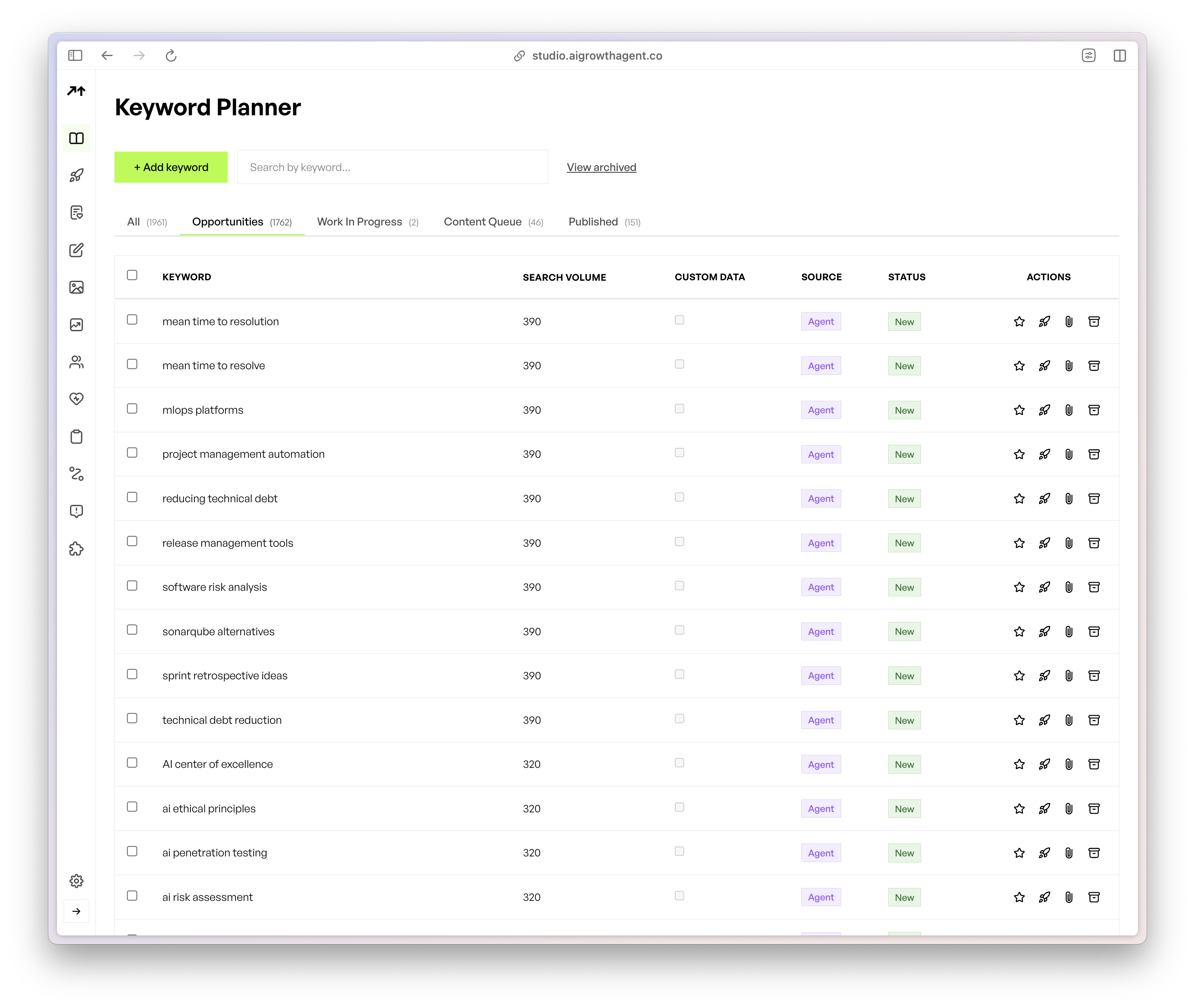
Programmatic SEO focuses on entire topic spaces instead of single keywords. The research process maps thousands of related queries, themes, and questions that buyers ask across traditional and AI search tools.
Teams identify:
- Patterns in questions that AI tools surface frequently
- Gaps where competitors lack depth or clarity
- Content clusters that signal strong topical authority
AI Growth Agent ingests your Manifesto, analyzes large query sets, and turns them into content pillars and clusters. Each asset fits into a clear strategy for visibility and citation. Schedule a demo to see if you’re a good fit for this programmatic approach.
Step 3: Engineering Content for AI Citation
Technical Infrastructure for AI-Optimized Content
Strong AI performance usually starts with a clean, optimized blog or content hub, often on a dedicated subdomain that mirrors your main brand design. This setup gives you control over page speed, structure, and indexability.
AI Growth Agent can deploy a new, optimized blog or integrate with platforms such as WordPress. The hosted option offers a fully managed environment where technical SEO and AI-facing elements are handled for you.
The Programmatic Content Agent in Action
The Programmatic SEO Content Agent follows a clear sequence:
- Strategy and briefs that align each article to a pillar, cluster, and target intent
- Research that combines credible web sources with your Manifesto
- Drafting that produces original articles from tactical explainers to long-form guides
- Fact-checking workflows that verify claims and data
- Technical engineering that applies schema, metadata, image optimization, LLM.txt, and MCP
This approach turns each article into a structured resource that AI systems can crawl, interpret, and cite.
Step 4: Monitoring and Iterating for Continuous AI Search Gains
Managing Programmatic SEO in the AI Growth Agent Studio
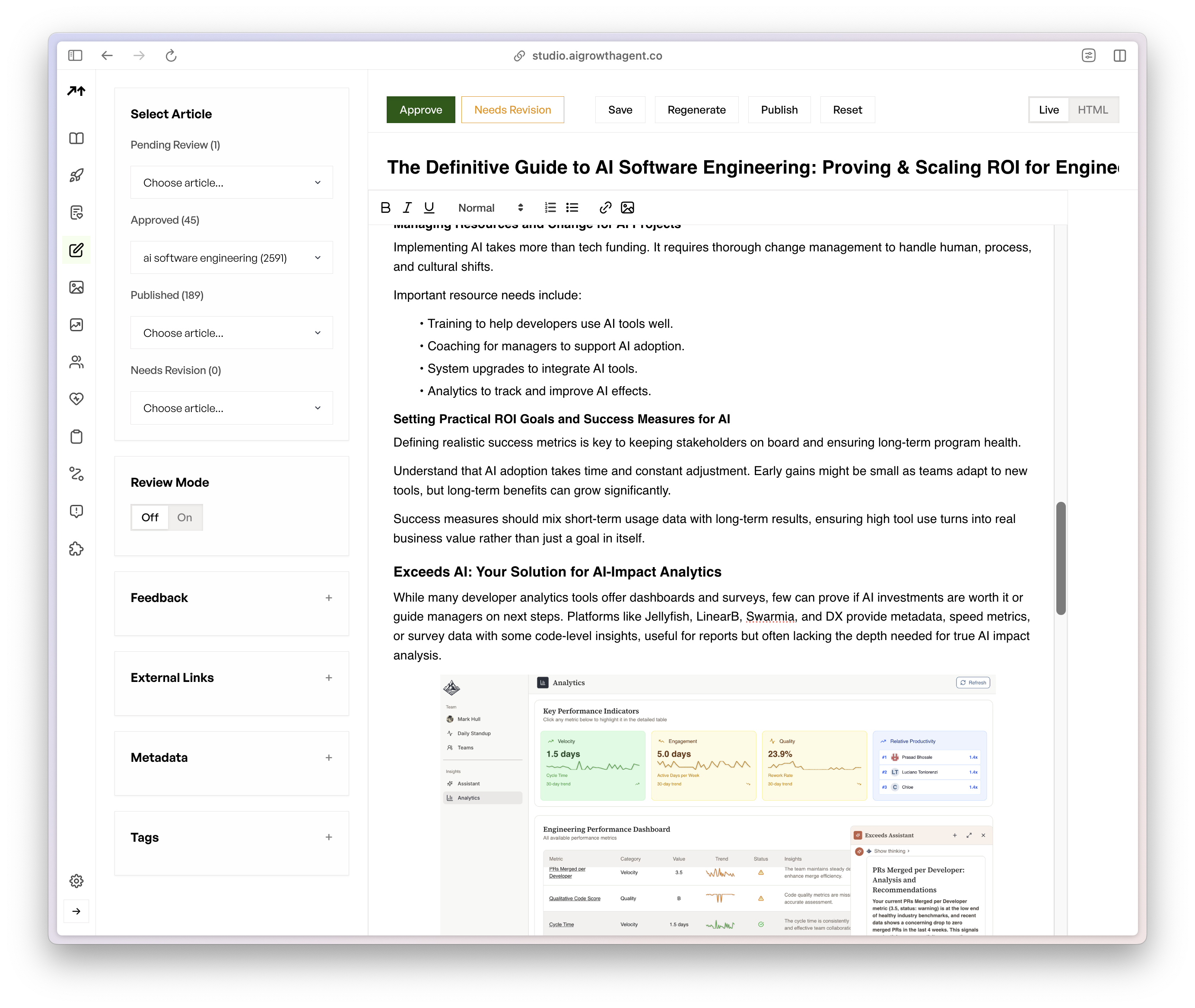
The AI Growth Agent Studio serves as a command center for programmatic SEO. Marketing leaders can review drafts, edit copy, give feedback, and choose between manual approvals or more automated publishing modes.
This setup keeps strategic control in your hands while the platform handles the heavy lifting of research, drafting, and technical optimization.
AI Search Performance Metrics and Feedback Loops
Ongoing measurement is essential for programmatic SEO. Helpful metrics include:
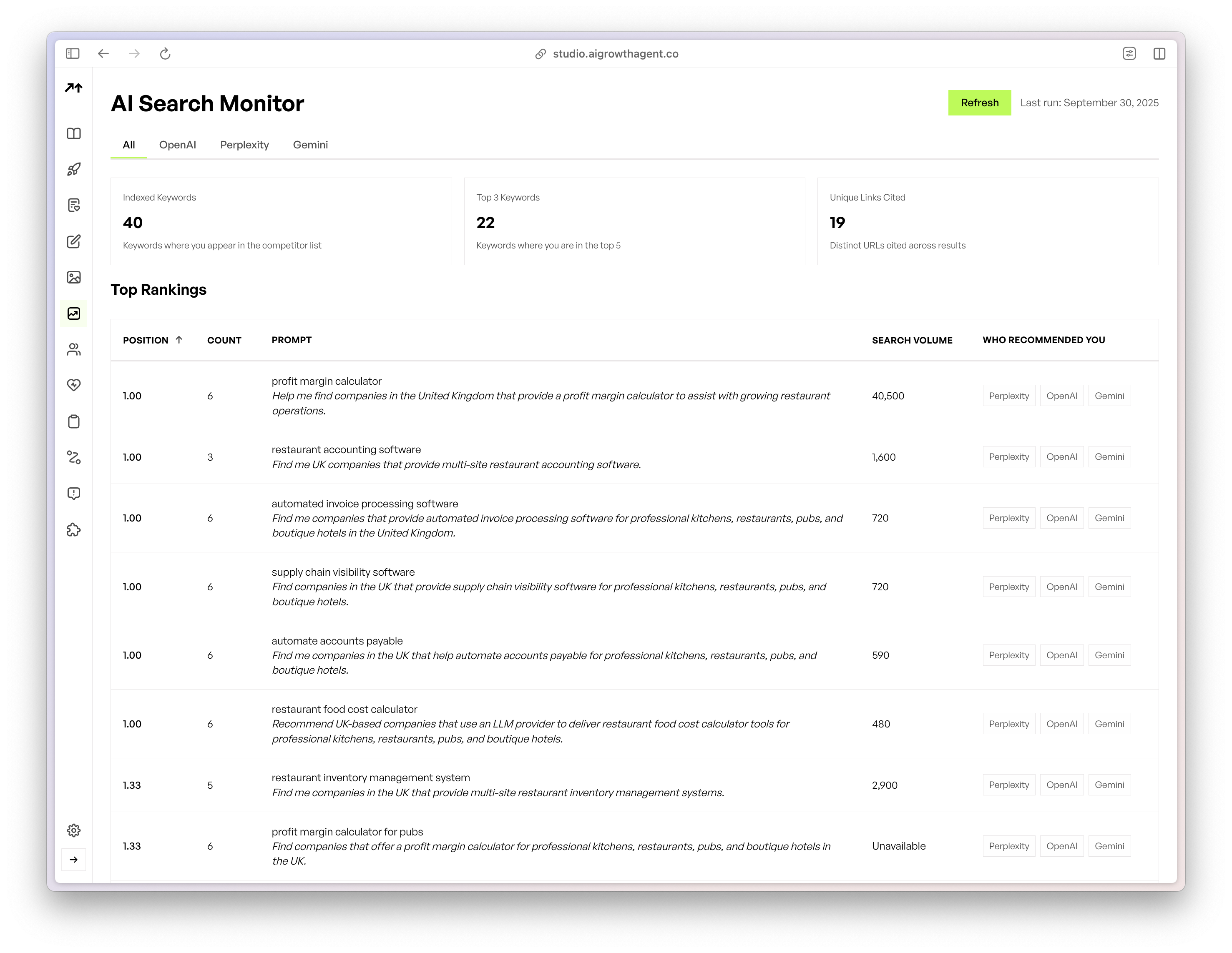
- Where and how often your pages appear in responses from ChatGPT, Gemini, and Perplexity
- Which URLs drive the most AI citations and organic traffic
- How LLM-focused bots crawl your site over time
Combining these signals with Google Search Console data clarifies which topics and formats perform best. Teams can then refine briefs, expand high-performing clusters, and retire content that no longer supports strategic goals.
Why Programmatic SEO Is a Practical Path Forward
Common Pitfalls in AI Search Optimization
Many marketing teams depend on traditional SEO agencies or small internal teams that focus on bespoke content. Output is usually slow and limited, which makes it hard to signal topical authority to AI systems.
Another common issue is reliance on basic AI writing tools without a technical layer. These tools shift strategy, formatting, schema, and publishing work back to your team. The result is more copy, but not more AI-ready content.
How AI Growth Agent Extends Your Capabilities
AI Growth Agent focuses on capabilities that support scale and quality together:
- Multi-tenant deployment for brands that manage several product lines or markets
- Programmatic content tied to timely topics and news events
- Database-to-content workflows that convert internal data into structured articles
- Automated image selection and metadata to strengthen on-page relevance
|
Feature |
AI Growth Agent |
Traditional SEO Agency |
Basic AI Tools |
|
Approach |
Programmatic platform |
Manual service |
Standalone writing |
|
Scale and speed |
Autonomous, high volume |
Limited, slower pace |
Dependent on your workflow |
|
Technical SEO |
Automated schema, LLM.txt, MCP |
Mostly manual |
Unstructured text only |
|
Strategic value |
Authority built at scale |
Custom but hard to scale |
Low citation potential |
Marketing leaders who want an AI-optimized programmatic SEO can schedule a consultation session with AI Growth Agent and review how this model would fit their stack and goals.
Frequently Asked Questions about AI Search Optimization
How quickly can I see results with AI-optimized content?
Most AI Growth Agent clients begin to see AI citations and new rankings within two to three weeks of publishing. For example, BeConfident reached a top recommendation in Google AI Overview with Gemini in Brazil shortly after launching programmatic content. Fast results occur because the content is engineered for how AI systems crawl and cite sources.
Is programmatic SEO only for large enterprises?
Programmatic SEO works for both complex enterprises and smaller premium brands. The main requirement is a clear brand and offering. AI Growth Agent handles the research, content generation, and technical implementation so teams of many sizes can participate.
How does AI Growth Agent protect content quality and brand voice?
The onboarding process configures the agent with your Company Manifesto, brand guidelines, and examples. That source of truth guides every outline and draft, which keeps tone, terminology, and positioning consistent while still adapting to each topic.
Can AI Growth Agent integrate with my existing CMS?
AI Growth Agent integrates with WordPress, HubSpot, Webflow, and other common CMS platforms. The hosted option provides the most control over performance and AI-facing features, but teams that prefer self-hosting can still capture many of the technical SEO benefits.
What makes programmatic SEO different from traditional content marketing?
Traditional content marketing focuses on individual articles and campaigns. Programmatic SEO builds an entire content system that covers a topic space with structured, interlinked pages that satisfy AI and human users. Automation handles schema, metadata, and LLM interfacing so your team can focus on strategy.
Conclusion: Secure Your Brand’s Authority in the AI Search Era
AI search has reshaped how buyers discover brands and evaluate options. A small set of well-structured, authoritative sources often shapes the answers that models provide.
Programmatic SEO with a strong technical foundation gives marketing leaders a way to match that new reality. AI Growth Agent offers tools and workflows that turn your expertise into AI-ready content, published consistently and monitored for performance.
Brands that act now can establish durable authority in their categories while AI systems are still shaping their reference sets. Schedule a consultation session with AI Growth Agent today to assess your current visibility and plan a path toward stronger AI search performance.
