Key Takeaways
- AI answer engines like Perplexity AI shift competition from ranking links to earning limited citation slots in synthesized answers.
- Marketing teams that create clear, structured, question-driven content gain more chances to appear as cited sources across multi-step research journeys.
- Technical elements such as schema markup, LLM.txt files, and Model Context Protocol help Perplexity interpret, evaluate, and prioritize brand content.
- Consistent monitoring of citations supports smarter content investment decisions and highlights where additional coverage or updates are needed.
- AI Growth Agent helps teams operationalize Perplexity AI optimization with automation, scalable content coverage, and citation monitoring, with demos available for marketing leaders.
Why Perplexity AI Matters for Marketing Leaders
Perplexity AI changes how people discover information. Instead of a list of links, it generates direct answers and shows a small set of cited sources. The system uses large language models and Retrieval-Augmented Generation to synthesize responses from web and API content.
Marketing leaders now compete for citations inside those answers, not only for organic rankings. Perplexity emphasizes clarity and synthesis without ads, which encourages users to rely on consolidated AI outputs instead of scanning many pages. A small number of referenced sources receives most of the attention.
The value of being one of a few cited sources has increased, because user attention now concentrates on those references. Brands that plan for this shift can capture more visibility with fewer, better placements.
How Perplexity AI Works and What It Favors
Perplexity focuses on semantic understanding and contextual reasoning, interpreting meaning and intent instead of matching exact keywords. Content that answers questions directly and aligns with likely user intent fits this model well.
On-demand Retrieval and Answer Synthesis
Perplexity performs on-demand crawling and hybrid retrieval across the open web and trusted APIs, then applies filtering, ranking, and reranking before generating an answer with RAG. Fresh and authoritative content can appear quickly in responses.
Citation-first User Experience
Each answer includes visible citations that link back to underlying sources. Users can inspect those sources, which raises the bar for accuracy, clarity, and trustworthiness in the cited pages.
Multi-turn Conversations and Context
Perplexity maintains context across follow-up questions. Brands that publish deep, related content on a topic gain repeated opportunities for citation as users refine or extend their questions.
Strategic Implications: Competing in the AI Citation Layer
Competition now centers on which sources feed the synthesis layer, not just which pages rank on page one. Authority, clarity, and coverage become more important than narrow keyword wins.
New Visibility Metrics for Leaders
Leaders benefit from tracking how often their content appears in AI answers. Useful KPIs include:
- Frequency of citations across target topics and queries
- Specific URLs that earn citations most often
- Types of questions where the brand appears or is absent
Authority Over Sheer Volume
Perplexity retrieves multiple documents and relies on ranking and reranking to strengthen factual grounding. Consistent, accurate information across your domain increases citation odds.
Content velocity still matters, especially across many subtopics within a category. Teams that combine quality with scale create more surfaces where Perplexity can recognize authority.
Best Practices for Perplexity AI Answer Engine Optimization
Content Strategy for AI Search
Human-centered content that answers common questions directly and presents information in an organized way aligns well with AI source selection. Keywords still matter, but clarity and completeness carry more weight.
Question-focused resources that solve real problems tend to surface more often than pages designed only around search volume. Topic maps, FAQs, comparison guides, and how-to content all help position your site as a reference.
Technical SEO for AI Citation
Technical foundations for Perplexity optimization extend beyond traditional SEO basics:
- Advanced schema markup, to clarify entities, relationships, and content purpose for retrieval systems
- LLM.txt files, to guide AI crawlers toward priority pages and provide context about site sections
- Model Context Protocol, to open direct, structured access to data and content repositories
- Citation-friendly formatting, with descriptive headings, concise paragraphs, and quotable sections that Perplexity can extract cleanly
Building Recognized Authority
Perplexity factors recency into retrieval and values current, high-quality information. Clear authorship, updated data, and transparent methodologies all support stronger trust signals.
Marketing leaders can encourage subject-matter experts to contribute content, publish unique insights or benchmarks, and refresh important pages on a predictable schedule.
AI Growth Agent helps operationalize these practices across large content portfolios.
How AI Growth Agent Supports Perplexity AI Optimization
Most teams face constraints on technical resources and publishing capacity. AI Growth Agent focuses on programmatic content engineering and monitoring for AI answer engines, including Perplexity.
Automated Technical Infrastructure
The Programmatic SEO Agent configures advanced schema markup, LLM.txt files, and Model Context Protocol integrations. This setup helps Perplexity interpret site content and increases the likelihood of accurate citation.
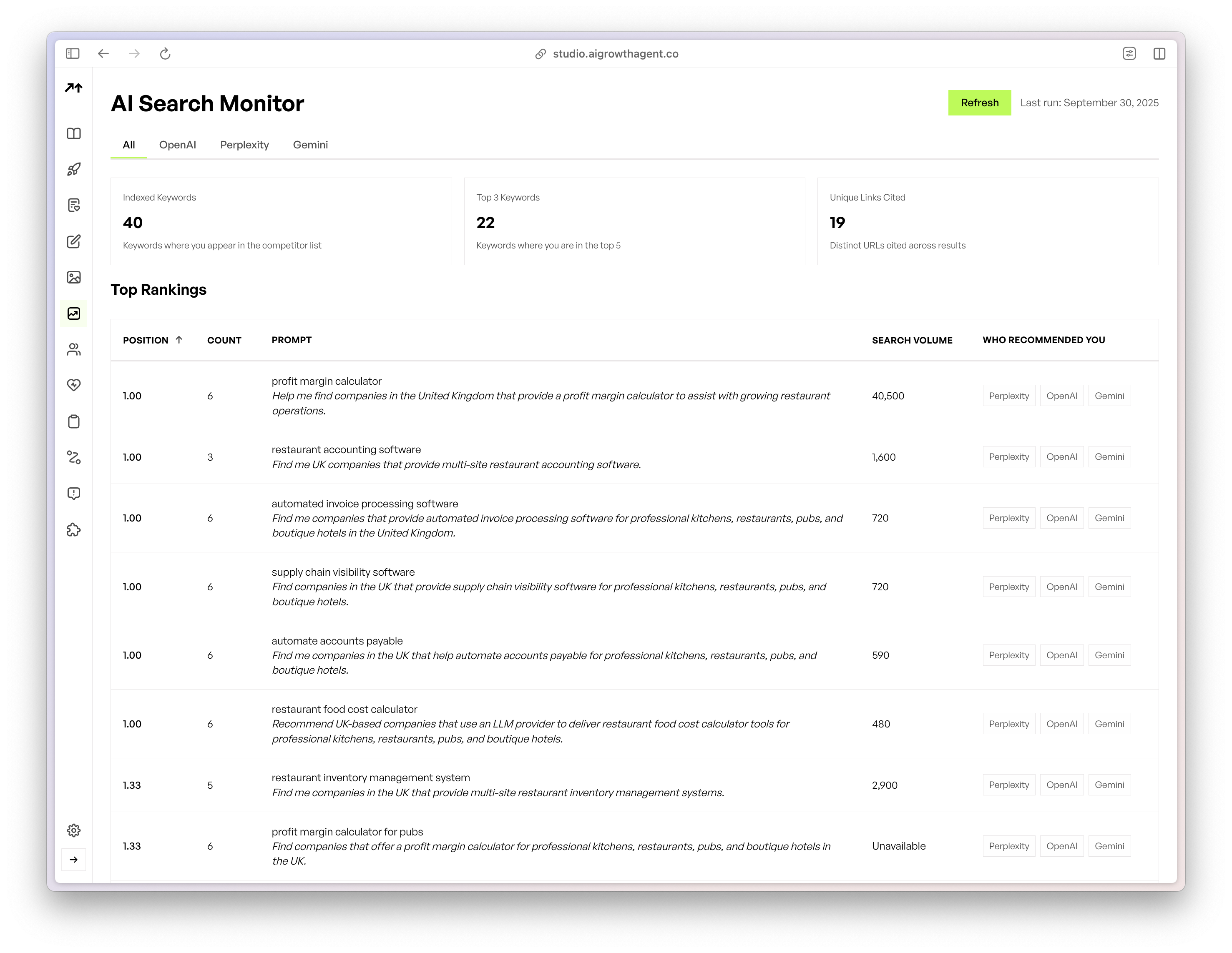
Citation Monitoring and Feedback Loops
The AI Search Monitor tracks where and how your pages appear in AI answers. Teams can see cited URLs, topic coverage, and keyword indexing patterns, then adjust content plans based on real citation data.
Programmatic Content Coverage
AI Growth Agent engineers structured topic coverage across an industry, which supports consistent, authoritative presence in AI search results. The system focuses on depth across clusters of related questions instead of isolated articles.
Common Challenges in Perplexity AI Optimization
Avoiding Legacy SEO Shortcuts
Perplexity relies on advanced natural language processing and contextual relevance. Keyword stuffing, low-value link schemes, and thin pages work against selection as a trusted source.
Scaling High-quality Content
Many marketing teams struggle to publish enough high-quality content to cover their full topic landscape. Programmatic approaches, editorial systems, and AI-assisted workflows help close that gap while maintaining standards.
Managing Technical Complexity
Perplexity-focused optimization often requires coordination between marketing, SEO, data, and engineering teams. Implementing LLM.txt, Model Context Protocol, and detailed schema across large sites can feel demanding without specialized support.
|
Feature |
Perplexity AI |
Traditional Search |
AI Chatbots |
|
Answer Format |
Synthesized responses with citations |
Ranked link lists |
Generated text without sources |
|
Source Transparency |
Hyperlinked citations |
Link attribution |
No source verification |
|
Content Selection |
Real-time authority verification |
Static index ranking |
Training data cutoff |
|
User Experience |
Conversational with context |
Query-by-query |
Chat-based interaction |
Frequently Asked Questions About Perplexity AI Optimization
How does Perplexity AI select sources?
Perplexity scans the web and connected APIs at query time, retrieves candidate documents, and applies ranking and reranking to favor recent, relevant, and well-supported information. It then uses those sources as grounding for its synthesized answer and cites a limited number directly.
What role does traditional SEO play?
Traditional SEO practices still matter. Clear site structure, crawlable pages, and high-quality content support visibility in Perplexity retrieval. Tactics that aim only to exploit ranking formulas, such as keyword stuffing or aggressive link schemes, provide little benefit for AI answer engines.
What content is most likely to be cited?
Perplexity tends to cite pages that offer comprehensive, accurate, and current answers to specific questions. Structured formats, data-backed claims, and explicit explanations of methods or reasoning help AI systems understand and trust the material.
How can teams track Perplexity citations?
Teams can monitor citations by using tools that identify when URLs appear in AI-generated responses. AI Growth Agent includes an AI Search Monitor that surfaces cited pages, keyword coverage, and topic gaps so teams can refine their content strategy.
Conclusion: Position Your Brand Inside AI-generated Answers
Perplexity AI adds a new layer to search, where brands compete to inform synthesized answers rather than only chasing traditional rankings. Marketing leaders who plan for citations, not just clicks, place their organizations where users now read and act.
Success depends on authoritative content, solid technical foundations, and the ability to scale coverage across important topics. Manual efforts alone often struggle to meet these demands in a consistent way.