Written by: Mariana Fonseca, Editorial Team, AI Growth Agent
AI search is reshaping how brands are discovered and valued. Traditional SEO agencies, though effective in the past, often fall short in this new landscape. If you’re a marketing leader, this article compares alternative solutions, moving beyond hourly billing to a technology-focused approach for AI search success.
Navigating this shift means facing a hard truth. Old methods can’t match the pace, scale, or technical demands needed to stand out in AI search results. Waiting weeks for a single article while competitors publish daily, high-value content is no longer an option. Let’s explore how to adapt with tools built for AI search.
Why Traditional SEO Agencies Struggle in the AI Search Landscape
Your Digital Presence Is at Risk Without Action
Each day without a high-volume content plan shrinks your brand’s online footprint. With AI-generated content flooding the web, your voice gets buried if you’re not keeping up. Once prominent in your niche, your company could fade into the background of AI search results.
For leaders, this goes beyond losing visibility. It’s a growing problem that impacts strategy. When potential customers query AI assistants about solutions like yours, those systems pull from a vast content pool. Without enough authoritative material, AI will favor competitors, letting them shape the narrative in your market.
The financial stakes are high. One well-crafted piece of content can attract thousands of qualified leads over time. Yet, traditional agencies often produce limited output, missing countless opportunities. Meanwhile, competitors using advanced platforms capture those leads and searches.
This isn’t just about small gains or metrics. If AI search can’t find deep, reliable content from your brand, it skips you for recommendations. This creates a cycle where less visibility means fewer mentions, further reducing your presence in AI responses.
Daily Content Is Now the Standard for Authority
AI search has redefined competitive content marketing with a need for daily, high-quality updates. Just as social media changed posting expectations, AI search sets a new standard where consistent publishing is key to staying relevant.
Large Language Models behind AI search value fresh, detailed, and regular content more than older algorithms did. These systems prioritize the most current and thorough information, putting brands with irregular posting at a disadvantage in AI rankings.
Traditional SEO agencies, tied to human limitations, often charge high fees for a small number of articles monthly. This worked when targeting specific keywords over long periods. However, AI search demands ongoing expertise across a wide range of topics, something agencies often can’t sustain.
Technical requirements have also outpaced many agencies. AI indexing needs specific markup and optimizations that require skills beyond typical agency offerings.
Book a consultation to see how autonomous content platforms can help your brand publish daily and build authority in AI search.
AI Authority Relies on Citations, Not Just Keywords
Success in SEO now hinges on how often AI cites your content, not just keyword rankings. Traditional agencies focus on older algorithms like Google’s PageRank, while AI search evaluates authority through content depth, credibility, and completeness.
This shift exposes a gap that agencies can’t easily bridge. Their keyword-driven tactics miss the broader need for topical expertise that AI demands. When tools like ChatGPT or Perplexity process a query, they seek sources offering the most detailed and reliable coverage, not just keyword matches.
AI-powered SEO platforms cut costs by automating technical and strategic tasks, challenging traditional agency pricing. Beyond cost, agencies often lack the setup for the advanced optimizations AI search needs for proper indexing and visibility.
Brands stuck with traditional agencies play an outdated game while competitors gain ground in AI search. Every month of slow content output means missed chances to be cited and positioned strongly in channels critical to B2B discovery.
Exploring Options Beyond First Page Sage for AI Search Success
Marketing leaders see the limits of traditional agencies, and the market offers new paths. Knowing the strengths and drawbacks of each can guide your content strategy and resource decisions in the AI search era.
Traditional SEO Agencies: Built for a Past Era
Agencies like First Page Sage rose when SEO meant technical fixes and link building. Their model, based on human expertise and hourly rates, worked when content needs were lower and algorithm updates were less frequent.
- Strengths: They bring proven human skills, established client ties, and broad services beyond content. Teams grasp core SEO concepts and offer guidance from years in digital marketing.
- Weaknesses: Their drawbacks outweigh the benefits for AI search. High costs, long contracts, and limited returns make them unfit for the content volume needed today. Human limits restrict output, hindering the deep topical authority AI search requires.
More concerning, many agencies lack the technical know-how for AI-specific optimizations. Their generic content often misses unique brand angles or the expertise AI uses to judge citation value.
Key Point: Limited by human capacity and hourly billing, traditional agencies can’t deliver the scale or speed needed for AI search. Their model suits an older SEO era, not modern demands.
In-House Teams: Valuable but Overstretched
Many firms try to boost content output by growing internal teams. This has benefits but faces real hurdles for scaling in AI search.
- Strengths: Internal staff know the brand deeply, ensuring content reflects true positioning. They access experts, product details, and customer data that agencies often miss.
- Weaknesses: Capacity limits make in-house teams unfit as the main driver for AI search. Even with dedicated writers, headcount and other priorities cap output across channels.
Additionally, most in-house groups lack the AI technical skills for key optimizations. Building systems for markup and automated SEO needs engineering resources beyond the typical marketing scope.
The trade-off is clear. Time spent on manual content pulls focus from strategy, campaigns, or growth plans that need human insight.
Key Point: In-house teams shine in strategy and brand voice but can’t scale for AI search authority. Their best use is guiding direction, not producing content manually.
Basic AI Writing Tools: Speed Without Substance
Simple AI writing tools and templates promise easy content automation. Yet, they lack the depth needed for serious AI search results at an enterprise level.
- Strengths: These tools cost less upfront and speed up drafts compared to human writers. They offer a starting point for content workflows.
- Weaknesses: Their limits show when matched against AI citation needs. AI content often feels repetitive, lacking the fresh insights vital for authority.
Output is often generic, missing the unique perspective needed for thought leadership in B2B spaces. Significant human effort remains for research, editing, and publishing, adding quality risks without solving resource issues.
Worst of all, these tools skip technical optimizations. They can’t handle advanced markup or SEO needs that AI search prioritizes for indexing.
Key Point: Basic AI tools seem efficient but need heavy oversight and lack depth for authority. They don’t solve core AI search challenges.
AI Growth Agent: Your Engine for AI Search Results
AI Growth Agent offers a fresh approach, an autonomous platform crafted for AI search demands. It doesn’t tweak old methods but builds a new way to meet the scale, speed, and technical needs of modern algorithms.
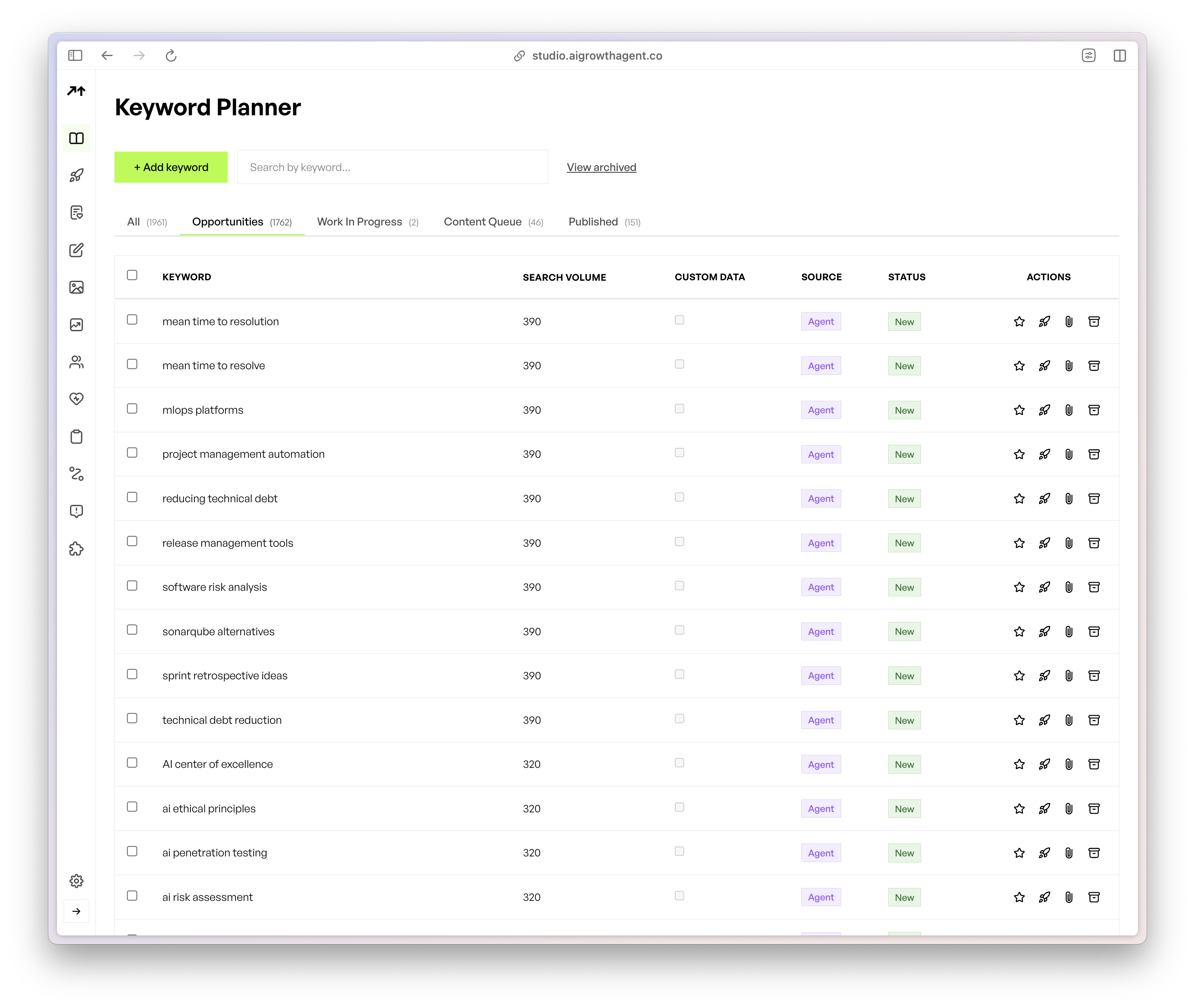
- Strengths: It provides full, scalable content creation, producing daily pieces while keeping brand voice via a custom Company Manifesto. Built-in technical features like schema markup ensure strong AI indexing.
- More Benefits: The platform reacts to trends in real-time and supports multiple brands with parallel agents. Results tracking through AI Growth Agent Studio shows a clear impact on citations and traffic.
- Limitations: It works best with a solid SEO base and isn’t a fix for broken websites. It’s ideal for premium brands aiming to lead, not those needing basic content help.
Key Point: AI Growth Agent is built for the AI search era, offering scale and precision while freeing leaders for strategy over manual work. Book a demo to see if it fits your needs.
Comparing AI Search Solutions
|
Feature / Solution |
Traditional SEO Agency (e.g., Sage) |
In-House Team |
Basic AI Tools |
AI Growth Agent |
|
Content Velocity |
Low (limited output) |
Moderate |
High (low quality) |
High (daily, quality) |
|
AI Technical Optimization |
Limited |
Low |
None |
Advanced (built-in) |
|
Scalability for AI Search |
Very Limited |
Limited |
Limited (quality) |
High |
|
Brand Voice Alignment |
Often Generic |
High |
Low |
High (via Manifesto) |
|
Manual Effort Needed |
High (briefing) |
Very High |
High |
Low (oversight) |
|
AI Citation Tracking |
Limited |
No |
No |
Real-time Monitor |
Why Leaders Pick AI Growth Agent
Focus Your Team on Strategy, Not Content Tasks
Adopting an autonomous content platform frees your marketing team from hands-on content work. Leaders often spend hours on research, writing, and publishing, leaving little time for bigger-picture goals.
AI Growth Agent shifts this. After setting up the Company Manifesto and keyword plan, it runs independently with minimal input. Your team can pivot to market positioning, competitor analysis, and growth strategies.
Integration fits existing processes. Through AI Growth Agent Studio, leaders give feedback to refine content, reducing involvement over time as the platform learns preferences.
For firms with multiple brands, parallel agent deployment lets one team manage complex strategies efficiently. This saves time and boosts strategic focus.
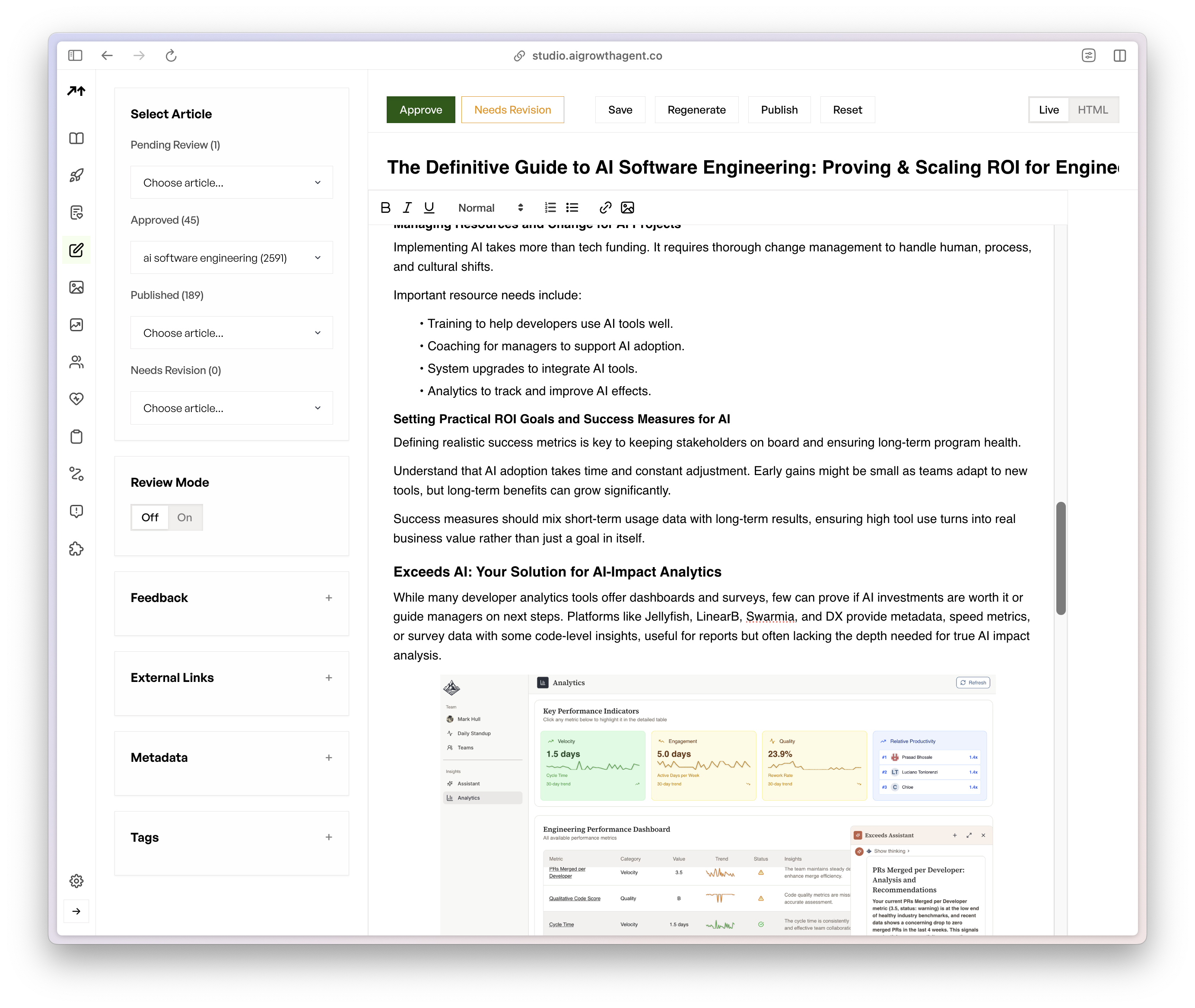
Build Authority That Competitors Can’t Match
In the AI era, daily high-quality content outpaces sporadic publishing. AI search judges authority by depth and freshness, making consistency non-negotiable for visibility.
AI Growth Agent helps build a content lead that competitors struggle to close with older methods. While others manage a few articles monthly, this platform delivers daily output with technical precision and brand alignment.
This edge compounds. Each piece boosts domain authority and expertise signals AI uses for citations. Over time, the content gap widens, tough for rivals to overcome.
Technical optimization adds another layer. Advanced SEO features ensure better indexing, tipping the scales when AI weighs similar content from different brands.
Stay Agile with Rapid Market Response
AI search evolves fast, demanding content strategies that adapt to updates, trends, and competition. Traditional teams often lag with slow planning cycles unfit for this pace.
AI Growth Agent generates content in real-time, letting your brand comment on industry news swiftly to join key conversations. This speed boosts visibility for trending topics.
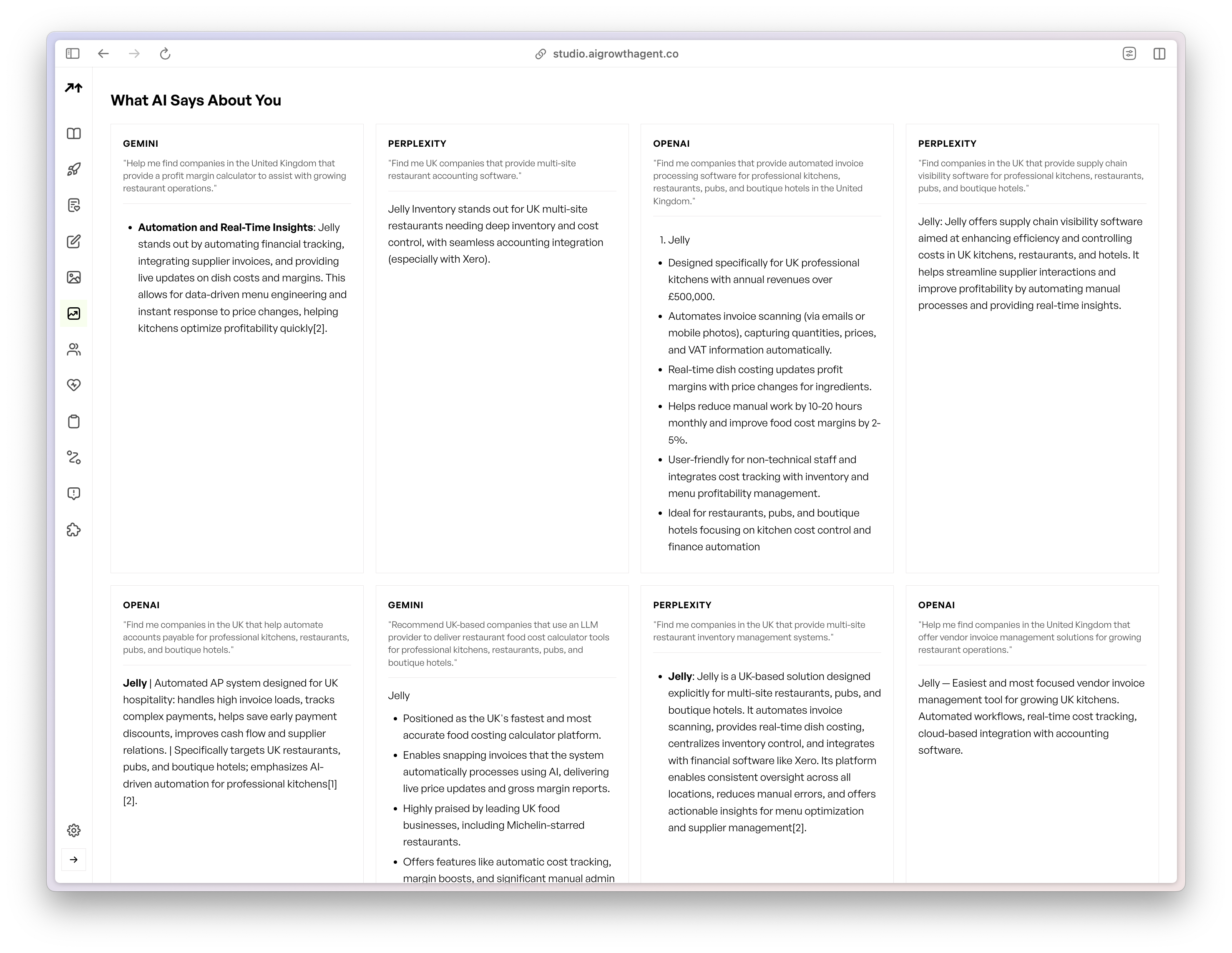
Its AI Search Monitor tracks performance on ChatGPT, Gemini, and Perplexity, guiding strategy tweaks with real citation data. This keeps content aligned with AI shifts.
For fast-moving tech markets, such agility sets you apart. Leading on new trends and maintaining strong industry coverage enhances search presence and positioning.
Book a consultation to learn how an autonomous platform offers the agility and scale your brand needs for AI search success.
Common Questions on AI Search
What Limits Traditional SEO Agencies in AI Search?
Traditional agencies face built-in constraints for AI search. Human capacity and hourly billing restrict output, making it hard to create the volume of optimized content needed for top results. Their limited production can’t build the wide expertise AI prioritizes.
Many also lack the technical skills for advanced optimizations essential for AI indexing. Plus, their generic content often misses unique brand angles that AI values for citations.
Costs add to the issue. High fees for slow delivery don’t match the pace AI demands. While competitors publish regularly with modern tools, agency clients fall behind.
How Do AI SEO Tools Overcome Human Content Limits?
AI SEO platforms automate the full content process while keeping brand consistency. They handle research, strategy, writing, optimization, and publishing, bypassing human bottlenecks.
Technical tasks like schema markup happen automatically, ensuring strong indexing without needing niche expertise from your team.
These platforms scale output and maintain voice by learning from company data. This mix of volume, technical depth, and alignment is tough to achieve manually.
Cost savings stand out. Automation cuts per-piece expenses compared to agencies or in-house work, letting teams focus on strategy over routine tasks.
Can Basic AI Tools Match Dedicated AI Search Platforms?
Basic AI tools aren’t enough for enterprises in AI search. While they generate text, they miss the strategy, technical depth, and brand fit needed for content AI values.
They require heavy manual work for planning, editing, and publishing, keeping resource limits while risking quality. They also lack technical SEO for indexing.
Platforms like AI Growth Agent cover the full process autonomously, from strategy to publishing. Features like brand integration and citation tracking set them apart.
Quality differs greatly. Basic tools often output repetitive text, lacking the unique insights needed for authority. Enterprise platforms balance scale with differentiation.
What’s the Role of Humans with AI Growth Agent?
With AI Growth Agent, human input centers on strategy and quality, not production. Leaders set direction via the initial Company Manifesto, shaping brand voice and guidelines.
Ongoing work means reviewing content in the Studio interface, offering feedback to refine output. This loop helps the AI learn preferences, cutting manual effort over time.
Humans also track results via the AI Search Monitor, adjusting plans based on citation data from major AI tools. This aligns content with market shifts.
The aim is to move human focus to high-impact areas like positioning and growth, not routine content tasks. Expertise stays vital but targets maximum value.
How Soon Do Results Show with Autonomous Platforms?
Autonomous platforms bring results in stages. Within a month, you’ll see faster content output and less team burden for creation tasks.
Citation gains appear as topical authority builds through steady, optimized publishing. The AI Search Monitor tracks progress across major engines for strategy tweaks.
Traffic grows as content ranks and domain authority rises from consistent posts. Results compound over time with ongoing effort.
Competitive edges form as content volume outpaces traditional methods. This builds lasting authority, boosting AI search visibility and market stance.
Final Thoughts: Leading AI Search
Relying on traditional SEO agencies for AI search authority is tough for B2B SaaS firms. Marketing leaders can’t settle for slow, human-limited content when competitors use autonomous tools to pull ahead.
The decision isn’t about picking agencies or small tweaks. It’s about embracing tech-driven content or risking weaker positioning as AI search drives discovery.
Agencies like First Page Sage offer experience but can’t match the scale, speed, or technical needs of AI search. Their billing model limits output for today’s demands.
In-house teams guide strategy well but can’t scale content without overloading resources. Basic AI tools seem helpful but keep manual burdens and quality risks.
AI Growth Agent delivers the tech shift. This autonomous platform scales content with precision, letting teams focus on strategy while building AI-valued authority.
Brands adapting to autonomous content will lead over those stuck in old ways. This gap may grow, making early adoption a key edge.
AI asks many questions. AI Growth Agent helps your enteprise answer them clearly. If you’re ready to lead your category in AI search, book a consultation with AI Growth Agent to build your advantage.