Written by: Mariana Fonseca, Editorial Team, AI Growth Agent
Executive summary
- AI search now evaluates brands on real-time authority signals, so manual backlink analysis and content production can no longer keep pace with how ChatGPT, Gemini, Perplexity, and AI Overviews surface recommendations.
- Marketing teams often face data overload from tools like Ahrefs and Semrush, yet still struggle to turn competitor backlink intelligence into clear, prioritized actions that improve domain authority.
- AI Growth Agent programmatically ingests competitor backlink data, identifies gaps and opportunities, and then engineers technically optimized content architectures designed to earn high-value links and AI citations.
- A multi-tenant architecture supports enterprises and portfolio companies, enabling parallel, market-specific SEO agents that share learning while keeping strategies segmented by brand or business unit.
- The AI Search Monitor closes the loop by tracking how content and backlinks influence citations and visibility in AI search systems, then automatically adjusts strategy based on real performance.
- Organizations that adopt programmatic backlink analysis gain a structural speed and scale advantage over manual agencies and self-service tools, building domain authority in a predictable, compounding way.
The Problem: Why Manual Backlink Analysis Fails in AI Search
Marketing leaders today face an unresolved challenge. The volume of backlink data has exploded, AI search engines have changed how domain authority is measured, and manual processes no longer match the pace of modern search. The result is reduced visibility, missed citations, and competitors capturing authority that could belong to your brand.
Data overload and limited insight from competitor backlinks
Many marketing teams work with more backlink data than they can reasonably interpret. Tools like Ahrefs and Semrush deliver comprehensive competitor backlink analysis, but the volume of domains, anchors, and metrics often turns into noise instead of guidance.
Marketing leaders often struggle with the sheer volume of competitor backlink data and differentiating between quality and low-value links. Access to data is not the issue. The real challenge is turning that data into a clear plan. Manual review requires hours in spreadsheets, pattern hunting, and case-by-case judgments about which links matter and which may be neutral or harmful.
This analysis load creates a hidden cost. While teams spend weeks reviewing competitor profiles and debating priorities, competitors with more automated workflows move faster. They claim link opportunities, improve their authority, and secure citations in AI systems while slower organizations remain stuck in interpretation mode.
The velocity gap between manual analysis and AI-driven search
Speed now plays a central role in authority building. AI search engines index content and adjust authority signals in near real time. Advanced features include identifying broken competitor backlinks, tracking lost backlinks, and analyzing anchor text trends, yet manual tracking of these changes introduces delays between insight and response.
Most manual workflows follow a similar pattern. A team discovers a new competitor backlink, reviews the linked content, designs a response, writes and edits new material, then waits for publication and indexing. That sequence can stretch across weeks or months. During that time, the competitive landscape may shift and the original opportunity can lose value.
AI systems like ChatGPT, Gemini, and Perplexity update their models continually. They reward brands that publish consistent, authoritative content and maintain a steady stream of reliable signals. In contrast, manual backlink analysis introduces a persistent delay between what the market is doing and how a brand responds.
Falling behind in the AI citation race
Domain authority is no longer only about search rankings. It now strongly influences which brands AI assistants cite when users ask for recommendations or explanations. Without a programmatic method to turn competitor data into link opportunities and content, brands risk remaining absent at these critical moments.
AI engines evaluate authority through many signals, and backlink profiles remain one of the main indicators of trust and expertise. Competitors that analyze and act on backlink opportunities in a systematic way position themselves as reliable category sources. Teams that rely on slow, manual workflows often watch competitors accumulate citations while their own brands rarely appear in AI answers.
This visibility gap tends to widen over time. Each missed opportunity to publish targeted, well-structured content reduces future chances of citation. AI systems incorporate interaction and performance signals into their models, which amplifies early leaders that invested in structured, repeatable authority-building processes.
Fragmented SEO execution and missed authority gains
Many teams treat backlink analysis, content strategy, technical SEO, and brand positioning as separate efforts. They review competitor backlinks in one platform, plan content in a second, and manage technical changes through another set of tools or teams. This separation creates friction.
A core method is to define content/backlink gaps, identifying domains that link to your competitors but not to you, but manual workflows often stop at the insight stage. The opportunity exists on paper yet never consistently converts into briefs, content, technical implementation, and outreach.
Effective authority building requires a connected system that links competitive intelligence, content decisions, technical requirements, and performance tracking. Manual coordination across these components is difficult to sustain, especially when markets move quickly and stakeholders change priorities.
Technical debt and incomplete AI indexing
AI search engines interpret content through specific technical signals. Schema markup, LLM.txt files, descriptive metadata, and structured data all influence how AI systems read, store, and cite your work. Managing these elements by hand across large content libraries is complex and easy to under-resource.
Teams may identify a strong backlink opportunity yet still fall short on impact if they lack the specialists or time to apply structured data and AI-focused technical best practices to the related content. The jump from analysis to technically sound implementation often becomes a bottleneck.
Over time, this technical debt compounds. Competitors that consistently combine competitive insights with technical implementation build a stronger base of machine-readable content. Their work becomes easier for AI systems to interpret and recommend, while less optimized sites struggle to catch up even if they target similar topics.
The Solution: AI Growth Agent’s Programmatic Competitor Backlink Strategy
AI Growth Agent converts competitor backlink analysis from a manual task into a programmatic workflow. The platform ingests backlink intelligence, identifies high-value opportunities, and then engineers content and technical execution so your brand can build domain authority and AI citations in a structured way.
Automating competitor backlink intelligence at scale
AI Growth Agent connects with leading backlink platforms and processes large volumes of competitor data programmatically. Specialized AI-powered tools like Ahrefs, Semrush, Majestic, Ubersuggest, Serpstat, and SearchX are highly effective for comprehensive competitor backlink analysis, and AI Growth Agent uses the outputs of these tools while removing much of the manual interpretation work.
The system automatically highlights high-value linking domains, recurring anchor text patterns, and clear content gaps where competitors have earned authoritative backlinks and your brand has not. Ahrefs uses AI to assess contextual relevance and authenticity of backlinks, providing actionable insights for link building, and AI Growth Agent takes that level of intelligence further by translating it into structured content plans.
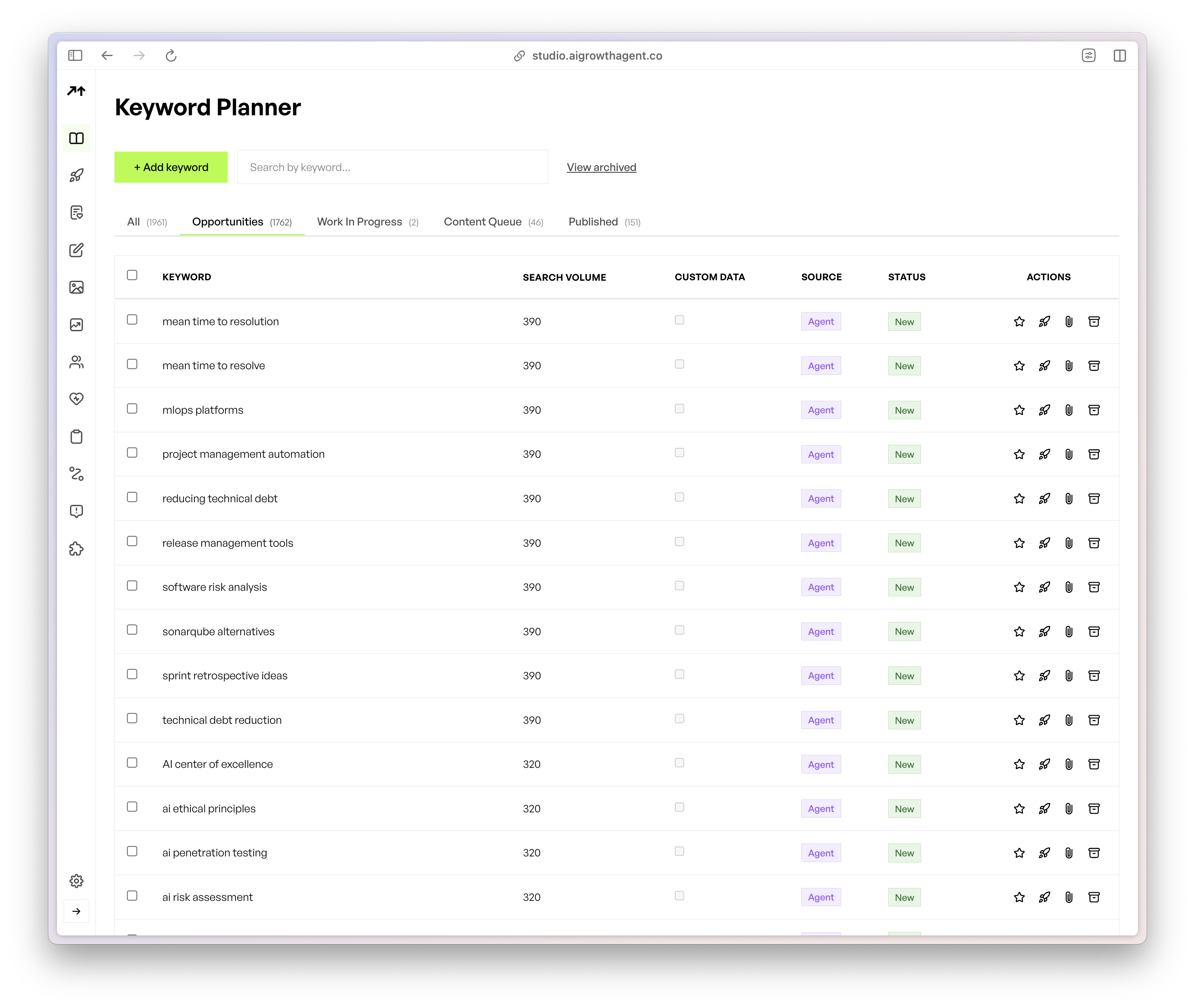
The platform monitors competitor backlink profiles on an ongoing basis. It tracks new links, loss of existing links, and shifts in anchor and topic patterns, then updates content priorities accordingly. This automation allows brands to respond to market changes within hours rather than weeks.
Marketing teams that want to turn competitor intelligence into an organized authority-building plan can schedule a demo with AI Growth Agent and see how this programmatic approach supports faster, more consistent execution.
Engineering high-authority content architectures from competitive insights
Competitor backlink analysis delivers value only when it guides content that earns similar or better links. AI Growth Agent uses its competitive insights to generate topic maps, outlines, and content assets that target specific domains, themes, and question types.
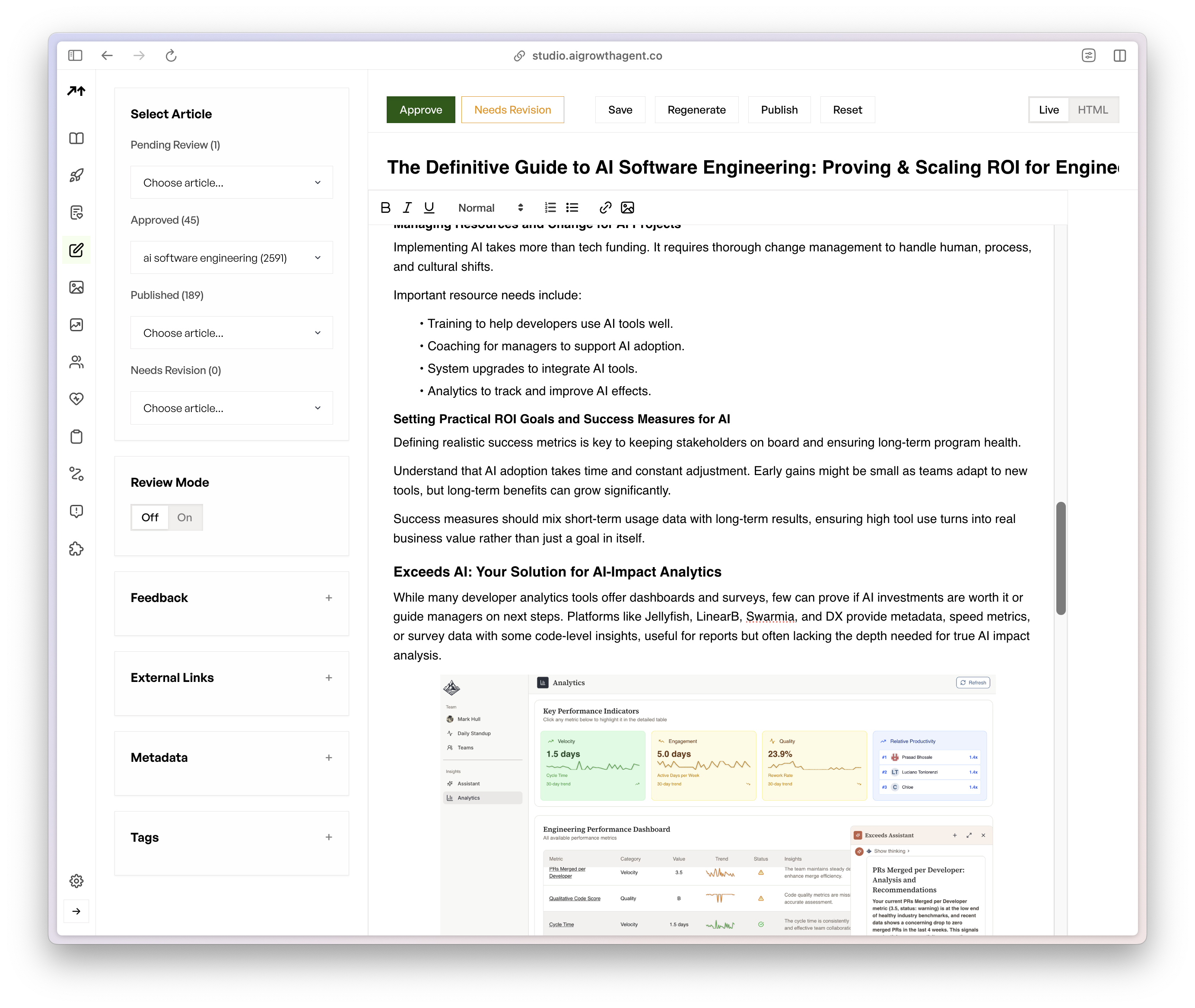
The system reviews the pages that attracted strong backlinks for competitors, analyzes why they appealed to linking domains, and then produces content designed to offer clearer explanations, more depth, or better structure. Each asset includes schema markup, optimized metadata, and LLM.txt alignment to support AI crawling and citation.
Visual content often strengthens link-worthiness and user engagement. AI Growth Agent allows teams to specify brand images and assets for inclusion in generated content so that authority-building pieces remain consistent with visual guidelines while still being optimized for search and AI systems.
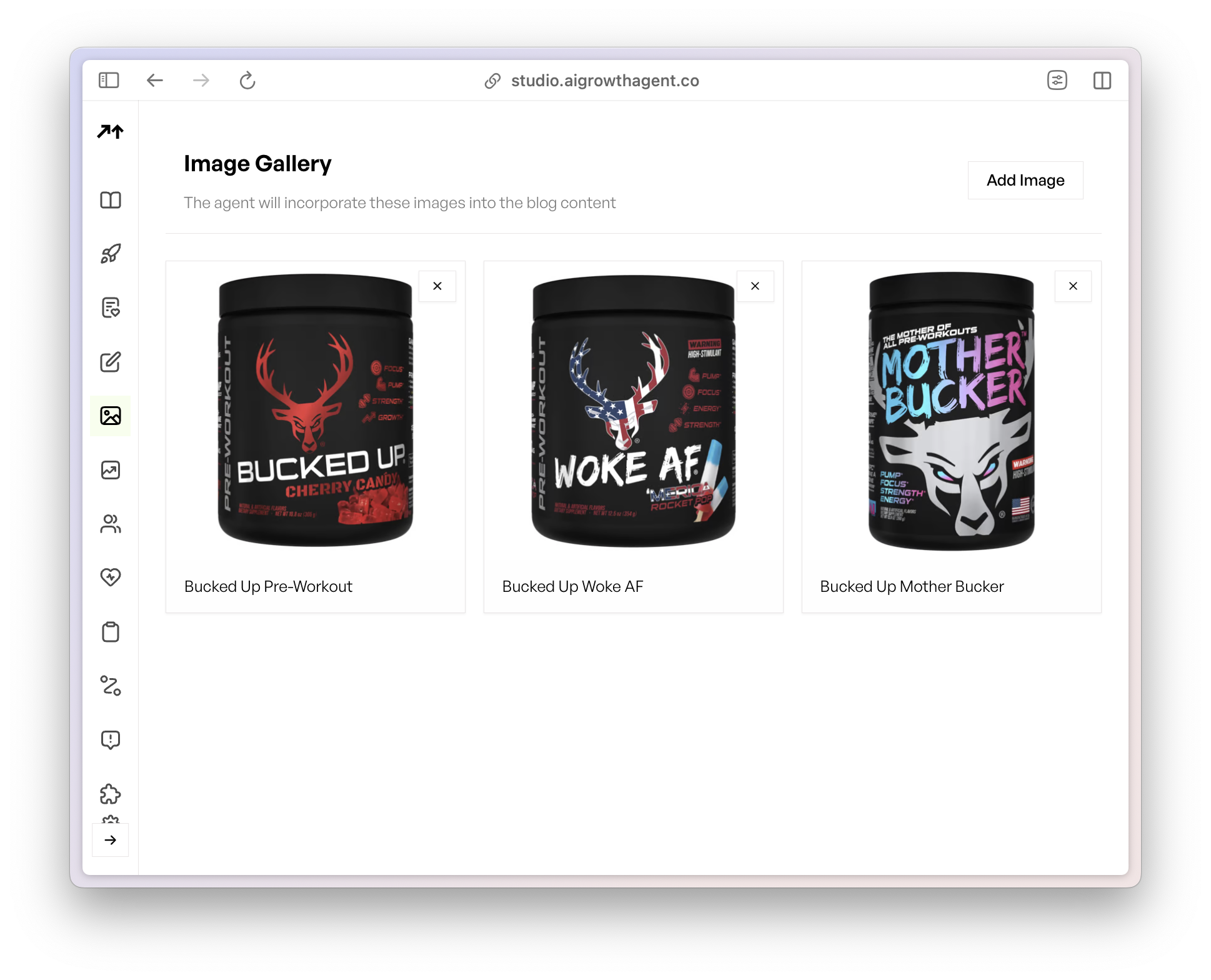
This content engineering workflow operates at a volume that would be difficult for manual teams to match. Instead of producing an occasional article from a competitor analysis, teams can support a steady pipeline of structured, technically optimized content that addresses the most important backlink and citation opportunities.
The integration between insight and execution also creates an ongoing feedback loop. Performance data from published content informs the next wave of planning so the system continues to refine which topics, formats, and structures deliver the strongest impact on authority.
Multi-tenant deployment for scalable domain authority
Enterprises and portfolio operators often manage multiple brands, each in different markets with distinct competitor sets. AI Growth Agent’s multi-tenant design supports separate SEO agents for each brand or unit while keeping them manageable from a central interface.
Each agent maintains its own competitive intelligence and content plan. A private equity firm, for instance, can operate dedicated strategies for a SaaS company, a manufacturer, and a professional services firm in parallel. Every strategy uses competitor data that is specific to its market, yet all run on shared infrastructure.
This setup also supports broader pattern recognition. The platform can surface cross-market themes and link opportunities that appear across related industries. Insights from one niche can inform hypotheses and tests in another, without forcing teams to manually cross-reference large sets of data.
The centralized view gives marketing leaders clear reporting on how different brands build authority while avoiding the cost and complexity of managing separate tools or agencies for each business line.
The AI Search Monitor: real-time backlink impact and adaptive strategy
Backlink analysis focuses on inputs. Performance in AI search focuses on outputs. The AI Search Monitor links these perspectives by tracking how backlinks and content affect real visibility and citations in tools like ChatGPT, Gemini, and Perplexity.
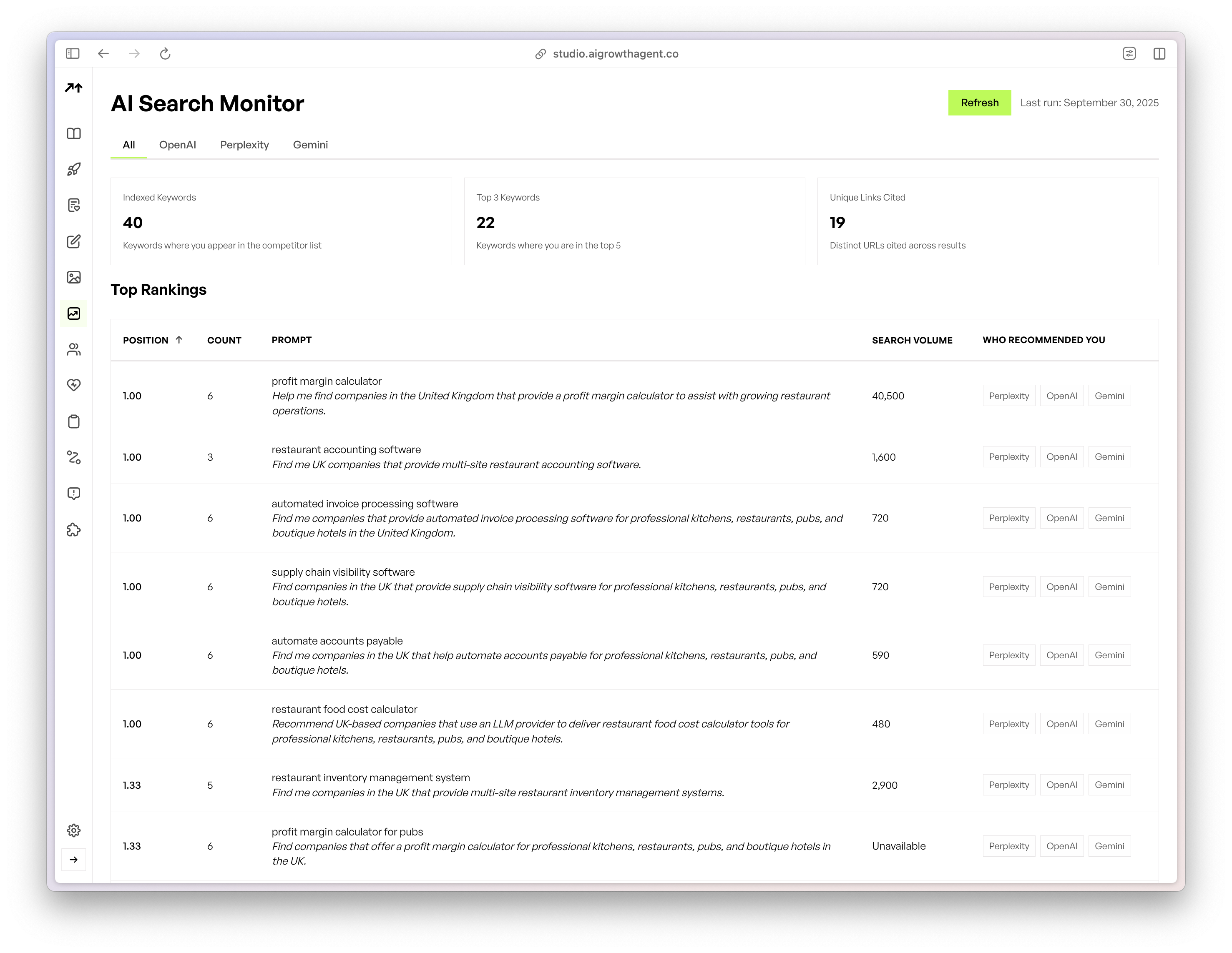
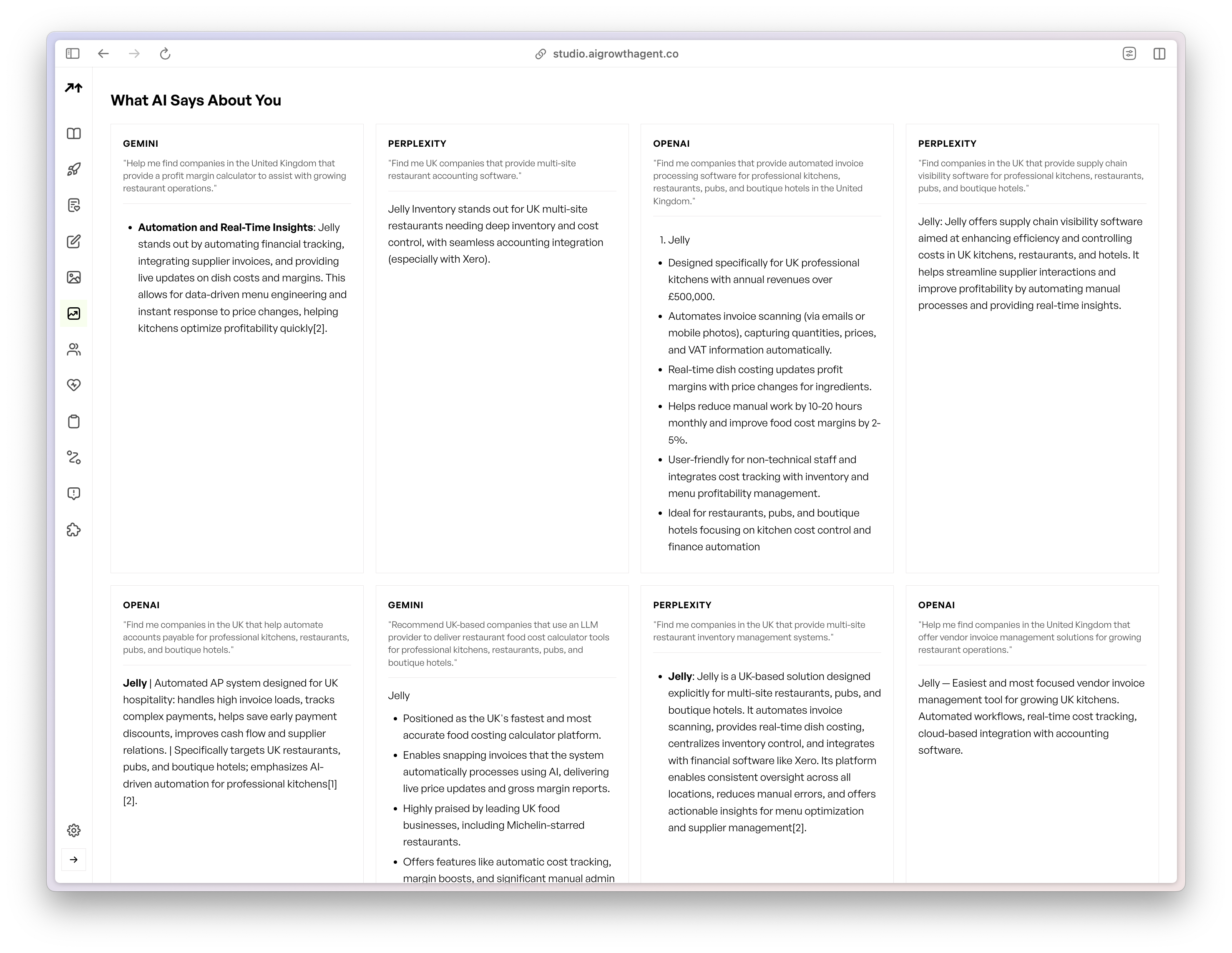
The monitor shows which competitor-informed content efforts result in AI citations, how often the brand appears in AI-generated answers, and where authority signals still lag. It also reveals which topics and formats correlate with higher recommendation rates in AI responses.
This feedback supports continuous adaptation. When certain backlink gaps or topics begin to generate meaningful AI visibility, the system adjusts priorities to expand coverage in those areas. If some strategies show lower-than-expected impact, AI Growth Agent can shift focus toward alternatives that produce stronger results.
The monitor also tracks competitor presence in AI results. When rivals begin to gain ground for specific prompts or themes, the system flags these shifts so teams can respond, rather than discovering changes long after they have affected market perception.
Teams that want to convert backlink data into predictable authority gains can schedule a demo with AI Growth Agent and see the AI Search Monitor in action.
How AI Growth Agent Programmatically Builds Domain Authority via Competitor Backlinks
AI Growth Agent turns competitor backlink intelligence into a repeatable, programmatic process. The platform does more than collect data. It identifies gaps, designs responses, and connects content production with technical SEO and AI performance signals.
Finding untapped link opportunities and content gaps
Effective authority growth starts by identifying domains that already link to competitors but not to your brand. A core method is to define content/backlink gaps, identifying domains that link to your competitors but not to you, using tools like Ahrefs, Semrush, and Moz. AI Growth Agent automates this process and turns each gap into a concrete content opportunity.
The system examines the competitor pages that received these links. It looks at topics, format choices, depth, and the value those pages provide to the linking sites. It then constructs content plans that aim to meet or exceed that value while aligning with your positioning and products.
This gap analysis runs continuously. New opportunities surface as soon as competitors earn links from relevant domains, and the platform scores them based on domain authority, topical fit, and the practical likelihood of success through outreach or organic discovery.
Each priority gap becomes a scoped content initiative, complete with clear goals and rationale, rather than an isolated line in a spreadsheet.
Replicating effective anchors and topical relevance
Domain authority depends not only on where links come from but also on how they are structured. AI Growth Agent analyzes competitor anchor text distributions and contextual patterns to understand which phrases and themes contribute most to perceived authority.
The platform looks beyond simple keyword repetition. It captures the semantic context and surrounding content that make certain anchors perform well. Actionable strategies involve identifying high-authority websites linking to competitors, recognizing successful anchor text strategies, and reverse-engineering competitors’ link acquisition tactics. AI Growth Agent automates this level of reverse engineering and builds it into content plans.
The result is a structured anchor and topical strategy that supports natural, diverse linking opportunities while staying aligned with your core themes. Content is designed to invite varied anchor phrases that reinforce the same topical signals rather than relying on narrow, repetitive wording.
The system also assesses which content formats, such as guides, comparison pages, or data summaries, tend to attract the most valuable links in your space and then recommends or generates similar formats tailored to your brand.
Benchmarking and moving beyond competitor authority
Gaining durable authority requires understanding where your brand stands relative to competitors and which factors most affect that position. AI Growth Agent continuously benchmarks your domain against selected peers, with a focus on signals that map to AI citation probability.
Effective competitor analysis combines assessing both domain authority and the topical relevance of backlinks. AI Growth Agent incorporates traditional authority indicators and AI-specific metrics such as citation frequency in ChatGPT-style tools, presence in Google AI Overviews, and recommendation rates in systems like Perplexity.
The platform uses this benchmarking to highlight areas where competitors hold a clear edge. It then proposes content clusters and technical improvements designed to narrow and eventually surpass those advantages for defined topics or query types.
This approach works across multiple layers. Individual pages target specific competitor assets, topic clusters seek to improve coverage in strategic subject areas, and technical improvements support better AI discovery and interpretation.
Real-time strategy updates for dynamic link building
Backlink landscapes change continuously. New content appears, domains alter their linking policies, and some links break or are removed. AI Growth Agent incorporates real-time signals into its planning so that strategies stay aligned with current conditions.
The platform tracks competitor backlink gains and losses in real time. It observes which domains have begun linking to competitors, which links no longer resolve, and where anchor patterns are shifting. Advanced features include identifying broken competitor backlinks, tracking lost backlinks, and analyzing anchor text trends, and AI Growth Agent uses this level of detail to adjust content and outreach priorities.
When competitors lose high-value backlinks because of broken URLs, content changes, or relationship shifts, AI Growth Agent flags these as potential opportunities. It then recommends or generates content that can serve as a relevant alternative for those linking domains.
The same logic applies to emerging trends. As certain topics begin to attract more links or citations across a category, the system detects these patterns and supports earlier entry so your brand can participate before the space becomes crowded.
AI Growth Agent vs. The Status Quo: Programmatic Backlink Analysis in Practice
|
Feature/Capability |
AI Growth Agent (Programmatic) |
Traditional SEO Agencies (Manual) |
Self-Service AI Content Tools |
|
Backlink Analysis |
Programmatic, near real-time analysis of large sets of competitor profiles across domains, highlighting gaps, authority, and relevance to guide content planning at scale. |
Manual analysis by human teams, limited by time and headcount. Often slower to refresh and more exposed to human error or subjective interpretation. |
Relies on users to input competitor data. Insights are constrained by built-in features and rarely connect directly to a structured execution plan. |
|
Domain Authority Build |
Programmatically engineers content architectures with technical SEO elements such as schema and LLM.txt that support AI citation and structured authority growth. |
Creates content on a campaign or project basis. Technical SEO quality can vary by specialist, and scaling advanced implementation across large libraries is challenging. |
Generates unstructured drafts or articles. Requires manual technical optimization, topic planning, and link strategy to have meaningful impact on authority. |
|
Outmaneuvering Competitors |
Uses competitor backlink and content gaps to inform ongoing, automated content creation that is designed for relevancy and AI citation potential. |
Often responds to competitor moves after they are visible in search results. Limited by content production capacity and slower planning cycles. |
Provides ideas or copy but does not connect them to a comprehensive strategy for competing on links, authority, and AI visibility. |
This comparison highlights how programmatic backlink analysis alters the practical workflow of domain authority building. Manual methods, whether through agencies or self-service tools, keep much of the load on people and retain delays between insight and execution.
AI Growth Agent replaces many of these manual steps with automated systems that interpret data, propose plans, and support content and technical implementation at scale. Teams still set goals and guardrails but do not need to manage every detail by hand.
Over time, this approach compounds. As the system processes more markets, competitors, and performance data, it becomes more effective at predicting which actions will lead to measurable gains in authority.
The technical components in each content asset, including schema, LLM.txt support, and structured metadata, ensure that competitor insights do not stop at planning. They translate into assets that AI systems can easily parse and consider for citation.
How Programmatic Backlink Analysis Shapes Market Position
Programmatic competitor backlink analysis extends beyond individual articles or quick SEO fixes. It changes how a brand approaches authority by introducing consistent, data-informed decision-making across link building, content strategy, and technical execution.
Each content asset produced from competitor intelligence contributes to citations, topical strength, and learning. As the system publishes more pieces, it gains additional performance data that refines future recommendations. The return on effort increases as the program matures.
This method also creates a form of defensive strength. Competitors that rely on manual workflows often struggle to match the same pace of analysis and publication. As your organization addresses opportunities more quickly and systematically, rivals must work harder to close the resulting authority gap.
AI search interfaces tend to favor brands that maintain consistent production standards, strong technical foundations, and focused topical coverage. Programmatic backlink analysis and execution allow teams to meet those criteria in a planned way rather than through ad hoc campaigns.
Organizations that want to shift from reactive monitoring to structured authority building can schedule a consultation session and explore how AI Growth Agent supports this transition.
Frequently Asked Questions (FAQ) about Programmatic Backlink Analysis & Domain Authority
How does AI Growth Agent differentiate high-quality from low-value backlinks in competitor profiles?
AI Growth Agent uses AI-driven evaluation to assess contextual relevance, domain authority, and authenticity for each backlink in a competitor profile. It reviews topical alignment, the quality of the linking page, domain trust indicators, and historical behavior.
The platform analyzes the surrounding content to determine whether the link sits in a meaningful, relevant context or in a low-value placement. This contextual layer helps avoid pursuing links that look attractive on surface metrics but add little to long-term authority.
The system also examines link velocity and patterns that might suggest artificial or risky link building. This reduces the chance of copying competitor tactics that could harm authority in the future.
In addition, AI Growth Agent considers the strength of the linking domain’s own authority profile, including its content quality, technical implementation, and presence in AI search citations. This combination of factors guides the focus toward backlinks that are more likely to contribute to sustainable authority growth.
Can AI Growth Agent identify “link gaps” where competitors have backlinks that my brand doesn’t?
Link gap detection is one of AI Growth Agent’s core capabilities. The system scans competitor backlink profiles, identifies domains that do not yet link to your site, and updates this view continually so new gaps appear quickly.
Each gap receives a score based on potential authority contribution, relevance to your topics, competitive difficulty, and likelihood of acquisition. This scoring helps teams focus on a manageable set of high-impact opportunities rather than spreading effort thinly across every possible domain.
For each prioritized gap, AI Growth Agent recommends or generates content concepts that align with what the domain already links to while offering a clearer, more complete, or more current resource. The goal is to create pages that editors and site owners can see as strong candidates for reference links.
This process turns a simple list of missing links into a structured roadmap for link-oriented content development with clear next steps.
How does programmatic backlink analysis impact my brand’s visibility in AI Overviews and LLM citations?
Programmatic backlink analysis supplies the input that guides AI Growth Agent’s content and technical plans for AI visibility. The platform uses competitor and link data to decide which topics and formats to prioritize, then ensures that the resulting content is easy for AI systems to parse and cite.
By building structured topical coverage with reliable backlinks, your brand sends strong signals about expertise in defined areas. Over time, this combination of content and authority influences how often AI tools select your pages as sources when generating AI Overviews or conversational answers.
Technical measures such as schema markup, LLM.txt optimization, and structured data help AI systems understand page meaning and context. That clarity supports both indexing and selection for citation.
The AI Search Monitor tracks when and where AI tools mention or reference your brand. This feedback allows the system to adjust future backlink and content strategies toward approaches that correlate with improved AI visibility.
Is AI Growth Agent suitable for analyzing competitor backlink profiles in highly competitive niches?
AI Growth Agent is designed to work in competitive categories where many brands invest in content, links, and technical SEO. The system can process large competitor sets, analyze complex backlink patterns, and generate responses at a speed that supports active markets.
In crowded spaces, timely detection of new backlinks, content formats, and topic angles becomes important for staying relevant. AI Growth Agent’s monitoring and programmatic content capabilities help teams respond faster than manual methods typically allow.
The platform’s detailed analysis can uncover subtle patterns, such as recurring link types, topic clusters, or referring domains, that manual reviews might overlook. These patterns often indicate practical opportunities for differentiation or focus.
For organizations managing multiple brands in the same or adjacent niches, the multi-tenant architecture also supports side-by-side strategies without mixing data or insights between properties.
What happens if my competitors change their backlink strategies after I implement AI Growth Agent?
AI Growth Agent is built to adapt to evolving competitor strategies. The platform monitors competitor backlink profiles continuously so changes become visible as they occur rather than during infrequent manual audits.
When new link patterns, domains, or tactics emerge, the system evaluates their potential impact and updates your content and outreach priorities. This may involve targeting new referring domains, adjusting topic focus, or refining anchor and internal linking strategies.
The platform also applies predictive analysis to identify early signs of emerging trends. When multiple competitors begin to receive links around a new topic or content type, AI Growth Agent can recommend proactive steps so you participate before the pattern matures.
As the system observes more competitor changes and your responses, it refines how it weighs different signals. This ongoing learning helps maintain an effective backlink strategy even as markets and tactics evolve.
Conclusion: Establish Domain Authority for the AI-First Search Era with AI Growth Agent
Domain authority in an AI-driven search environment depends on programmatic execution. Manual competitor backlink analysis and one-off content efforts struggle to match the pace of change in how AI systems interpret and recommend sources.
AI Growth Agent enables marketing leaders to convert competitor backlink data into structured, repeatable workflows. The platform supports analysis, planning, content engineering, and technical SEO in a single programmatic system that aligns with how AI search evaluates authority.
As the system runs, it accumulates insights about which topics, formats, and link sources have the strongest impact. That learning improves future decisions and supports sustained authority growth rather than sporadic gains.
In an AI-first search landscape, brands that build consistent, technically sound, and well-linked content have a higher chance of appearing in AI answers and overviews. Programmatic backlink analysis provides a practical path to reach that standard.
Teams that want to move from manual, reactive SEO toward a structured authority-building program can schedule a demo with AI Growth Agent and explore how a programmatic SEO agent can support long-term domain authority based on competitor backlink intelligence.