


Written by: Mariana Fonseca, Editorial Team, AI Growth Agent
Executive Summary
- Mobile-friendly, technically structured content now plays a central role in domain authority for AI-powered search.
- AI systems such as ChatGPT, Gemini, and Perplexity favor sites with deep, consistent content, strong technical SEO, and reliable mobile experiences.
- Manual optimization cannot keep pace with the scale and precision required for AI citation and modern domain authority.
- Programmatic content engineering provides a way to generate, structure, and maintain technically sound content at scale.
- AI Growth Agent offers an autonomous platform that helps marketing leaders improve AI visibility, organic traffic, and operational efficiency through programmatic SEO and AI search monitoring.
The Problem: Why Authoritative Content Is Now Central To AI Search Authority
High-quality, structured content has become a primary factor in whether your pages are discovered, indexed, and cited by AI search engines. The relationship between businesses and search has shifted from manual keyword targeting to programmatic content that supports authority and citation within large language models (LLMs).
Authoritative content is no longer a secondary consideration. It now determines how visible your brand is when AI assistants generate answers, recommendations, and summaries across millions of queries.
How AI Search Engines Prioritize Authoritative Content for Citation and Indexing
Major AI search engines, including Google Gemini, Perplexity, and ChatGPT, increasingly factor technical structure, mobile performance, and content depth into indexing and citation. These systems prioritize sites that deliver comprehensive, well-organized content that is easy to parse on any device.
AI engines need reliable, trustworthy information that can be evaluated quickly. When an AI system receives a query, it scans potential sources and looks for clear signals of authority and accessibility. Sites with deep, structured content, strong mobile usability, and clean markup signal technical competence and value, which AI algorithms interpret as trust indicators.
Content that is comprehensive, technically optimized, and consistent is more likely to be selected as a source for AI-generated responses. Marketing leaders need to recognize that their digital presence is not only serving human visitors. It is also being assessed constantly by AI crawlers that determine whether content is eligible for citation across a wide range of search intents.
The Silent Authority Erosion: What Happens When Your Content Fails AI Scrutiny
Poor content structure and weak technical implementation reduce the chances that AI systems will retrieve, summarize, or cite a site. This creates a slow erosion of domain authority that often goes unnoticed until performance has already declined.
When AI search engines encounter usability or structural issues, they quickly move past problematic content to more accessible alternatives. This is not only about user experience. It is also about algorithmic trust. Trust and authority signals in AI search algorithms increasingly align with content depth, technical optimization, and mobile friendliness.
The subtle nature of this shift makes it easy to miss. Traditional SEO metrics reveal ranking drops relatively quickly. AI citation loss, by contrast, tends to happen gradually. Your content may still rank well in classic search results, yet your brand may appear less often when potential customers ask AI assistants for recommendations in your category. This gradual absence can weaken long-term market positioning and perceived authority.
Ignoring content performance and technical quality leads to fewer inclusions in AI summaries and answers. Over time, this reduces domain authority and competitive visibility in generative search environments. Competitors that focus on AI discovery and citation steadily gain share, even if their traditional rankings appear similar.
Beyond Basic Content: Nuanced Challenges for AI Indexing
Modern content optimization extends far beyond simple keyword usage. Several technical and structural factors now influence whether AI systems can effectively parse and use your content:
- Content depth and clarity that allow AI models to extract precise answers
- Consistent metadata and headings that define hierarchy and context
- Mobile-friendly layouts that perform well across devices
- Accurate technical SEO that supports efficient crawling and indexing
Content readability and structure shape AI’s ability to interpret information. Incomplete or poorly formatted pages create barriers for AI crawlers attempting to understand the value of your content. Weak technical SEO can also signal lower content quality to AI algorithms.
Asset crawlability presents another important challenge. Images, scripts, and other assets that fail to load correctly or lack optimization create incomplete content profiles that AI systems struggle to process. This missing data lowers the likelihood of comprehensive citation and recommendation.
Content consistency across platforms has become more important as AI systems evaluate a unified brand narrative. When messaging, facts, or structures conflict, AI systems may misinterpret or overlook critical information, which reduces citation potential.
Marketing teams that want to eliminate these content optimization gaps can use programmatic tools to enforce structure, alignment, and mobile-ready presentation at scale. Schedule a consultation session to see how AI Growth Agent can engineer authoritative content for AI search authority.
The Solution: How Programmatic Content Engineering Builds AI Authority
The volume and precision required for AI authority are difficult to achieve with manual processes alone. Marketing leaders need programmatic systems that can engineer content optimized for AI citation, technical SEO, and mobile usability at scale.
This shift moves teams beyond traditional SEO tactics toward comprehensive content engineering that addresses the full range of AI and search requirements, from schema and metadata to layout and device performance.
Autonomous Content Optimization: How Programmatic SEO Delivers Technical Excellence
Key content and technical metrics that relate to domain authority and AI visibility include structural consistency, schema markup, page speed, and mobile responsiveness. Programmatic SEO platforms can optimize these elements across large content libraries without constant manual effort.
Content structure optimization includes improving readability, metadata, internal links, and keyword clustering. Automated systems can apply rules that make content more comprehensive and easier for AI systems to cite, a task that becomes difficult to manage manually at scale.
Technical SEO optimization focuses on elements such as schema markup, structured metadata, and clean URL structures. Programmatic systems can apply and maintain these standards across new and existing content, creating consistent experiences that AI algorithms interpret as well-organized and reliable.
Programmatic optimization provides a repeatable foundation for performance across all content. This technical base supports more frequent and stable AI citation.
Structured Data for AI Citation: Leveraging Schema for Content Parsing
AI search engines rely heavily on structured data to understand, categorize, and quote content. Programmatic systems can implement comprehensive schema markup that manual workflows often apply slowly or inconsistently.
Advanced schema implementations can include organization details, product information, FAQ blocks, and breadcrumb data. These elements help AI systems understand content hierarchy, relationships, and context. Clear structure makes it easier for algorithms to extract specific information points and use them in generated responses.
The use of LLM.txt files is an emerging method for guiding AI systems directly. Programmatic systems can generate and maintain these files, giving AI search engines explicit instructions on how to interpret and cite content. This direct communication channel creates additional opportunities for citation optimization.
Content Consistency at Scale: Ensuring Unified Experiences Programmatically
Sites that want to perform well in AI search need consistent, high-quality content experiences. Maintaining that consistency manually across hundreds or thousands of pages is a challenge for most marketing teams.
Programmatic content engineering helps each piece of content meet defined technical standards while remaining aligned with AI indexing requirements. This includes consistent meta descriptions, stable core content, and matching structured data across formats and channels.
Content synchronization also benefits from automated monitoring and updating systems. Programmatic tools can detect discrepancies, flag issues that may affect AI citation consistency and domain authority, and trigger updates without requiring a full manual audit.
Scaling Content: The Role of Multi-Tenant Programmatic Deployment for Enterprises
Enterprise organizations often operate multiple brands, regions, or product lines. Maintaining consistent optimization in this environment can be difficult without shared systems.
Multi-tenant programmatic deployment provides a structured way to scale content engineering across complex organizations. Teams can manage multiple content streams from a central interface while preserving distinct brand voices, keyword strategies, and optimization rules for each tenant.
Each programmatic agent follows its own content manifesto and technical specifications while using shared optimization infrastructure. This setup supports rapid scaling across diverse markets and properties while maintaining a consistent level of technical quality for AI citation.
How AI Growth Agent Helps You Build AI Domain Authority
AI Growth Agent is a comprehensive solution designed to address the intersection of technical SEO, content structure, and AI citation optimization at scale. Instead of relying on manual audits or generic AI writing tools, AI Growth Agent deploys specialized programmatic SEO agents that engineer content architectures for AI search authority.
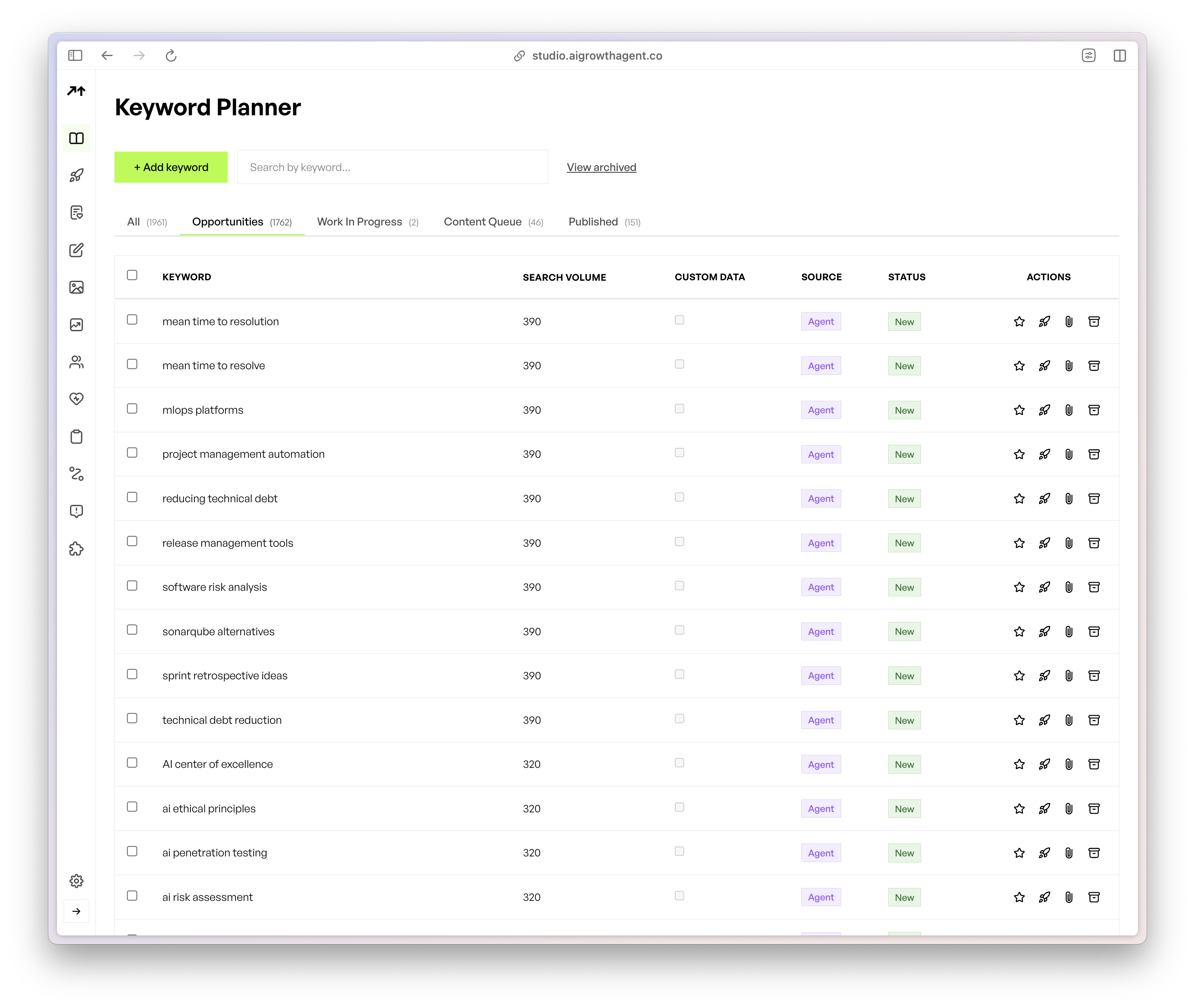
Key Features:
End-to-End Programmatic Optimization: AI Growth Agent applies comprehensive optimization across all content, including schema markup injection and LLM.txt file generation. Each piece of content is created or updated with consistent technical specifications that AI search engines can parse, index, and cite.
Autonomous Technical Infrastructure: The platform establishes an optimized blog architecture that closely matches your brand while providing a clean technical foundation for programmatic content deployment. This infrastructure aligns with AI search engine requirements for indexing, speed, and mobile accessibility.
Real-Time Programmatic Content Injection: AI Growth Agent enables fast generation of optimized content that addresses trending topics and associated AI search demand. This capability helps your brand respond quickly to market shifts while preserving technical and structural quality.
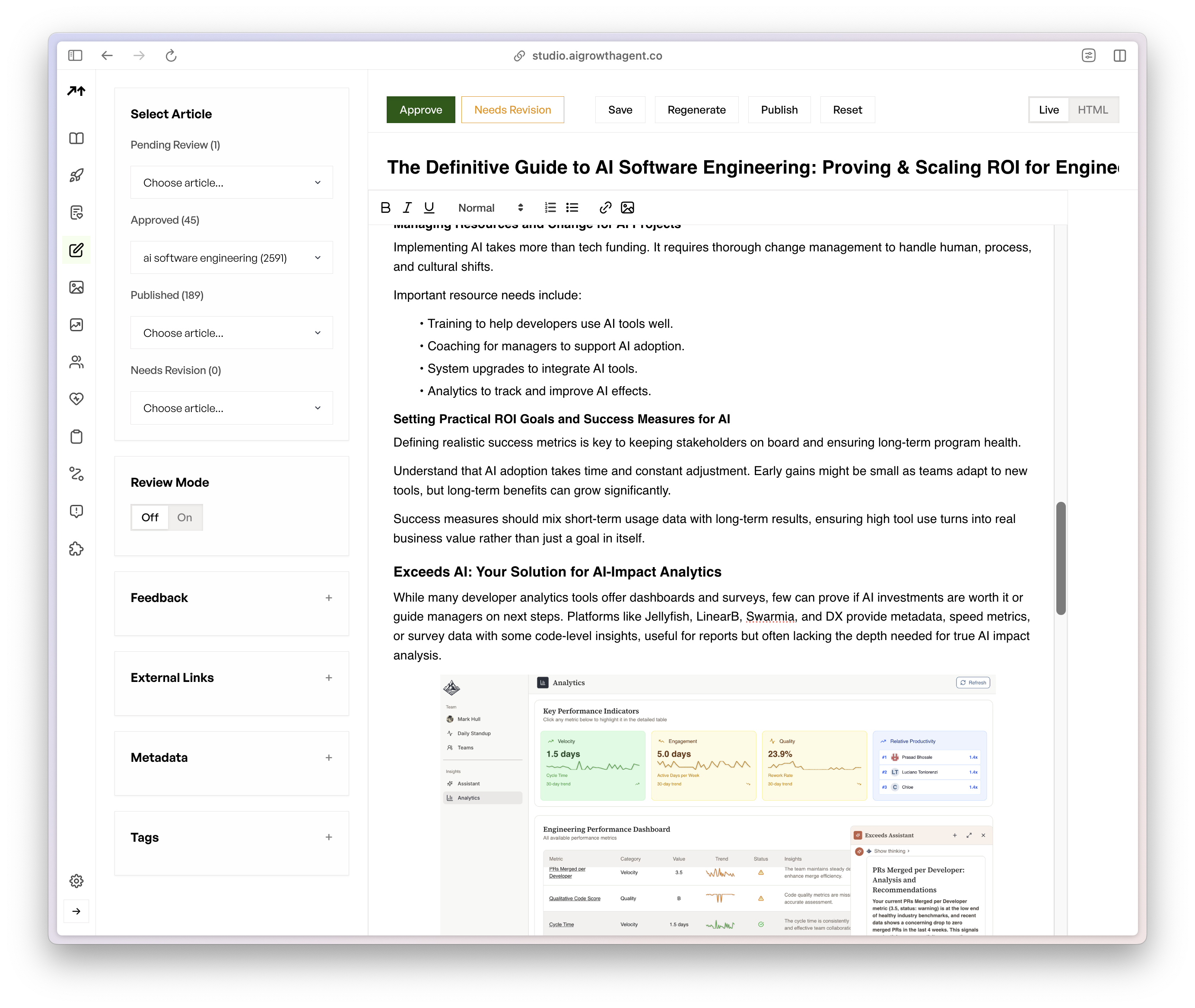
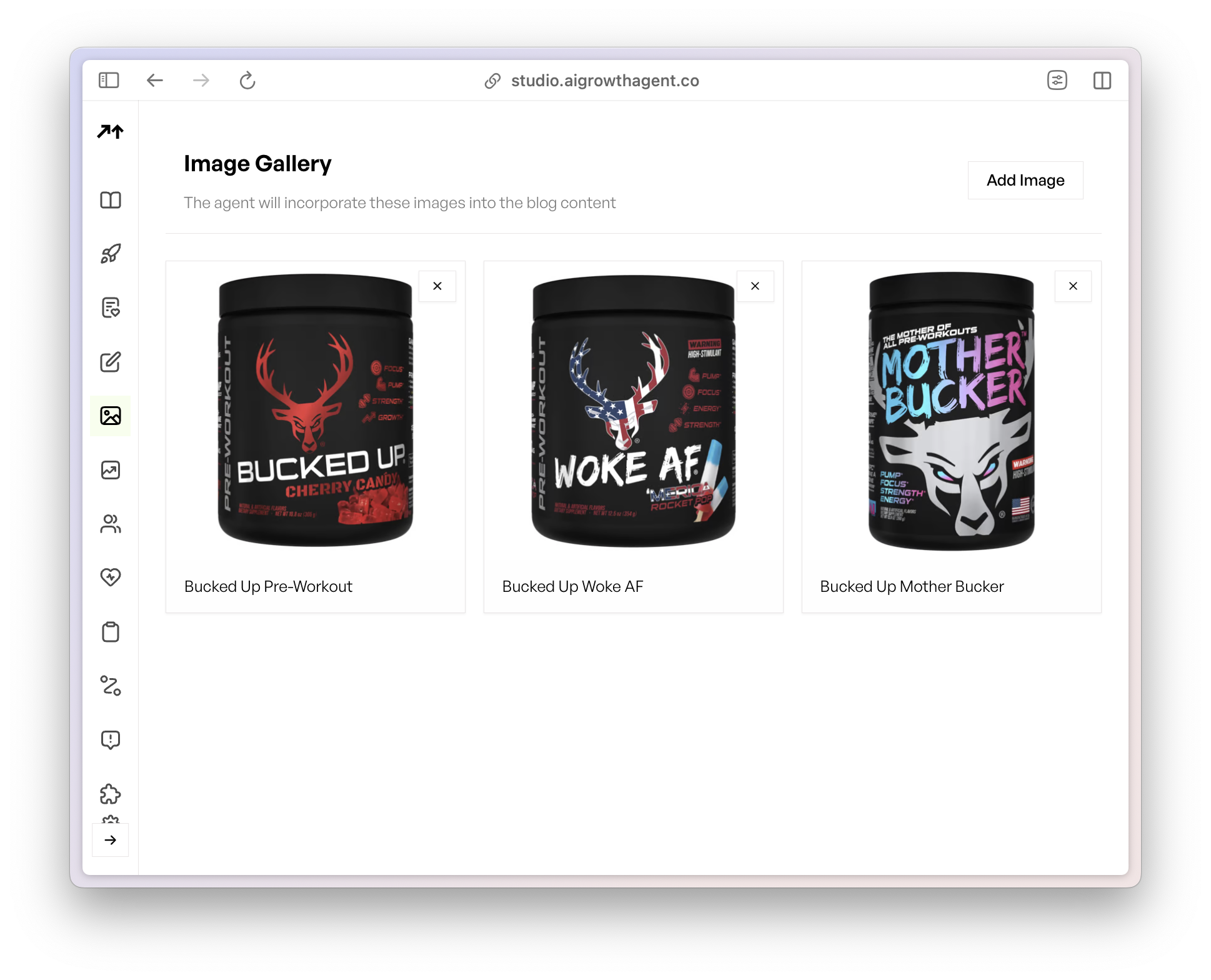
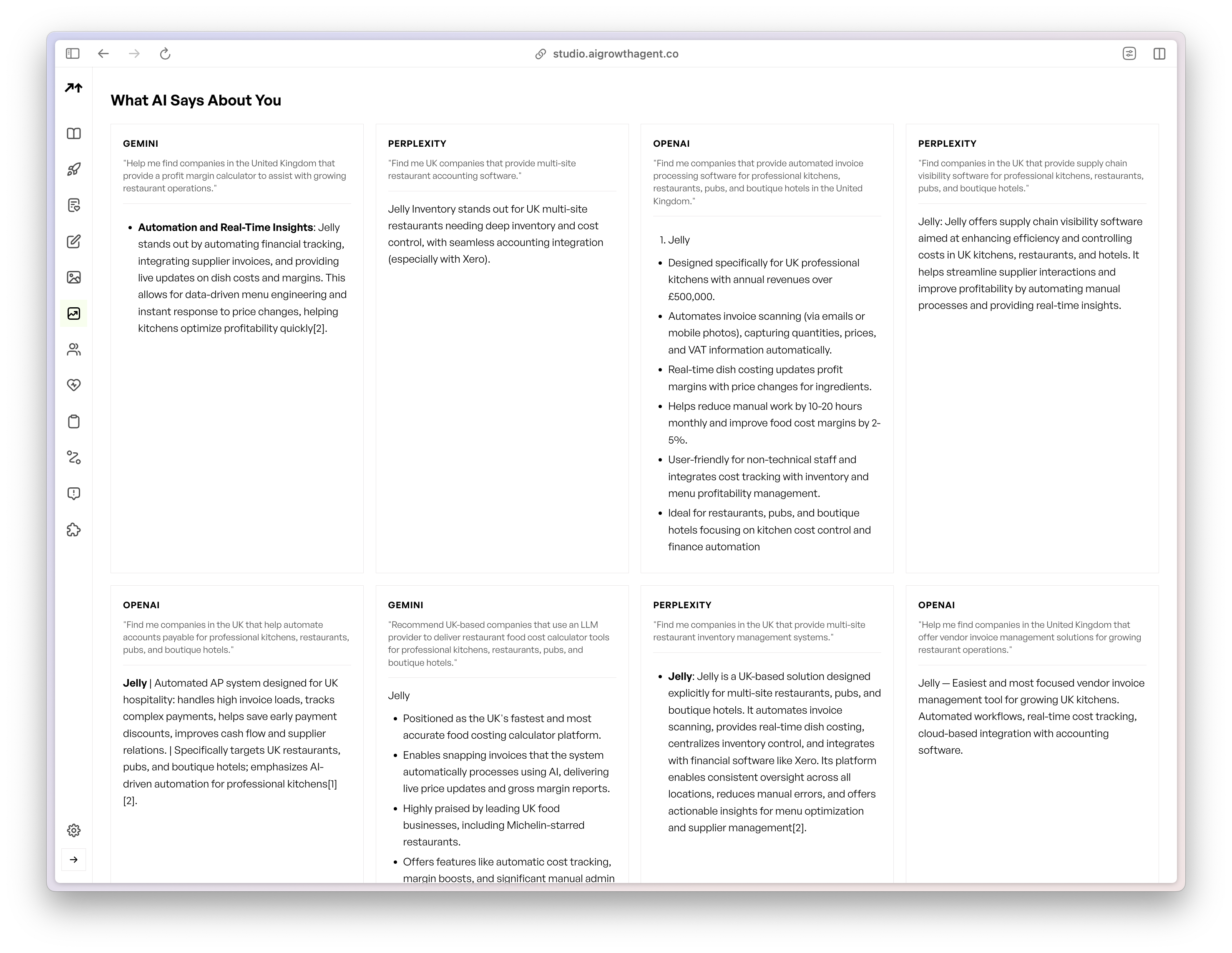
AI Search Monitor & Feedback Loop: The platform monitors content performance across ChatGPT, Gemini, and Perplexity, showing which URLs contribute to AI visibility and citations. These insights allow continuous optimization of content strategy based on real AI citation data.
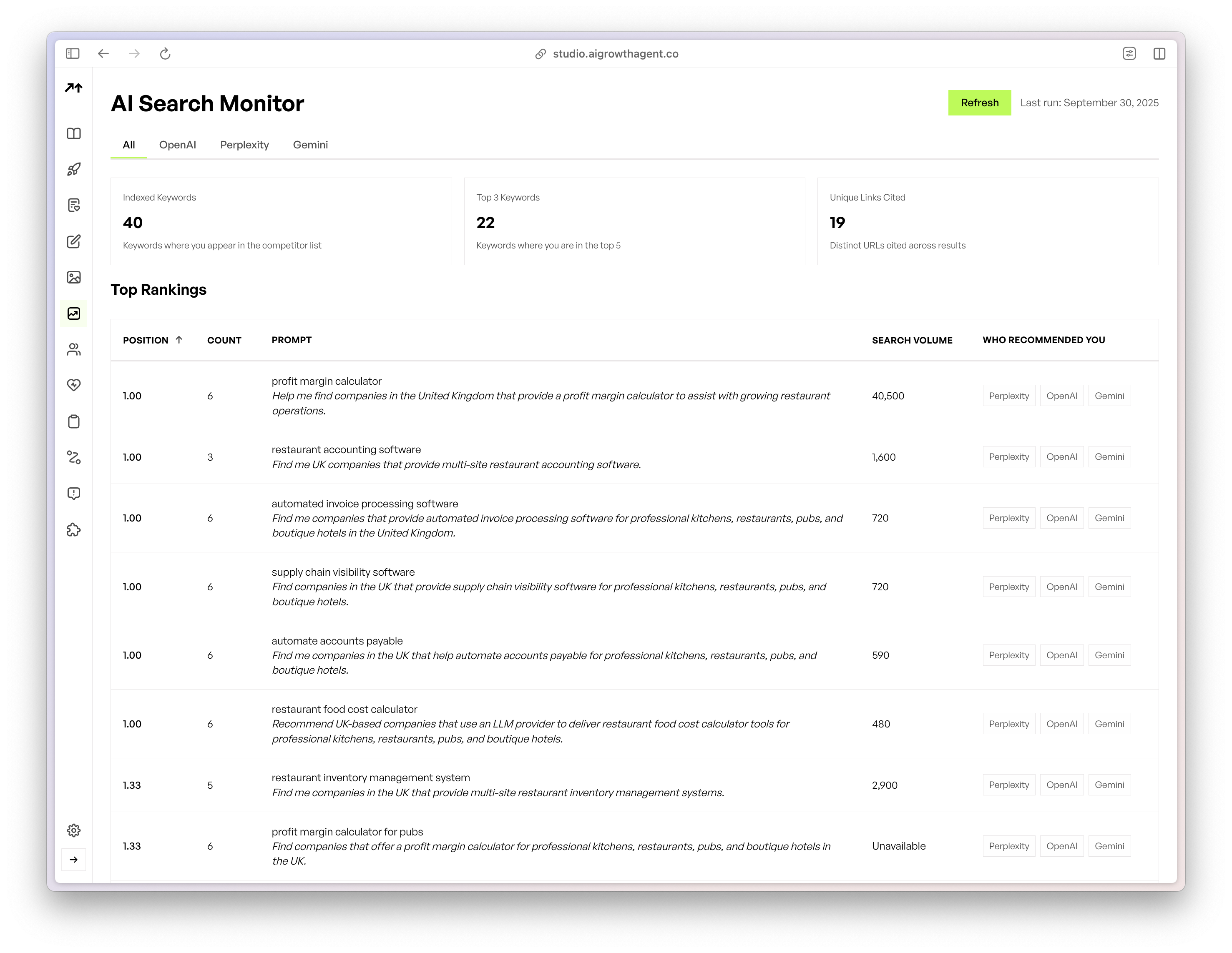
Comparison: AI Growth Agent vs. Traditional Approaches for AI Authority
|
Feature Category |
AI Growth Agent (Programmatic) |
Traditional SEO Agencies (Manual) |
Basic AI Content Tools (Unstructured) |
|
Content Optimization |
Automated schema, LLM.txt for AI citation |
Manual audits, slower implementation, limited scale |
Requires manual integration and technical SEO |
|
Content Scale |
Autonomous engineering of high-volume, optimized content |
Limited by human resources, slower output |
Produces unstructured text, lacks technical SEO |
|
AI Indexing & Citation |
Engineered for direct AI interface and citation via LLM.txt |
Relies on traditional ranking signals, less focused on AI |
No specific engineering for AI citation |
|
Technical SEO Depth |
Advanced schema, structured site architecture |
Variable, often limited AI-specific support |
None, depends on user’s technical expertise |
Marketing leaders who want to make their digital presence a stronger source of AI authority can see how these capabilities work in practice. Schedule a consultation session with AI Growth Agent to review options for AI domain authority.
What Marketing Leaders Gain From Stronger AI Domain Authority
Programmatic content engineering with AI Growth Agent can drive measurable gains across AI visibility, organic search performance, and operational efficiency. Many organizations see early movement in AI exposure and traffic as optimized content is deployed.
Higher AI Citation & Recommendation
AI Growth Agent clients often achieve stronger citation and recommendation positions across major AI search engines as their technical and content profiles improve. In many cases, visibility increases begin within weeks of programmatic deployment.
The programmatic approach reinforces consistent technical quality across all content. This consistency creates the reliability and authority signals AI search engines look for when selecting sources. Over time, this can lead to more citation opportunities across related topics and keyword clusters.
Superior Organic Traffic & Visibility
Combined technical optimization and programmatic content volume often translate into better organic search performance. AI Growth Agent’s programmatic methods apply a consistent standard across core SEO and content metrics.
Each programmatically optimized article contributes to overall domain authority and coverage. The cumulative effect of hundreds or thousands of technically sound articles can produce traffic volume that is difficult to achieve with manual content approaches alone.
Operational Efficiency & Scalability
AI Growth Agent reduces the operational bottlenecks that limit content scale. The programmatic model manages technical tasks while preserving brand voice and content quality standards defined by your team.
The set-it-and-monitor-it nature of programmatic content engineering allows marketing leaders to focus on strategy, partnerships, and experimentation while the AI agent handles execution details. This efficiency opens room for growth initiatives that were previously constrained by time and resources.
Future-Proofing Your Digital Presence
The AI search landscape is changing rapidly, with new platforms and optimization requirements emerging on a regular basis. Programmatic content engineering gives organizations a technical foundation that can adapt without requiring a full rebuild of the content program.
AI Growth Agent’s monitoring capabilities act as an early warning system for algorithm shifts and new optimization patterns. This proactive view helps marketing leaders stay ahead of competitive threats and act quickly on emerging citation opportunities.
Brands that want to protect and grow their digital footprint in the age of AI search benefit from acting early. Schedule a demo to discover how AI Growth Agent can help future-proof your content strategy for sustained AI domain authority.
Frequently Asked Questions About Content and AI Search
How does content quality specifically impact my chances of being cited by AI search engines like ChatGPT and Perplexity?
Content quality affects AI citation probability because AI search engines prioritize sources that combine strong information value with sound technical structure. When AI systems evaluate candidates for citation, they consider technical performance metrics, content depth, and clarity as trust signals. Sites with poor content experiences or weak technical setups are often filtered out during selection, even if the topic is relevant. Well-written content that lacks technical optimization can therefore remain invisible to AI search engines.
What specific content issues prevent content from ranking well in AI-powered search results?
Several technical and structural issues limit performance in AI-powered search. Poor structure makes it hard for AI systems to parse and segment content into clear answers. Inadequate metadata and headings obscure the main topics and reduce topical clarity. Content inconsistencies, incomplete data, or missing assets interfere with full evaluation. These issues combine to create negative signals that AI algorithms interpret as lower quality or reduced trustworthiness, which lowers citation odds.
How does technical SEO relate to AI search engine optimization and domain authority building?
Technical SEO is a key component of AI search optimization because it measures how accessible and understandable your content is for crawlers. Optimized metadata and schema help AI systems interpret context more quickly, which improves citation chances. Clean site structures, fast load times, and mobile-friendly layouts support smooth crawling and indexing. AI search engines use these signals as indicators of content quality and site authority, so weak technical SEO often correlates with lower AI citation frequency.
Can programmatic SEO maintain content quality while optimizing for AI search?
Programmatic SEO can maintain or improve content quality while also enhancing technical optimization at scale. Advanced systems such as AI Growth Agent generate and refine content using defined quality standards and brand guidelines. They also apply comprehensive technical SEO practices, including schema markup and metadata optimization that manual processes may overlook. When implemented correctly, this approach improves both human readability and AI accessibility.
How quickly can I expect to see results from AI optimization efforts?
Many organizations begin to see results from AI-focused optimization within 2 to 3 weeks, with more significant improvements appearing over 2 to 3 months. Early changes may include better indexing coverage and stronger visibility metrics. AI citation improvements often follow within the first month as systems recognize technical upgrades. Larger gains in domain authority and stable AI citation positions usually develop over 3 to 6 months as technical consistency and content volume build trust with algorithms.
Conclusion: Competing Effectively in AI Search With AI Growth Agent
The convergence of AI-powered search and the need for authoritative, mobile-friendly content has created a new challenge for marketing leaders. Traditional, largely manual approaches often lack the precision and scale needed to earn consistent AI citations and build domain authority.
AI Growth Agent provides an autonomous, programmatic approach to content engineering, technical optimization, and AI monitoring. By combining structured content creation with automated schema, LLM.txt management, and AI search feedback, the platform delivers a level of consistency that is difficult to match manually.
The AI search imperative is already reshaping how buyers discover brands and make decisions. Organizations that delay comprehensive optimization face a gradual loss of authority as competitors capture a larger share of AI citations and recommendations.


