


Written by: Mariana Fonseca, Editorial Team, AI Growth Agent
Executive summary
- AI search engines now assess domain authority through machine-validated quality signals, structured data, and topical depth, so traditional keyword-focused SEO alone no longer sustains visibility.
- Manual content production struggles to keep pace with AI-generated volume, which creates a growing authority and visibility gap for many brands in AI search results.
- Technical SEO for AI search focuses on schema markup, site architecture, internal linking, and programmatic infrastructure that make expertise easy for large language models to understand and trust.
- AI Growth Agent provides an automated system for creating and maintaining technically optimized content architectures, schema, and AI-facing files across brands and subdomains.
- Real-time monitoring of AI citations and feedback loops supports ongoing refinement of both content and infrastructure, which helps preserve authority as AI systems and algorithms change.
- Organizations that adopt programmatic technical SEO early can secure durable visibility and citations across AI search platforms such as ChatGPT, Google AI Overviews, Gemini, and Perplexity.
The Problem: Why Brands Struggle to Build Authority in the AI Search Era
The Vanishing Digital Footprint
Many premium brands see their digital presence shrink as AI-generated content increases across the web. A high volume of low-quality or generic material dilutes visibility, which makes it harder for established companies to maintain a distinct voice and recognizable authority. This growing noise creates a situation where brands with strong products and services can appear less visible to AI search engines that must separate real expertise from commodity content.
The rapid growth of AI-generated material means brands that rely on manual content alone, even when quality is high, face a structural disadvantage. Their carefully developed articles compete with large volumes of programmatically generated pages that emphasize scale. Without a strategy that addresses this difference in velocity, even strong brands can lose share of voice in AI search results and appear less often in AI-generated answers.
E-E-A-T Redefined: Beyond Keywords to Trust and Context
AI search engines prioritize expertise, authority, and trustworthiness through language and context analysis rather than simple keyword matching or link counts. This shift limits the impact of tactics like keyword stuffing or surface-level on-page tweaks for building real authority.
Modern AI algorithms use multi-dimensional analysis that includes semantic understanding, factual consistency with trusted databases, and cross-checking of claims against authoritative sources. AI-powered search systems focus on meaningful insights and expert perspectives, and they rely on technical signals such as structured data and schema markup to interpret and rank authoritative pages. Brands now need to show expertise through solid topic coverage, regular publishing, and technical foundations that clearly communicate authority to AI models.
The updated E-E-A-T framework places stronger weight on Experience. Brands must show real-world application of their knowledge, not just theoretical understanding. Many companies excel at what they do but find it difficult to express that practical experience in ways that AI systems can detect, verify, and reward with higher authority.
The Velocity Gap: The Unattainable Pace of Manual Authority Building
Establishing topical authority depends on pillar-hub content structures, where core pages cover themes broadly and supporting pages answer clusters of related queries. This model requires steady publication of research-backed, technically optimized content that shows both breadth and depth within a topic.
Manual content workflows rarely match the pace that AI search rewards. Many teams publish only a few high-quality pieces each month, while AI systems tend to favor recency, consistency, and comprehensive coverage across connected topics. Ongoing optimization and thoughtful content structuring play central roles in maintaining authority within fast-moving AI-driven search environments.
This gap in velocity creates a strategic risk. Competitors that use programmatic methods can produce more technically optimized content, respond faster to new topics, and gradually dominate AI citations. Brands that invest heavily in traditional, manual content efforts often see diminishing returns as automated but well-structured content ecosystems capture a larger share of AI search visibility.
Brands that want to close this gap and build AI-ready authority can use programmatic technical SEO to scale their efforts. Schedule a consultation session to see how AI Growth Agent supports this shift.
The Solution: Technical SEO as the Blueprint for AI Domain Authority
Consistent citation and recommendation by AI search engines require a technically sound and programmatically structured digital presence. This presence must communicate expertise, authority, and trust through signals that AI systems can interpret. Traditional SEO focused heavily on keywords and basic on-page elements. Technical SEO for AI search instead emphasizes infrastructure that helps machines understand, validate, and confidently cite your content.
Advanced Schema Markup: Programming for AI Understanding
Technical signals such as structured data and schema markup help AI systems interpret and rank authoritative pages for relevant queries. Detailed schema implementation acts as a direct language between your content and AI models, which clarifies entities, relationships, and context that plain text alone may not convey.
Advanced schema extends beyond basic article markup to include entity-level data for people, organizations, products, and key concepts. This structured representation helps AI search engines validate expertise and map how ideas connect across your site. When content carries accurate schema, AI can more easily identify the author’s background, the organization’s role, and how each piece fits into a larger knowledge graph.
Specialized schemas, including FAQ, How-to, and Review markup, create additional opportunities for AI citation. Each schema type sends a specific confidence signal that assists AI systems in deciding when and how to reference your content. Over time, this foundation supports more frequent and more precise citations across a wide range of user queries.
Optimal Site Architecture & Internal Linking: Engineering Topical Authority
AI search engines tend to favor content architectures that show clear breadth and depth around topics, rather than isolated pages that chase individual keywords. Site structures that follow a pillar-hub logic, combined with thoughtful internal linking, create topic maps that AI systems can follow and trust.
Effective technical architecture for AI search organizes content into clusters where each page reinforces related concepts. Internal linking patterns that strengthen topical hubs can significantly improve perceived authority in technical SEO evaluations. This network of connections helps AI systems see your coverage as both cohesive and comprehensive, which increases the likelihood of citation across related queries.
Implementation details matter. URL structures, breadcrumb navigation, and contextual internal links should guide both users and AI crawlers through logical paths. When AI encounters a consistently organized structure, it can more easily infer that your site covers a topic in depth, which supports higher citation rates and more frequent inclusion in AI-generated responses.
Programmatic Content & Technical Infrastructure: Scaling Authority Autonomously
Brands gain an advantage in AI search when they pair technical infrastructure with programmatic content creation. This includes support for specialized files such as LLM.txt and Model Context Protocol implementations that speak directly to AI systems. Ongoing optimization through intelligent content structuring helps maintain authority in a rapidly changing AI search landscape.
Automated systems make it possible to reach the volume and precision that AI search now expects. These systems manage complex tasks such as canonical URL logic, XML sitemap design, robots.txt configuration, and metadata deployment across large content catalogs.
Programmatic infrastructure also enables faster responses to AI search engine feedback. Content structures and technical elements can adjust as AI algorithms evolve, new queries emerge, and user behavior changes. This adaptive capacity is difficult to match with manual workflows, yet it is increasingly important for preserving and growing domain authority in AI search.
AI Growth Agent: The Autonomous Solution for Technical SEO Optimization and AI Domain Authority
AI Growth Agent provides an automated system that focuses on advanced technical SEO for AI search. The platform reduces technical friction while building content architectures that help brands become recognized authorities within their categories. The outcome is more consistent citation and recommendation across AI search engines.
Autonomous Technical Infrastructure for Flawless Indexing
AI Growth Agent sets up and maintains optimized blog architectures that handle the core technical details required for effective AI indexing. The agent can create dedicated subdomains that align with your brand design while offering a clean, performance-focused foundation for programmatic SEO.
The system manages canonical URLs, XML sitemaps, robots.txt files, and advanced metadata across all content. This level of precision helps AI search engines crawl, understand, and index your pages without many of the errors or gaps that occur in manual setups.
The platform connects with existing tools such as WordPress, Hashnode, Webflow, Framer, Sanity, and HubSpot. Many clients choose the hosted option to reduce maintenance and simplify operations. In either case, the infrastructure is built to scale for high publishing volumes without introducing technical bottlenecks.
Programmatic SEO Content Agent Capabilities: Engineering Content for AI
The AI Growth Agent content system automates the technical engineering of each article. It applies advanced schema markup, optimized metadata, and proprietary LLM.txt and Model Context Protocol files that support direct communication with AI systems. This approach helps each published piece align with AI search optimization best practices.
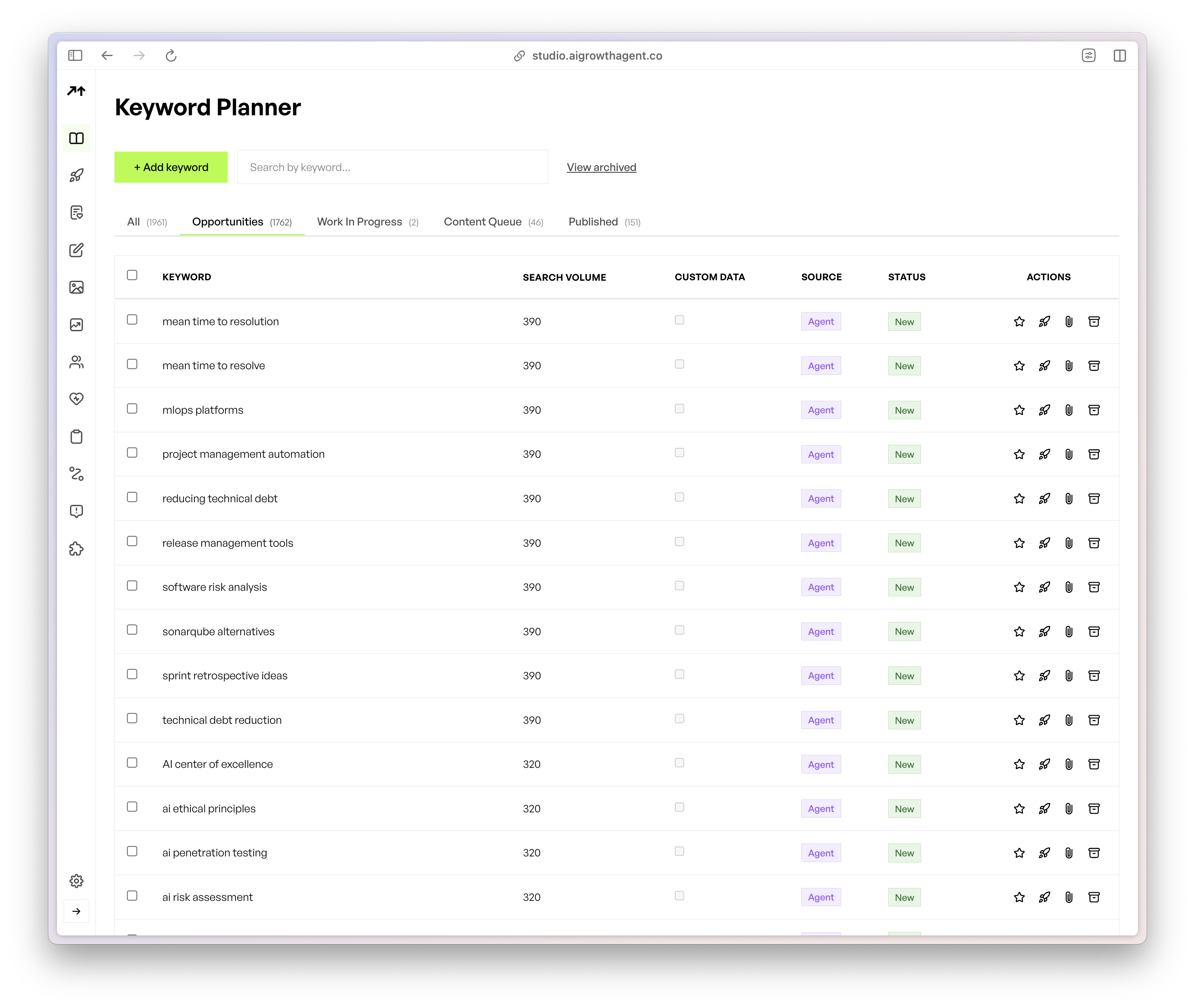
The content agent also supports semantic keyword clustering, entity relationship mapping, and contextual internal linking. These capabilities help define topic clusters and ensure that each article strengthens your overall topical authority. The system can generate rich snippets, FAQ sections, and other structured elements that improve how AI systems interpret and surface your content.
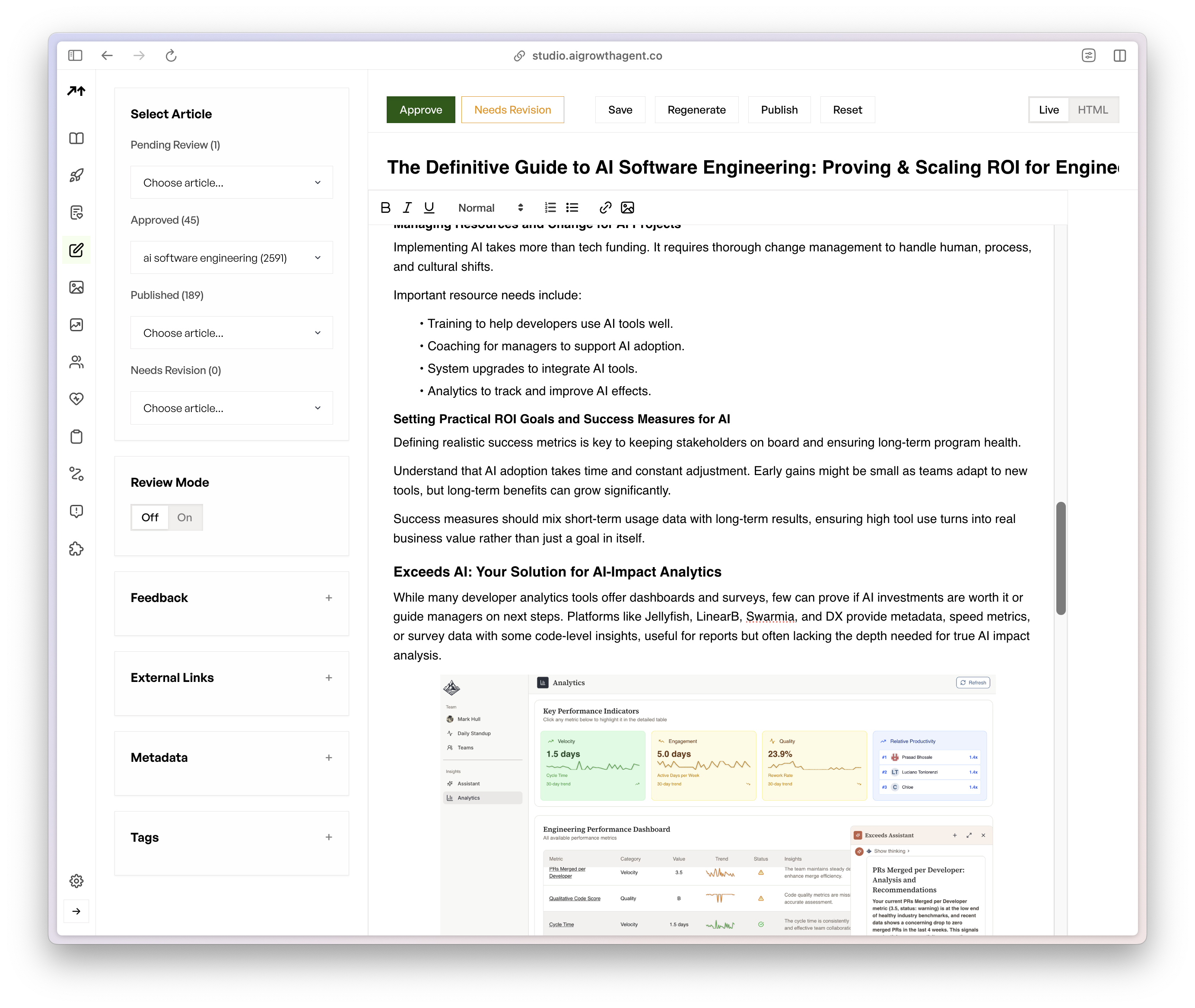
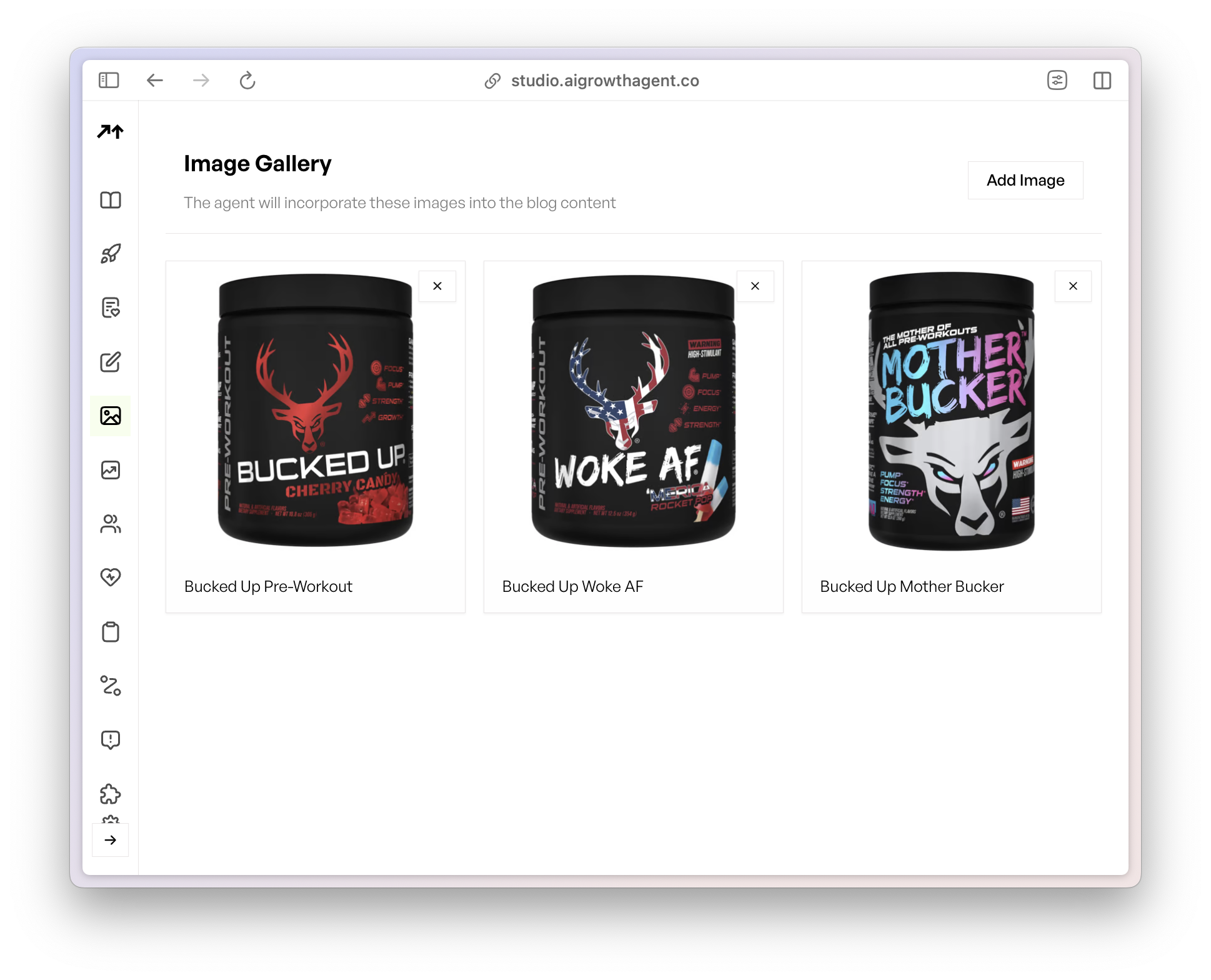
The platform can also work with your brand images and visual assets so that content includes relevant graphics where appropriate, which improves both user experience and clarity.
The proprietary LLM.txt and MCP implementation gives AI systems a structured way to access your content library. This clarity makes it easier for AI engines to understand what you publish and when to reference it, which can support higher citation rates and more accurate recommendations.
Multi-Tenant Programmatic Deployment: Scaling Across Brands & Divisions
AI Growth Agent supports multi-brand programmatic SEO strategies from a single platform. Each brand can maintain its own Manifesto, keyword approach, and technical profile. This structure is particularly useful for private equity groups, venture portfolios, and enterprises with multiple business units.
The multi-tenant design allows central teams to oversee many programmatic SEO campaigns while preserving brand-specific tone, targeting, and configuration. Each agent instance runs with its own infrastructure and content plan, while still benefiting from updates and improvements at the platform level.
This approach makes enterprise-scale SEO more achievable without linear growth in team size or management overhead. A unified dashboard gives leaders visibility into performance while still allowing detailed control within each brand or division.
Real-Time Programmatic Content Injection: Capturing Trending Authority
AI Growth Agent helps brands respond quickly to trending topics and news by generating and publishing SEO-optimized content while interest is still rising. This supports timely relevance and early authority on emerging subjects.
The system tracks conversations, news, and search behavior related to your space, then produces content briefs and technical specifications that align with those trends. This programmatic process increases the chance that your brand becomes a core reference on new developments.
Each real-time piece includes full technical optimization, including schema, internal linking, and AI-friendly formatting. Fast deployment after a trend appears can create a measurable advantage in gaining early citations and building recognizable thought leadership.
Database-to-Content Automation: Unlocking Proprietary Data Assets
AI Growth Agent can convert proprietary internal data into structured, SEO-focused content at scale. This turns information that typically stays inside tools and reports into material that supports authority and AI citations.
The system ingests structured data exports and can generate technically optimized pages that highlight your unique insights. Customer success metrics can become case studies, product specifications can become comparison resources, and research findings can become in-depth articles.
This database-to-content workflow includes entity-focused schema markup, cross-linking between related records, and AI-oriented formatting that improves discoverability. Brands can use this capability to express their existing data advantages in a way that strengthens long-term positioning in AI search.
AI Search Monitor & Feedback Loop: Continuous Optimization for Citation
AI Growth Agent includes an AI Search Monitor that provides real-time feedback on AI citations and crawl behavior across major AI search engines, including ChatGPT, Gemini, and Perplexity. The tool offers performance metrics that support continuous technical and content improvements.
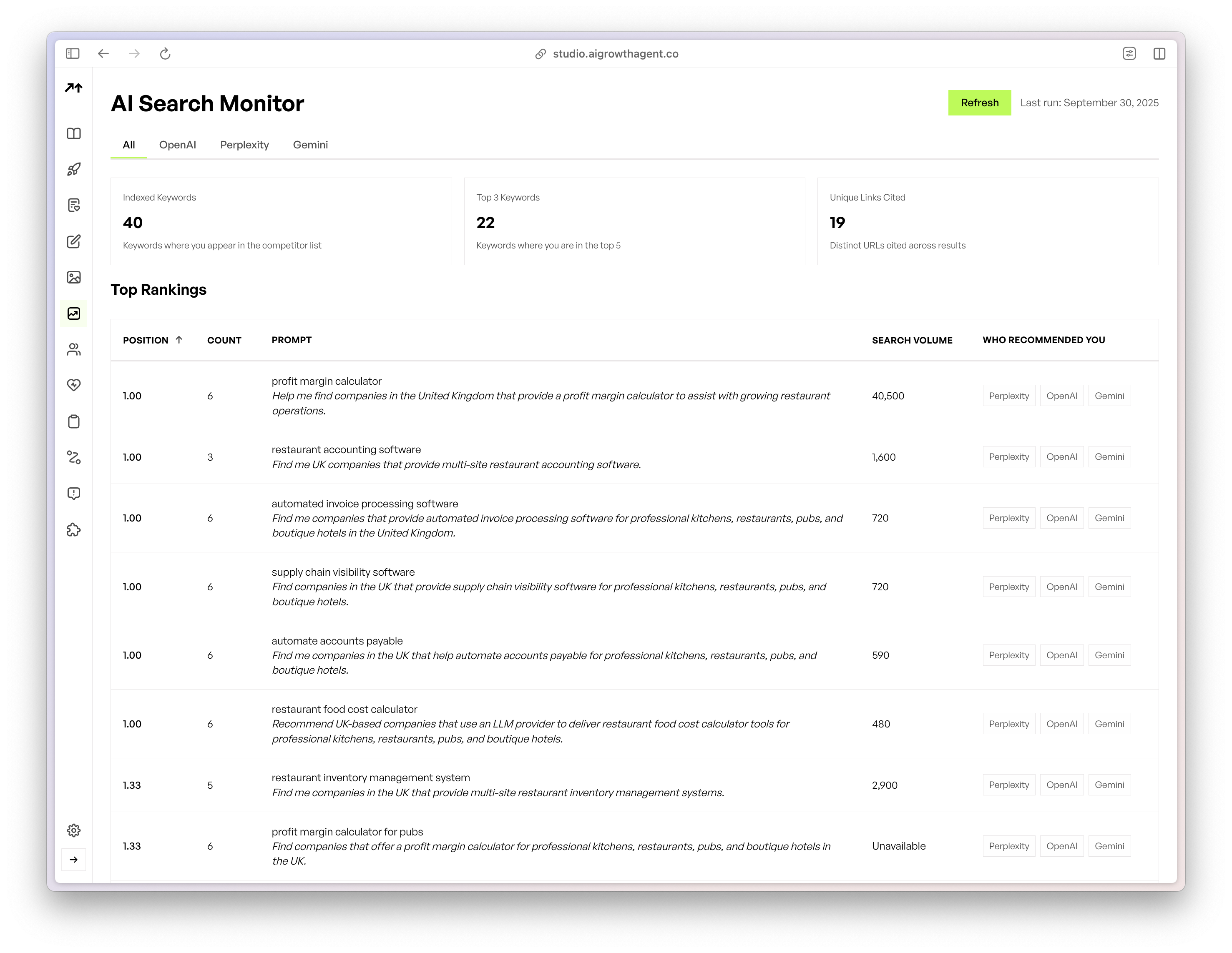
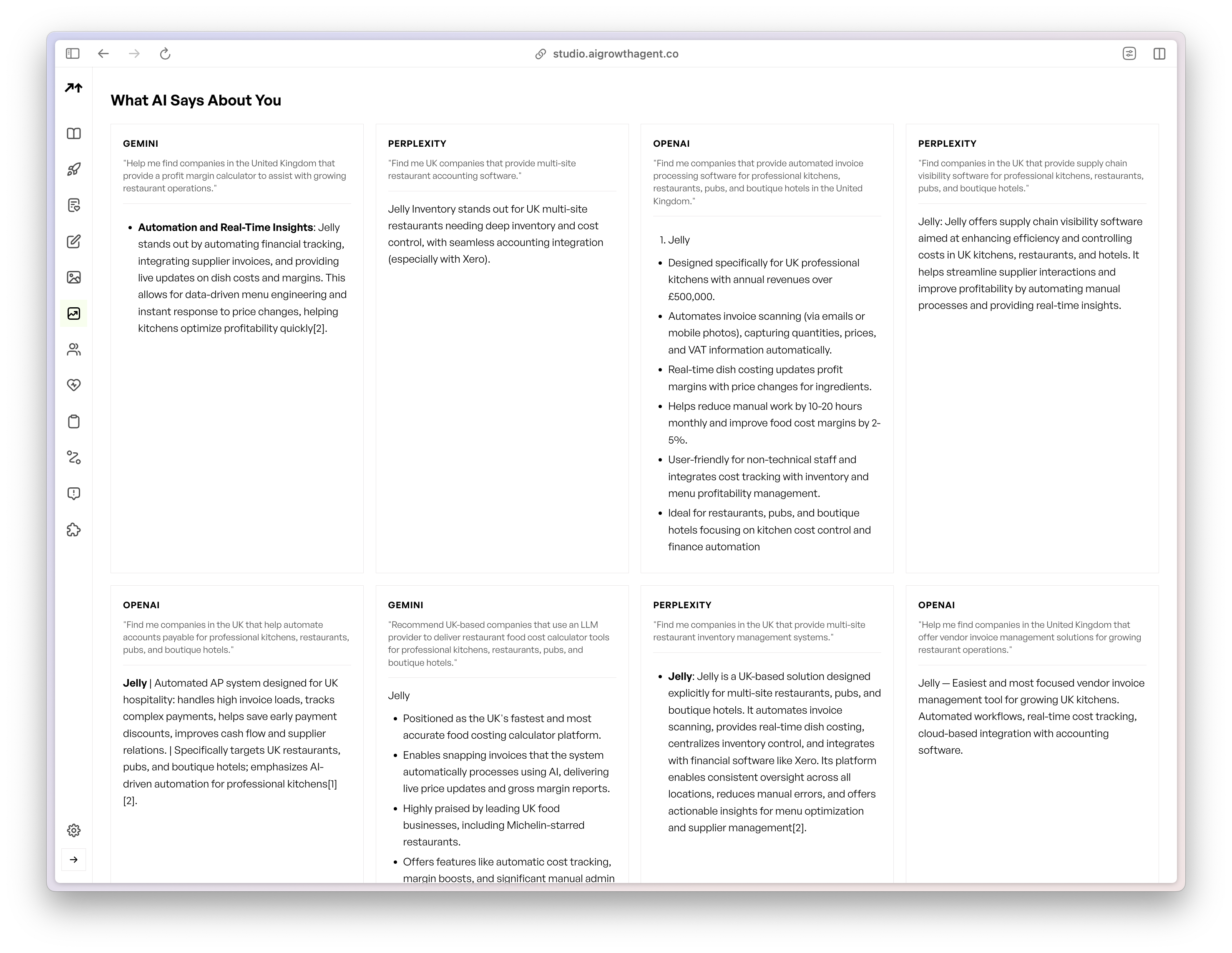
The monitor tracks how often your content is cited, the context of those mentions, and how you compare to competitors. Insights cover content types, technical patterns, and topical approaches that correlate with higher citation rates, which supports more informed strategy decisions.
Feedback loops connect these insights with automatic technical and structural adjustments. Over time, this cycle helps your programmatic SEO strategy evolve alongside AI algorithms so that performance remains strong rather than declining as search behavior shifts.
Teams that want to see how this works in practice can explore the platform in detail. Schedule a demo to see if you’re a good fit for AI Growth Agent’s approach to technical SEO and AI search authority.
AI Growth Agent vs. Traditional Methods: Who Wins in AI Search?
The rise of AI search makes a shift from manual SEO processes to programmatic technical implementation increasingly important. Traditional approaches, whether agency-based, in-house, or reliant on basic AI tools, often fall short on velocity, technical depth, and continuous optimization for AI-driven results.
|
Feature / Aspect |
Traditional SEO Agencies |
Internal Marketing Teams |
AI Growth Agent |
|
Content Velocity & Scale |
Slow, limited by human capacity and billable hour constraints |
Slow, resource-constrained by team size and competing priorities |
High speed and scale with consistent technical implementation |
|
Technical SEO Expertise |
Varied quality, requires manual implementation of complex schemas |
Lacks specialized engineering resources for advanced technical requirements |
Automated advanced schema, LLM.txt, and MCP implementation |
|
AI Domain Authority Impact |
Incremental improvements, difficult to scale for consistent AI citation |
Often flat results, struggles against AI content volume increases |
Designed to increase citation and recommendation from AI search engines |
|
Adaptability to AI Search |
Reactive approach, struggles with real-time optimization requirements |
Slow to adapt, requires manual updates for algorithm changes |
Proactive system designed for AI search optimization and adaptation |
This comparison highlights structural limits in traditional methods that make sustained AI search optimization difficult. Manual workflows rarely deliver the combination of technical precision, content volume, and continuous adaptation that AI search engines now favor.
AI search engines often rely on trusted third-party databases and authoritative lists, and strong placement in these sources can significantly influence citations and perceived authority. Programmatic strategies are better positioned to build and maintain these external relationships at scale while also keeping internal technical execution consistent.
Cost structures also differ. Manual authority building typically requires ongoing agency fees, new hires, and close management. AI Growth Agent instead provides a system that runs continuously with less day-to-day oversight, which can offer more predictable costs relative to output.
Frequently Asked Questions About Technical SEO for AI Domain Authority
How do AI search engines truly define and evaluate “domain authority” in 2025?
AI search engines now treat domain authority as a multi-layered signal rather than a single score. Modern systems go beyond legacy metrics like Domain Authority or raw backlink counts. They analyze content freshness, subject matter expertise, semantic relevance, and how consistently a site demonstrates knowledge on related topics. Experience, Expertise, Authoritativeness, and Trustworthiness (E-E-A-T) remain central, but they are evaluated with language models that can identify genuine insight, cross-check claims against trusted sources, and compare coverage across many sites.
These systems also examine technical foundations, including schema quality, site architecture, and the presence of AI-facing files such as LLM.txt that support machine understanding. Domain authority in 2025 depends partly on real-time signals such as citation frequency within authoritative databases, references on credible platforms, and the uniqueness of insights on emerging topics. Unlike static metrics, AI-driven authority changes as content quality, technical optimization, and demonstrated expertise evolve.
What specific technical SEO elements are most crucial for AI citation and recommendation in dynamic AI search results?
Several technical SEO elements now play a central role in AI citation. Advanced schema markup that describes entities in detail, structured internal linking that clarifies topical hubs, and AI-focused files such as LLM.txt and Model Context Protocol implementations all help AI systems understand when your content is a good match for a query.
Site architecture that organizes pages into clear topical hierarchies, consistent metadata management across posts, and accurate entity relationship mapping further support AI interpretation. Relevant backlinks from authoritative domains still matter, but context and thematic alignment with your focus areas carry more weight than sheer link volume. Engagement indicators such as click-through rate and dwell time provide additional feedback signals that AI systems can use to refine how they assess authority.
Real-time or near real-time optimization has become increasingly important. Automated schema updates, algorithm-aware internal linking adjustments, and clear freshness signals all contribute to maintaining citation rates as AI search behavior shifts.
Can traditional agencies or existing internal teams truly achieve programmatic SEO efficiency and technical optimization at the scale AI demands?
Most traditional agencies and internal teams face structural constraints that limit their ability to match the efficiency and depth of a programmatic SEO system. Content calendars that deliver only a few high-quality pieces per month rarely provide the coverage and consistency that AI search now rewards, especially when competitors publish optimized content daily across topic clusters.
Technical requirements pose an additional challenge. Advanced schema design, entity mapping, and AI communication protocols require engineering support that many marketing teams do not have. As a result, implementation often remains partial or inconsistent, which lowers the impact on AI citations. Continuous optimization is equally demanding, since AI algorithms update frequently and manual teams may not have the bandwidth to respond quickly.
Strategic planning at scale is also difficult without dedicated tools. Managing keyword clustering, content architecture, and competitor tracking across many topics can become resource intensive. For many organizations, the costs and complexity of doing programmatic SEO manually outweigh the benefits, which is why automated platforms have become more attractive.
How quickly can a brand using programmatic technical SEO optimization see tangible results in AI search citations and domain authority?
Brands that implement programmatic technical SEO with a mature system often begin seeing new AI search citations within weeks. In many cases, more substantial authority gains appear over a two to three month period of consistent publishing and optimization. Faster progress comes from launching with strong technical foundations so AI crawlers can understand and index content without major obstacles.
Observed outcomes show how this can work in practice. Some companies using AI Growth Agent have seen Perplexity recommendations in about two weeks, Google AI Overview citations in roughly three weeks, and a broader AI search presence across ChatGPT, Gemini, and Perplexity in about two months. These timelines reflect the combination of solid technical execution, steady content velocity, and structured topical coverage.
Long-term performance depends on continued optimization and expansion. Programmatic systems are designed to maintain this cadence with less manual effort, which supports ongoing growth in citation frequency and recommendation rates as the content library deepens.
What role does content freshness play in maintaining AI search authority, and how can brands ensure consistent updates?
Content freshness acts as a clear signal that a brand is actively maintaining its knowledge, not just hosting static information. AI search engines often prefer recently updated material for topics that change quickly, because stale information can reduce user trust. This dynamic places ongoing pressure on brands to keep content current and to demonstrate that updates reflect new data or developments.
Brands that want consistent freshness usually benefit from structured processes rather than occasional updates. Useful practices include automated content audits that flag outdated sections, scheduled refresh cycles for key pages, and new content that addresses emerging questions within existing topic areas. Technical elements such as visible update dates, correct markup, and version-aware structures help AI systems understand when information was last reviewed.
Programmatic platforms can support this by monitoring industry signals, competitor content, and performance trends, then triggering updates or new pieces as needed. This systematic approach reduces the risk of content aging unnoticed, which in turn helps maintain AI search visibility over time.
Teams that want to implement these technical SEO strategies at scale can explore how AI Growth Agent structures and automates the work. Schedule a consultation session to see how the platform supports AI-focused domain authority.
Conclusion: Secure Your Brand’s Technical SEO Position and AI Domain Authority with AI Growth Agent
Advanced technical SEO optimization has become a central requirement for maintaining visibility and authority in the AI search era. Google’s evaluation of website authority for AI Overviews includes content quality, publishing cadence, and domain reputation, which makes consistent expert publishing an important success factor.
Brands that rely solely on manual SEO efforts, traditional agencies, or basic AI content tools risk falling behind as more competitors adopt programmatic technical approaches. The gap in speed and coverage tends to widen over time, which makes early investment in advanced systems more valuable.
AI Growth Agent offers a practical option for teams that see the importance of AI search optimization but lack the time or technical depth to build such systems themselves. The platform focuses on removing common technical obstacles and on establishing the infrastructure required for recurring AI citations across ChatGPT, Google AI Overviews, Perplexity, and other AI search products.
Client outcomes show that programmatic technical SEO can compress timelines for gaining AI visibility and can support stronger category positioning through consistent content deployment. These results highlight what becomes possible when technical SEO and content velocity operate together under a single system.
The opportunity to establish durable AI search authority is still open, but competition is increasing as more organizations adopt similar strategies. Early movers can build momentum through topical coverage and citation history that are difficult and time consuming for others to match.
Marketing and growth leaders who want to strengthen their position in AI search can start by reviewing their current technical foundation and content architecture. Schedule a consultation session with AI Growth Agent to see specific recommendations for building and maintaining domain authority through programmatic technical SEO.


